BY
Muhammad Musawar Ali
MPHIL, ICAP
1
Personality can be defined as consistent
behavior patterns and intrapersonal
process originating within the
individual.
There are two parts to it.
First part is concerned with consistent
patterns of behavior.
Personality researchers often refer to
these as individuals differences.
The important point is here that
personality is consistent.
2
 We can identify these consistent behavior pattern across
time and across situation.
 Some one who is competitive to work is also quite likely
competitive to sports.
 The second part is intrapersonal process in contrast to
interpersonal process.
 Interpersonal process : which take place between
people.
 Intrapersonal process: include all the emotional,
motivational, and cognitive process that go on inside of
us that affect how we act and feel.
3
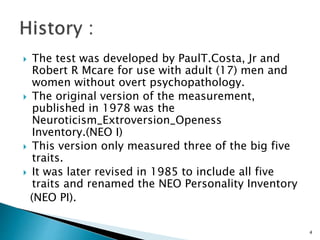
 The test was developed by PaulT.Costa, Jr and
Robert R Mcare for use with adult (17) men and
women without overt psychopathology.
 The original version of the measurement,
published in 1978 was the
Neuroticism_Extroversion_Openess
Inventory.(NEO I)
 This version only measured three of the big five
traits.
 It was later revised in 1985 to include all five
traits and renamed the NEO Personality Inventory
(NEO PI).
4
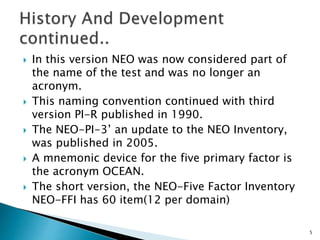
 In this version NEO was now considered part of
the name of the test and was no longer an
acronym.
 This naming convention continued with third
version PI-R published in 1990.
 The NEO-PI-3’ an update to the NEO Inventory,
was published in 2005.
 A mnemonic device for the five primary factor is
the acronym OCEAN.
 The short version, the NEO-Five Factor Inventory
NEO-FFI has 60 item(12 per domain)
5
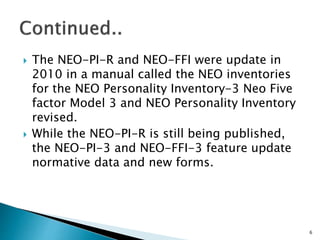
 The NEO-PI-R and NEO-FFI were update in
2010 in a manual called the NEO inventories
for the NEO Personality Inventory-3 Neo Five
factor Model 3 and NEO Personality Inventory
revised.
 While the NEO-PI-R is still being published,
the NEO-PI-3 and NEO-FFI-3 feature update
normative data and new forms.
6
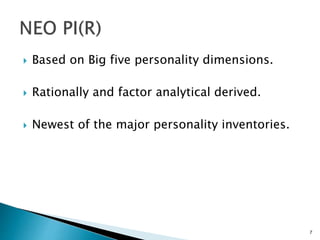
 Based on Big five personality dimensions.
 Rationally and factor analytical derived.
 Newest of the major personality inventories.
7
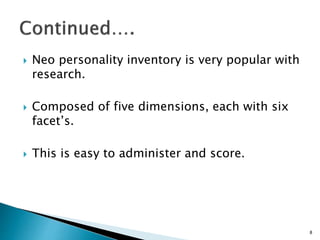
 Neo personality inventory is very popular with
research.
 Composed of five dimensions, each with six
facet’s.
 This is easy to administer and score.
8
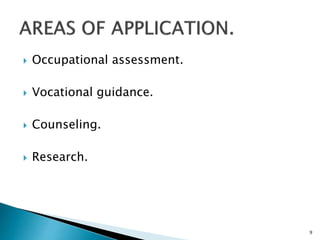
 Occupational assessment.
 Vocational guidance.
 Counseling.
 Research.
9
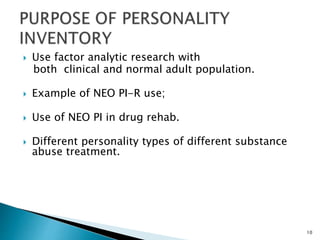
 Use factor analytic research with
both clinical and normal adult population.
 Example of NEO PI-R use;
 Use of NEO PI in drug rehab.
 Different personality types of different substance
abuse treatment.
10
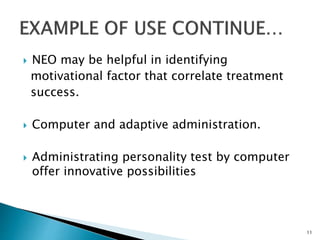
 NEO may be helpful in identifying
motivational factor that correlate treatment
success.
 Computer and adaptive administration.
 Administrating personality test by computer
offer innovative possibilities
11
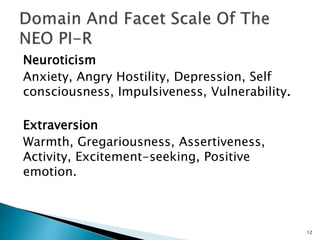
Neuroticism
Anxiety, Angry Hostility, Depression, Self
consciousness, Impulsiveness, Vulnerability.
Extraversion
Warmth, Gregariousness, Assertiveness,
Activity, Excitement-seeking, Positive
emotion.
12
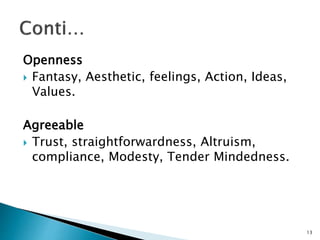
Openness
 Fantasy, Aesthetic, feelings, Action, Ideas,
Values.
Agreeable
 Trust, straightforwardness, Altruism,
compliance, Modesty, Tender Mindedness.
13
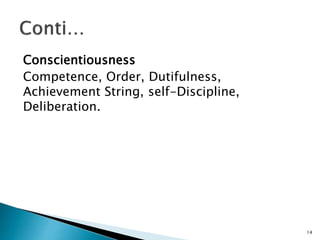
Conscientiousness
Competence, Order, Dutifulness,
Achievement String, self-Discipline,
Deliberation.
14
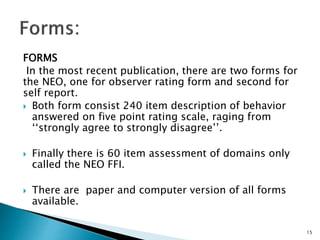
FORMS
In the most recent publication, there are two forms for
the NEO, one for observer rating form and second for
self report.
 Both form consist 240 item description of behavior
answered on five point rating scale, raging from
‘‘strongly agree to strongly disagree’’.
 Finally there is 60 item assessment of domains only
called the NEO FFI.
 There are paper and computer version of all forms
available.
15
 Instrument format 5 point rating scale;
 Strongly disagree
 Disagree
 Neutral
 Agree
 Strongly Agree
16
 Costa and McCrae report that assessment
should not be evaluated if there are more
than 40 items missing.
 They also state that despite the fact
assessment is balanced to control for the
effect of acquiescence and saying that is
more than 150 responses, or less than 50
responses ,are agree or strongly agree, the
result should be interpreted with caution.
17
 Scores can be reported to most test taker on your
NEO summary which provide a brief explanation of
the assessment and gives the participants domain
levels and strength based description of three level
(high medium and low domain) in each.
 For example, low N reads secure hardy and generally
relaxed even under stressful conditions.
 Where high N reads sensitive emotional and prone to
experience feelings that are upsetting .’’For profile
interpretation , facet and domain score are reported
in Score and are recorded visually as compared to the
appropriate norm group, much like other measures of
personality.
18
 Test form standard
 No of item 243
 Time taken-35 minute
19
 The psychometric properties reported below
relate to the UK adaptive of the NEO PI-R.
 Reliability:
Item analysis (Cronbach Alpha) and factor
analysis were carried out on a sample of 609
respondents in the UK Anglicization study.
The UK results show close alignment with
these from the US. The domain scales show
internal reliabilities which range from .87
to.92.
20
 Facet scale show internal reliabilities ranging
from .58 to .82.
 Test retest reliabilities are all above .75.
 Validity:
 Validity data is extensive for a full account
the readers is referred to the professional
Manual and referred list are available from
the publisher.
21
 Appears relevant in many cultures and
countries
 European, Italina, German, Finnish and Polish
Spinach, Indian, Asian ,Japanes ,Chinese, Korean,
Filipino and African American.
22
 Rapidly becoming one of the most popular
measure of normal personality.
 Use in both research and applied content.
 Information from the NEO-PI –R is rich
providing many insight.
 Five factor model relates personality,
presenting complain treatment plan and
treatment outcome well.
23

Neo personality inventory

  • 1.
  • 2.
    Personality can bedefined as consistent behavior patterns and intrapersonal process originating within the individual. There are two parts to it. First part is concerned with consistent patterns of behavior. Personality researchers often refer to these as individuals differences. The important point is here that personality is consistent. 2
  • 3.
     We canidentify these consistent behavior pattern across time and across situation.  Some one who is competitive to work is also quite likely competitive to sports.  The second part is intrapersonal process in contrast to interpersonal process.  Interpersonal process : which take place between people.  Intrapersonal process: include all the emotional, motivational, and cognitive process that go on inside of us that affect how we act and feel. 3
  • 4.
     The testwas developed by PaulT.Costa, Jr and Robert R Mcare for use with adult (17) men and women without overt psychopathology.  The original version of the measurement, published in 1978 was the Neuroticism_Extroversion_Openess Inventory.(NEO I)  This version only measured three of the big five traits.  It was later revised in 1985 to include all five traits and renamed the NEO Personality Inventory (NEO PI). 4
  • 5.
     In thisversion NEO was now considered part of the name of the test and was no longer an acronym.  This naming convention continued with third version PI-R published in 1990.  The NEO-PI-3’ an update to the NEO Inventory, was published in 2005.  A mnemonic device for the five primary factor is the acronym OCEAN.  The short version, the NEO-Five Factor Inventory NEO-FFI has 60 item(12 per domain) 5
  • 6.
     The NEO-PI-Rand NEO-FFI were update in 2010 in a manual called the NEO inventories for the NEO Personality Inventory-3 Neo Five factor Model 3 and NEO Personality Inventory revised.  While the NEO-PI-R is still being published, the NEO-PI-3 and NEO-FFI-3 feature update normative data and new forms. 6
  • 7.
     Based onBig five personality dimensions.  Rationally and factor analytical derived.  Newest of the major personality inventories. 7
  • 8.
     Neo personalityinventory is very popular with research.  Composed of five dimensions, each with six facet’s.  This is easy to administer and score. 8
  • 9.
     Occupational assessment. Vocational guidance.  Counseling.  Research. 9
  • 10.
     Use factoranalytic research with both clinical and normal adult population.  Example of NEO PI-R use;  Use of NEO PI in drug rehab.  Different personality types of different substance abuse treatment. 10
  • 11.
     NEO maybe helpful in identifying motivational factor that correlate treatment success.  Computer and adaptive administration.  Administrating personality test by computer offer innovative possibilities 11
  • 12.
    Neuroticism Anxiety, Angry Hostility,Depression, Self consciousness, Impulsiveness, Vulnerability. Extraversion Warmth, Gregariousness, Assertiveness, Activity, Excitement-seeking, Positive emotion. 12
  • 13.
    Openness  Fantasy, Aesthetic,feelings, Action, Ideas, Values. Agreeable  Trust, straightforwardness, Altruism, compliance, Modesty, Tender Mindedness. 13
  • 14.
    Conscientiousness Competence, Order, Dutifulness, AchievementString, self-Discipline, Deliberation. 14
  • 15.
    FORMS In the mostrecent publication, there are two forms for the NEO, one for observer rating form and second for self report.  Both form consist 240 item description of behavior answered on five point rating scale, raging from ‘‘strongly agree to strongly disagree’’.  Finally there is 60 item assessment of domains only called the NEO FFI.  There are paper and computer version of all forms available. 15
  • 16.
     Instrument format5 point rating scale;  Strongly disagree  Disagree  Neutral  Agree  Strongly Agree 16
  • 17.
     Costa andMcCrae report that assessment should not be evaluated if there are more than 40 items missing.  They also state that despite the fact assessment is balanced to control for the effect of acquiescence and saying that is more than 150 responses, or less than 50 responses ,are agree or strongly agree, the result should be interpreted with caution. 17
  • 18.
     Scores canbe reported to most test taker on your NEO summary which provide a brief explanation of the assessment and gives the participants domain levels and strength based description of three level (high medium and low domain) in each.  For example, low N reads secure hardy and generally relaxed even under stressful conditions.  Where high N reads sensitive emotional and prone to experience feelings that are upsetting .’’For profile interpretation , facet and domain score are reported in Score and are recorded visually as compared to the appropriate norm group, much like other measures of personality. 18
  • 19.
     Test formstandard  No of item 243  Time taken-35 minute 19
  • 20.
     The psychometricproperties reported below relate to the UK adaptive of the NEO PI-R.  Reliability: Item analysis (Cronbach Alpha) and factor analysis were carried out on a sample of 609 respondents in the UK Anglicization study. The UK results show close alignment with these from the US. The domain scales show internal reliabilities which range from .87 to.92. 20
  • 21.
     Facet scaleshow internal reliabilities ranging from .58 to .82.  Test retest reliabilities are all above .75.  Validity:  Validity data is extensive for a full account the readers is referred to the professional Manual and referred list are available from the publisher. 21
  • 22.
     Appears relevantin many cultures and countries  European, Italina, German, Finnish and Polish Spinach, Indian, Asian ,Japanes ,Chinese, Korean, Filipino and African American. 22
  • 23.
     Rapidly becomingone of the most popular measure of normal personality.  Use in both research and applied content.  Information from the NEO-PI –R is rich providing many insight.  Five factor model relates personality, presenting complain treatment plan and treatment outcome well. 23