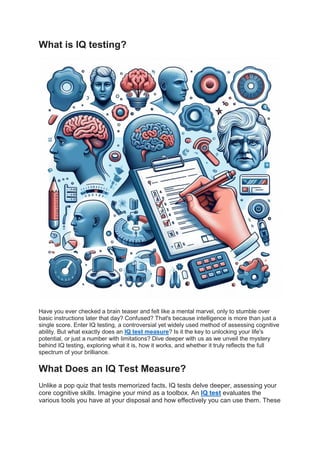
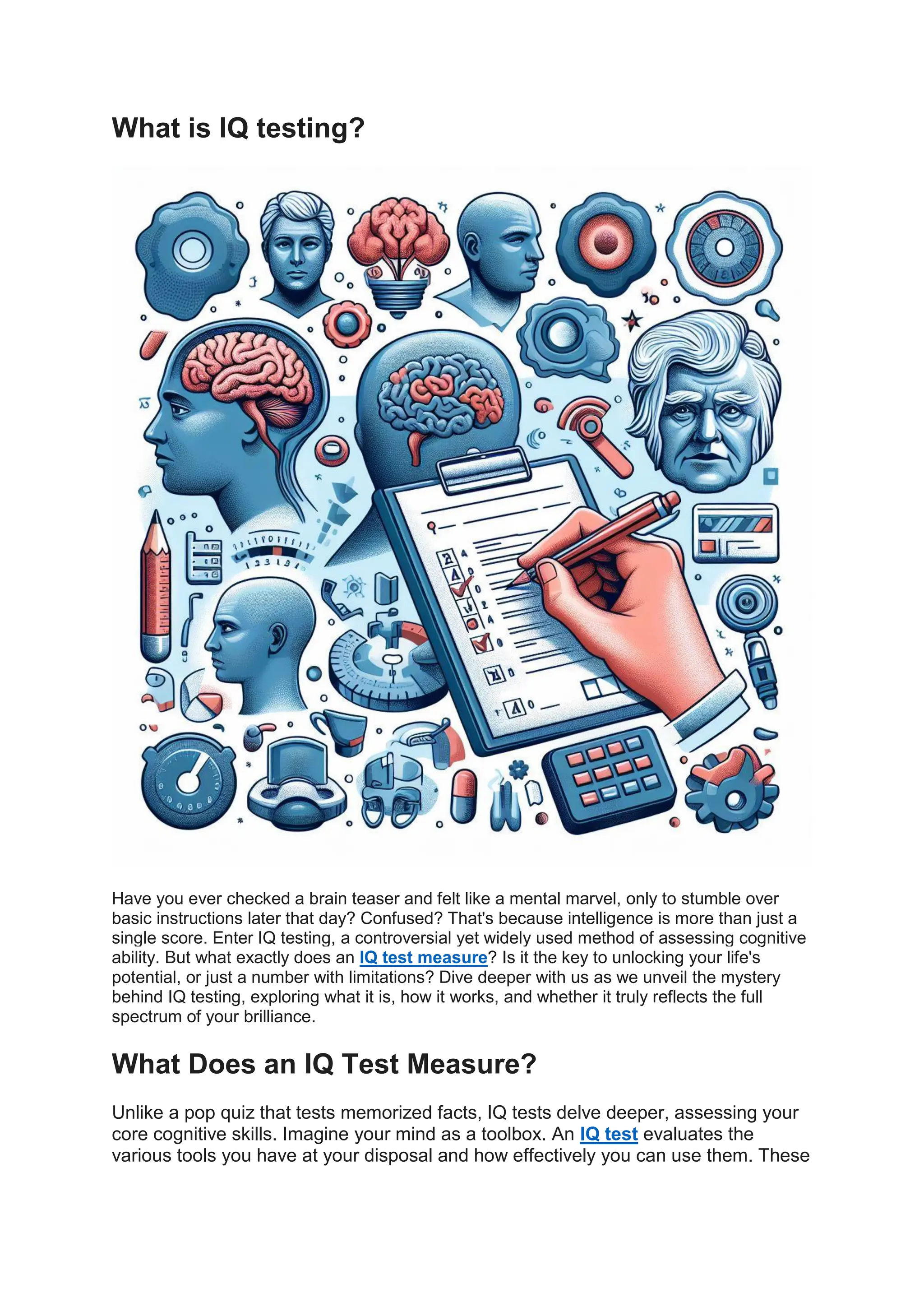
What is IQ testing?
Have you ever checked a brain teaser and felt like a mental marvel, only to stumble over
basic instructions later that day? Confused? That's because intelligence is more than just a
single score. Enter IQ testing, a controversial yet widely used method of assessing cognitive
ability. But what exactly does an IQ test measure? Is it the key to unlocking your life's
potential, or just a number with limitations? Dive deeper with us as we unveil the mystery
behind IQ testing, exploring what it is, how it works, and whether it truly reflects the full
spectrum of your brilliance.
What Does an IQ Test Measure?
Unlike a pop quiz that tests memorized facts, IQ tests delve deeper, assessing your
core cognitive skills. Imagine your mind as a toolbox. An IQ test evaluates the
various tools you have at your disposal and how effectively you can use them. These
tools can be broadly categorized into two main domains: fluid intelligence and
crystallized intelligence.
Fluid Intelligence: The Mind's Toolkit
Fluid intelligence represents your ability to think abstractly, solve problems on the fly,
and reason logically in novel situations. It's like the mental equivalent of a Swiss
Army knife - adaptable and versatile. Here's a closer look at what fluid intelligence
entails:
 Pattern Recognition: Can you identify underlying patterns and relationships
between seemingly unrelated things? Fluid intelligence allows you to decipher
complex puzzles, sequences, and analogies.
 Abstract Reasoning: Fluid intelligence empowers you to move beyond concrete
information and grasp underlying concepts. Imagine completing a series where each
shape follows a specific rule. This ability to think outside the box is a hallmark of
strong fluid intelligence.
 Problem-Solving: Faced with a new challenge, fluid intelligence equips you to
analyze the situation, break it down into manageable parts, and devise effective
solutions. It's about thinking strategically and coming up with creative approaches.
Crystallized Intelligence: The Knowledge Bank
Crystallized intelligence, on the other hand, reflects your accumulated knowledge
and learned skills. It's the vast repository of information you've gathered throughout
your life experiences and formal education.
 Vocabulary and Verbal Comprehension: Crystallized intelligence is evident in your
understanding of words, their nuances, and how they are used to communicate
effectively. A strong vocabulary and the ability to grasp complex concepts are
hallmarks of crystallized intelligence.
 Information Retrieval: How efficiently can you access and retrieve the knowledge
stored in your mind? Crystallized intelligence allows you to tap into your memory
banks and apply learned information to new situations. Imagine being asked to
define a specific historical event or explain a scientific phenomenon. Crystallized
intelligence helps you access relevant knowledge from your mental library.
 Fund of Knowledge: The broader and deeper your knowledge base, the higher
your crystallized intelligence score. This includes factual knowledge across various
domains like history, science, and literature.
How is an IQ Test Administered?
Imagine walking into a quiet room, pencils sharpened and mind focused. That's the
typical setting for an IQ test administration, conducted by a qualified professional like
a psychologist or school counselor. Standardized procedures ensure fairness and
accurate scoring across the board. But what exactly happens during an IQ test? Let's
break down the process:
The Standardized Testing Environment:
Consistency is key in IQ testing. To ensure a level playing field, the test is
administered in a quiet, distraction-free environment. The examiner provides clear
instructions and times each section carefully. This standardization allows for
accurate comparisons between individuals who may have taken the test in different
locations.
Types of IQ Tests:
There's no single "IQ test." Psychologists have developed various assessments
tailored to different age groups and purposes. Here are some common types:
 Verbal IQ Tests: These tests rely heavily on language skills. You might be asked to
define words, complete analogies, or answer comprehension questions based on a
reading passage.
 Nonverbal IQ Tests: These tests minimize the use of language, making them
suitable for individuals with language barriers or learning disabilities. Common
examples include puzzles, pattern recognition tasks, or completing visual
sequences.
 Performance IQ Tests: These tests assess your ability to manipulate objects or
complete tasks that require motor skills and coordination. Examples might include
assembling blocks or copying designs.
Choosing the Right Test:
The selection of a specific IQ test depends on the individual's age, background, and
the reason for testing. Psychologists carefully choose the most appropriate test to
get the most accurate picture of the person's cognitive abilities.
What Are IQ Scores Used for?
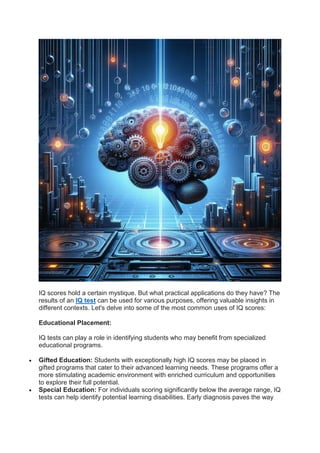
IQ scores hold a certain mystique. But what practical applications do they have? The
results of an IQ test can be used for various purposes, offering valuable insights in
different contexts. Let's delve into some of the most common uses of IQ scores:
Educational Placement:
IQ tests can play a role in identifying students who may benefit from specialized
educational programs.
 Gifted Education: Students with exceptionally high IQ scores may be placed in
gifted programs that cater to their advanced learning needs. These programs offer a
more stimulating academic environment with enriched curriculum and opportunities
to explore their full potential.
 Special Education: For individuals scoring significantly below the average range, IQ
tests can help identify potential learning disabilities. Early diagnosis paves the way
for appropriate interventions and support services, allowing them to thrive in the
learning environment.
Diagnosing Intellectual Disabilities:
IQ tests are a crucial component in diagnosing intellectual disabilities. An intellectual
disability is characterized by significant limitations in both intellectual functioning and
adaptive behavior. While IQ scores alone are not sufficient for diagnosis, they
provide valuable data points alongside other assessments to create a
comprehensive picture.
Cognitive Research Studies:
Researchers use IQ tests to study the nature of intelligence, how it develops over
time, and its relationship with various factors. By analyzing IQ scores across different
populations, researchers can gain insights into the influence of genetics,
environment, and socio-economic background on cognitive development.
Limitations of IQ Testing
IQ tests, despite their widespread use, are not without limitations. It's important to
understand these limitations to ensure a balanced interpretation of the scores. Here's
a closer look at some key points to consider:
Cultural Bias and Socioeconomic Factors:
IQ tests have been criticized for cultural bias. Language-based tasks might
disadvantage individuals from non-dominant cultures or those with limited access to
quality education. Similarly, socio-economic factors like access to educational
resources and exposure to stimulating environments can influence performance. A
child from a disadvantaged background might score lower simply due to a lack of
opportunity, not a reflection of their true potential.
Limited Scope of Intelligence:
IQ tests primarily assess cognitive abilities in specific domains. However, intelligence
is a multifaceted concept. Creativity, social intelligence, emotional intelligence, and
practical problem-solving skills are all crucial aspects of human intelligence that are
not captured by traditional IQ tests. For instance, someone with a high IQ might
struggle with social interactions or lack the ability to apply their knowledge in real-
world situations.
Overemphasis on a Single Score:
IQ is reported as a single score, often overshadowing the valuable information
gleaned from individual subtests within the assessment. A closer look at a person's
strengths and weaknesses across different cognitive domains can provide a much
richer picture of their abilities. Focusing solely on the overall IQ score can lead to
oversimplification and missed opportunities to identify specific areas for
development.
Benefits and Drawbacks of IQ Testing
IQ testing, like any assessment tool, has both advantages and disadvantages.
Weighing these factors can help you understand the potential value and limitations of
IQ testing in different scenarios.
Benefits of IQ Testing:
 Identification of Strengths and Weaknesses: IQ testing provides a snapshot of an
individual's cognitive profile, highlighting areas of strength and weakness. This
information can be valuable for educators and psychologists in tailoring interventions
and support strategies. For example, a student who excels in verbal reasoning but
struggles with visual-spatial tasks might benefit from targeted instruction that
leverages their strengths while providing additional support in weaker areas.
 Educational Planning: IQ scores can inform educational decisions by identifying
students who may require specialized programs. Gifted students can be placed in
challenging environments that nurture their intellectual curiosity, while those with
learning disabilities can receive appropriate support services to help them reach their
full potential.
Drawbacks of IQ Testing:
 Labeling and Stigma: IQ scores can be misused to label individuals, leading to
negative stereotypes and self-fulfilling prophecies. A student labeled as "low IQ"
might lose motivation and develop learned helplessness. It's crucial to remember
that IQ is just one piece of the puzzle and shouldn't define a person's potential for
growth and achievement.
 Pressure to Perform and Test Anxiety: The emphasis on IQ scores can create
undue pressure on test-takers, leading to anxiety and potentially hindering their
performance. This can be particularly detrimental for children who may not
understand the purpose of the test or feel overwhelmed by the testing environment.
Is IQ Fixed or Can It Change?
Nature versus nurture - the age-old debate applies to intelligence as well. IQ scores
have traditionally been viewed as a relatively fixed reflection of inherent cognitive
ability. However, recent research suggests a more nuanced picture. Let's explore the
factors influencing IQ and the potential for change:
Nature vs. Nurture: The Complex Dance
Genetics undoubtedly play a role in shaping our cognitive abilities. Studies on twins
indicate a heritability component to IQ, meaning genes influence your intellectual
potential. However, genes are not a deterministic blueprint. Environmental factors
significantly impact how those genes are expressed.
 Early Childhood Experiences: The quality of early childhood experiences has a
profound impact on brain development. Stimulating environments rich in learning
opportunities can nurture cognitive skills, while neglect or deprivation can hinder
development. Proper nutrition, emotional security, and access to educational
resources all contribute to a child's cognitive potential.
 Brain Plasticity: The brain is not a static organ. Neuroplasticity refers to the brain's
ability to adapt and change throughout life. Learning new skills, engaging in mentally
stimulating activities, and even adopting healthy lifestyle habits can promote new
neural connections and enhance cognitive function.
The Potential for Cognitive Improvement
While significant gains may be challenging in adulthood, the brain's capacity for
learning and adaptation offers opportunities for cognitive improvement. Here are
some ways to potentially boost your cognitive abilities:
 Engage in Lifelong Learning: Continuously challenge your mind by learning new
skills, pursuing hobbies that stimulate your brain, and exposing yourself to new
ideas. This can involve anything from taking a language class to learning a musical
instrument to simply reading challenging books.
 Maintain a Healthy Lifestyle: Exercise, proper sleep, and a balanced diet all play a
crucial role in brain health. These healthy habits can optimize cognitive function and
potentially enhance your learning and memory capabilities.
 Cognitive Training Programs: Brain-training games and exercises specifically
designed to target cognitive skills like memory, attention, and problem-solving can
offer some benefits. While the long-term effects of such programs are still being
researched, they may provide a way to keep your mind sharp and improve specific
cognitive domains.
Alternatives to IQ Testing
IQ testing, while informative in certain contexts, doesn't paint the whole picture of
intelligence. Fortunately, there are alternative assessments that can provide a more
well-rounded understanding of an individual's strengths and weaknesses. Let's
explore some viable options:
Multiple Intelligence Assessments:
Howard Gardner's theory of multiple intelligences proposes that intelligence is not
singular, but rather multifaceted. His framework identifies eight distinct intelligences,
each representing a unique cognitive strength:
 Linguistic intelligence: Skill with language, communication, and written expression.
 Logical-mathematical intelligence: Ability to analyze problems, reason logically,
and perform mathematical calculations.
 Bodily-kinesthetic intelligence: Physical coordination, dexterity, and control over
bodily movements.
 Spatial intelligence: Ability to perceive the world visually, manipulate spatial
relationships, and imagine objects in three dimensions.
 Musical intelligence: Sensitivity to music, rhythm, and melody.
 Interpersonal intelligence: Skill in understanding and interacting with others,
building relationships, and collaborating effectively.
 Intrapersonal intelligence: Self-awareness, self-reflection, and the ability to
understand one's own emotions and motivations.
 Naturalistic intelligence: Sensitivity to nature, the ability to recognize patterns in
the natural world, and a connection with the environment.
Multiple intelligence assessments evaluate an individual's strengths across these
various domains, providing a more comprehensive picture of their cognitive abilities.
This information can be valuable in educational settings, career guidance, and
identifying areas for personal development.
Achievement Tests:
Unlike IQ tests that measure potential, achievement tests assess what a person has
already learned and mastered in specific subject areas. These tests can be
standardized or curriculum-based, measuring knowledge and skills acquired through
instruction.
 Math Achievement Tests: Evaluate a student's understanding of mathematical
concepts, problem-solving abilities, and proficiency in applying mathematical skills.
 Reading Comprehension Tests: Assess a student's ability to read and understand
written text, including vocabulary knowledge, critical thinking skills, and the ability to
draw inferences from the text.
 Science Achievement Tests: Measure a student's knowledge of scientific concepts,
ability to analyze data, and understanding of scientific processes.
Achievement tests provide valuable data for educators to gauge student progress,
identify areas needing improvement, and tailor instruction to meet individual learning
needs. They offer a more targeted assessment of academic skills compared to
broader IQ tests.
Conclusion: Beyond the IQ Score
IQ testing has sparked curiosity and debate for decades. While it offers a snapshot
of cognitive abilities, it's crucial to remember that intelligence is a multifaceted
concept. A single score cannot capture the full spectrum of human potential.
A Holistic View of Intelligence:
Moving beyond the limitations of IQ testing, a comprehensive evaluation considers
multiple factors. This includes an individual's academic performance, creative
abilities, social skills, emotional intelligence, and real-world problem-solving
capabilities.
 Social and Emotional Intelligence: The ability to understand and manage
emotions, empathize with others, build positive relationships, and navigate social
situations is a vital aspect of intelligence. Someone with a high IQ might struggle in
these areas, highlighting the importance of considering emotional intelligence
alongside cognitive abilities.
 Real-world Application: Can you translate theoretical knowledge into practical
solutions? The ability to apply knowledge and skills in real-world contexts is a
hallmark of intelligence. Someone with a strong grasp of scientific concepts but
struggles to design an experiment might demonstrate a gap between theoretical
knowledge and practical application.
Embracing Individual Strengths:
Understanding your unique strengths and weaknesses is far more empowering than
fixating on a single IQ score. This knowledge empowers you to:
 Pursue Your Passions: Identify areas where your strengths lie and explore
activities that ignite your curiosity and fuel your potential.
 Develop a Growth Mindset: View intelligence as a journey, not a destination.
Embrace challenges as opportunities to learn and grow, fostering a growth mindset
that celebrates continuous learning and improvement.
Ultimately, IQ testing offers a piece of the puzzle. By considering a wider range of
factors and focusing on fostering your unique strengths, you can unlock your full
potential and thrive in all aspects of life.

What is an IQ testing | IQ Score | IQ Level

  • 1.
    What is IQtesting? Have you ever checked a brain teaser and felt like a mental marvel, only to stumble over basic instructions later that day? Confused? That's because intelligence is more than just a single score. Enter IQ testing, a controversial yet widely used method of assessing cognitive ability. But what exactly does an IQ test measure? Is it the key to unlocking your life's potential, or just a number with limitations? Dive deeper with us as we unveil the mystery behind IQ testing, exploring what it is, how it works, and whether it truly reflects the full spectrum of your brilliance. What Does an IQ Test Measure? Unlike a pop quiz that tests memorized facts, IQ tests delve deeper, assessing your core cognitive skills. Imagine your mind as a toolbox. An IQ test evaluates the various tools you have at your disposal and how effectively you can use them. These
  • 2.
    tools can bebroadly categorized into two main domains: fluid intelligence and crystallized intelligence. Fluid Intelligence: The Mind's Toolkit Fluid intelligence represents your ability to think abstractly, solve problems on the fly, and reason logically in novel situations. It's like the mental equivalent of a Swiss Army knife - adaptable and versatile. Here's a closer look at what fluid intelligence entails:  Pattern Recognition: Can you identify underlying patterns and relationships between seemingly unrelated things? Fluid intelligence allows you to decipher complex puzzles, sequences, and analogies.  Abstract Reasoning: Fluid intelligence empowers you to move beyond concrete information and grasp underlying concepts. Imagine completing a series where each shape follows a specific rule. This ability to think outside the box is a hallmark of strong fluid intelligence.  Problem-Solving: Faced with a new challenge, fluid intelligence equips you to analyze the situation, break it down into manageable parts, and devise effective solutions. It's about thinking strategically and coming up with creative approaches. Crystallized Intelligence: The Knowledge Bank Crystallized intelligence, on the other hand, reflects your accumulated knowledge and learned skills. It's the vast repository of information you've gathered throughout your life experiences and formal education.  Vocabulary and Verbal Comprehension: Crystallized intelligence is evident in your understanding of words, their nuances, and how they are used to communicate effectively. A strong vocabulary and the ability to grasp complex concepts are hallmarks of crystallized intelligence.  Information Retrieval: How efficiently can you access and retrieve the knowledge stored in your mind? Crystallized intelligence allows you to tap into your memory banks and apply learned information to new situations. Imagine being asked to define a specific historical event or explain a scientific phenomenon. Crystallized intelligence helps you access relevant knowledge from your mental library.  Fund of Knowledge: The broader and deeper your knowledge base, the higher your crystallized intelligence score. This includes factual knowledge across various domains like history, science, and literature. How is an IQ Test Administered?
  • 3.
    Imagine walking intoa quiet room, pencils sharpened and mind focused. That's the typical setting for an IQ test administration, conducted by a qualified professional like a psychologist or school counselor. Standardized procedures ensure fairness and accurate scoring across the board. But what exactly happens during an IQ test? Let's break down the process: The Standardized Testing Environment: Consistency is key in IQ testing. To ensure a level playing field, the test is administered in a quiet, distraction-free environment. The examiner provides clear instructions and times each section carefully. This standardization allows for accurate comparisons between individuals who may have taken the test in different locations. Types of IQ Tests:
  • 4.
    There's no single"IQ test." Psychologists have developed various assessments tailored to different age groups and purposes. Here are some common types:  Verbal IQ Tests: These tests rely heavily on language skills. You might be asked to define words, complete analogies, or answer comprehension questions based on a reading passage.  Nonverbal IQ Tests: These tests minimize the use of language, making them suitable for individuals with language barriers or learning disabilities. Common examples include puzzles, pattern recognition tasks, or completing visual sequences.  Performance IQ Tests: These tests assess your ability to manipulate objects or complete tasks that require motor skills and coordination. Examples might include assembling blocks or copying designs. Choosing the Right Test: The selection of a specific IQ test depends on the individual's age, background, and the reason for testing. Psychologists carefully choose the most appropriate test to get the most accurate picture of the person's cognitive abilities. What Are IQ Scores Used for?
  • 5.
    IQ scores holda certain mystique. But what practical applications do they have? The results of an IQ test can be used for various purposes, offering valuable insights in different contexts. Let's delve into some of the most common uses of IQ scores: Educational Placement: IQ tests can play a role in identifying students who may benefit from specialized educational programs.  Gifted Education: Students with exceptionally high IQ scores may be placed in gifted programs that cater to their advanced learning needs. These programs offer a more stimulating academic environment with enriched curriculum and opportunities to explore their full potential.  Special Education: For individuals scoring significantly below the average range, IQ tests can help identify potential learning disabilities. Early diagnosis paves the way
  • 6.
    for appropriate interventionsand support services, allowing them to thrive in the learning environment. Diagnosing Intellectual Disabilities: IQ tests are a crucial component in diagnosing intellectual disabilities. An intellectual disability is characterized by significant limitations in both intellectual functioning and adaptive behavior. While IQ scores alone are not sufficient for diagnosis, they provide valuable data points alongside other assessments to create a comprehensive picture. Cognitive Research Studies: Researchers use IQ tests to study the nature of intelligence, how it develops over time, and its relationship with various factors. By analyzing IQ scores across different populations, researchers can gain insights into the influence of genetics, environment, and socio-economic background on cognitive development. Limitations of IQ Testing IQ tests, despite their widespread use, are not without limitations. It's important to understand these limitations to ensure a balanced interpretation of the scores. Here's a closer look at some key points to consider: Cultural Bias and Socioeconomic Factors: IQ tests have been criticized for cultural bias. Language-based tasks might disadvantage individuals from non-dominant cultures or those with limited access to quality education. Similarly, socio-economic factors like access to educational resources and exposure to stimulating environments can influence performance. A child from a disadvantaged background might score lower simply due to a lack of opportunity, not a reflection of their true potential. Limited Scope of Intelligence: IQ tests primarily assess cognitive abilities in specific domains. However, intelligence is a multifaceted concept. Creativity, social intelligence, emotional intelligence, and practical problem-solving skills are all crucial aspects of human intelligence that are not captured by traditional IQ tests. For instance, someone with a high IQ might struggle with social interactions or lack the ability to apply their knowledge in real- world situations. Overemphasis on a Single Score: IQ is reported as a single score, often overshadowing the valuable information gleaned from individual subtests within the assessment. A closer look at a person's strengths and weaknesses across different cognitive domains can provide a much richer picture of their abilities. Focusing solely on the overall IQ score can lead to
  • 7.
    oversimplification and missedopportunities to identify specific areas for development. Benefits and Drawbacks of IQ Testing IQ testing, like any assessment tool, has both advantages and disadvantages. Weighing these factors can help you understand the potential value and limitations of IQ testing in different scenarios. Benefits of IQ Testing:  Identification of Strengths and Weaknesses: IQ testing provides a snapshot of an individual's cognitive profile, highlighting areas of strength and weakness. This information can be valuable for educators and psychologists in tailoring interventions and support strategies. For example, a student who excels in verbal reasoning but struggles with visual-spatial tasks might benefit from targeted instruction that leverages their strengths while providing additional support in weaker areas.  Educational Planning: IQ scores can inform educational decisions by identifying students who may require specialized programs. Gifted students can be placed in challenging environments that nurture their intellectual curiosity, while those with learning disabilities can receive appropriate support services to help them reach their full potential. Drawbacks of IQ Testing:  Labeling and Stigma: IQ scores can be misused to label individuals, leading to negative stereotypes and self-fulfilling prophecies. A student labeled as "low IQ" might lose motivation and develop learned helplessness. It's crucial to remember that IQ is just one piece of the puzzle and shouldn't define a person's potential for growth and achievement.  Pressure to Perform and Test Anxiety: The emphasis on IQ scores can create undue pressure on test-takers, leading to anxiety and potentially hindering their performance. This can be particularly detrimental for children who may not understand the purpose of the test or feel overwhelmed by the testing environment. Is IQ Fixed or Can It Change? Nature versus nurture - the age-old debate applies to intelligence as well. IQ scores have traditionally been viewed as a relatively fixed reflection of inherent cognitive ability. However, recent research suggests a more nuanced picture. Let's explore the factors influencing IQ and the potential for change: Nature vs. Nurture: The Complex Dance Genetics undoubtedly play a role in shaping our cognitive abilities. Studies on twins indicate a heritability component to IQ, meaning genes influence your intellectual potential. However, genes are not a deterministic blueprint. Environmental factors significantly impact how those genes are expressed.
  • 8.
     Early ChildhoodExperiences: The quality of early childhood experiences has a profound impact on brain development. Stimulating environments rich in learning opportunities can nurture cognitive skills, while neglect or deprivation can hinder development. Proper nutrition, emotional security, and access to educational resources all contribute to a child's cognitive potential.  Brain Plasticity: The brain is not a static organ. Neuroplasticity refers to the brain's ability to adapt and change throughout life. Learning new skills, engaging in mentally stimulating activities, and even adopting healthy lifestyle habits can promote new neural connections and enhance cognitive function. The Potential for Cognitive Improvement While significant gains may be challenging in adulthood, the brain's capacity for learning and adaptation offers opportunities for cognitive improvement. Here are some ways to potentially boost your cognitive abilities:  Engage in Lifelong Learning: Continuously challenge your mind by learning new skills, pursuing hobbies that stimulate your brain, and exposing yourself to new ideas. This can involve anything from taking a language class to learning a musical instrument to simply reading challenging books.  Maintain a Healthy Lifestyle: Exercise, proper sleep, and a balanced diet all play a crucial role in brain health. These healthy habits can optimize cognitive function and potentially enhance your learning and memory capabilities.  Cognitive Training Programs: Brain-training games and exercises specifically designed to target cognitive skills like memory, attention, and problem-solving can offer some benefits. While the long-term effects of such programs are still being researched, they may provide a way to keep your mind sharp and improve specific cognitive domains. Alternatives to IQ Testing IQ testing, while informative in certain contexts, doesn't paint the whole picture of intelligence. Fortunately, there are alternative assessments that can provide a more well-rounded understanding of an individual's strengths and weaknesses. Let's explore some viable options: Multiple Intelligence Assessments: Howard Gardner's theory of multiple intelligences proposes that intelligence is not singular, but rather multifaceted. His framework identifies eight distinct intelligences, each representing a unique cognitive strength:  Linguistic intelligence: Skill with language, communication, and written expression.  Logical-mathematical intelligence: Ability to analyze problems, reason logically, and perform mathematical calculations.  Bodily-kinesthetic intelligence: Physical coordination, dexterity, and control over bodily movements.  Spatial intelligence: Ability to perceive the world visually, manipulate spatial relationships, and imagine objects in three dimensions.
  • 9.
     Musical intelligence:Sensitivity to music, rhythm, and melody.  Interpersonal intelligence: Skill in understanding and interacting with others, building relationships, and collaborating effectively.  Intrapersonal intelligence: Self-awareness, self-reflection, and the ability to understand one's own emotions and motivations.  Naturalistic intelligence: Sensitivity to nature, the ability to recognize patterns in the natural world, and a connection with the environment. Multiple intelligence assessments evaluate an individual's strengths across these various domains, providing a more comprehensive picture of their cognitive abilities. This information can be valuable in educational settings, career guidance, and identifying areas for personal development. Achievement Tests: Unlike IQ tests that measure potential, achievement tests assess what a person has already learned and mastered in specific subject areas. These tests can be standardized or curriculum-based, measuring knowledge and skills acquired through instruction.  Math Achievement Tests: Evaluate a student's understanding of mathematical concepts, problem-solving abilities, and proficiency in applying mathematical skills.  Reading Comprehension Tests: Assess a student's ability to read and understand written text, including vocabulary knowledge, critical thinking skills, and the ability to draw inferences from the text.  Science Achievement Tests: Measure a student's knowledge of scientific concepts, ability to analyze data, and understanding of scientific processes. Achievement tests provide valuable data for educators to gauge student progress, identify areas needing improvement, and tailor instruction to meet individual learning needs. They offer a more targeted assessment of academic skills compared to broader IQ tests. Conclusion: Beyond the IQ Score IQ testing has sparked curiosity and debate for decades. While it offers a snapshot of cognitive abilities, it's crucial to remember that intelligence is a multifaceted concept. A single score cannot capture the full spectrum of human potential. A Holistic View of Intelligence: Moving beyond the limitations of IQ testing, a comprehensive evaluation considers multiple factors. This includes an individual's academic performance, creative abilities, social skills, emotional intelligence, and real-world problem-solving capabilities.  Social and Emotional Intelligence: The ability to understand and manage emotions, empathize with others, build positive relationships, and navigate social situations is a vital aspect of intelligence. Someone with a high IQ might struggle in
  • 10.
    these areas, highlightingthe importance of considering emotional intelligence alongside cognitive abilities.  Real-world Application: Can you translate theoretical knowledge into practical solutions? The ability to apply knowledge and skills in real-world contexts is a hallmark of intelligence. Someone with a strong grasp of scientific concepts but struggles to design an experiment might demonstrate a gap between theoretical knowledge and practical application. Embracing Individual Strengths: Understanding your unique strengths and weaknesses is far more empowering than fixating on a single IQ score. This knowledge empowers you to:  Pursue Your Passions: Identify areas where your strengths lie and explore activities that ignite your curiosity and fuel your potential.  Develop a Growth Mindset: View intelligence as a journey, not a destination. Embrace challenges as opportunities to learn and grow, fostering a growth mindset that celebrates continuous learning and improvement. Ultimately, IQ testing offers a piece of the puzzle. By considering a wider range of factors and focusing on fostering your unique strengths, you can unlock your full potential and thrive in all aspects of life.