Download to read offline
![.
.
.
.
.
.
.
.
.
.
.
.
.
.
.
.
.
.
.
.
.
.
.
.
.
.
.
.
.
.
.
.
.
.
.
.
.
.
.
.
.
.
.
.
.
.
.
.
.
.
.
.
.
.
.
.
.
.
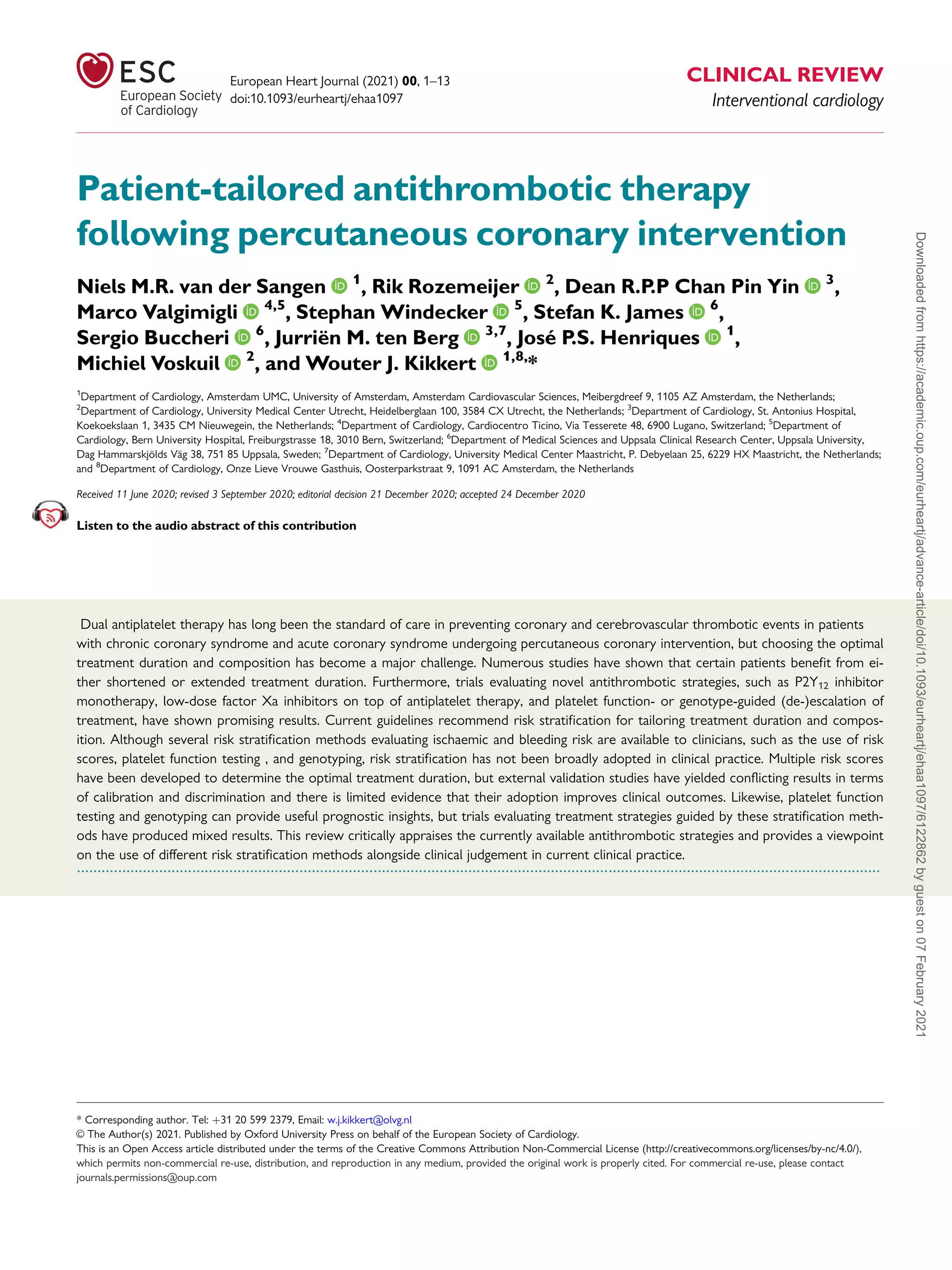
Keywords Dual antiplatelet therapy • Patient-tailored antithrombotic therapy • Risk stratification
Introduction
Dual antiplatelet therapy (DAPT), consisting of aspirin and a P2Y12 in-
hibitor, prevents stent-related and non-stent-related coronary and
cerebrovascular thrombotic events and remains the standard of care
following percutaneous coronary intervention (PCI) in patients with
chronic coronary syndrome (CCS) and acute coronary syndrome
(ACS).1–3
Inevitably, DAPT increases bleeding complications, which
are associated with significant morbidity and mortality.4
Therefore,
when determining the duration and composition of an antithrom-
botic regimen, physicians must carefully balance the advantages and
drawbacks associated with this therapy. Historically, DAPT was rec-
ommended for at least 12 months after first-generation drug-eluting
stent (DES) implantation because of concerns over late and very late
stent thrombosis. However, the rates of late and very late stent
thrombosis have decreased considerably with the advent of new gen-
eration DES.5,6
In addition, some, but not all, randomized controlled
trials (RCTs) have shown a reduction in bleeding complications with-
out a signal of increased ischaemic events with a short course DAPT
(3–6months) as compared to 12 months DAPT in patients at rela-
tively low risk of thrombotic events.7–18
On the other hand, extend-
ing DAPT up to 3 years has been associated with a reduction in
ischaemic events, with a similar increase in bleeding events, as com-
pared to 12 months DAPT in patients treated with DES or in patients
with a previous myocardial infarction (MI).17–25
Furthermore, the
field of antithrombotic therapy is rapidly evolving with novel antith-
rombotic strategies emerging, such as P2Y12 inhibitor monotherapy,
low-dose factor Xa inhibitors in addition to antiplatelet therapy, and
platelet function- or genotype-guided de-escalation or escalation of
P2Y12 inhibition.26–35
However, interpretation of results from RCTs
investigating antithrombotic therapies is hampered by the use of
composite (primary) endpoints, which combine ischaemic events [i.e.
(cardiovascular) mortality, MI, and stroke] and major bleeding. The
individual components of these combined endpoints can have mark-
edly different impact on mortality, morbidity, and quality of life.36
For
example, bleeding (even major bleeding) is rarely fatal or disabling,
whereas ischaemic stroke frequently results in permanent disability.
Taken together, clinical decision-making regarding the optimal
Graphical Abstract
....................................................................................................................................................................................................
2 N.M.R. van der Sangen et al.
Downloaded
from
https://academic.oup.com/eurheartj/advance-article/doi/10.1093/eurheartj/ehaa1097/6122862
by
guest
on
07
February
2021](https://image.slidesharecdn.com/patient-tailoredantithrombotictherapy-210402221658/85/Patient-tailored-antithrombotic-therapy-2-320.jpg)
![.
.
.
.
.
.
.
.
.
.
.
.
.
.
.
.
.
.
.
.
.
.
.
.
.
.
.
.
.
.
.
.
.
.
.
.
.
.
.
.
.
.
.
.
.
.
.
.
.
.
.
.
.
.
.
.
.
.
.
.
.
.
.
.
.
.
.
.
.
.
.
.
.
.
.
.
.
.
.
.
.
.
.
.
.
.
.
.
.
.
.
.
.
.
.
.
.
.
.
.
.
.
.
.
.
.
.
.
.
.
.
.
.
.
.
.
.
.
.
.
.
.
.
.
.
.
.
.
.
.
.
.
.
.
.
.
.
.
.
.
.
.
.
.
.
.
.
.
.
.
.
.
.
.
.
.
.
.
.
.
.
.
.
.
.
.
.
.
.
.
.
.
.
are concerns of high on-treatment platelet reactivity. To address
these concerns, physicians may consider PFT to assess treatment re-
sponse, but this specific strategy remains to be investigated.
Clopidogrel monotherapy has only been evaluated in East Asian
patients, who have an unique risk profile.28,29
Therefore, caution
should be taken when extrapolating these trials results to other eth-
nicities. Thus far, experience with prasugrel monotherapy in the set-
ting of P2Y12 inhibitor monotherapy has been limited. Of note, there
are currently no randomized studies available comparing P2Y12 in-
hibitor monotherapy to aspirin monotherapy after a short course of
DAPT and experience with P2Y12 inhibitor monotherapy beyond 1
year after stent implantation is limited.
Extended dual antiplatelet
therapy
Nine RCTs compared extended DAPT (18–48 months) with stand-
ard DAPT (6–12 months) (Supplementary material online, Table
S3).17–25
Most trials did not demonstrate a benefit of extended
DAPT. The majority of patients enrolled in these trials had CCS and
clopidogrel was used almost exclusively. Two studies randomized
patients at the time of PCI or shortly thereafter, potentially diluting
differences in outcome between the two groups.17,18
Importantly,
the adequately powered DAPT trial demonstrated that long DAPT
(30 months) significantly reduced the risk of definite or probable
stent thrombosis and major adverse cardiac events (MACE), but was
also associated with an increased risk of bleeding.22
Overall, at
30months after index PCI, there was a trend towards increased all-
cause mortality (0.5% absolute increase) with extended DAPT,
explained by a statistically significant increase in non-cardiovascular
mortality, mainly attributed to increased cancer related mortality.
The PEGASUS-TIMI 54 trial included patients who suffered an MI 1–
3 years before enrollment and had at least one additional high-risk
feature (age >
_65years, diabetes mellitus requiring medication, mul-
tiple prior MI’s, multivessel disease or renal impairment). The study
showed that extended DAPT with ticagrelor (median 33 months)
compared to aspirin monotherapy reduced the risk of MI, stroke, and
cardiovascular death combined but increased the risk of major bleed-
ing and did not reduce all-cause mortality.24
The absolute decrease in
the primary efficacy endpoint was similar in magnitude to the increase
in the primary bleeding endpoint indicating no clear benefit for the
study population as a whole.
In a pre-specified subgroup of CCS patients with diabetes and pre-
vious PCI of the THEMIS trial, long-term DAPT with ticagrelor
(60 mg twice daily) on top of aspirin (for a median of 3.3years) was
associated with a 1.3% absolute reduction in cardiovascular death,
MI, and stroke [number needed to treat (NNT) 77], coupled with an
increase in major bleeding [0.9% absolute increase, number needed
to harm (NNH) 111].47
The high NNT and similar NNH currently
only support extended DAPT in diabetic patients having undergone
PCI and at high ischaemic risk without high bleeding risk. Accordingly,
ticagrelor has been approved by the FDA to reduce the risk of MI or
stroke in high-risk patients with CCS. Importantly, in THEMIS, in
patients without a previous intervention, long-term ticagrelor plus as-
pirin increased the rate of major bleeding (including intracranial
haemorrhage) without a reduction in ischaemic events and should
therefore be avoided.
A meta-analysis investigating extended DAPT in patients with prior
MI showed a reduction in stent thrombosis, stroke, and MI, which
translated into decreased cardiovascular mortality.48
However, other
meta-analyses including lower risk patients did not show reduced
cardiovascular mortality and extended DAPT was even associated
with an increased risk of non-cardiovascular and all-cause mortal-
ity.49–51
Hence, current guidelines recommend that extended DAPT
can be considered in patients with high thrombotic risk without high
bleeding risk.1–3
Low-dose factor Xa inhibitor on
top of antiplatelet therapy
Factor Xa inhibitors and other anticoagulants ultimately inhibit the
formation or activation of thrombin, which plays a crucial role in both
coagulation and platelet activation and may offer a synergistic benefit
when added to antiplatelet therapy.52
A strong asset of dual-pathway
inhibition is that anticoagulants, like factor Xa-inhibitors, modulate a
number of inflammatory pathways which may reduce their contribu-
tion to atherogenesis.52
Oral anticoagulants have been shown to miti-
gate the risk of arterial thrombotic events, but because DAPT was
superior to aspirin and warfarin in preventing stent thrombosis, the
latter strategy was abandoned in favour of DAPT following PCI.53
However, recently reported studies investigating (low-dose) non-
vitamin K antagonist oral anticoagulants (Supplementary material on-
line, Table S4) have renewed interest in combining lower anticoagu-
lant doses with antiplatelet therapy.
In the placebo-controlled ATLAS ACS 2-TIMI 51 trial, low-dose
rivaroxaban (2.5mg twice daily) reduced the incidence of cardiovas-
cular death, MI, and stroke in ACS patients mostly treated with as-
pirin and clopidogrel, at the expense of increased bleeding.31
Subsequently, in the COMPASS trial, low-dose rivaroxaban (2.5mg
twice daily) on top of aspirin as compared to aspirin alone was associ-
ated with reduced risk of cardiovascular death, MI or stroke in
patients with CCS and peripheral artery disease at moderate-high
risk of ischaemic events.32
In high-risk subgroups (e.g. patients with
diabetes, moderate chronic kidney disease, and current smokers),
low-dose rivaroxaban was associated with even greater absolute risk
reductions. Unfortunately, pre-specified significance thresholds for
cardiovascular and all-cause mortality were not met and patients on
low-dose rivaroxaban on top of aspirin had more major (though not-
fatal) bleeding events.32
Interestingly, low-dose rivaroxaban and as-
pirin as compared to aspirin alone significantly reduced the rate of
stroke by 42% (driven by a 49% relative reduction in ischaemic stroke
partially offset by a numeric increase in haemorrhagic stroke), making
low-dose rivaroxaban plus aspirin an important new option for
stroke prevention in patients with atherosclerosis.54
A substantial fraction (approximately 50%) of coronary or periph-
eral artery disease patients encountered in daily practice seem eligible
for this strategy based on an analysis in the REACH registry.55
However, exclusion criteria like high bleeding risk, an indication for
therapeutic anticoagulation or DAPT, and a history of recent stroke
are common, warranting careful patient selection for this novel ap-
proach. Current guidelines now highlight low-dose rivaroxaban on
4 N.M.R. van der Sangen et al.
Downloaded
from
https://academic.oup.com/eurheartj/advance-article/doi/10.1093/eurheartj/ehaa1097/6122862
by
guest
on
07
February
2021](https://image.slidesharecdn.com/patient-tailoredantithrombotictherapy-210402221658/85/Patient-tailored-antithrombotic-therapy-4-320.jpg)
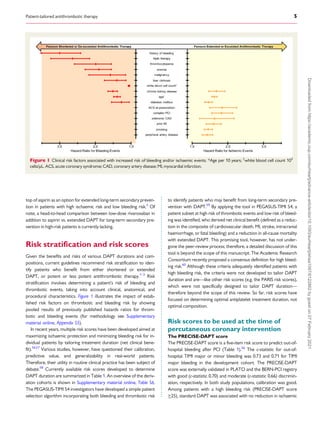
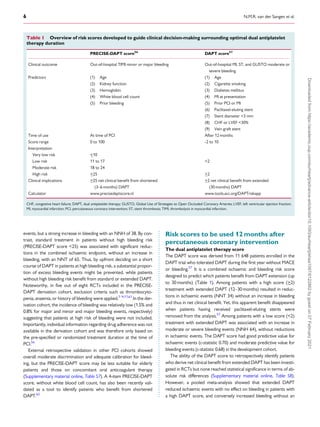
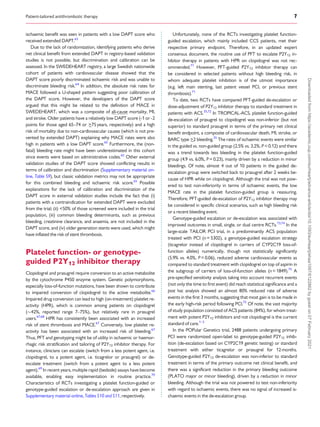
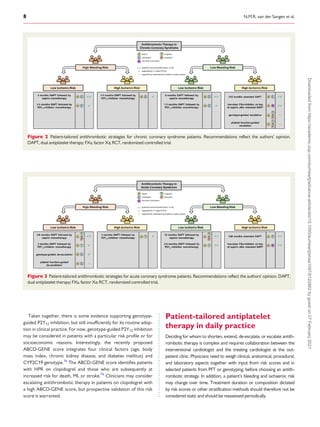
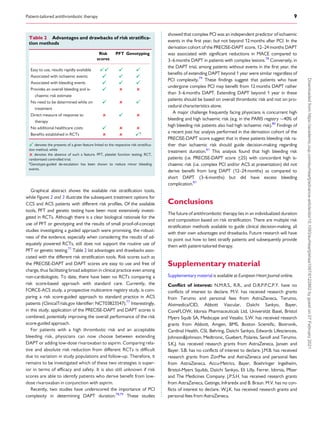

This review discusses patient-tailored antithrombotic therapy following percutaneous coronary intervention (PCI), emphasizing the challenges of selecting optimal treatment durations and strategies for dual antiplatelet therapy (DAPT). It highlights the significance of risk stratification methods, which can include risk scores and platelet function testing, but notes that their adoption in clinical practice remains limited despite evidence suggesting benefits for certain patient populations. Additionally, the review evaluates various novel antithrombotic strategies and the importance of balancing ischemic and bleeding risks in treatment decisions.


