EXTREME EVENTS in Italy
Hurricanes, tornadoes and waterspouts
Cloudbusters
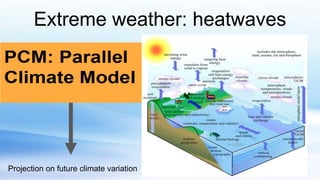
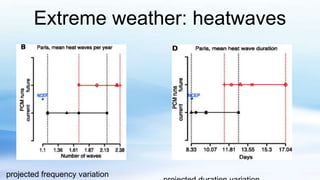
Extreme weather: heatwaves
droughts
severe storms and wind
Floods
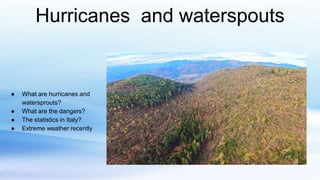
Hurricanes and waterspouts
● What are hurricanes and
watersprouts?
● What are the dangers?
● The statistics in Italy?
● Extreme weather recently
Hurricanes and waterspouts
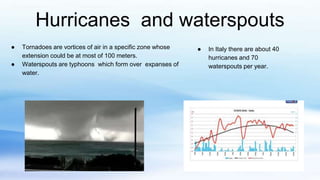
● Tornadoes are vortices of air in a specific zone whose
extension could be at most of 100 meters.
● Waterspouts are typhoons which form over expanses of
water.
● In Italy there are about 40
hurricanes and 70
waterspouts per year.
Hurricanes and waterspouts
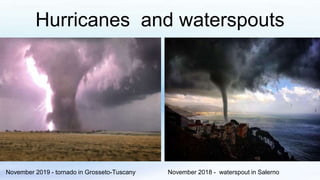
November 2019 - tornado in Grosseto-Tuscany November 2018 - waterspout in Salerno
CLOUDBURSTS
Cloudbursts are a phenomenon that
occurs when hot air from sea level rises
comes into contact with colder air; the
water droplets in the air condence and
fall in form of rain.
The greater the difference in temperature
the greater the intensity of the phenomeno
They occur by the sea more frequently
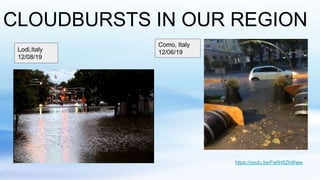
CLOUDBURSTS IN OUR REGION
Lodi,Italy
12/08/19
Como, Italy
12/06/19
https://youtu.be/FwIiH5ZhWww
Extreme weather: heatwaves
Analysis of the effects of global warming on the frequency and
harshness of heatwaves( “A prolonged period of extremely high
temperatures for a particular region in a particular season”) in Italy
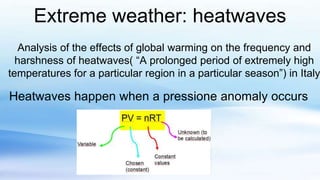
Heatwaves happen when a pressione anomaly occurs
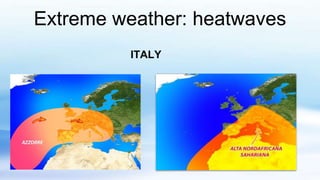
Extreme weather: heatwaves
ITALY
Extreme weather: heatwaves
Projection on future climate variation
Extreme weather: heatwaves
projected frequency variation
Extreme weather: heatwaves
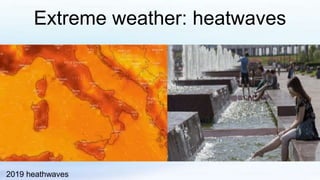
2019 heathwaves
Extreme weather: droughts
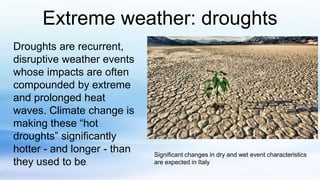
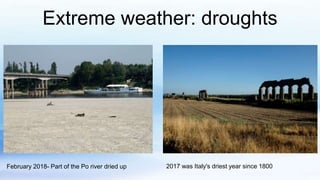
Droughts are recurrent,
disruptive weather events
whose impacts are often
compounded by extreme
and prolonged heat
waves. Climate change is
making these “hot
droughts” significantly
hotter - and longer - than
they used to be.
Significant changes in dry and wet event characteristics
are expected in Italy
Extreme weather: droughts
February 2018- Part of the Po river dried up 2017 was Italy's driest year since 1800
Extreme weather: severe storms
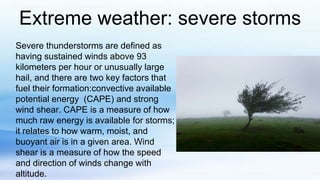
Severe thunderstorms are defined as
having sustained winds above 93
kilometers per hour or unusually large
hail, and there are two key factors that
fuel their formation:convective available
potential energy (CAPE) and strong
wind shear. CAPE is a measure of how
much raw energy is available for storms;
it relates to how warm, moist, and
buoyant air is in a given area. Wind
shear is a measure of how the speed
and direction of winds change with
altitude.
Extreme weather: severe storms
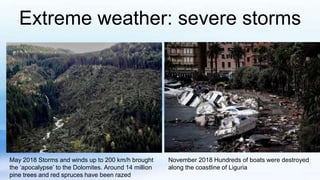
May 2018 Storms and winds up to 200 km/h brought
the ‘apocalypse’ to the Dolomites. Around 14 million
pine trees and red spruces have been razed
November 2018 Hundreds of boats were destroyed
along the coastline of Liguria
Floods
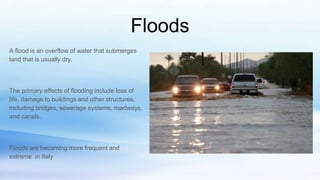
A flood is an overflow of water that submerges
land that is usually dry.
The primary effects of flooding include loss of
life, damage to buildings and other structures,
including bridges, sewerage systems, roadways,
and canals.
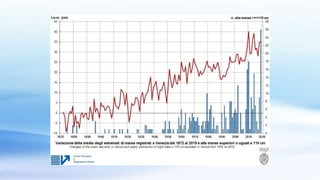
Floods are becoming more frequent and
extreme in Italy
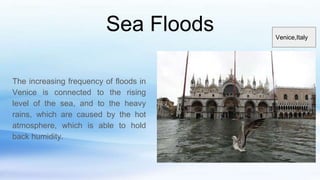
The increasing frequency of floods in
Venice is connected to the rising
level of the sea, and to the heavy
rains, which are caused by the hot
atmosphere, which is able to hold
back humidity.
Sea Floods Venice,Italy
References
Helpsavenature.com
Blogs.ei.columbia.edu
Nationalgeographic.it
https://www.nasa.gov
https://www.climatechangepost.com
https://www.esa.int/Applications/Observing_the_Earth/Space_for_our_climate/Spa
ce_in_climate_change
https://www.nssl.noaa.gov/

Extreme events italy