THREE-DIMENSIONAL (3D)
INSTRUCTIONAL MEDIA
Objects and Specimens
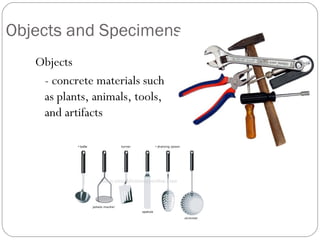
Objects
- concrete materials such
as plants, animals, tools,
and artifacts
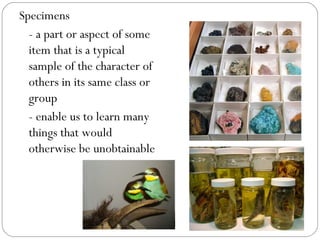
Specimens
- a part or aspect of some
item that is a typical
sample of the character of
others in its same class or
group
- enable us to learn many
things that would
otherwise be unobtainable
Points to Consider in Using Objects and
Specimens for Teaching
1. Develop a purpose for using them
2. Provide opportunities for students to work with or to
manipulate
3. Present just enough at a time
4. Present in a dramatic way
Advantages
1. less abstract, more concrete
2. attracts attention
3. students become more familiar with objects
Limitations
1. need bigger storage
2. prone to possible damage
3. some have limitation in availability
Models and Mock-ups
Models
- modified real things, reproductions of costly or
delicate items
- replicas of real objects which may be larger or
smaller than the real thing
- can be made to show interior view of objects and
they can be simplified to any extent desired in order
that the basic concept represented may be
communicated most adequately
Varied Purposes of Models
1. when real objects are too small or too large to bring
into the classroom
2. to present subject matter involving the past and the
future
3. physical inaccessibility
4.abstract construction
5. to explain processes
Types of Models
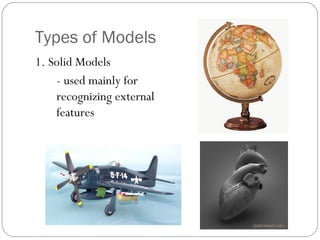
1. Solid Models
- used mainly for
recognizing external
features
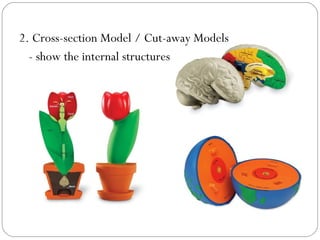
2. Cross-section Model / Cut-away Models
- show the internal structures
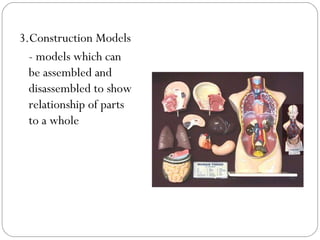
3.Construction Models
- models which can
be assembled and
disassembled to show
relationship of parts
to a whole
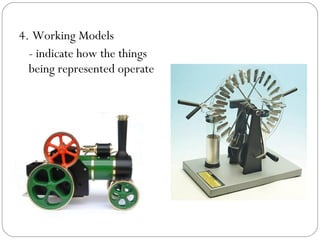
4. Working Models
- indicate how the things
being represented operate
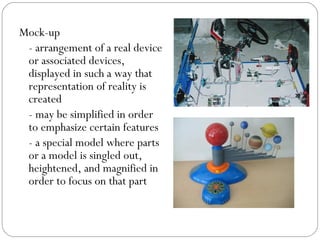
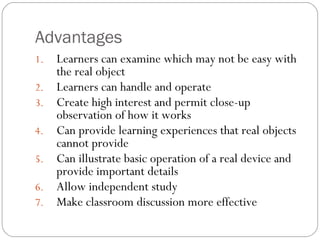
Mock-up
- arrangement of a real device
or associated devices,
displayed in such a way that
representation of reality is
created
- may be simplified in order
to emphasize certain features
- a special model where parts
or a model is singled out,
heightened, and magnified in
order to focus on that part
Advantages
1. Learners can examine which may not be easy with
the real object
2. Learners can handle and operate
3. Create high interest and permit close-up
observation of how it works
4. Can provide learning experiences that real objects
cannot provide
5. Can illustrate basic operation of a real device and
provide important details
6. Allow independent study
7. Make classroom discussion more effective
Limitations
1. Require tedious work
2. Expensive
3. Might distort some real concepts
4. Big or heavy models may be difficult to handle for
actual lecture
Diorama
- of Greek origin which means “to see through”
- a 3D representation of events, ideas or concepts
against a scenic background
- miniature scene in 3D treatment meant to replicate
reality
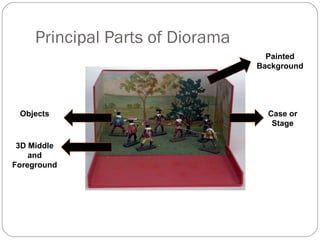
Principal Parts of Diorama
Painted
Background
Case or
Stage
3D Middle
and
Foreground
Objects
Advantages
1. Have intrinsic value
2. Allow us to compare past and present conditions
3. Help us make connections to the real world
4. Develops students’ creativity
5. Can be viewed, handled, and examined by
students
6. Adds interest and meaning to the lesson
Limitations
1. Demands a bigger space in terms of use and
storage
2. Expensive
3. Easily damaged
Puppets
- are artificial figures whose movements are controlled
by a person
- are moved by hand, strings, wires or rods
- are made to represent a person, animal, plant or an
object
Types of Puppets
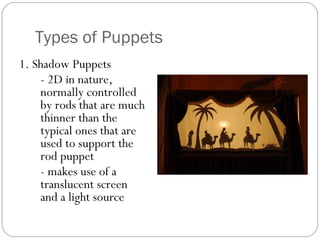
1. Shadow Puppets
- 2D in nature,
normally controlled
by rods that are much
thinner than the
typical ones that are
used to support the
rod puppet
- makes use of a
translucent screen
and a light source
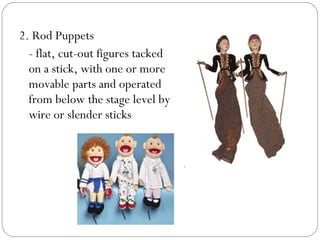
2. Rod Puppets
- flat, cut-out figures tacked
on a stick, with one or more
movable parts and operated
from below the stage level by
wire or slender sticks
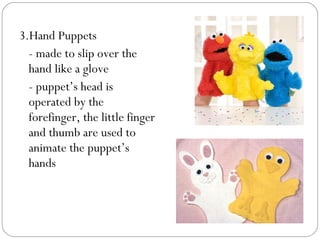
3.Hand Puppets
- made to slip over the
hand like a glove
- puppet’s head is
operated by the
forefinger, the little finger
and thumb are used to
animate the puppet’s
hands
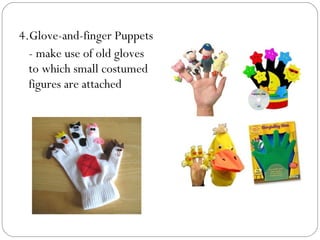
4.Glove-and-finger Puppets
- make use of old gloves
to which small costumed
figures are attached
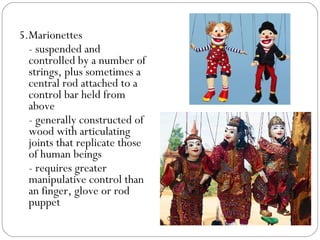
5.Marionettes
- suspended and
controlled by a number of
strings, plus sometimes a
central rod attached to a
control bar held from
above
- generally constructed of
wood with articulating
joints that replicate those
of human beings
- requires greater
manipulative control than
an finger, glove or rod
puppet
Advantages
1. Boost active participation among students
2. Stirring and attention-getting
3. Fascination of the inanimate objects
4. Enjoyable and spontaneous learning experience
5. Students become more creative
Limitations
1. Time consuming
2. Expensive
3. Demands extra effort
4. Can compete with the teacher
Principles in Choosing Puppet Play
for Teaching
1. Do not use puppets for plays that can
be done just as well or better by
another dramatic means
2. Puppet play must be based on actions
rather than words
3. Keep plays short
4. Do not omit the possibilities of
music and dancing as part of the
show
5. Adapt in all respect to your audience
6. Do not hesitate to adapt puppet play
Resource Person – someone
invited to talk about
something
Consider the following when
inviting and using a resource
speaker:
1. engage the expert
2. clarify the purposes of the
visit
3. subject should be of
educational relevance and
value to the students
Consider the following when
inviting and using a resource
speaker (cont.):
4. speaker should not tend to
disrupt the educational
program
5. info to be discussed should
be appropriate to the age and
maturity of students
6. teacher should remain in
the classroom throughout the
presentation
Introducing the Speaker/s
1.Prepare what you are going to say
2. Follow the TIS formula
T – topic / title of speaker’s talk
I – importance of the topic
S – speaker’s outstanding qualifications
3. Announce speaker’s name distinctly and clearly
4. Be enthusiastic about the speaker
Things to Remember when Invited as a
Resource Speaker
1. Restrict subject to fit the time at your disposal
2. Arrange ideas in sequence
3. Enumerate points as you make them
4. Compare the strange with the familiar
5. Turn a fact into a picture
6. Avoid technical terms
7. Use appropriate media
8. Speak with contagious enthusiasm
9. Show respect and affection to your audience
10. Begin in a friendly way
When delivering the talk…..
1. Crash thoroughly your shell of self-consciousness
2. Don’t try to imitate others
3. Converse with your audience
4. Put your heart into your speaking
5. Practice making your voice strong and flexible
Advantages
1. Less preparation on the part of the teacher
2. Thorough discussion of the topic
3. It might add enthusiasm to the audience if the
speaker is good
Limitations
1. Hassle in searching for the suitable speaker
2. It might confuse the audience if the speaker is not
good enough
3. Less enthusiasm from the audience if the speaker is
boring

Three dimensional (3 d) instructional media1

  • 1.
  • 2.
    Objects and Specimens Objects -concrete materials such as plants, animals, tools, and artifacts
  • 3.
    Specimens - a partor aspect of some item that is a typical sample of the character of others in its same class or group - enable us to learn many things that would otherwise be unobtainable
  • 4.
    Points to Considerin Using Objects and Specimens for Teaching 1. Develop a purpose for using them 2. Provide opportunities for students to work with or to manipulate 3. Present just enough at a time 4. Present in a dramatic way
  • 5.
    Advantages 1. less abstract,more concrete 2. attracts attention 3. students become more familiar with objects Limitations 1. need bigger storage 2. prone to possible damage 3. some have limitation in availability
  • 6.
    Models and Mock-ups Models -modified real things, reproductions of costly or delicate items - replicas of real objects which may be larger or smaller than the real thing - can be made to show interior view of objects and they can be simplified to any extent desired in order that the basic concept represented may be communicated most adequately
  • 7.
    Varied Purposes ofModels 1. when real objects are too small or too large to bring into the classroom 2. to present subject matter involving the past and the future 3. physical inaccessibility 4.abstract construction 5. to explain processes
  • 8.
    Types of Models 1.Solid Models - used mainly for recognizing external features
  • 9.
    2. Cross-section Model/ Cut-away Models - show the internal structures
  • 10.
    3.Construction Models - modelswhich can be assembled and disassembled to show relationship of parts to a whole
  • 11.
    4. Working Models -indicate how the things being represented operate
  • 12.
    Mock-up - arrangement ofa real device or associated devices, displayed in such a way that representation of reality is created - may be simplified in order to emphasize certain features - a special model where parts or a model is singled out, heightened, and magnified in order to focus on that part
  • 13.
    Advantages 1. Learners canexamine which may not be easy with the real object 2. Learners can handle and operate 3. Create high interest and permit close-up observation of how it works 4. Can provide learning experiences that real objects cannot provide 5. Can illustrate basic operation of a real device and provide important details 6. Allow independent study 7. Make classroom discussion more effective
  • 14.
    Limitations 1. Require tediouswork 2. Expensive 3. Might distort some real concepts 4. Big or heavy models may be difficult to handle for actual lecture
  • 15.
    Diorama - of Greekorigin which means “to see through” - a 3D representation of events, ideas or concepts against a scenic background - miniature scene in 3D treatment meant to replicate reality
  • 16.
    Principal Parts ofDiorama Painted Background Case or Stage 3D Middle and Foreground Objects
  • 17.
    Advantages 1. Have intrinsicvalue 2. Allow us to compare past and present conditions 3. Help us make connections to the real world 4. Develops students’ creativity 5. Can be viewed, handled, and examined by students 6. Adds interest and meaning to the lesson
  • 18.
    Limitations 1. Demands abigger space in terms of use and storage 2. Expensive 3. Easily damaged
  • 19.
    Puppets - are artificialfigures whose movements are controlled by a person - are moved by hand, strings, wires or rods - are made to represent a person, animal, plant or an object
  • 20.
    Types of Puppets 1.Shadow Puppets - 2D in nature, normally controlled by rods that are much thinner than the typical ones that are used to support the rod puppet - makes use of a translucent screen and a light source
  • 21.
    2. Rod Puppets -flat, cut-out figures tacked on a stick, with one or more movable parts and operated from below the stage level by wire or slender sticks
  • 22.
    3.Hand Puppets - madeto slip over the hand like a glove - puppet’s head is operated by the forefinger, the little finger and thumb are used to animate the puppet’s hands
  • 23.
    4.Glove-and-finger Puppets - makeuse of old gloves to which small costumed figures are attached
  • 24.
    5.Marionettes - suspended and controlledby a number of strings, plus sometimes a central rod attached to a control bar held from above - generally constructed of wood with articulating joints that replicate those of human beings - requires greater manipulative control than an finger, glove or rod puppet
  • 25.
    Advantages 1. Boost activeparticipation among students 2. Stirring and attention-getting 3. Fascination of the inanimate objects 4. Enjoyable and spontaneous learning experience 5. Students become more creative Limitations 1. Time consuming 2. Expensive 3. Demands extra effort 4. Can compete with the teacher
  • 26.
    Principles in ChoosingPuppet Play for Teaching 1. Do not use puppets for plays that can be done just as well or better by another dramatic means 2. Puppet play must be based on actions rather than words 3. Keep plays short 4. Do not omit the possibilities of music and dancing as part of the show 5. Adapt in all respect to your audience 6. Do not hesitate to adapt puppet play
  • 27.
    Resource Person –someone invited to talk about something Consider the following when inviting and using a resource speaker: 1. engage the expert 2. clarify the purposes of the visit 3. subject should be of educational relevance and value to the students
  • 28.
    Consider the followingwhen inviting and using a resource speaker (cont.): 4. speaker should not tend to disrupt the educational program 5. info to be discussed should be appropriate to the age and maturity of students 6. teacher should remain in the classroom throughout the presentation
  • 29.
    Introducing the Speaker/s 1.Preparewhat you are going to say 2. Follow the TIS formula T – topic / title of speaker’s talk I – importance of the topic S – speaker’s outstanding qualifications 3. Announce speaker’s name distinctly and clearly 4. Be enthusiastic about the speaker
  • 30.
    Things to Rememberwhen Invited as a Resource Speaker 1. Restrict subject to fit the time at your disposal 2. Arrange ideas in sequence 3. Enumerate points as you make them 4. Compare the strange with the familiar 5. Turn a fact into a picture 6. Avoid technical terms 7. Use appropriate media 8. Speak with contagious enthusiasm 9. Show respect and affection to your audience 10. Begin in a friendly way
  • 31.
    When delivering thetalk….. 1. Crash thoroughly your shell of self-consciousness 2. Don’t try to imitate others 3. Converse with your audience 4. Put your heart into your speaking 5. Practice making your voice strong and flexible
  • 32.
    Advantages 1. Less preparationon the part of the teacher 2. Thorough discussion of the topic 3. It might add enthusiasm to the audience if the speaker is good Limitations 1. Hassle in searching for the suitable speaker 2. It might confuse the audience if the speaker is not good enough 3. Less enthusiasm from the audience if the speaker is boring