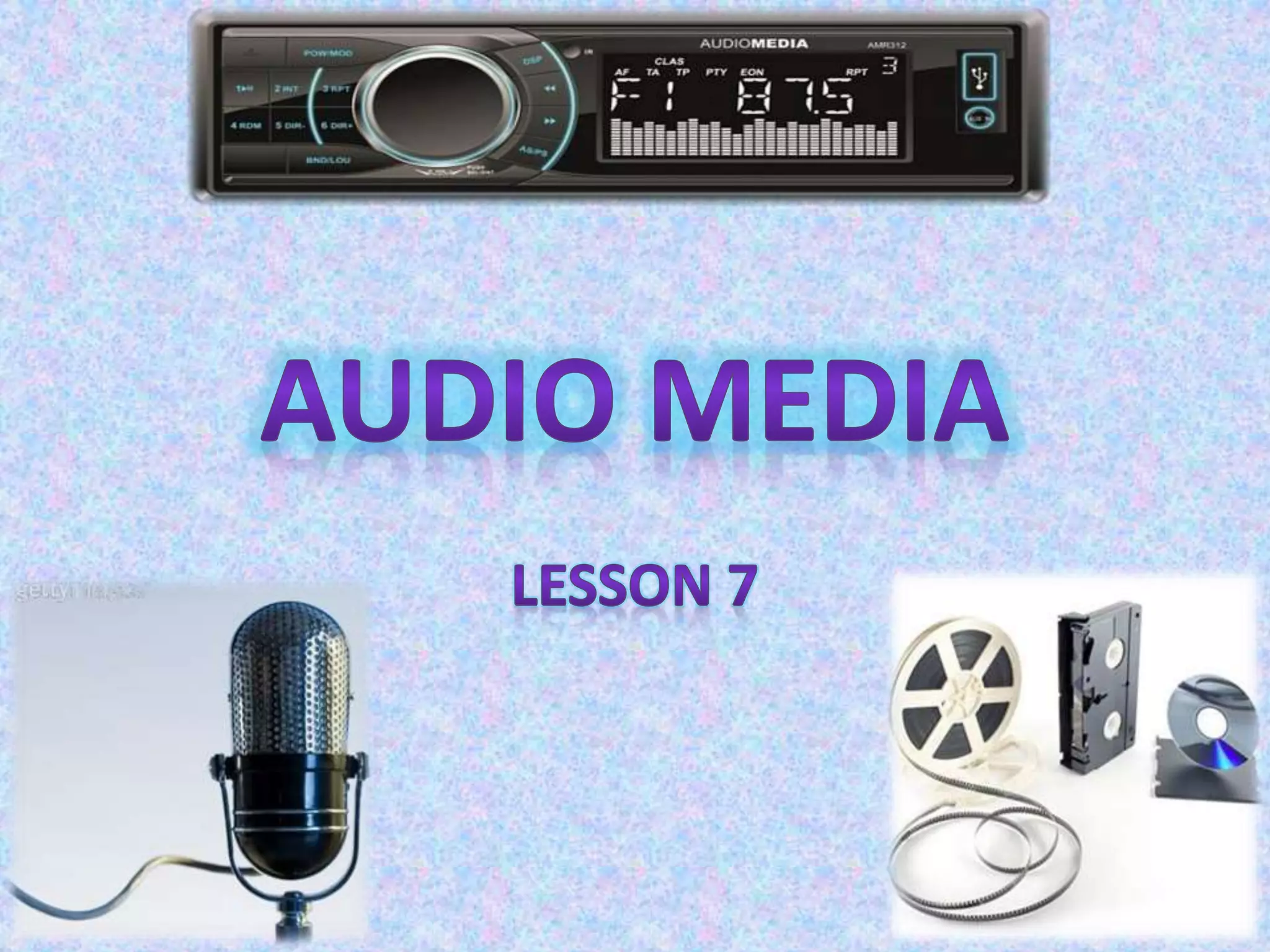
Audio Media
• Audio- media are materials or sounds that are
transmitted, produced or received thru high
fidelity waves that are heard thru certain
equipments.
• Inexpensive materials and easy to use
• The materials are light and usually portable
and easily duplicated or replaced.
Kinds of Audio Media
A. Radio broadcast which can be live or taped
(canned) programs
 It is an inexpensive means of reaching a mass
audience or a great numbers of learners.
 It is usually taped to eliminate problems of
scheduling, timing and accuracy in the unfolding of
the activities
 It is valued for its immediacy, realism, and emotional
impact.
 It provides the listeners an identical listening
experience
 The weakness of this is that it is a one- way
communication device.
B. Recordings
 These may come in the form of ordinary
cartridge, open reel tapes, compact discs and
the digital video disc.
 Advantages: two- way communication
device, eliminates the scheduling problem of
radio, Teachers can pre- hear the material so
they can evaluate its quality, content and
expected impact, it can also be reused in the
future if properly stored.
Uses of the audio media in
instruction
• It is effective in story telling especially if
pictures accompany them.
• Good for stimulating listener’s imagination
• Can be used to improve listening skills
• It is ideal for teaching foreign language
• Useful for those who have reading disabilities
or non- readers
Next topic: The Chalkboard
and Other Display materials
The Uses of Chalkboard
To illustrate facts and processes, often with a help
of drawings and sketches, maps and others.
To present important facts and principles such as
new words, terms, rules, definitions and
classifications.
To provide a good medium for students’
demonstration.
To display a wide variety of materials ranging
from the motivational, developmental to evaluate
activities.
To enhance maximum pupil participation
To provide for individual differences
Quality of a good chalkboard
within the reach of the students.
easily cleaned
It should not be glaring
It should not be abrasive
Suggestions in using the
chalkboard
a) Keep the chalkboard clean.
b) Make your letters and drawings large enough to be
seen by everybody.
c) Avoid hiding the materials or writings on the board.
d) Always write or prepare your materials ahead of
teaching time.
e) It is best to line the black board especially in elem.
grades so that students/ pupils will learn to write
legibly.
f) Avoid overcrowding materials to be displayed on the
board at one time unless your purpose requires to.
Advantages of the
chalkboard
a) Mistakes can be erased right away.
b) Teachers’ demonstration can be paced to suit
the level of the pupils.
c) Maximum student participation is insured as
pupils go the board.
d) Can be used for demonstrating purposes
e) It is always available.
Bulletin Board Display
• It is a medium for displaying materials which
must be cooperatively planned and put up by
the teacher and her/ his students.
Purposes of Bulletin Board
a) To approach a unit
b) To develop a unit
c) To summarize a unit
Multi- purpose board
• This type of bulletin board serves many
purposes like to announce important events or
occasions; to inform the public about programs
and offerings; to congratulate winners or high
performers, and the like.
Quality of a good bulletin board
or multi- purpose board
It should be finished with edge
It must be fixed on the wall to prevent
accidents
It must be colorful and attractive
Have at least unified theme for clarity
Avoid overcrowded display
In putting it up, be guided by the principles of
balance, unity, harmony, proportion, and
contrast
Next topic: E- board
• E-board provides the hardware and the
operational software but it will be the specialist
application- the E-board ‘app’ if you like, which
transforms the enabling technology into a viable
solution and new stream of business for the
specialist integrator.
• It is a large- format enables the display of
multiple source of data. Sources can be overlaid
to enable effective data visualisation or analysis,
to facilitate discussion and provide improved
decision making w/ groups.
E-board can…
• Act as a ‘digital library’ interface, providing
access to information or assets- information
leaflets in a hospital for instance, or to digital
images of the reserve collection at an art
gallery.
• Reduce the need for staff to provide
information and act as queue-busting aids at
peak times, for example in stations, tourist
attractions or public buildings.
• Reduce the cost print; avoid the problems of
out-of-date information and of running out of
print stock.
• Provide an easy-to-use interface for the
young, elderly or those with learning of
physical difficulties to ensure all needs are
catered for.
-end- (YEHET!!) 

[EDUCATIONAL TECHNOLOGY 2] Audio media

  • 2.
    Audio Media • Audio-media are materials or sounds that are transmitted, produced or received thru high fidelity waves that are heard thru certain equipments. • Inexpensive materials and easy to use • The materials are light and usually portable and easily duplicated or replaced.
  • 3.
    Kinds of AudioMedia A. Radio broadcast which can be live or taped (canned) programs  It is an inexpensive means of reaching a mass audience or a great numbers of learners.  It is usually taped to eliminate problems of scheduling, timing and accuracy in the unfolding of the activities  It is valued for its immediacy, realism, and emotional impact.  It provides the listeners an identical listening experience  The weakness of this is that it is a one- way communication device.
  • 4.
    B. Recordings  Thesemay come in the form of ordinary cartridge, open reel tapes, compact discs and the digital video disc.  Advantages: two- way communication device, eliminates the scheduling problem of radio, Teachers can pre- hear the material so they can evaluate its quality, content and expected impact, it can also be reused in the future if properly stored.
  • 5.
    Uses of theaudio media in instruction • It is effective in story telling especially if pictures accompany them. • Good for stimulating listener’s imagination • Can be used to improve listening skills • It is ideal for teaching foreign language • Useful for those who have reading disabilities or non- readers
  • 6.
    Next topic: TheChalkboard and Other Display materials
  • 8.
    The Uses ofChalkboard To illustrate facts and processes, often with a help of drawings and sketches, maps and others. To present important facts and principles such as new words, terms, rules, definitions and classifications. To provide a good medium for students’ demonstration. To display a wide variety of materials ranging from the motivational, developmental to evaluate activities. To enhance maximum pupil participation To provide for individual differences
  • 9.
    Quality of agood chalkboard within the reach of the students. easily cleaned It should not be glaring It should not be abrasive
  • 10.
    Suggestions in usingthe chalkboard a) Keep the chalkboard clean. b) Make your letters and drawings large enough to be seen by everybody. c) Avoid hiding the materials or writings on the board. d) Always write or prepare your materials ahead of teaching time. e) It is best to line the black board especially in elem. grades so that students/ pupils will learn to write legibly. f) Avoid overcrowding materials to be displayed on the board at one time unless your purpose requires to.
  • 11.
    Advantages of the chalkboard a)Mistakes can be erased right away. b) Teachers’ demonstration can be paced to suit the level of the pupils. c) Maximum student participation is insured as pupils go the board. d) Can be used for demonstrating purposes e) It is always available.
  • 13.
    Bulletin Board Display •It is a medium for displaying materials which must be cooperatively planned and put up by the teacher and her/ his students.
  • 14.
    Purposes of BulletinBoard a) To approach a unit b) To develop a unit c) To summarize a unit
  • 15.
    Multi- purpose board •This type of bulletin board serves many purposes like to announce important events or occasions; to inform the public about programs and offerings; to congratulate winners or high performers, and the like.
  • 16.
    Quality of agood bulletin board or multi- purpose board It should be finished with edge It must be fixed on the wall to prevent accidents It must be colorful and attractive Have at least unified theme for clarity Avoid overcrowded display In putting it up, be guided by the principles of balance, unity, harmony, proportion, and contrast
  • 17.
  • 18.
    • E-board providesthe hardware and the operational software but it will be the specialist application- the E-board ‘app’ if you like, which transforms the enabling technology into a viable solution and new stream of business for the specialist integrator. • It is a large- format enables the display of multiple source of data. Sources can be overlaid to enable effective data visualisation or analysis, to facilitate discussion and provide improved decision making w/ groups.
  • 19.
    E-board can… • Actas a ‘digital library’ interface, providing access to information or assets- information leaflets in a hospital for instance, or to digital images of the reserve collection at an art gallery. • Reduce the need for staff to provide information and act as queue-busting aids at peak times, for example in stations, tourist attractions or public buildings.
  • 20.
    • Reduce thecost print; avoid the problems of out-of-date information and of running out of print stock. • Provide an easy-to-use interface for the young, elderly or those with learning of physical difficulties to ensure all needs are catered for.
  • 23.