Two-DimensionalFine Art Media“Art” can refer to highly developed skill or the mastery of a medium.
Fine Art Media > Two-Dimensional ArtMedium or media (pl.) – the material and tools used by an artist to create art.Technique is the method and procedure used with an art medium. Craftsmanship is the skill with which the media and techniques are employed.
Fine Art Media > Two-Dimensional ArtTwo-dimensional art is any art work that has length and width, but no actual depth.Classified as: Drawing 		- Digital Drawing
Painting- Printmaking- Mixed Media	- Camera Arts
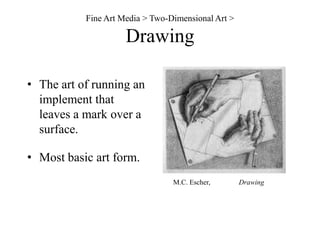
Fine Art Media > Two-Dimensional Art > DrawingThe art of running an implement that leaves a mark over a surface.Most basic art form.M.C. Escher,                Drawing
Fine Art Media > Two-Dimensional Art >DRAWING CATAGORIESSketches to record an idea or information;  personal note-taking
Plans or preparatory studies for future projects
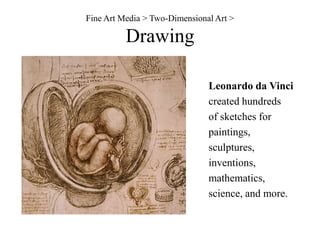
Fully developed finished works of artFine Art Media > Two-Dimensional Art > DrawingLeonardo da Vinci created hundreds of sketches forpaintings,sculptures,inventions,mathematics, science, and more.
0“Drawing . . . is the necessary beginning of everything in art, and not having it, one has nothing.”–Giorgio Vasari
0Fine Art Media > Two-Dimensional Art > DrawingThe most common support is monochromatic paper or parchment. But drawing can be found on a large variety of different surfaces. Support - the surface on which to drawMonochromatic - one color Linear - made of lines
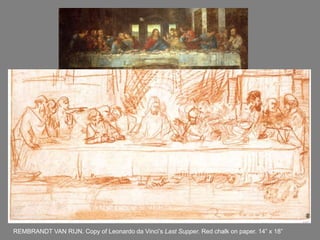
REMBRANDT VAN RIJN. Copy of Leonardo da Vinci’s Last Supper. Red chalk on paper. 14”x 18”
Fine Art Media > Two-dimensional Art > Drawing >Drawing MaterialsDry Media SilverpointGraphiteCharcoalPastels, chalkOil pastels, crayonsColored pencilsLiquid Media
Pen & Ink
Brush & Ink
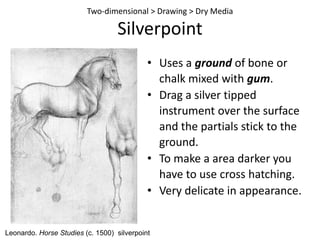
Ink WashTwo-dimensional > Drawing > Dry MediaSilverpointUses a ground of bone or chalk mixed with gum.Drag a silver tipped instrument over the surface and the partials stick to the ground. To make a area darker you have to use cross hatching. Very delicate in appearance.  Leonardo. Horse Studies (c. 1500)  silverpoint
Two-dimensional > Drawing > Dry MediaMetalpointNot used a lot anymore (not forgiving in mistakes)Process:  thin wire of metal (usually silver) in a holding device leaving marks on a drawing surface specially coated with paint.Much like scratchboard.Use thin, delicate lines with hatching and cross-hatching
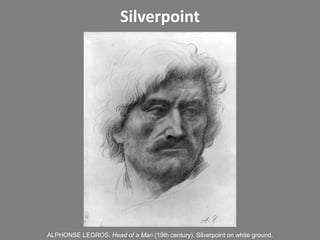
SilverpointALPHONSE LEGROS. Head of a Man (19th century). Silverpoint on white ground.
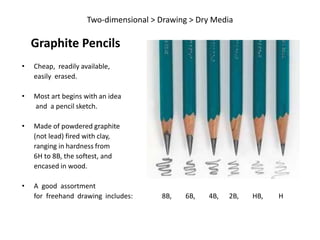
Two-dimensional > Drawing > Dry Media   Graphite PencilsCheap,  readily available,         easily  erased.Most art begins with an idea          and  a pencil sketch.Made of powdered graphite        (not lead) fired with clay, 	ranging in hardness from        6H to 8B, the softest, and 	encased in wood. A  good  assortment         for  freehand  drawing  includes:                 8B,        6B,        4B,      2B,        HB,         H
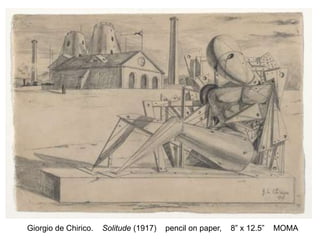
Giorgio de Chirico.    Solitude (1917)    pencil on paper,    8” x 12.5”    MOMA
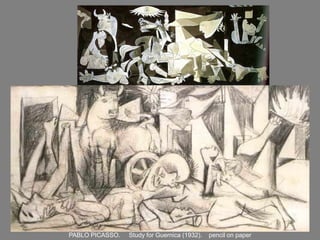
PABLO PICASSO. Study for Guernica(1932).    pencil on paper
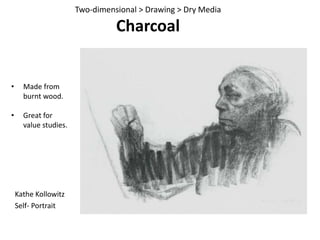
Two-dimensional > Drawing > Dry MediaCharcoalMade from burnt wood. Great for value studies.   Kathe Kollowitz  Self- Portrait
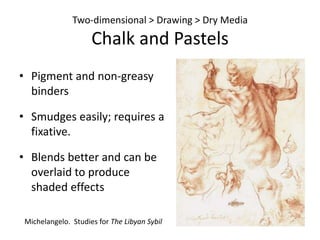
Two-dimensional > Drawing > Dry MediaChalk and PastelsPigment and non-greasy   bindersSmudges easily; requires a fixative.Blends better and can be overlaid to produce shaded effectsMichelangelo.  Studies for The Libyan Sybil
Chalk and PastelsChalk and pastel are very similar to charcoal.The compositions of the media differ.Made of ground chalk mixed with powered pigments and a gum binder. Introduced to France in the 1400s. Comes in many natural and synthetic colorsOcher - dark yellow that comes from iron oxide in some clays. Umber  - yellowish or reddish brown color that comes from earth containing oxides or manganese and iron.Sanguine - a “earthy” red color
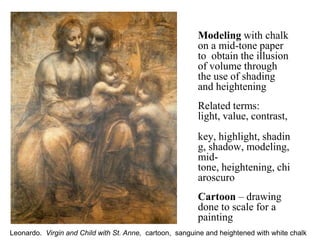
Modeling with chalk on a mid-tone paper to  obtain the illusion of volume through the use of shading and heighteningRelated terms: light, value, contrast,  key, highlight, shading, shadow, modeling, mid-tone, heightening, chiaroscuroCartoon – drawing done to scale for a painting Leonardo.  Virgin and Child with St. Anne,  cartoon,  sanguine and heightened with white chalk
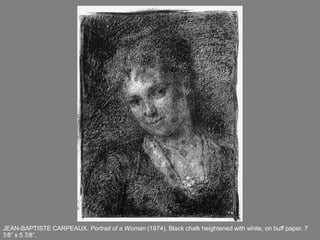
JEAN-BAPTISTE CARPEAUX. Portrait of a Woman (1874). Black chalk heightened with white, on buff paper. 77⁄8” x 57⁄8”.
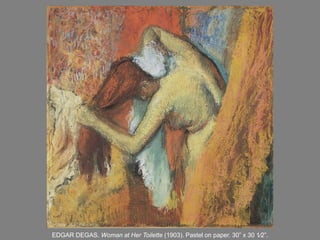
EDGAR DEGAS. Woman at Her Toilette (1903). Pastel on paper. 30” x 301⁄2”.
Two-dimensional > Drawing > Dry MediaCrayonsStrictly defined, the term crayon includes any drawing material in stick form (This can include charcoal, chalk, and pastel, plus wax implements.)Conté Crayons is one of the most popular commercially manufactured crayons (a little greasier than chalk - coming in red, black, and brown colors).
Two-dimensional > Drawing > Dry Media CrayonsOil pastels combine ground pigment and oil binder - adhere better to the drawing paper; wide variety of colors; more difficult to blendWax crayons combine ground pigment with a wax binder – less apt to smudge; non-toxic for kids use.
Two-dimensional > Drawing > Liquid MediaPen and InkCan have variety of line width depending on tip of pen and the pressure on the tip.Crow quill with ink well or fountain pen.Also, used for writingAsian calligraphy artistsFavored by and readily available to RembrandtMade thousands of pen and ink sketches
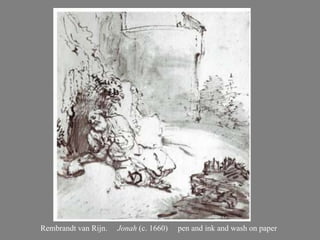
Rembrandt van Rijn.     Jonah (c. 1660)     pen and ink and wash on paper
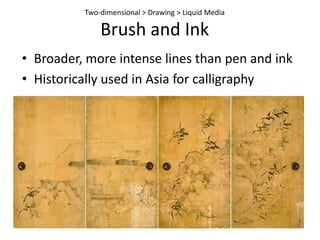
Two-dimensional > Drawing > Liquid Media Brush and InkBroader, more intense lines than pen and inkHistorically used in Asia for calligraphy
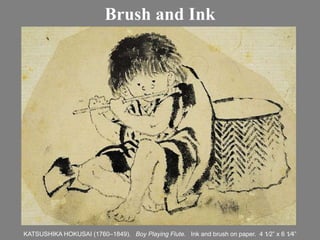
Brush and InkKATSUSHIKA HOKUSAI (1760–1849). Boy Playing Flute.Ink and brush on paper. 41⁄2” x 61⁄4”
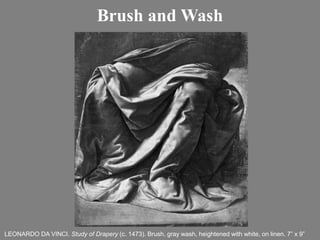
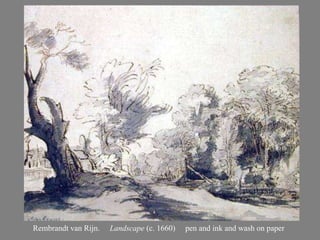
Two-dimensional > Drawing > Liquid Media Brush & Ink WashWatered down inkBroad, quick areas of value Used for spontaneity and immediacy.The brush can define volume and shadowing, from thin line to a broad sweep.  
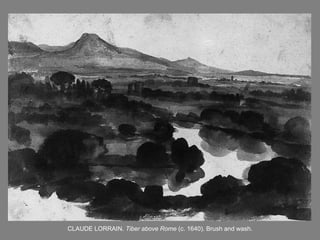
CLAUDE LORRAIN. Tiber above Rome (c. 1640). Brush and wash.
Brush and WashLEONARDO DA VINCI. Study of Drapery (c. 1473). Brush, gray wash, heightened with white, on linen. 7” x 9”
Rembrandt van Rijn.     Landscape (c. 1660)     pen and ink and wash on paper
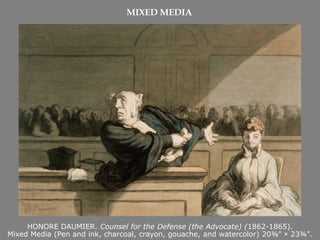
MIXED MEDIAHONORE DAUMIER. Counsel for the Defense (the Advocate) (1862-1865).Mixed Media (Pen and ink, charcoal, crayon, gouache,and watercolor) 20⅜" × 23¾".
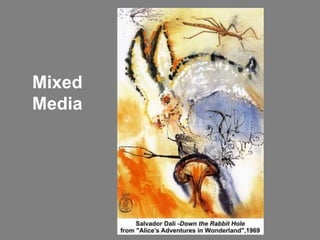
Mixed Media
Two-dimensional > Drawing > Digital DrawingComputer-based drawingCan be erased and reworked easierMore colors, brush and pen sizes, and drawing “canvas” available.Paint programs; i.e., Adobe Illustrator Prints to many different supports
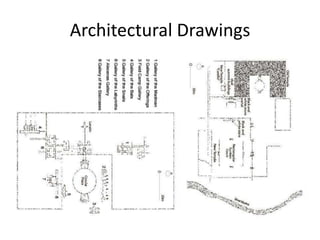
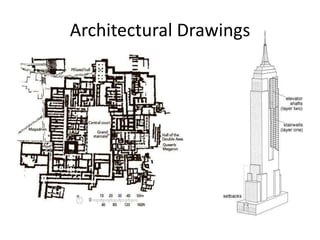
Two-dimensional > Drawing > Digital DrawingArchitectural & EngineeringUses programs to create building and structure plansSeveral different programs available:AutoCad (85% engineering firms use), Cad Pipe (draws ductwork in 3-D), Pro-E (3-D drawing for assembly of industrial and manufacturing—easy to modify), MicroStation (often used by government—works with AutoCad program well)
Architectural Drawings
Two-dimensional > Wet MediaPaintingUses full spectrum of colorsFramed to protect and give them an impression of being “precious”Classified as: Fresco 		- Encaustic
Tempera		- Oil- Acrylic    		- Watercolor
Two-dimensional > Wet MediaPaintingPaint is a fluid substance made of pigment suspended in a liquid binder that is used to cover or decorate a surface. Painting is the process of applying paint to a surface using tools such as brushes, a roller, a painting knife, or a paint sprayer.
Fine Art Media > Two-dimensional Art > Painting >Painting MaterialsPigment - color material
Binder - a liquid that holds the particles of pigment together without dissolving them.
Vehicle/solvent works as a paint thinner.
Support – the canvas, paper, wood panel, wall, or other surface that is painted on.
Gesso – a base paint primer that helps paint attach to the supportFine Art Media > Two-dimensional Art > Painting >FrescoPigments mixed with water and applied to a plaster support (usually wet also)
Wall-painting technique often used for large scale murals
Works are guided by a full-sized drawing called a cartoon.
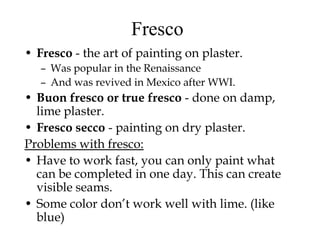
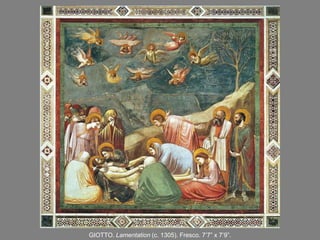
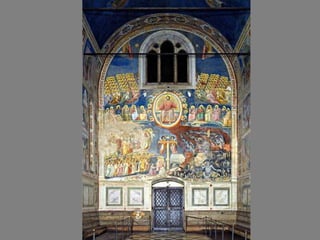
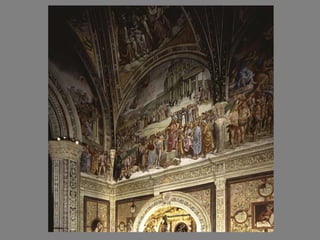
When ready to paint, the artist simply connects the dots.FrescoFresco - the art of painting on plaster. Was popular in the Renaissance And was revived in Mexico after WWI. Buon fresco or true fresco - done on damp, lime plaster. Fresco secco - painting on dry plaster. Problems with fresco:Have to work fast, you can only paint what can be completed in one day. This can create visible seams.Some color don’t work well with lime. (like blue)
GIOTTO. Lamentation (c. 1305). Fresco. 7’7” x 7’9”.
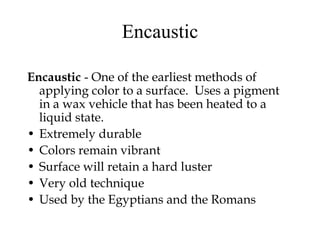
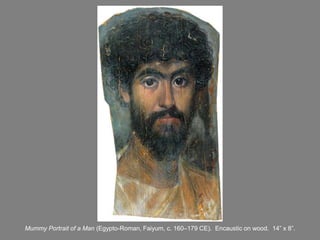
EncausticEncaustic - One of the earliest methods of applying color to a surface.  Uses a pigment in a wax vehicle that has been heated to a liquid state. Extremely durableColors remain vibrantSurface will retain a hard lusterVery old techniqueUsed by the Egyptians and the Romans
Mummy Portrait of a Man (Egypto-Roman, Faiyum, c. 160–179 CE). Encaustic on wood.14” x 8”.
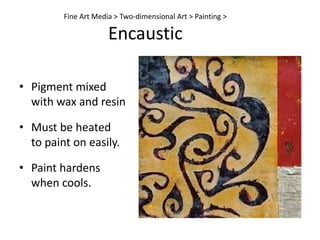
Fine Art Media > Two-dimensional Art > Painting > Encaustic Pigment mixed    with wax and resinMust be heated      to paint on easily.Paint hardens    when cools.
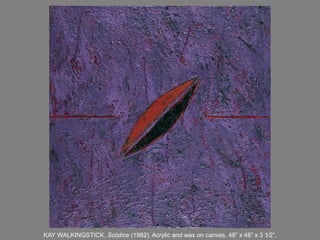
KAY WALKINGSTICK. Solstice (1982). Acrylic and wax on canvas. 48” x 48” x 31⁄2”.
Fine Art Media > Two-dimensional Art > Painting >TemperaMade with water and pigment
Bright colors that last longer than oil paint
Can be mixed with egg yolk to make it thicker,  harder, and more permanent.
Tempera is often used to paint on wood panels with a base of gesso.TemperaEgg Tempera - uses ground pigments mixed with vehicle of egg yolk thinned with waterPopular for centuries the tradition composition is rarely used todayUsed by the Greeks and RomansUse the exclusive painting medium of artists in the Middle Ages. Fell out of favor in the 1300’s with the introduction of oil painting.
Advantages of TemperaExtremely durablePure and brilliant colorsColor did not become compromised by oxidation Consistency and fluidity allowed for precisionDisadvantages: Dries quicklyHard to reworkCan not provide subtle gradation of tone.
Tempera TerminologyGesso - A combination of powdered chalk and plaster and animal glue used as a ground in tempera. Gilding - the application of thinly hammered sheets of gold to a panel surface. (Commonly used in conjunction with tempera.)Egg Tempera - the egg mixture traditionally used as a binder in tempera.
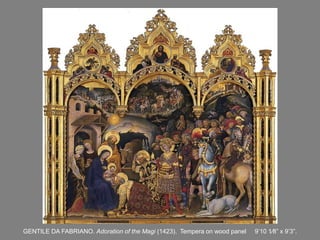
GENTILE DA FABRIANO. Adoration of the Magi (1423). Tempera on wood panel9’101⁄8” x 9’3”.
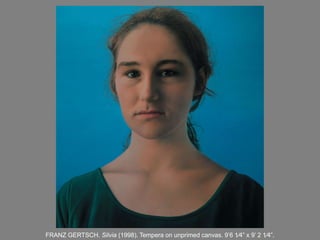
FRANZ GERTSCH. Silvia (1998). Tempera on unprimed canvas. 9’61⁄4” x 9’ 21⁄4”.
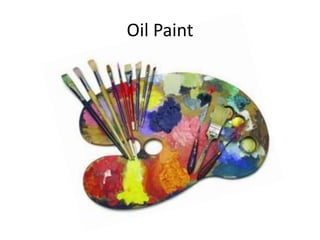
Oil Paint
Fine Art Media > Two-dimensional Art > Painting >Oil PaintPigment mixed with linseed oil.
First used on wooden panels and then graduated to flexible stretched canvas.
Used on large, bold projects
Dries VERY slowly
Colors can be blended subtly and areas can be reworked easily
Sometimes takes weeks or months to dry
Paint can become “muddy” from mixing colors and paint too muchOilOil painting - consists of ground pigments combined with a linseed oil and a turpentine  thinner.The transition from tempera to oil was gradual.Naturally slow drying – can be speeded up with agentsThe first oils were on wood panels.Glazing - the application of multiple layers of transparent films of paint to a surface.
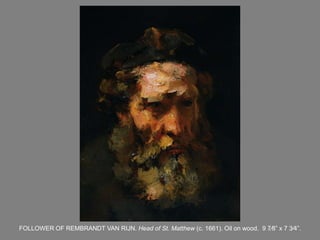
FOLLOWER OF REMBRANDT VAN RIJN. Head of St. Matthew (c. 1661). Oil on wood.97⁄8” x 73⁄4”.
Oil’s AdvantagesSlow drying lets you rework problem areas.  Colors can be blended easily.Can creates nice delicate colors.The eventual use of canvas as a ground allowed paintings to get much bigger. DisadvantagesSlow drying	- Toxic solventsCracking, yellowing, darkening with age
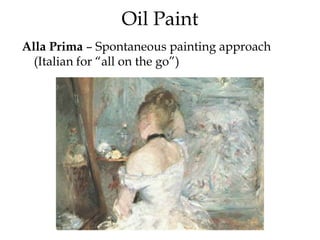
Oil PaintAlla Prima – Spontaneous painting approach (Italian for “all on the go”)
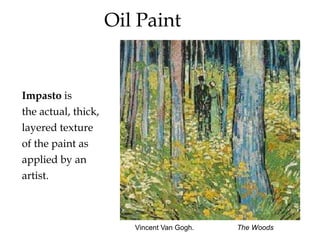
Oil PaintImpasto is        the actual, thick, layered texture  of the paint as applied by an artist.   Vincent Van Gogh.	      The Woods
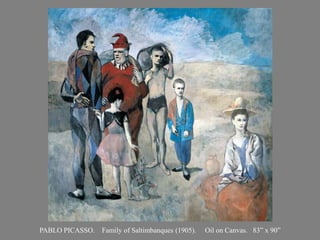
PABLO PICASSO.    Family of Saltimbanques (1905).     Oil on Canvas.   83” x 90”
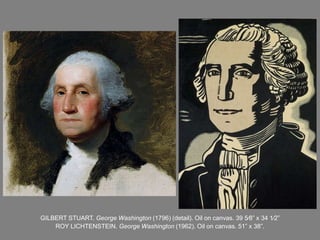
Compare and ContrastThe George Washingtonsof Stuart and Lichtenstein
GILBERT STUART. George Washington (1796) (detail). Oil on canvas. 395⁄8” x 341⁄2”ROY LICHTENSTEIN. George Washington (1962). Oil on canvas. 51” x 38”.
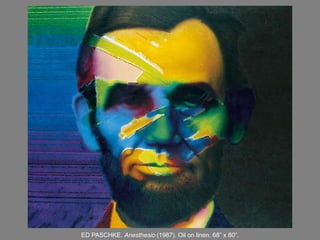
ED PASCHKE. Anesthesio (1987). Oil on linen. 68” x 80”.
AcrylicSynthetic artist color, also called polymerMade of acrylic resin, polymerized through emulsions in waterCan mimic the effects of oil, watercolor, tempera, and gouache paints.Dries quickly and permanentlyKeep brush in water while painting, so they do not dry out.
AcrylicAcrylic - is a mixture of pigment and a plastic vehicle that can be thinned with water. Advantages of acrylic paint over oil paint:No messy solvents – water cleanup.Can be used on a variety of surfaces.Surfaces don’t need special preparation. Stays flexible - no crackingNo yellowing or darkening with age
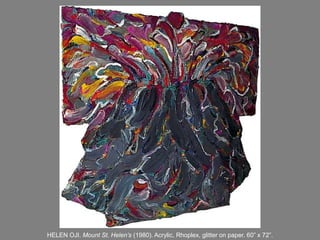
HELEN OJI. Mount St. Helen’s (1980). Acrylic, Rhoplex, glitter on paper. 60” x 72”.
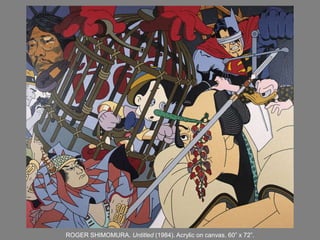
ROGER SHIMOMURA. Untitled (1984). Acrylic on canvas. 60” x 72”.
Fine Art Media > Two-dimensional Art > Painting >WatercolorPigment with water and gum arabic
Mostly used on paper
Mainly used for small, intimate works
Transparency is the desired characteristic

Two-Dimensional Fine Art Media

  • 1.
    Two-DimensionalFine Art Media“Art”can refer to highly developed skill or the mastery of a medium.
  • 2.
    Fine Art Media> Two-Dimensional ArtMedium or media (pl.) – the material and tools used by an artist to create art.Technique is the method and procedure used with an art medium. Craftsmanship is the skill with which the media and techniques are employed.
  • 3.
    Fine Art Media> Two-Dimensional ArtTwo-dimensional art is any art work that has length and width, but no actual depth.Classified as: Drawing - Digital Drawing
  • 4.
    Painting- Printmaking- MixedMedia - Camera Arts
  • 5.
    Fine Art Media> Two-Dimensional Art > DrawingThe art of running an implement that leaves a mark over a surface.Most basic art form.M.C. Escher, Drawing
  • 6.
    Fine Art Media> Two-Dimensional Art >DRAWING CATAGORIESSketches to record an idea or information; personal note-taking
  • 7.
    Plans or preparatorystudies for future projects
  • 8.
    Fully developed finishedworks of artFine Art Media > Two-Dimensional Art > DrawingLeonardo da Vinci created hundreds of sketches forpaintings,sculptures,inventions,mathematics, science, and more.
  • 9.
    0“Drawing . .. is the necessary beginning of everything in art, and not having it, one has nothing.”–Giorgio Vasari
  • 10.
    0Fine Art Media> Two-Dimensional Art > DrawingThe most common support is monochromatic paper or parchment. But drawing can be found on a large variety of different surfaces. Support - the surface on which to drawMonochromatic - one color Linear - made of lines
  • 11.
    REMBRANDT VAN RIJN.Copy of Leonardo da Vinci’s Last Supper. Red chalk on paper. 14”x 18”
  • 12.
    Fine Art Media> Two-dimensional Art > Drawing >Drawing MaterialsDry Media SilverpointGraphiteCharcoalPastels, chalkOil pastels, crayonsColored pencilsLiquid Media
  • 13.
  • 14.
  • 15.
    Ink WashTwo-dimensional >Drawing > Dry MediaSilverpointUses a ground of bone or chalk mixed with gum.Drag a silver tipped instrument over the surface and the partials stick to the ground. To make a area darker you have to use cross hatching. Very delicate in appearance. Leonardo. Horse Studies (c. 1500) silverpoint
  • 16.
    Two-dimensional > Drawing> Dry MediaMetalpointNot used a lot anymore (not forgiving in mistakes)Process: thin wire of metal (usually silver) in a holding device leaving marks on a drawing surface specially coated with paint.Much like scratchboard.Use thin, delicate lines with hatching and cross-hatching
  • 17.
    SilverpointALPHONSE LEGROS. Headof a Man (19th century). Silverpoint on white ground.
  • 18.
    Two-dimensional > Drawing> Dry Media Graphite PencilsCheap, readily available, easily erased.Most art begins with an idea and a pencil sketch.Made of powdered graphite (not lead) fired with clay, ranging in hardness from 6H to 8B, the softest, and encased in wood. A good assortment for freehand drawing includes: 8B, 6B, 4B, 2B, HB, H
  • 19.
    Giorgio de Chirico. Solitude (1917) pencil on paper, 8” x 12.5” MOMA
  • 20.
    PABLO PICASSO. Studyfor Guernica(1932). pencil on paper
  • 21.
    Two-dimensional > Drawing> Dry MediaCharcoalMade from burnt wood. Great for value studies. Kathe Kollowitz Self- Portrait
  • 22.
    Two-dimensional > Drawing> Dry MediaChalk and PastelsPigment and non-greasy bindersSmudges easily; requires a fixative.Blends better and can be overlaid to produce shaded effectsMichelangelo. Studies for The Libyan Sybil
  • 23.
    Chalk and PastelsChalkand pastel are very similar to charcoal.The compositions of the media differ.Made of ground chalk mixed with powered pigments and a gum binder. Introduced to France in the 1400s. Comes in many natural and synthetic colorsOcher - dark yellow that comes from iron oxide in some clays. Umber - yellowish or reddish brown color that comes from earth containing oxides or manganese and iron.Sanguine - a “earthy” red color
  • 24.
    Modeling with chalkon a mid-tone paper to obtain the illusion of volume through the use of shading and heighteningRelated terms: light, value, contrast, key, highlight, shading, shadow, modeling, mid-tone, heightening, chiaroscuroCartoon – drawing done to scale for a painting Leonardo. Virgin and Child with St. Anne, cartoon, sanguine and heightened with white chalk
  • 25.
    JEAN-BAPTISTE CARPEAUX. Portraitof a Woman (1874). Black chalk heightened with white, on buff paper. 77⁄8” x 57⁄8”.
  • 26.
    EDGAR DEGAS. Womanat Her Toilette (1903). Pastel on paper. 30” x 301⁄2”.
  • 27.
    Two-dimensional > Drawing> Dry MediaCrayonsStrictly defined, the term crayon includes any drawing material in stick form (This can include charcoal, chalk, and pastel, plus wax implements.)Conté Crayons is one of the most popular commercially manufactured crayons (a little greasier than chalk - coming in red, black, and brown colors).
  • 28.
    Two-dimensional > Drawing> Dry Media CrayonsOil pastels combine ground pigment and oil binder - adhere better to the drawing paper; wide variety of colors; more difficult to blendWax crayons combine ground pigment with a wax binder – less apt to smudge; non-toxic for kids use.
  • 29.
    Two-dimensional > Drawing> Liquid MediaPen and InkCan have variety of line width depending on tip of pen and the pressure on the tip.Crow quill with ink well or fountain pen.Also, used for writingAsian calligraphy artistsFavored by and readily available to RembrandtMade thousands of pen and ink sketches
  • 30.
    Rembrandt van Rijn. Jonah (c. 1660) pen and ink and wash on paper
  • 32.
    Two-dimensional > Drawing> Liquid Media Brush and InkBroader, more intense lines than pen and inkHistorically used in Asia for calligraphy
  • 33.
    Brush and InkKATSUSHIKAHOKUSAI (1760–1849). Boy Playing Flute.Ink and brush on paper. 41⁄2” x 61⁄4”
  • 34.
    Two-dimensional > Drawing> Liquid Media Brush & Ink WashWatered down inkBroad, quick areas of value Used for spontaneity and immediacy.The brush can define volume and shadowing, from thin line to a broad sweep.  
  • 35.
    CLAUDE LORRAIN. Tiberabove Rome (c. 1640). Brush and wash.
  • 36.
    Brush and WashLEONARDODA VINCI. Study of Drapery (c. 1473). Brush, gray wash, heightened with white, on linen. 7” x 9”
  • 37.
    Rembrandt van Rijn. Landscape (c. 1660) pen and ink and wash on paper
  • 38.
    MIXED MEDIAHONORE DAUMIER.Counsel for the Defense (the Advocate) (1862-1865).Mixed Media (Pen and ink, charcoal, crayon, gouache,and watercolor) 20⅜" × 23¾".
  • 39.
  • 40.
    Two-dimensional > Drawing> Digital DrawingComputer-based drawingCan be erased and reworked easierMore colors, brush and pen sizes, and drawing “canvas” available.Paint programs; i.e., Adobe Illustrator Prints to many different supports
  • 41.
    Two-dimensional > Drawing> Digital DrawingArchitectural & EngineeringUses programs to create building and structure plansSeveral different programs available:AutoCad (85% engineering firms use), Cad Pipe (draws ductwork in 3-D), Pro-E (3-D drawing for assembly of industrial and manufacturing—easy to modify), MicroStation (often used by government—works with AutoCad program well)
  • 42.
  • 43.
  • 44.
    Two-dimensional > WetMediaPaintingUses full spectrum of colorsFramed to protect and give them an impression of being “precious”Classified as: Fresco - Encaustic
  • 45.
  • 46.
    Two-dimensional > WetMediaPaintingPaint is a fluid substance made of pigment suspended in a liquid binder that is used to cover or decorate a surface. Painting is the process of applying paint to a surface using tools such as brushes, a roller, a painting knife, or a paint sprayer.
  • 47.
    Fine Art Media> Two-dimensional Art > Painting >Painting MaterialsPigment - color material
  • 48.
    Binder - aliquid that holds the particles of pigment together without dissolving them.
  • 49.
    Vehicle/solvent works asa paint thinner.
  • 50.
    Support – thecanvas, paper, wood panel, wall, or other surface that is painted on.
  • 51.
    Gesso – abase paint primer that helps paint attach to the supportFine Art Media > Two-dimensional Art > Painting >FrescoPigments mixed with water and applied to a plaster support (usually wet also)
  • 52.
    Wall-painting technique oftenused for large scale murals
  • 53.
    Works are guidedby a full-sized drawing called a cartoon.
  • 54.
    When ready topaint, the artist simply connects the dots.FrescoFresco - the art of painting on plaster. Was popular in the Renaissance And was revived in Mexico after WWI. Buon fresco or true fresco - done on damp, lime plaster. Fresco secco - painting on dry plaster. Problems with fresco:Have to work fast, you can only paint what can be completed in one day. This can create visible seams.Some color don’t work well with lime. (like blue)
  • 55.
    GIOTTO. Lamentation (c.1305). Fresco. 7’7” x 7’9”.
  • 58.
    EncausticEncaustic - Oneof the earliest methods of applying color to a surface. Uses a pigment in a wax vehicle that has been heated to a liquid state. Extremely durableColors remain vibrantSurface will retain a hard lusterVery old techniqueUsed by the Egyptians and the Romans
  • 59.
    Mummy Portrait ofa Man (Egypto-Roman, Faiyum, c. 160–179 CE). Encaustic on wood.14” x 8”.
  • 60.
    Fine Art Media> Two-dimensional Art > Painting > Encaustic Pigment mixed with wax and resinMust be heated to paint on easily.Paint hardens when cools.
  • 61.
    KAY WALKINGSTICK. Solstice(1982). Acrylic and wax on canvas. 48” x 48” x 31⁄2”.
  • 62.
    Fine Art Media> Two-dimensional Art > Painting >TemperaMade with water and pigment
  • 63.
    Bright colors thatlast longer than oil paint
  • 64.
    Can be mixedwith egg yolk to make it thicker, harder, and more permanent.
  • 65.
    Tempera is oftenused to paint on wood panels with a base of gesso.TemperaEgg Tempera - uses ground pigments mixed with vehicle of egg yolk thinned with waterPopular for centuries the tradition composition is rarely used todayUsed by the Greeks and RomansUse the exclusive painting medium of artists in the Middle Ages. Fell out of favor in the 1300’s with the introduction of oil painting.
  • 66.
    Advantages of TemperaExtremelydurablePure and brilliant colorsColor did not become compromised by oxidation Consistency and fluidity allowed for precisionDisadvantages: Dries quicklyHard to reworkCan not provide subtle gradation of tone.
  • 67.
    Tempera TerminologyGesso -A combination of powdered chalk and plaster and animal glue used as a ground in tempera. Gilding - the application of thinly hammered sheets of gold to a panel surface. (Commonly used in conjunction with tempera.)Egg Tempera - the egg mixture traditionally used as a binder in tempera.
  • 68.
    GENTILE DA FABRIANO.Adoration of the Magi (1423). Tempera on wood panel9’101⁄8” x 9’3”.
  • 69.
    FRANZ GERTSCH. Silvia(1998). Tempera on unprimed canvas. 9’61⁄4” x 9’ 21⁄4”.
  • 70.
  • 71.
    Fine Art Media> Two-dimensional Art > Painting >Oil PaintPigment mixed with linseed oil.
  • 72.
    First used onwooden panels and then graduated to flexible stretched canvas.
  • 73.
    Used on large,bold projects
  • 74.
  • 75.
    Colors can beblended subtly and areas can be reworked easily
  • 76.
    Sometimes takes weeksor months to dry
  • 77.
    Paint can become“muddy” from mixing colors and paint too muchOilOil painting - consists of ground pigments combined with a linseed oil and a turpentine thinner.The transition from tempera to oil was gradual.Naturally slow drying – can be speeded up with agentsThe first oils were on wood panels.Glazing - the application of multiple layers of transparent films of paint to a surface.
  • 78.
    FOLLOWER OF REMBRANDTVAN RIJN. Head of St. Matthew (c. 1661). Oil on wood.97⁄8” x 73⁄4”.
  • 79.
    Oil’s AdvantagesSlow dryinglets you rework problem areas. Colors can be blended easily.Can creates nice delicate colors.The eventual use of canvas as a ground allowed paintings to get much bigger. DisadvantagesSlow drying - Toxic solventsCracking, yellowing, darkening with age
  • 80.
    Oil PaintAlla Prima– Spontaneous painting approach (Italian for “all on the go”)
  • 81.
    Oil PaintImpasto is the actual, thick, layered texture of the paint as applied by an artist. Vincent Van Gogh. The Woods
  • 82.
    PABLO PICASSO. Family of Saltimbanques (1905). Oil on Canvas. 83” x 90”
  • 83.
    Compare and ContrastTheGeorge Washingtonsof Stuart and Lichtenstein
  • 84.
    GILBERT STUART. GeorgeWashington (1796) (detail). Oil on canvas. 395⁄8” x 341⁄2”ROY LICHTENSTEIN. George Washington (1962). Oil on canvas. 51” x 38”.
  • 85.
    ED PASCHKE. Anesthesio(1987). Oil on linen. 68” x 80”.
  • 86.
    AcrylicSynthetic artist color,also called polymerMade of acrylic resin, polymerized through emulsions in waterCan mimic the effects of oil, watercolor, tempera, and gouache paints.Dries quickly and permanentlyKeep brush in water while painting, so they do not dry out.
  • 87.
    AcrylicAcrylic - isa mixture of pigment and a plastic vehicle that can be thinned with water. Advantages of acrylic paint over oil paint:No messy solvents – water cleanup.Can be used on a variety of surfaces.Surfaces don’t need special preparation. Stays flexible - no crackingNo yellowing or darkening with age
  • 88.
    HELEN OJI. MountSt. Helen’s (1980). Acrylic, Rhoplex, glitter on paper. 60” x 72”.
  • 89.
    ROGER SHIMOMURA. Untitled(1984). Acrylic on canvas. 60” x 72”.
  • 90.
    Fine Art Media> Two-dimensional Art > Painting >WatercolorPigment with water and gum arabic
  • 91.
  • 92.
    Mainly used forsmall, intimate works
  • 93.
    Transparency is thedesired characteristic

Editor's Notes

  • #13 Not used a lot anymore (not forgiving in mistakes)Process: thin wire of metal (usually silver) in a holding device scratches lines onto a drawing surface specially coated with paint.Much like scratchboard.Use thin, delicate lines with hatching and cross-hatching
  • #15 Pencil - Most traditional mediaReplaced silverpointCapable of creating a wide range of effects. History: Came into use in the 1500sMass produced pencils invented in late eighteenth century. Uses a thin rod of graphite encased in wood or paper. The graphite is ground to dust, mixed with clay and baked. The more clay, the harder the pencil.Graphite is also available in bar, crayon, chunk, and powdered form. Use paper with a smooth or hot press surface that has very little tooth or texture. Can be erased; softer graphite smudges easily - can be controlled by spraying a synthetic fixative over the drawing. Begin lightly with the hardest pencil and gradually darken the drawing with softer graphite. Do not put harder graphite over softer. Use a light hand. Be careful not to score the paper surface with the harder pencils.
  • #18 CharcoalMade from burnt wood. Great for value studies. Gives us a sense of three-dimensional space and a great range of lights and darks with minimal effort. Known for expressive, direct and immediate qualities. Can create bold, thick lines or be sharpened to a point for more detailed marks. Use paper with a medium to heavy tooth or texture. Can be erased; smudges easily - can be controlled by spraying a synthetic fixative over the drawing.Charcoal comes in three basic types: Willow charcoal is light-weight, hard and brittle. It is powdery and easily rubbed off.Vine charcoal is a fine quality natural charcoal made from hardwoods, which offers a full range of tone, yet is easily erased or blended with a paper stump.Compressed charcoal is made of powdered charcoal and is available in varying degrees of hardness. It has a good overall considency, but its dense tone can be difficult to erase and blend. It is available in squared bars, rounded crayons, pencils, chunks, and powdered. Begin lightly with the hardest charcoal and gradually darken the drawing with softer charcoal. Do not put harder charcoal over softer. Break into small pieces or sharpen for better control. Use a light hand. Build up your darker values slowly after fixing each layer to control smudging. Make sure to erase any smudges or finger prints before fixing.
  • #51 Pigment mixed with wax and resinMust be heated to paint on easily.Paint hardens when cools.Used mainly by Greek and Roman artists.