

Interactive Instructions
By: Madeleine Siy
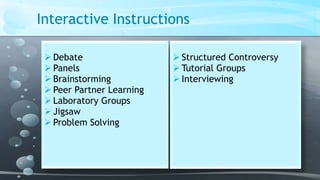
Interactive Instructions
 Debate
 Panels
 Brainstorming
 Peer Partner Learning
 Laboratory Groups
 Jigsaw
 Problem Solving

 Structured Controversy
 Tutorial Groups
 Interviewing
Debate
• is a structured contest of argumentation in which two opposing
individuals or teams defend and attack a given proposition. The

procedure is bound by rules that vary based on location and
participants. The process is adjudicated and a winner is declared.
Purpose of Debate
1. To engage learners in a combination of activities to interact with
the curriculum.
2. It forces the participants to consider not only the facts of a
situations but the implication as well
3. This competitive aspects encourage and a commitment to position
4. It requires them to engage in research, encourage the development
of listening and oratory skills, create an environment where
students must think critically.
Note:
• To avoid problems, clearly communicate to the students the debate
rules that will guide the interaction.
− Be critical of ideas, not people.
− Focus on the best decision, not on "winning."

− Encourage everyone's position, even if you do not agree.
− Use paraphrasing when you are not clear about what someone said.
− Try to understand both sides of the issue.
Panel
Panel
• Students present (either prepared or extemporaneously) their
knowledge or their opinions on a question or topic. Groups are

assigned a topic to research and asked to make a short presentation
before the floor is opened to questions from the audience.
Types of Panel discussions
1. Public panel discussion


These are organized for common men problems

 To provide factual information regarding current
problems

2. Educational panel discussion
 These are organized for educational institutions
 To provide factual information and conceptual knowledge
Brainstorming
Brainstorming
• Brainstorming is a large or small group activity which encourages children
to focus on a topic and contribute to the free flow of ideas. The teacher
may begin by posing a question or a problem, or by introducing a topic.
Students then express possible answers, relevant words and ideas.
Contributions are accepted without criticism or judgement.
Purposes and uses of Brainstorming
1. to focus students' attention on a particular topic
2. to generate a quantity of ideas
3. to teach acceptance and respect for individual differences
4. to encourage learners to take risks in sharing their ideas and
opinions
How can I do it?
1.
2.
3.
4.
5.

In a small or large group select a leader and a recorder
Define the problem or idea to be brainstormed
Set up the rules for the session.
Start the brainstorming.
Once you have finished brainstorming, go through the results
and begin evaluating the responses.
6. Now that you have narrowed your list down some, discuss the
remaining responses as a group.
Note:
• Establish a warm, supportive environment.
• Emphasize that a quantity of ideas is the goal.

• Discourage evaluative or critical comments from peers.
• Encourage and provide opportunity for all students to participate.
• Initially emphasize the importance of listening to expressed ideas,
and model printing and recording of the ideas, then read each
contribution to or with the group.
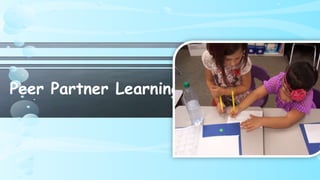
Peer Partner Learning
• Peer partner learning is a collaborative experience in which students
learn from and with each other for individual purposes

• Purpose of Peer Partner Learning
 Students reflect upon previously taught material by helping peers

to learn and, at the same time, develop and hone their social
skills.
How can I do it?
• Students work together as partners, one functioning as a "doer" and
the other as a "helper". The doer performs a task or answers

questions; the helper observes and provides feedback and helping
information. The doer is the student and the helper takes on the
role of teacher. Later, the partners reverse roles.
Laboratory Groups
• Laboratory Groups are "cooperative learning groups in an
experimental setting.”

• Purposes of Laboratory Groups
 To give first-hand experience in the laboratory which may

increase interest
 To provide student participation in original research
 To develop skill in the use of laboratory equipment and
instruments
Advantages

Disadvantages

 Learning by doing

• Uneconomical way of learning

 Impressions through several
sense make learning more
effective

• Becomes mechanical – at
times.

 Undergoing actual experience
is more vivid
 It is a direct preparation for
life

• The expensive materials
sometimes does not justify
results.
• Loss of time occurs due to
indiscriminate overuse of the
method.
Jigsaw Learning
Jigsaw
• Is a cooperative learning strategy that enables each student of a
“home” group to specialize in one aspect of a learning unit.

Students meet with members from other groups who are assigned
the same aspect, and after mastering the material, return to the
“home” group and teach the material to their group members.
Purposes of Jigsaw
• To develop teamwork and cooperative learning skills within all
students.
• It helps develop a depth of knowledge not possible if the
students were to try and learn all of the material on their own.
• It allows students to be introduced to material and yet maintain
a high level of personal responsibility.
How can I do it?
1. Assign students to “home” teams of 4 or 5 students

2. Assign study topics to “home” team members by giving them an
assignment sheet
3. Have students move to “expert” groups where everyone in the group has

the same topic as themselves.
4. Students work with members of their “expert” group to read about
and/or research their topic. They prepare a short presentation and
decide how they will teach their topic to their “home” team.
5. Students return to their “home” teams and take turns teaching

their team members the material.
6. Involve the class in a whole-group review of all the content you
expect them to master on the assessment.
Problem Solving
Problem Solving
• is a constructivist approach that promotes student involvement and
active learning. This instructional strategy uses real-world problems

as the organizational focus of student learning. In problem-solving,
students are self-directed learners while the teacher acts as
facilitator.
Purposes of Problem Solving
• To help students think about a problem without applying their pre-

conceived ideas

• It is best to help students understand complex, ethical
dilemmas, think about the future or do some strategic planning
Types of Problem Solving
1. Reflective Problem Solving
 Once you have broken the students into groups, the students
define the problem, analyze the problem, establish the criteria
for evaluating solutions, propose solutions and take action.
2. Creative Problem Solving
 uses the same basic focus, but the process is less geared towards
solutions and more towards a focus on brainstorming. The focus is
on creating ideas rather than solving a clear existing problem.
Structured Controversy
• This strategy involves providing students with a limited amount of
background information and asking them to construct an argument

based on this information. This they do by working in groups.
Purpose of Structured Controversy
1. to help students gain deep understanding of all positions related to
a controversial topic or issue

2. purposeful use of controversy
3. requires reasoned judgment, not mere factual knowledge
4. student groups argue for and against an issue, then reach a
consensus that is supported by evidence
Steps to follow:
• Choose a discussion topic that has at least two well documented
positions.
• Prepare materials
• Structure the controversy:
• Conduct the controversy:
Tutorial Groups
Tutorial Groups
• Tutorial groups are set up to help students who need remediation or
additional practice, or for students who can benefit from enrichment. A
tutorial group is usually led by the teacher. Tutorial groups provide for
greater attention to individual needs and allow students to participate
more actively. Peer tutoring occurs when a student (the tutor) is assigned
to help other students (the learners).
Interviewing
Interviewing
• Interviewing, a meeting during which information is obtained by one
person from another, is an excellent means for students to gain an insight
into another's worldview. Effective on-line interviewing, like face-to-face
interviewing, begins with the development of basic skills and thorough
preparation. Students may be the interviewer or the interviewee,
depending upon the skill set being developed and the information sought.

Interactive instructions

  • 1.
  • 2.
    Interactive Instructions  Debate Panels  Brainstorming  Peer Partner Learning  Laboratory Groups  Jigsaw  Problem Solving  Structured Controversy  Tutorial Groups  Interviewing
  • 4.
    Debate • is astructured contest of argumentation in which two opposing individuals or teams defend and attack a given proposition. The procedure is bound by rules that vary based on location and participants. The process is adjudicated and a winner is declared.
  • 5.
    Purpose of Debate 1.To engage learners in a combination of activities to interact with the curriculum. 2. It forces the participants to consider not only the facts of a situations but the implication as well 3. This competitive aspects encourage and a commitment to position 4. It requires them to engage in research, encourage the development of listening and oratory skills, create an environment where students must think critically.
  • 6.
    Note: • To avoidproblems, clearly communicate to the students the debate rules that will guide the interaction. − Be critical of ideas, not people. − Focus on the best decision, not on "winning." − Encourage everyone's position, even if you do not agree. − Use paraphrasing when you are not clear about what someone said. − Try to understand both sides of the issue.
  • 7.
  • 8.
    Panel • Students present(either prepared or extemporaneously) their knowledge or their opinions on a question or topic. Groups are assigned a topic to research and asked to make a short presentation before the floor is opened to questions from the audience.
  • 9.
    Types of Paneldiscussions 1. Public panel discussion  These are organized for common men problems  To provide factual information regarding current problems 2. Educational panel discussion  These are organized for educational institutions  To provide factual information and conceptual knowledge
  • 10.
  • 11.
    Brainstorming • Brainstorming isa large or small group activity which encourages children to focus on a topic and contribute to the free flow of ideas. The teacher may begin by posing a question or a problem, or by introducing a topic. Students then express possible answers, relevant words and ideas. Contributions are accepted without criticism or judgement.
  • 12.
    Purposes and usesof Brainstorming 1. to focus students' attention on a particular topic 2. to generate a quantity of ideas 3. to teach acceptance and respect for individual differences 4. to encourage learners to take risks in sharing their ideas and opinions
  • 13.
    How can Ido it? 1. 2. 3. 4. 5. In a small or large group select a leader and a recorder Define the problem or idea to be brainstormed Set up the rules for the session. Start the brainstorming. Once you have finished brainstorming, go through the results and begin evaluating the responses. 6. Now that you have narrowed your list down some, discuss the remaining responses as a group.
  • 14.
    Note: • Establish awarm, supportive environment. • Emphasize that a quantity of ideas is the goal. • Discourage evaluative or critical comments from peers. • Encourage and provide opportunity for all students to participate. • Initially emphasize the importance of listening to expressed ideas, and model printing and recording of the ideas, then read each contribution to or with the group.
  • 15.
  • 16.
    Peer Partner Learning •Peer partner learning is a collaborative experience in which students learn from and with each other for individual purposes • Purpose of Peer Partner Learning  Students reflect upon previously taught material by helping peers to learn and, at the same time, develop and hone their social skills.
  • 17.
    How can Ido it? • Students work together as partners, one functioning as a "doer" and the other as a "helper". The doer performs a task or answers questions; the helper observes and provides feedback and helping information. The doer is the student and the helper takes on the role of teacher. Later, the partners reverse roles.
  • 19.
    Laboratory Groups • LaboratoryGroups are "cooperative learning groups in an experimental setting.” • Purposes of Laboratory Groups  To give first-hand experience in the laboratory which may increase interest  To provide student participation in original research  To develop skill in the use of laboratory equipment and instruments
  • 20.
    Advantages Disadvantages  Learning bydoing • Uneconomical way of learning  Impressions through several sense make learning more effective • Becomes mechanical – at times.  Undergoing actual experience is more vivid  It is a direct preparation for life • The expensive materials sometimes does not justify results. • Loss of time occurs due to indiscriminate overuse of the method.
  • 21.
  • 22.
    Jigsaw • Is acooperative learning strategy that enables each student of a “home” group to specialize in one aspect of a learning unit. Students meet with members from other groups who are assigned the same aspect, and after mastering the material, return to the “home” group and teach the material to their group members.
  • 23.
    Purposes of Jigsaw •To develop teamwork and cooperative learning skills within all students. • It helps develop a depth of knowledge not possible if the students were to try and learn all of the material on their own. • It allows students to be introduced to material and yet maintain a high level of personal responsibility.
  • 24.
    How can Ido it? 1. Assign students to “home” teams of 4 or 5 students 2. Assign study topics to “home” team members by giving them an assignment sheet 3. Have students move to “expert” groups where everyone in the group has the same topic as themselves. 4. Students work with members of their “expert” group to read about and/or research their topic. They prepare a short presentation and decide how they will teach their topic to their “home” team.
  • 25.
    5. Students returnto their “home” teams and take turns teaching their team members the material. 6. Involve the class in a whole-group review of all the content you expect them to master on the assessment.
  • 26.
  • 27.
    Problem Solving • isa constructivist approach that promotes student involvement and active learning. This instructional strategy uses real-world problems as the organizational focus of student learning. In problem-solving, students are self-directed learners while the teacher acts as facilitator.
  • 28.
    Purposes of ProblemSolving • To help students think about a problem without applying their pre- conceived ideas • It is best to help students understand complex, ethical dilemmas, think about the future or do some strategic planning
  • 29.
    Types of ProblemSolving 1. Reflective Problem Solving  Once you have broken the students into groups, the students define the problem, analyze the problem, establish the criteria for evaluating solutions, propose solutions and take action. 2. Creative Problem Solving  uses the same basic focus, but the process is less geared towards solutions and more towards a focus on brainstorming. The focus is on creating ideas rather than solving a clear existing problem.
  • 30.
  • 31.
    Structured Controversy • Thisstrategy involves providing students with a limited amount of background information and asking them to construct an argument based on this information. This they do by working in groups.
  • 32.
    Purpose of StructuredControversy 1. to help students gain deep understanding of all positions related to a controversial topic or issue 2. purposeful use of controversy 3. requires reasoned judgment, not mere factual knowledge 4. student groups argue for and against an issue, then reach a consensus that is supported by evidence
  • 33.
    Steps to follow: •Choose a discussion topic that has at least two well documented positions. • Prepare materials • Structure the controversy: • Conduct the controversy:
  • 34.
  • 35.
    Tutorial Groups • Tutorialgroups are set up to help students who need remediation or additional practice, or for students who can benefit from enrichment. A tutorial group is usually led by the teacher. Tutorial groups provide for greater attention to individual needs and allow students to participate more actively. Peer tutoring occurs when a student (the tutor) is assigned to help other students (the learners).
  • 36.
  • 37.
    Interviewing • Interviewing, ameeting during which information is obtained by one person from another, is an excellent means for students to gain an insight into another's worldview. Effective on-line interviewing, like face-to-face interviewing, begins with the development of basic skills and thorough preparation. Students may be the interviewer or the interviewee, depending upon the skill set being developed and the information sought.