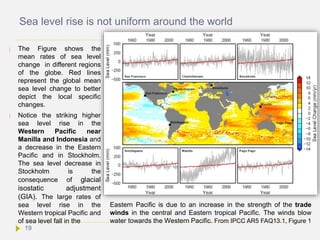
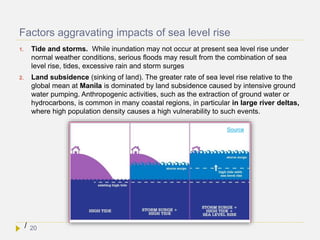
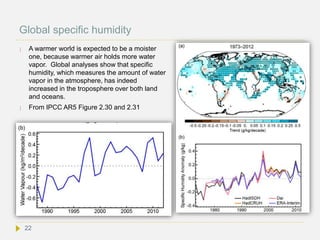
1) Oceans have absorbed over 90% of the excess heat from global warming since 1970, causing ocean temperatures and heat content to rise steadily. This increased heat will affect global climate patterns.
2) Measurements by multiple agencies show the ocean continues to warm both at the surface and at depth, with higher rates of warming at high latitudes and in the Southern Ocean. Warming oceans also lead to rising sea levels and ocean acidification.
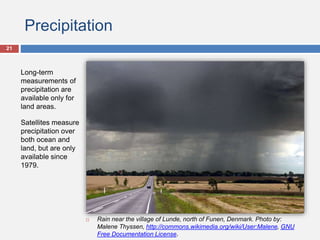
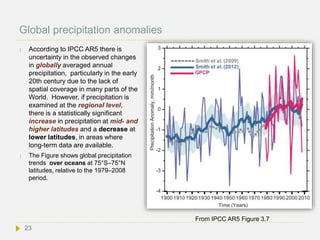
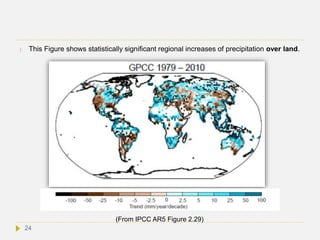
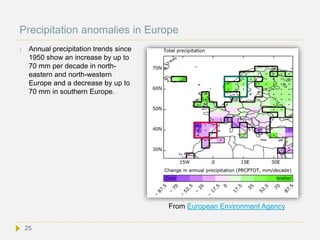
3) Precipitation patterns are changing, with statistically significant increases at northern latitudes and decreases at southern latitudes, consistent with a warmer and moister atmosphere under climate change.



![Rate of anthropogenic CO2 storage in oceans
Between 2000 to 2010 Cant storage was 2.3 [1.7 -
2.9] Gt Carbon equivalents/year. This amounts to
roughly 25% of total anthropogenic carbon
emissions/year. Cant storage rate of CO2 in oceans
differs widely by region, with the north Atlantic and
southern oceans being much more active. The Figure
shows the regional distribution of the storage rate
(mols/m2/year) averaged over 1980–2005 [See
Reference].
Source
8](https://image.slidesharecdn.com/changesinthehydrosphere-140804074612-phpapp02/85/Climate-change-Changes-in-the-hydrosphere-8-320.jpg)
![Ocean acidification by CO2
Atmospheric CO2 dissolves in water (aq). The following dissociations and
chemical equilibria are then quickly formed:
The H+ ion concentration determines the acidity, which is expressed as pH
(log H+ ion concentration)
The preindustrial surface ocean pH was ~8.25. Between 1751 and 1994 pH
decreased (acidification) to ~8.14,[4] representing an increase of almost
30% in H+ ion concentration.[5][6]
10](https://image.slidesharecdn.com/changesinthehydrosphere-140804074612-phpapp02/85/Climate-change-Changes-in-the-hydrosphere-10-320.jpg)

![Sea level rise
Global mean sea level (GMSL) is defined as the height of the sea with respect to a
land benchmark and averaged over a period of time (such as a month or a year).
GMSL is determined by the distribution of land and ocean basins over the globe,
water mass, water temperature, water flow from rivers and ice, evaporation and
precipitation. Sea level change is measured from tide gauges, and since 1992
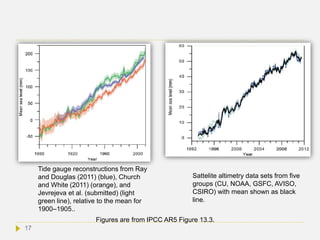
also by satellite altimeters [27][28] A change in GMSL can result from a real change in
sea level, or from a change in the height of the land on which the tide gauge
operates. Satellite data are based solely on measured sea level.
The long-term tide gauge data include a small correction factor because the size
and shape of the oceans are changing slowly over time (see next slide).
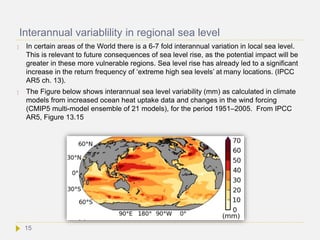
Regional sea level may differ substantially from the global average, as a result of
changes in dynamical redistribution of water masses, winds, air pressure, air-sea
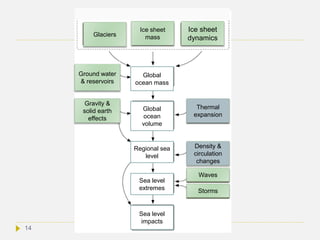
heat, freshwater fluxes, and ocean currents (see next slide).
Time scales: Mass added to the ocean propagates rapidly around the globe such
that all regions experience a sea level change within days, while an influx of
freshwater changes ocean temperature and salinity and thus changes ocean
currents; these processes take decades to propagate around the globe (IPCC AR5
chapt. 13).
12](https://image.slidesharecdn.com/changesinthehydrosphere-140804074612-phpapp02/85/Climate-change-Changes-in-the-hydrosphere-12-320.jpg)
![Natural factors affecting sea level
Over short time periods: Local mean sea level (LMSL) can change in response
to waves, tides, winds, storm surges, evaporation and precipitation, water runoff
from rivers and floods, atmospheric pressure, ocean currents, local ocean
temperature changes and salinity (density). Regional differences in the strength of
gravity also affect sea level.
On the timescale of years and decades, sea level may show considerable
variability as a consequence of climate variability.[29] For example, approximately a
10 mm rise and fall of global mean sea level accompanied the 1997–1998 El Nino
event, and a temporary 5 mm fall accompanied the 2010–2011 event.[30]
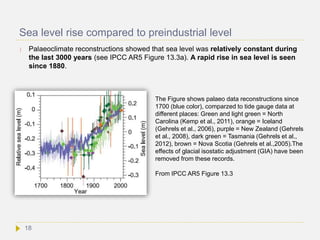
Over millenia, vertical movements of land occur because of glacial isostatic
adjustment (GIA) of the Earth’s mantle to the melting of ice sheets since the last
Ice Age peak (20,000 years ago). The weight of the ice sheet depresses the
underlying land, and when ice melts away, the land slowly rebounds upwards while
the ocean basins deepen. For example, GIA causes a steady fall in sea level
recorded at Stockholm.
Read more
13](https://image.slidesharecdn.com/changesinthehydrosphere-140804074612-phpapp02/85/Climate-change-Changes-in-the-hydrosphere-13-320.jpg)