Welcome
you all
TO THE WORLD
OF
TGA
PRESENTED BY
S.MATHIVANAN. M.PHARM-1st YEAR

DEPARTMENT OF PHARMACEUTICS
Outline of this seminar
Definition of thermal analysis
What is thermal analysis and its types
Thermogravimetric analysis
TGA Theory and their types
Instrumentation of TGA
Methodology
Factors affecting thermogravimetry results
TGA applications.
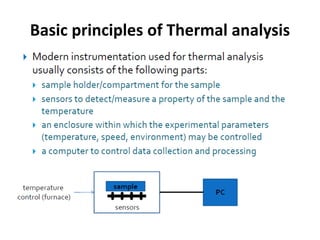
Thermal analysis
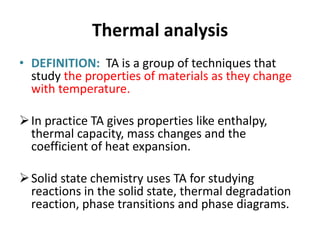
• DEFINITION: TA is a group of techniques that
study the properties of materials as they change
with temperature.
In practice TA gives properties like enthalpy,
thermal capacity, mass changes and the
coefficient of heat expansion.
Solid state chemistry uses TA for studying
reactions in the solid state, thermal degradation
reaction, phase transitions and phase diagrams.
Introduction
• Thermal analysis is defined as “series of
techniques for measuring the temperature
dependency of a physical property of a certain
substance while varying the temperature of the
substance according to a specific program.”
• Physical properties include mass, temperature,
enthalpy, dimension, dynamic characteristics, and
others, and depending on the physical properties
to be measured, the techniques of thermal
analysis.
Cont…
• Conventionally thermal analysis has been mainly
employed in measurements for research and
development, but in recent times it is used in
many practical applications, as the testing
standards on the basis of thermal analysis have
been established, for example, in quality control
in the production field, process control, and
material acceptance inspection.
• It is also applied in wide fields, including
polymer, glass, ceramics, metal, explosives,
semiconductors, medicines, and foods.
Basic principles of Thermal analysis
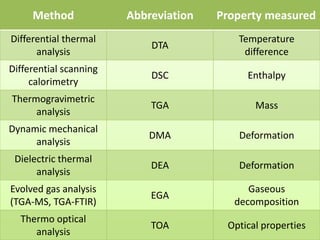
Method Abbreviation Property measured
Differential thermal
analysis
DTA
Temperature
difference
Differential scanning
calorimetry
DSC Enthalpy
Thermogravimetric
analysis
TGA Mass
Dynamic mechanical
analysis
DMA Deformation
Dielectric thermal
analysis
DEA Deformation
Evolved gas analysis
(TGA-MS, TGA-FTIR)
EGA
Gaseous
decomposition
Thermo optical
analysis
TOA Optical properties
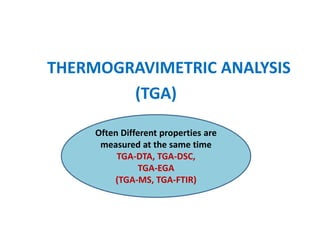
THERMOGRAVIMETRIC ANALYSIS
(TGA)
Often Different properties are
measured at the same time
TGA-DTA, TGA-DSC,
TGA-EGA
(TGA-MS, TGA-FTIR)
TGA
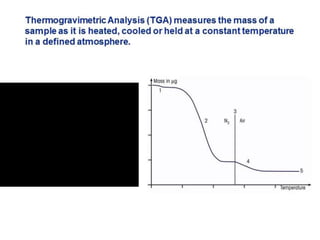
Measurement changes in weight in relation to
changes in temperature.
THEORY:
A large number of chemical substance
invariably decompose upon heating, and this
of heating a sample to observe weight
changes is the underlying principle of thermo
gravimetric analysis(TGA).
Cont…
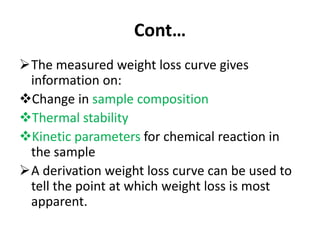
The measured weight loss curve gives
information on:
Change in sample composition
Thermal stability
Kinetic parameters for chemical reaction in
the sample
A derivation weight loss curve can be used to
tell the point at which weight loss is most
apparent.
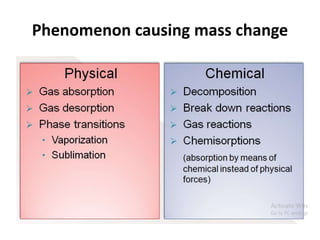
Phenomenon causing mass change
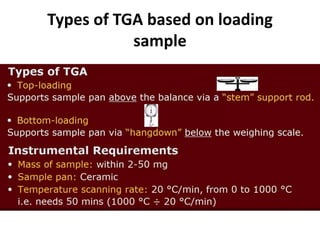
Types of TGA
DYNAMIC TGA
• Sample is subjected to condition of
continuous increase in temperature that is
invariably found to be linear with time.
STATIC TGA (Iso thermal)
• Sample is maintained at a constant
temperature for a period of time during which
any changes in weight observed carefully
Types of TGA based on loading
sample
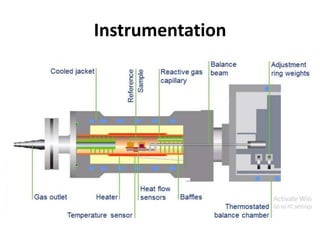
Instrumentation
Instrumentation
1. A high precision balance
2. Sample holder
3. A furnace
4. Furnace programmer(controller)
5. A recording device
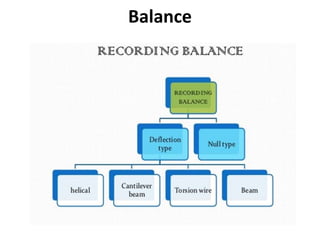
Balance
Null point type
It makes use of an appropriate sensing-
element which aptly detects any slightest
deviation of the balance beam.
It provides the application of a restoring
forces, directly proportional to the change in
weight, thereby returning the beam to its
original null-point.
The restoring force is subsequently recorded
either directly or with the aid of a transducer.
Deflection type
It is essentially based on either a conventional
analytical balanced consisting of:
Beam type: Conversion of beam deflection
Helical spring type: Elongation or contraction of
the spring with weight changes.
Cantilever beam type: One end of the beam is
fixed and the other end, on which the sample is
placed, is free to undergo deflection.
Torsion wire type: The wire is firmly fixed at
either or both ends so that the deflection of the
beam are proportional to weight changes.
Ideal properties of balance
Its accuracy, sensitivity, reproducibility and
capacity should be similar to analytical
balance
It should have a high degree of mechanical
and electrical stability
It should have a rapid response to weight
changes.
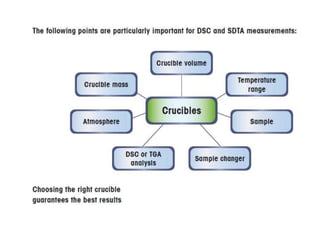
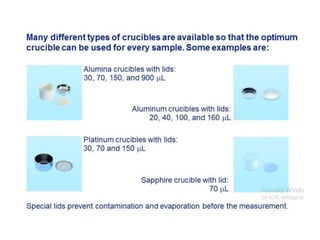
Sample holder
 This is most important in accurate TGA
 Depending upon the nature of sample, its weight and
quantity to be handled, different size and shapes of
sample holders known as crucibles are employed
 These are constructed from various materials like glass,
quartz, aluminum, stainless steels, platinum etc;
 These generally are of 2 types,
a. Shallow pan for holding samples which eliminates gas,
vapours of volatile matter by diffusion during heating
b. Deep crucible for general purpose.
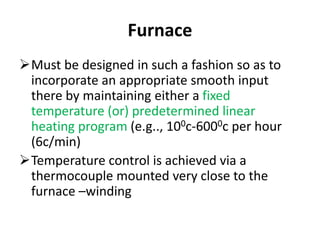
Furnace
Must be designed in such a fashion so as to
incorporate an appropriate smooth input
there by maintaining either a fixed
temperature (or) predetermined linear
heating program (e.g.., 100c-6000c per hour
(6c/min)
Temperature control is achieved via a
thermocouple mounted very close to the
furnace –winding
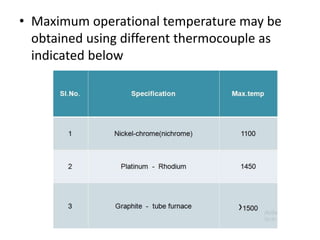
• Maximum operational temperature may be
obtained using different thermocouple as
indicated below
Furnace temperature programmer
(controller)
These are the controller which can provide
gradual rise of temperature at a fixed rate.
This device has a course and fine control knob
through which desired temperature with
respect to rate or time can be obtained.
This controlling is done by increasing voltage
through the heated element by motor driven
variable transformer or by different
thermocouples.
Recorder
The recording device must be such so as to
1. Record both temperature and weight
continuously and
2. Make a definite periodic records of the time.
• One main advantage of these recorder is that
can check the heating rate of the furnace for
linearity.
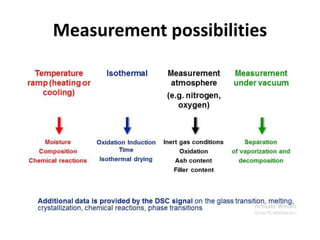
Measurement possibilities
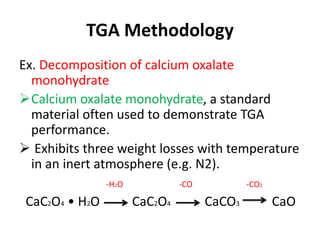
TGA Methodology
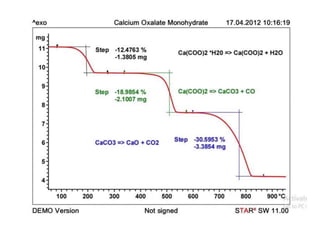
Ex. Decomposition of calcium oxalate
monohydrate
Calcium oxalate monohydrate, a standard
material often used to demonstrate TGA
performance.
 Exhibits three weight losses with temperature
in an inert atmosphere (e.g. N2).
-H2O -CO -CO2
CaC2O4 • H2O CaC2O4 CaCO3 CaO
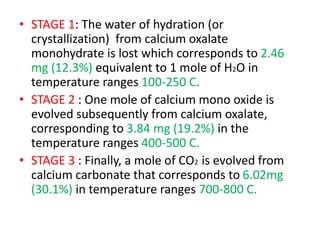
• STAGE 1: The water of hydration (or
crystallization) from calcium oxalate
monohydrate is lost which corresponds to 2.46
mg (12.3%) equivalent to 1 mole of H2O in
temperature ranges 100-250 C.
• STAGE 2 : One mole of calcium mono oxide is
evolved subsequently from calcium oxalate,
corresponding to 3.84 mg (19.2%) in the
temperature ranges 400-500 C.
• STAGE 3 : Finally, a mole of CO2 is evolved from
calcium carbonate that corresponds to 6.02mg
(30.1%) in temperature ranges 700-800 C.
Factors affecting results
1. Instrumental factor:
These include various aspects of instrument like,
 Furnace heating (its temperature and rate)
 Recording of changes on charts (its speed)
 Furnace atmosphere (its rate of cooling and
maintaining temperature),
 Sample holder and its geometry (decomposition of
calcium carbonate carried out in inert nitrogen)
 Sensitivity of balance.
•
Cont…
2. Characteristics of sample:
The important factors about the sample are
 Weight of sample (E.g. decomposition of calcium oxalate.)
 Particle size of sample (decomposition proceeds at higher
temperature)
 Nature of evolved gas or volatile matter
 Thermal conductivity of sample.
 The heat of decomposition of the reaction.
 Compactness of the Sample (decomposes higher than
the loose samples)
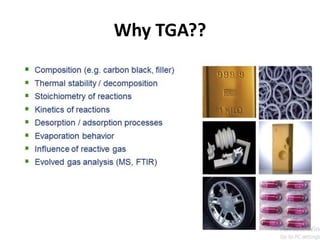
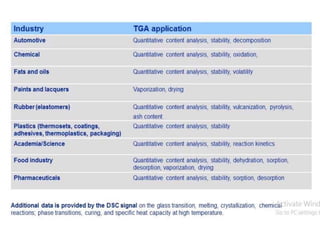
Why TGA??
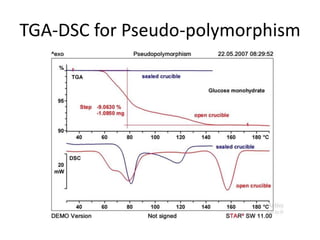
TGA-DSC for Pseudo-polymorphism
THANK YOU…!!!

Thermogravimetric analysis - Pharmaceutical analysis

  • 1.
  • 2.
    PRESENTED BY S.MATHIVANAN. M.PHARM-1stYEAR DEPARTMENT OF PHARMACEUTICS
  • 3.
    Outline of thisseminar Definition of thermal analysis What is thermal analysis and its types Thermogravimetric analysis TGA Theory and their types Instrumentation of TGA Methodology Factors affecting thermogravimetry results TGA applications.
  • 4.
    Thermal analysis • DEFINITION:TA is a group of techniques that study the properties of materials as they change with temperature. In practice TA gives properties like enthalpy, thermal capacity, mass changes and the coefficient of heat expansion. Solid state chemistry uses TA for studying reactions in the solid state, thermal degradation reaction, phase transitions and phase diagrams.
  • 5.
    Introduction • Thermal analysisis defined as “series of techniques for measuring the temperature dependency of a physical property of a certain substance while varying the temperature of the substance according to a specific program.” • Physical properties include mass, temperature, enthalpy, dimension, dynamic characteristics, and others, and depending on the physical properties to be measured, the techniques of thermal analysis.
  • 6.
    Cont… • Conventionally thermalanalysis has been mainly employed in measurements for research and development, but in recent times it is used in many practical applications, as the testing standards on the basis of thermal analysis have been established, for example, in quality control in the production field, process control, and material acceptance inspection. • It is also applied in wide fields, including polymer, glass, ceramics, metal, explosives, semiconductors, medicines, and foods.
  • 7.
    Basic principles ofThermal analysis
  • 8.
    Method Abbreviation Propertymeasured Differential thermal analysis DTA Temperature difference Differential scanning calorimetry DSC Enthalpy Thermogravimetric analysis TGA Mass Dynamic mechanical analysis DMA Deformation Dielectric thermal analysis DEA Deformation Evolved gas analysis (TGA-MS, TGA-FTIR) EGA Gaseous decomposition Thermo optical analysis TOA Optical properties
  • 9.
    THERMOGRAVIMETRIC ANALYSIS (TGA) Often Differentproperties are measured at the same time TGA-DTA, TGA-DSC, TGA-EGA (TGA-MS, TGA-FTIR)
  • 10.
    TGA Measurement changes inweight in relation to changes in temperature. THEORY: A large number of chemical substance invariably decompose upon heating, and this of heating a sample to observe weight changes is the underlying principle of thermo gravimetric analysis(TGA).
  • 11.
    Cont… The measured weightloss curve gives information on: Change in sample composition Thermal stability Kinetic parameters for chemical reaction in the sample A derivation weight loss curve can be used to tell the point at which weight loss is most apparent.
  • 13.
  • 14.
    Types of TGA DYNAMICTGA • Sample is subjected to condition of continuous increase in temperature that is invariably found to be linear with time. STATIC TGA (Iso thermal) • Sample is maintained at a constant temperature for a period of time during which any changes in weight observed carefully
  • 15.
    Types of TGAbased on loading sample
  • 16.
  • 17.
    Instrumentation 1. A highprecision balance 2. Sample holder 3. A furnace 4. Furnace programmer(controller) 5. A recording device
  • 18.
  • 19.
    Null point type Itmakes use of an appropriate sensing- element which aptly detects any slightest deviation of the balance beam. It provides the application of a restoring forces, directly proportional to the change in weight, thereby returning the beam to its original null-point. The restoring force is subsequently recorded either directly or with the aid of a transducer.
  • 20.
    Deflection type It isessentially based on either a conventional analytical balanced consisting of: Beam type: Conversion of beam deflection Helical spring type: Elongation or contraction of the spring with weight changes. Cantilever beam type: One end of the beam is fixed and the other end, on which the sample is placed, is free to undergo deflection. Torsion wire type: The wire is firmly fixed at either or both ends so that the deflection of the beam are proportional to weight changes.
  • 21.
    Ideal properties ofbalance Its accuracy, sensitivity, reproducibility and capacity should be similar to analytical balance It should have a high degree of mechanical and electrical stability It should have a rapid response to weight changes.
  • 22.
    Sample holder  Thisis most important in accurate TGA  Depending upon the nature of sample, its weight and quantity to be handled, different size and shapes of sample holders known as crucibles are employed  These are constructed from various materials like glass, quartz, aluminum, stainless steels, platinum etc;  These generally are of 2 types, a. Shallow pan for holding samples which eliminates gas, vapours of volatile matter by diffusion during heating b. Deep crucible for general purpose.
  • 25.
    Furnace Must be designedin such a fashion so as to incorporate an appropriate smooth input there by maintaining either a fixed temperature (or) predetermined linear heating program (e.g.., 100c-6000c per hour (6c/min) Temperature control is achieved via a thermocouple mounted very close to the furnace –winding
  • 26.
    • Maximum operationaltemperature may be obtained using different thermocouple as indicated below
  • 27.
    Furnace temperature programmer (controller) Theseare the controller which can provide gradual rise of temperature at a fixed rate. This device has a course and fine control knob through which desired temperature with respect to rate or time can be obtained. This controlling is done by increasing voltage through the heated element by motor driven variable transformer or by different thermocouples.
  • 28.
    Recorder The recording devicemust be such so as to 1. Record both temperature and weight continuously and 2. Make a definite periodic records of the time. • One main advantage of these recorder is that can check the heating rate of the furnace for linearity.
  • 29.
  • 30.
    TGA Methodology Ex. Decompositionof calcium oxalate monohydrate Calcium oxalate monohydrate, a standard material often used to demonstrate TGA performance.  Exhibits three weight losses with temperature in an inert atmosphere (e.g. N2). -H2O -CO -CO2 CaC2O4 • H2O CaC2O4 CaCO3 CaO
  • 32.
    • STAGE 1:The water of hydration (or crystallization) from calcium oxalate monohydrate is lost which corresponds to 2.46 mg (12.3%) equivalent to 1 mole of H2O in temperature ranges 100-250 C. • STAGE 2 : One mole of calcium mono oxide is evolved subsequently from calcium oxalate, corresponding to 3.84 mg (19.2%) in the temperature ranges 400-500 C. • STAGE 3 : Finally, a mole of CO2 is evolved from calcium carbonate that corresponds to 6.02mg (30.1%) in temperature ranges 700-800 C.
  • 33.
    Factors affecting results 1.Instrumental factor: These include various aspects of instrument like,  Furnace heating (its temperature and rate)  Recording of changes on charts (its speed)  Furnace atmosphere (its rate of cooling and maintaining temperature),  Sample holder and its geometry (decomposition of calcium carbonate carried out in inert nitrogen)  Sensitivity of balance. •
  • 34.
    Cont… 2. Characteristics ofsample: The important factors about the sample are  Weight of sample (E.g. decomposition of calcium oxalate.)  Particle size of sample (decomposition proceeds at higher temperature)  Nature of evolved gas or volatile matter  Thermal conductivity of sample.  The heat of decomposition of the reaction.  Compactness of the Sample (decomposes higher than the loose samples)
  • 35.
  • 37.
  • 40.