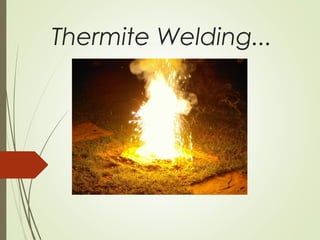
Thermite Welding...
The Basics
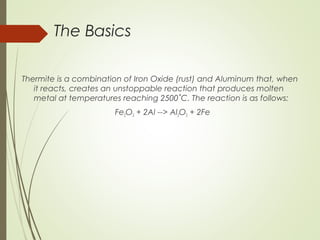
Thermite is a combination of Iron Oxide (rust) and Aluminum that, when
it reacts, creates an unstoppable reaction that produces molten
metal at temperatures reaching 2500˚C. The reaction is as follows:
Fe2O3 + 2Al --> Al2O3 + 2Fe
A Little History
 The Thermite reaction was discovered, and later
patented, by German chemist Dr. Hans Goldschmidt.
 The Doctor realized the application in welding, and
the first commercial use of Thermite was welding two
pieces of train track together in 1899.
 This would serve to be the primary use of Thermite
About Thermite Welding
 Ideal for welding train tracks
 No track removal necessary
 Very portable
Thermit Welding Mixtures
Thermit mixture most commonly used for the welding of ferrous material
are –
1.plain thermit: mixture of iron oxide and finely divided aluminum. It
product highest temperature for thermit welding .
2.mild steel thermit: plain thermit with the addition of mild steel
punchings to increase the metal product. Carbon & manganese also
added to balance reactance.
3.thermit for welding rails: plain thermit with addition of carbon and
manganese to increase hardness of rail joint
Method of thermit welding
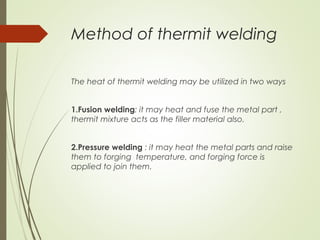
The heat of thermit welding may be utilized in two ways
1.Fusion welding: it may heat and fuse the metal part ,
thermit mixture acts as the filler material also.
2.Pressure welding : it may heat the metal parts and raise
them to forging temperature, and forging force is
applied to join them.
Procedure of thermit
welding
Various steps involved in fusion thermit welding of metal
part are;
Cleaning the joint: joints to be welded should be
cleaned and free from dust, grease, oxide, before
welding
Allow for contraction: A space of 1.5 to 6mm is given
between in as contruction allowance.
Construction of mould: A mould is the part in which
the metal art to be joint lies and molten metal is poured
in it. It is 100mm fixed between between wax pattern and
moulding box and should provide necessary pouring
gates, heating gates, and riser
Preheating the mould: Mould is preheated to remove
wax pattern, dry the mould thoroughly and to bring the
parts to be welded at desired temperature 816C to 982C
Crucible and it’s charging: Crucible is a conical
shape vessel. It is filled with required amount of thermit
mixture to joint the metal part
Igniting the metal mixture: Ignition of thermit mixture
lasts up to 66 seconds. After the ignition is completed
crucible is tapped to release molten metal mould where
fussion takes place
Opening the mould: Mould id opened after 2-4 hours.
The longer the mould is left unopened, the better it is.
Finishing the weld: After removing the mould riser and
gate are cut away by cutting torch and joint it prepared
Problems with Thermite
Welds
 The weld can be porous, resulting in weaker welds
than traditional welding, as seen here
Advantages
 It is very portable process
 No external power supply required
 It is very cheap process for repairing broken parts of
large metal structures such as rail lines
 One side welding can be done for railways
Limitations
 Can only be used for ferrous metals
 It is uneconomical when used for welding cheap
metals or light parts
 Thermit mixtures cannot be stored due to safety
hazards and should be used as soon as prepared.
Thermit applicaions
 Repairing fractured rails
 For butt welding pipes end to end
 For welding large fractured crank shafts
 For welding broken frames of machine
 Replacing broken pieces of large gears
Thank you…

Thermit welding

  • 1.
  • 2.
    The Basics Thermite isa combination of Iron Oxide (rust) and Aluminum that, when it reacts, creates an unstoppable reaction that produces molten metal at temperatures reaching 2500˚C. The reaction is as follows: Fe2O3 + 2Al --> Al2O3 + 2Fe
  • 3.
    A Little History The Thermite reaction was discovered, and later patented, by German chemist Dr. Hans Goldschmidt.  The Doctor realized the application in welding, and the first commercial use of Thermite was welding two pieces of train track together in 1899.  This would serve to be the primary use of Thermite
  • 4.
    About Thermite Welding Ideal for welding train tracks  No track removal necessary  Very portable
  • 5.
    Thermit Welding Mixtures Thermitmixture most commonly used for the welding of ferrous material are – 1.plain thermit: mixture of iron oxide and finely divided aluminum. It product highest temperature for thermit welding . 2.mild steel thermit: plain thermit with the addition of mild steel punchings to increase the metal product. Carbon & manganese also added to balance reactance. 3.thermit for welding rails: plain thermit with addition of carbon and manganese to increase hardness of rail joint
  • 6.
    Method of thermitwelding The heat of thermit welding may be utilized in two ways 1.Fusion welding: it may heat and fuse the metal part , thermit mixture acts as the filler material also. 2.Pressure welding : it may heat the metal parts and raise them to forging temperature, and forging force is applied to join them.
  • 7.
    Procedure of thermit welding Varioussteps involved in fusion thermit welding of metal part are; Cleaning the joint: joints to be welded should be cleaned and free from dust, grease, oxide, before welding Allow for contraction: A space of 1.5 to 6mm is given between in as contruction allowance. Construction of mould: A mould is the part in which the metal art to be joint lies and molten metal is poured in it. It is 100mm fixed between between wax pattern and moulding box and should provide necessary pouring gates, heating gates, and riser
  • 8.
    Preheating the mould:Mould is preheated to remove wax pattern, dry the mould thoroughly and to bring the parts to be welded at desired temperature 816C to 982C Crucible and it’s charging: Crucible is a conical shape vessel. It is filled with required amount of thermit mixture to joint the metal part Igniting the metal mixture: Ignition of thermit mixture lasts up to 66 seconds. After the ignition is completed crucible is tapped to release molten metal mould where fussion takes place Opening the mould: Mould id opened after 2-4 hours. The longer the mould is left unopened, the better it is. Finishing the weld: After removing the mould riser and gate are cut away by cutting torch and joint it prepared
  • 9.
    Problems with Thermite Welds The weld can be porous, resulting in weaker welds than traditional welding, as seen here
  • 10.
    Advantages  It isvery portable process  No external power supply required  It is very cheap process for repairing broken parts of large metal structures such as rail lines  One side welding can be done for railways
  • 11.
    Limitations  Can onlybe used for ferrous metals  It is uneconomical when used for welding cheap metals or light parts  Thermit mixtures cannot be stored due to safety hazards and should be used as soon as prepared.
  • 12.
    Thermit applicaions  Repairingfractured rails  For butt welding pipes end to end  For welding large fractured crank shafts  For welding broken frames of machine  Replacing broken pieces of large gears
  • 13.