Pattern Allowances
Subject : MP-II
Semester :4th
Division: FX-1
Branch: Mechanical
Prepared By:
1. Akash R. Ambaliya (140030119003)
Atmiya Institute of Technology & Science Gujarat Technological University
PATTERN ALLOWANCES
1. Shrinkage or contraction allowance.
2. Machining or finish allowance.
3. Draft of tapper allowances.
4. Distortion or chamber allowance.
5. Shake or rapping allowance.
SHRINKAGE ALLOWANCE
Most metals undergo noticeable volumetric
contraction when cooled.
Three principle stages of shrinkage:
 Shrinkage of liquid as it cools from the
solidification temperature
 Solidification shrinkage as the liquid turns into
solid
 Solid metal contraction as the solidified metal
cools to room temperature
SHRINKAGE ALLOWANCE
Liquid Shrinkage:
It refers to the reduction
in volume when the
metal changes from
liquid state to solid state
at the solidus
temperature.
To account for this
shrinkage; riser,which
feed the liquid metal to
the casting,are provided
in the mold.
Solid Shrinkage:
It refers to the reduction
in volume caused when
metal loses temperature
in solid state.
To account for this,
shrinkage allowance is
provided on the
patterns.
SHRINKAGE ALLOWANCE
Different metals shrink at different rates because
shrinkage is the property of the cast metal/alloy.
The metal shrinkage depends upon:
 1. The cast metal or alloy.
 2. Solidification temp. of the metal/alloy.
 3. Casted dimensions(size).
 4. Casting design aspects.
 5. Moulding conditions(i.e., mould materials and
moulding methods employed)
MACHINING ALLOWANCE
It is required because of,
 Castings get oxidized in the mold and during heat
treatment; scales etc., thus formed need to be
removed.
 It is the intended to remove surface roughness
and other imperfections from the castings.
 It is required to achieve exact casting dimensions.
 Surface finish is required on the casting.
MACHINING ALLOWANCE
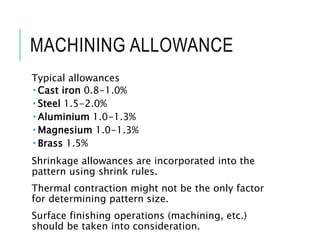
Typical allowances
 Cast iron 0.8-1.0%
 Steel 1.5-2.0%
 Aluminium 1.0-1.3%
 Magnesium 1.0-1.3%
 Brass 1.5%
Shrinkage allowances are incorporated into the
pattern using shrink rules.
Thermal contraction might not be the only factor
for determining pattern size.
Surface finishing operations (machining, etc.)
should be taken into consideration.
DRAFT ALLOWANCE
It is given to all surfaces perpendicular to parting
line.
Draft allowance is given so that the pattern can be
easily removed from the moulding material tightly
packed around it with out damaging the mould
cavity.
The amount of taper depends upon:
 Shape and size of pattern in the depth direction in
contact with the mould cavity.
 Moulding methods.
 Mould materials.
 Draft allowance is imparted on internal as well as
external surfaces; of course it is more on internal
WHAT IS DRAFT?
Minor changes in part design
can reduce need for coring
DISTORTION ALLOWANCE
A CASTING WILL DISTORT OR WRAP IF :
 It is of irregular shape,
 All it parts do not shrink uniformly i.e.,some parts
shrinks while others are restricted from during so,
 It is u or v-shape,
 The arms possess unequal thickness,
 It has long, rangy arms as those of propeller strut
for the ship.
 It is a long flat casting,
 One portion of the casting cools at a faster rate
SHAKE ALLOWANCE
A patter is shaken or rapped by striking the same
with a wooden piece from side to side.
This is done so that the pattern a little is loosened
in the mold cavity and can be easily removed.
In turn, therefore,rapping enlarges the mould cavity
which results in a bigger sized casting.
Hence, a allowance is provided on the pattern
i.e.,the pattern dimensions are kept smaller in order
to compensate the enlargement of mould cavity due
to rapping.
The magnitude of shake allowance can be reduced
by increasing the tapper.
Thank You…

pattern allownaces

  • 1.
    Pattern Allowances Subject :MP-II Semester :4th Division: FX-1 Branch: Mechanical Prepared By: 1. Akash R. Ambaliya (140030119003) Atmiya Institute of Technology & Science Gujarat Technological University
  • 2.
    PATTERN ALLOWANCES 1. Shrinkageor contraction allowance. 2. Machining or finish allowance. 3. Draft of tapper allowances. 4. Distortion or chamber allowance. 5. Shake or rapping allowance.
  • 3.
    SHRINKAGE ALLOWANCE Most metalsundergo noticeable volumetric contraction when cooled. Three principle stages of shrinkage:  Shrinkage of liquid as it cools from the solidification temperature  Solidification shrinkage as the liquid turns into solid  Solid metal contraction as the solidified metal cools to room temperature
  • 4.
    SHRINKAGE ALLOWANCE Liquid Shrinkage: Itrefers to the reduction in volume when the metal changes from liquid state to solid state at the solidus temperature. To account for this shrinkage; riser,which feed the liquid metal to the casting,are provided in the mold. Solid Shrinkage: It refers to the reduction in volume caused when metal loses temperature in solid state. To account for this, shrinkage allowance is provided on the patterns.
  • 5.
    SHRINKAGE ALLOWANCE Different metalsshrink at different rates because shrinkage is the property of the cast metal/alloy. The metal shrinkage depends upon:  1. The cast metal or alloy.  2. Solidification temp. of the metal/alloy.  3. Casted dimensions(size).  4. Casting design aspects.  5. Moulding conditions(i.e., mould materials and moulding methods employed)
  • 6.
    MACHINING ALLOWANCE It isrequired because of,  Castings get oxidized in the mold and during heat treatment; scales etc., thus formed need to be removed.  It is the intended to remove surface roughness and other imperfections from the castings.  It is required to achieve exact casting dimensions.  Surface finish is required on the casting.
  • 7.
    MACHINING ALLOWANCE Typical allowances Cast iron 0.8-1.0%  Steel 1.5-2.0%  Aluminium 1.0-1.3%  Magnesium 1.0-1.3%  Brass 1.5% Shrinkage allowances are incorporated into the pattern using shrink rules. Thermal contraction might not be the only factor for determining pattern size. Surface finishing operations (machining, etc.) should be taken into consideration.
  • 8.
    DRAFT ALLOWANCE It isgiven to all surfaces perpendicular to parting line. Draft allowance is given so that the pattern can be easily removed from the moulding material tightly packed around it with out damaging the mould cavity. The amount of taper depends upon:  Shape and size of pattern in the depth direction in contact with the mould cavity.  Moulding methods.  Mould materials.  Draft allowance is imparted on internal as well as external surfaces; of course it is more on internal
  • 9.
    WHAT IS DRAFT? Minorchanges in part design can reduce need for coring
  • 10.
    DISTORTION ALLOWANCE A CASTINGWILL DISTORT OR WRAP IF :  It is of irregular shape,  All it parts do not shrink uniformly i.e.,some parts shrinks while others are restricted from during so,  It is u or v-shape,  The arms possess unequal thickness,  It has long, rangy arms as those of propeller strut for the ship.  It is a long flat casting,  One portion of the casting cools at a faster rate
  • 12.
    SHAKE ALLOWANCE A patteris shaken or rapped by striking the same with a wooden piece from side to side. This is done so that the pattern a little is loosened in the mold cavity and can be easily removed. In turn, therefore,rapping enlarges the mould cavity which results in a bigger sized casting. Hence, a allowance is provided on the pattern i.e.,the pattern dimensions are kept smaller in order to compensate the enlargement of mould cavity due to rapping. The magnitude of shake allowance can be reduced by increasing the tapper.
  • 13.