Human Factors-Maintenance
and Inspection
Y. A. M. Parakrama
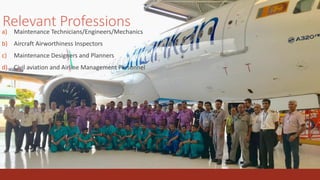
Relevant Professionsa) Maintenance Technicians/Engineers/Mechanics
b) Aircraft Airworthiness Inspectors
c) Maintenance Designers and Planners
d) Civil aviation and Airline Management Personnel
Background
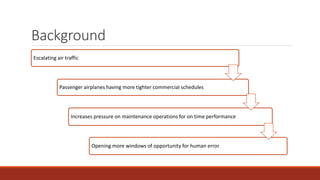
Escalating air traffic
Passenger airplanes having more tighter commercial schedules
Increases pressure on maintenance operations for on time performance
Opening more windows of opportunity for human error
On Coming Challenges
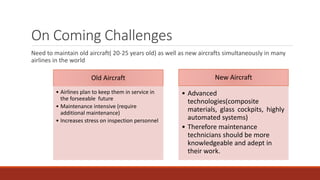
Need to maintain old aircraft( 20-25 years old) as well as new aircrafts simultaneously in many
airlines in the world
Old Aircraft
• Airlines plan to keep them in service in
the forseeable future
• Maintenance intensive (require
additional maintenance)
• Increases stress on inspection personnel
New Aircraft
• Advanced
technologies(composite
materials, glass cockpits, highly
automated systems)
• Therefore maintenance
technicians should be more
knowledgeable and adept in
their work.
Human Errors in Maintenance
Human
errors in
maintenance
results in physical failure
which was not there before
the maintenance task was
started
Unsafe conditions
undetected while
performing
maintenance task
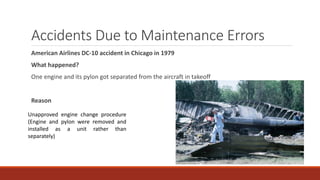
Accidents Due to Maintenance Errors
American Airlines DC-10 accident in Chicago in 1979
What happened?
One engine and its pylon got separated from the aircraft in takeoff
Reason
Unapproved engine change procedure
(Engine and pylon were removed and
installed as a unit rather than
separately)
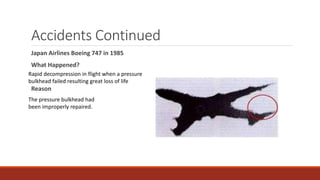
Accidents Continued
Japan Airlines Boeing 747 in 1985
What Happened?
Reason
Rapid decompression in flight when a pressure
bulkhead failed resulting great loss of life
The pressure bulkhead had
been improperly repaired.
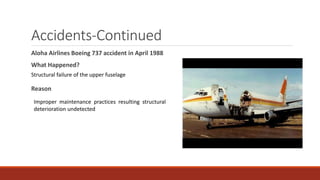
Accidents-Continued
Aloha Airlines Boeing 737 accident in April 1988
What Happened?
Reason
Structural failure of the upper fuselage
Improper maintenance practices resulting structural
deterioration undetected
Communication
❖Maintenance information should be understandable by the technicians and inspectors.
❖Therefore new manuals, job cards and service bulletins should be tested before distribution.
Real Example
“Anecdotal evidence suggests a case where a certain maintenance procedure was “proscribed”
(i.e. prohibited) in a service bulletin. The technician reading this concluded that the procedure
was “prescribed” (i.e. defined, laid down) and proceeded to perform the forbidden action”. This
highlights that it is important to use simplified English.
Communication-Continued
❖There should be proper communication among airlines.
❖There should be proper communication between airlines and aircraft manufacturers.
❖However the communication among airlines is compromised by industry cost control measures
and competitive pressures.
Real Example
“The investigation of the American Airline DC-10 accident at Chicago in 1979 revealed that
another airline using the same unapproved engine change procedures had discovered that the
procedure caused cracks in the pylon attachment area and as a consequence, had reverted to
using the approved procedures”.
Communication-Continued
❖Finally, There must also be a proper communication within an airline’s maintenance
organization as well.
❖Technicians, supervisors, quality control inspectors in a maintenance organization work in a
shift basis. Therefore it is very important to pass the information on previously done work to the
employees who are coming for the next shift.
Real Example
The reason for the EMB-120 accident is a failure in communication. The second shift supervisor
failed to solicit an end of shift verbal report from the two technicians he assigned to remove both
horizontal stabilizer de-ice boots. He also neglected to give the maintenance work cards to the
technicians so that they could record the work that had been started but not completed.
Physical Demands of a Technician
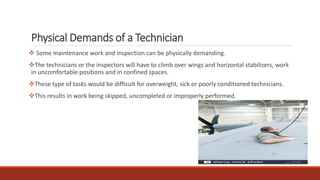
❖ Some maintenance work and inspection can be physically demanding.
❖The technicians or the inspectors will have to climb over wings and horizontal stabilizers, work
in uncomfortable positions and in confined spaces.
❖These type of tasks would be difficult for overweight, sick or poorly conditioned technicians.
❖This results in work being skipped, uncompleted or improperly performed.
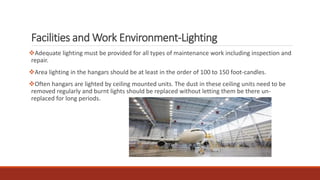
Facilities and Work Environment-Lighting
❖Adequate lighting must be provided for all types of maintenance work including inspection and
repair.
❖Area lighting in the hangars should be at least in the order of 100 to 150 foot-candles.
❖Often hangars are lighted by ceiling mounted units. The dust in these ceiling units need to be
removed regularly and burnt lights should be replaced without letting them be there un-
replaced for long periods.
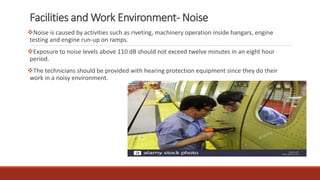
Facilities and Work Environment- Noise
❖Noise is caused by activities such as riveting, machinery operation inside hangars, engine
testing and engine run-up on ramps.
❖Exposure to noise levels above 110 dB should not exceed twelve minutes in an eight hour
period.
❖The technicians should be provided with hearing protection equipment since they do their
work in a noisy environment.
Facilities and Work Environment- Material
❖While maintaining aircrafts, employees may sometimes will have to handle toxic materials.
❖These materials may be used to carry out composite material structure repairs in aircrafts
(bonding chemicals). They can be tank sealants.
❖Also non-destructive testing techniques such as X-rays are potentially hazardous.
❖Therefore the employees need to be trained on properly handling toxic materials and they
should be provided with protective devices.
Redundancy-Human Factors
Software and Hardware Redundancy
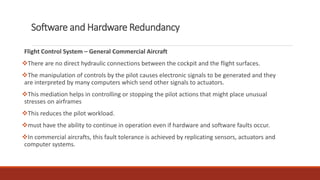
Flight Control System – General Commercial Aircraft
❖There are no direct hydraulic connections between the cockpit and the flight surfaces.
❖The manipulation of controls by the pilot causes electronic signals to be generated and they
are interpreted by many computers which send other signals to actuators.
❖This mediation helps in controlling or stopping the pilot actions that might place unusual
stresses on airframes
❖This reduces the pilot workload.
❖must have the ability to continue in operation even if hardware and software faults occur.
❖In commercial aircrafts, this fault tolerance is achieved by replicating sensors, actuators and
computer systems.
Software and Hardware Redundancy-Continued
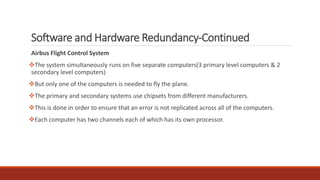
Airbus Flight Control System
❖The system simultaneously runs on five separate computers(3 primary level computers & 2
secondary level computers)
❖But only one of the computers is needed to fly the plane.
❖The primary and secondary systems use chipsets from different manufacturers.
❖This is done in order to ensure that an error is not replicated across all of the computers.
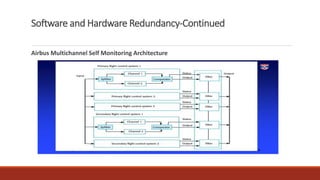
❖Each computer has two channels each of which has its own processor.
Software and Hardware Redundancy-Continued
Airbus Multichannel Self Monitoring Architecture
Thank You

Human factors - Maintenance and inspection

  • 1.
  • 2.
    Relevant Professionsa) MaintenanceTechnicians/Engineers/Mechanics b) Aircraft Airworthiness Inspectors c) Maintenance Designers and Planners d) Civil aviation and Airline Management Personnel
  • 3.
    Background Escalating air traffic Passengerairplanes having more tighter commercial schedules Increases pressure on maintenance operations for on time performance Opening more windows of opportunity for human error
  • 4.
    On Coming Challenges Needto maintain old aircraft( 20-25 years old) as well as new aircrafts simultaneously in many airlines in the world Old Aircraft • Airlines plan to keep them in service in the forseeable future • Maintenance intensive (require additional maintenance) • Increases stress on inspection personnel New Aircraft • Advanced technologies(composite materials, glass cockpits, highly automated systems) • Therefore maintenance technicians should be more knowledgeable and adept in their work.
  • 5.
    Human Errors inMaintenance Human errors in maintenance results in physical failure which was not there before the maintenance task was started Unsafe conditions undetected while performing maintenance task
  • 6.
    Accidents Due toMaintenance Errors American Airlines DC-10 accident in Chicago in 1979 What happened? One engine and its pylon got separated from the aircraft in takeoff Reason Unapproved engine change procedure (Engine and pylon were removed and installed as a unit rather than separately)
  • 7.
    Accidents Continued Japan AirlinesBoeing 747 in 1985 What Happened? Reason Rapid decompression in flight when a pressure bulkhead failed resulting great loss of life The pressure bulkhead had been improperly repaired.
  • 8.
    Accidents-Continued Aloha Airlines Boeing737 accident in April 1988 What Happened? Reason Structural failure of the upper fuselage Improper maintenance practices resulting structural deterioration undetected
  • 9.
    Communication ❖Maintenance information shouldbe understandable by the technicians and inspectors. ❖Therefore new manuals, job cards and service bulletins should be tested before distribution. Real Example “Anecdotal evidence suggests a case where a certain maintenance procedure was “proscribed” (i.e. prohibited) in a service bulletin. The technician reading this concluded that the procedure was “prescribed” (i.e. defined, laid down) and proceeded to perform the forbidden action”. This highlights that it is important to use simplified English.
  • 10.
    Communication-Continued ❖There should beproper communication among airlines. ❖There should be proper communication between airlines and aircraft manufacturers. ❖However the communication among airlines is compromised by industry cost control measures and competitive pressures. Real Example “The investigation of the American Airline DC-10 accident at Chicago in 1979 revealed that another airline using the same unapproved engine change procedures had discovered that the procedure caused cracks in the pylon attachment area and as a consequence, had reverted to using the approved procedures”.
  • 11.
    Communication-Continued ❖Finally, There mustalso be a proper communication within an airline’s maintenance organization as well. ❖Technicians, supervisors, quality control inspectors in a maintenance organization work in a shift basis. Therefore it is very important to pass the information on previously done work to the employees who are coming for the next shift. Real Example The reason for the EMB-120 accident is a failure in communication. The second shift supervisor failed to solicit an end of shift verbal report from the two technicians he assigned to remove both horizontal stabilizer de-ice boots. He also neglected to give the maintenance work cards to the technicians so that they could record the work that had been started but not completed.
  • 12.
    Physical Demands ofa Technician ❖ Some maintenance work and inspection can be physically demanding. ❖The technicians or the inspectors will have to climb over wings and horizontal stabilizers, work in uncomfortable positions and in confined spaces. ❖These type of tasks would be difficult for overweight, sick or poorly conditioned technicians. ❖This results in work being skipped, uncompleted or improperly performed.
  • 13.
    Facilities and WorkEnvironment-Lighting ❖Adequate lighting must be provided for all types of maintenance work including inspection and repair. ❖Area lighting in the hangars should be at least in the order of 100 to 150 foot-candles. ❖Often hangars are lighted by ceiling mounted units. The dust in these ceiling units need to be removed regularly and burnt lights should be replaced without letting them be there un- replaced for long periods.
  • 14.
    Facilities and WorkEnvironment- Noise ❖Noise is caused by activities such as riveting, machinery operation inside hangars, engine testing and engine run-up on ramps. ❖Exposure to noise levels above 110 dB should not exceed twelve minutes in an eight hour period. ❖The technicians should be provided with hearing protection equipment since they do their work in a noisy environment.
  • 15.
    Facilities and WorkEnvironment- Material ❖While maintaining aircrafts, employees may sometimes will have to handle toxic materials. ❖These materials may be used to carry out composite material structure repairs in aircrafts (bonding chemicals). They can be tank sealants. ❖Also non-destructive testing techniques such as X-rays are potentially hazardous. ❖Therefore the employees need to be trained on properly handling toxic materials and they should be provided with protective devices.
  • 16.
  • 17.
    Software and HardwareRedundancy Flight Control System – General Commercial Aircraft ❖There are no direct hydraulic connections between the cockpit and the flight surfaces. ❖The manipulation of controls by the pilot causes electronic signals to be generated and they are interpreted by many computers which send other signals to actuators. ❖This mediation helps in controlling or stopping the pilot actions that might place unusual stresses on airframes ❖This reduces the pilot workload. ❖must have the ability to continue in operation even if hardware and software faults occur. ❖In commercial aircrafts, this fault tolerance is achieved by replicating sensors, actuators and computer systems.
  • 18.
    Software and HardwareRedundancy-Continued Airbus Flight Control System ❖The system simultaneously runs on five separate computers(3 primary level computers & 2 secondary level computers) ❖But only one of the computers is needed to fly the plane. ❖The primary and secondary systems use chipsets from different manufacturers. ❖This is done in order to ensure that an error is not replicated across all of the computers. ❖Each computer has two channels each of which has its own processor.
  • 19.
    Software and HardwareRedundancy-Continued Airbus Multichannel Self Monitoring Architecture
  • 20.