By
S.SHANMUGASUNDARAM @ VENKADESH
KARAIKAL
KEY POINTS
• Thermite welding is a type of fusion welding
process.
• It is also known as Exothermic welding or
bonding.
• This process is used to welding a heavy and
large structures.
• It requires no electrode and power supply.
Principle
• In this process, welding is done by pouring
superheated liquid steel around parts to be
joined.
• A short molding process is to be done before
welding.
What is Thermite / Thermit?
• A mixture of fine aluminum powder and iron
oxide that produces a very high temperature on
combustion, used in welding and for incendiary
bombs.
Thermite reaction involving aluminum is also
called Goldschmidt alumino thermic reaction.
Usually this reaction is triggered by burning
magnesium ribbon in presence of Barium peroxide.
• By weight, 75% of iron oxide and 25% of fine
aluminum powder (OR)
• Fine aluminum powder and iron oxide should
have a ratio of 1:3 (by weight)
• We can also use copper or chromium instead
of aluminum.
• The ends of parts to be joined are kept parallel
with a uniform gap between them.
• That gap is filled with wax which becomes the
pattern.
• Molding sand is rammed around wax pattern.
Pouring gate, heating gate and risers are cut.
• Joints to be welded are preheated by a flame
(external source). Due to preheat wax melts
and goes out.
• After melting of wax, weld joints are
preheated due to flame.
• Then heating is stopped and heating gate is
closed.
• The mixture of aluminum and iron oxide is placed
in a crucible.
• Barium Peroxide is added to the crucible. Barium
peroxide arises by the reversible reaction of
O2 with barium oxide. The peroxide forms around
500°C and oxygen is released above 820°C
• Mixture is ignited using a match stick (or) small
magnesium wire. So combustion takes place in
the crucible.
• Due to combustion, thermite mixture becomes
superheated liquid within max. time of 30
seconds.
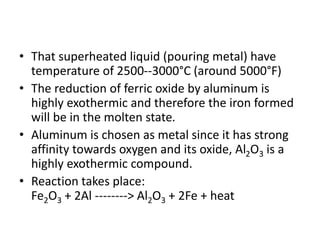
• That superheated liquid (pouring metal) have
temperature of 2500--3000°C (around 5000°F)
• The reduction of ferric oxide by aluminum is
highly exothermic and therefore the iron formed
will be in the molten state.
• Aluminum is chosen as metal since it has strong
affinity towards oxygen and its oxide, Al2O3 is a
highly exothermic compound.
• Reaction takes place:
Fe2O3 + 2Al --------> Al2O3 + 2Fe + heat
• Crucible is placed directly above the joints to
be welded.
• After preheating of joints, liquid thermite steel
from the crucible is poured into mold between
the gap to weld.
• The molten metal solidifies and weld is
completed.
• This process is used to weld very large works
like joining of rails, pipes, broken teeth on
large gears and large frame work.
• This process is generally used for welding
ferrous metals.
ADVANTAGES:
- Very large size structure can
be easily weld
- No power supply and
electrode needed
DISADVANTAGES:
- Skilled labor required
- Long process
Thermit welding

Thermit welding

  • 1.
  • 2.
    KEY POINTS • Thermitewelding is a type of fusion welding process. • It is also known as Exothermic welding or bonding. • This process is used to welding a heavy and large structures. • It requires no electrode and power supply.
  • 3.
    Principle • In thisprocess, welding is done by pouring superheated liquid steel around parts to be joined. • A short molding process is to be done before welding.
  • 4.
    What is Thermite/ Thermit? • A mixture of fine aluminum powder and iron oxide that produces a very high temperature on combustion, used in welding and for incendiary bombs. Thermite reaction involving aluminum is also called Goldschmidt alumino thermic reaction. Usually this reaction is triggered by burning magnesium ribbon in presence of Barium peroxide.
  • 5.
    • By weight,75% of iron oxide and 25% of fine aluminum powder (OR) • Fine aluminum powder and iron oxide should have a ratio of 1:3 (by weight) • We can also use copper or chromium instead of aluminum.
  • 6.
    • The endsof parts to be joined are kept parallel with a uniform gap between them. • That gap is filled with wax which becomes the pattern. • Molding sand is rammed around wax pattern. Pouring gate, heating gate and risers are cut.
  • 8.
    • Joints tobe welded are preheated by a flame (external source). Due to preheat wax melts and goes out. • After melting of wax, weld joints are preheated due to flame. • Then heating is stopped and heating gate is closed.
  • 9.
    • The mixtureof aluminum and iron oxide is placed in a crucible. • Barium Peroxide is added to the crucible. Barium peroxide arises by the reversible reaction of O2 with barium oxide. The peroxide forms around 500°C and oxygen is released above 820°C • Mixture is ignited using a match stick (or) small magnesium wire. So combustion takes place in the crucible. • Due to combustion, thermite mixture becomes superheated liquid within max. time of 30 seconds.
  • 10.
    • That superheatedliquid (pouring metal) have temperature of 2500--3000°C (around 5000°F) • The reduction of ferric oxide by aluminum is highly exothermic and therefore the iron formed will be in the molten state. • Aluminum is chosen as metal since it has strong affinity towards oxygen and its oxide, Al2O3 is a highly exothermic compound. • Reaction takes place: Fe2O3 + 2Al --------> Al2O3 + 2Fe + heat
  • 11.
    • Crucible isplaced directly above the joints to be welded. • After preheating of joints, liquid thermite steel from the crucible is poured into mold between the gap to weld. • The molten metal solidifies and weld is completed.
  • 14.
    • This processis used to weld very large works like joining of rails, pipes, broken teeth on large gears and large frame work. • This process is generally used for welding ferrous metals.
  • 15.
    ADVANTAGES: - Very largesize structure can be easily weld - No power supply and electrode needed DISADVANTAGES: - Skilled labor required - Long process