Meaning and role of theory in behavior science research
Course Instructor
Dr Rupasi Tiwari
ICAR-Indian Veterinary Research Institute
Izatnagar, UP, India
Theory
• It is thought that the word ‘theory’ has its origin from the
Latin noun ‘theoria,’ and the Greek noun ‘theoria’ and verb
‘theorein’ (usually translated as “to look at,” “to observe,” “to see,”
or “to contemplate”).
• A theory explains how thing work together and it makes
predictions as to what will happen in the future.
• Once you have a theory, you test it. It if holds up, it is a good
theory, if it doesn't, it should be discarded.
• The major goal of science is the generation and verification of
theory.
• A theory predicts and explains natural phenomena. Without
theories, science would be a futile exercise in statistics. (Goode &
Hatt ,1981)
Examples of Theories
Marx’s Theory
Freud’s Theory
Social Learning Theory
Parental Investment Theory
HYPOTHESIS
• supposition or proposed explanation made on the basis of
limited evidence
• act as a starting point for further investigation.
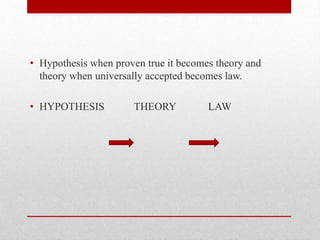
• Hypothesis when proven true it becomes theory and
theory when universally accepted becomes law.
• HYPOTHESIS THEORY LAW
THEORY-
The basic aim of science is to explain the natural
phenomenon , such explanations are called theories.
According to Kerlinger :
A theory is a set of interrelated constructs, definitions and
propositions that present a systematic view of phenomena
by specifying relations among variables, with the purpose
of explaining and predicting the phenomena.
This definition indicate three components of theory:
1. A theory is a set of propositions consisting of defined
constructs.
2. A theory sets the interrelations among a set of variables
1. A theory explains phenomena.
e.g. Theory of school failure
Thus ,
• A theory is a generalization about a phenomena and explanation of
how or why something occurs .
• Any statement that explain what is measured or described.
• Any general statement about cause and effect are theory based. for
example, "Illiteracy is the major cause of poor awareness about women’s
rights in rural areas..“
• Theory remains speculation until it is proved
• Theory becomes fact when proved .In fact we can consider a theory as a
broad family of ideas, assumptions, concepts, and hypotheses about
how the world works.
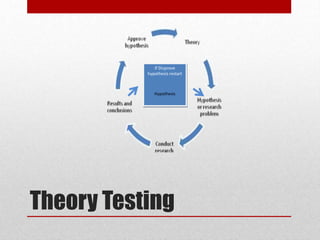
Theory Testing
If Disprove
hypothesis restart
Hypothesis
Functions of theory :
To describe, explain, predict or control human phenomena in a
variety of context .
1. THEORY AS ORIENTATION :
Example: football can be investigated;
• Within economic framework as we ascertain the patterns of
demands and supply to this play object.
• It may be object for chemical research.
• It may be mass for physical object .
• It may be seen as center of many sociologically interesting
activities.
Role of Theory
2. THEORY AS CONCEPTULISATION AND
CLASSIFICATION
Helps to conceptualize or classify
• Class system
• Social mobility
• Social distance
.
Role of Theory
3. THEORY AS SUMMARISING
• Empirical generalization.
• Systems of relationship between propositions
4. THEORY PREDICTS FACTS
e.g. remarriage rates of divorces age up to 25-35 are lower than
marriage rates of single persons at those age .And predict for
those areas where data are not available
5. THEORY POINTS TO GAP IN OUR KNOWLEDGE
Role of Theory
Role of Theory
• MEANS TO GUIDE AND INFORM RESEARCH
• IDENTIFYING AND DEFINING RESEARCH PROBLEMS
• INTERPRETATION OF NEW DATA / OLD DATA
• RESPOND TO NEW PROBLEMS
• PRESCRIBING OR EVALUATING SOLUTIONS TO RESEARCH
PROBLEMS,
Role of Theory
• WAY OF TELLING US THAT CERTAIN FACTS AMONG THE
ACCUMULATED KNOWLEDGE ARE IMPORTANT AND WHICH
FACTS ARE NOT
• MEANS OF PROVIDING MEMBERS OF A PROFESSIONAL
DISCIPLINE WITH A COMMON LANGUAGE AND A FRAME OF
REFERENCE FOR DEFINING BOUNDARIES OF THEIR
PROFESSION, AND
• A SOURCE OF ''CROSS FERTILIZATION'' OF RELATED FIELDS
Types of approaches to theory and Research:
theory-testing or theory-generating
Two types of approaches to the relationship between theory and
research include the deductive and inductive methods.
Deductive theory:
The deductive method argues from the general to the specific.
Under a deductive methodology, a researcher begins with a hypothesis,
then makes observations or collects data to test that hypothesis.
Based on empirical evidence from the study, the researcher then
decides whether to accept or reject the hypothesis.
The deductive methodology, in short, tests theories and hypotheses.
• Deductive theory: theory - hypothesis -data collection - findings -
hypothesis confirmed/rejected - revision of theory.
• Theory acts as starting point here.
Types of approaches to theory and
Research:
• Inductive theory: The inductive method, in
contrast, goes from the specific to the general.
• Under this methodology, social scientists observe
social phenomena, identify patterns and then
analyze them to reach broad conclusions and
develop new theories, based on research findings.
• Inductive theories: observation/findings -
theory.
• Theory acts as an outcome here.
Types of approaches to theory and
Research
Adaptive theory: This theory is the best of both worlds.
• It is a ‘third way’ , an amalgam of above approaches, falling somewhere
between deductive (theory testing) and inductive (theory generating)
approaches.
• Adaptive theory draws upon the whole range of approaches to theorizing in
research .
• It uses both inductive and deductive procedures for developing and
elaborating theory”.
• Most of us are neither merely empiricists (radical inductionists) or
theoreticians (radical deductivists) but our work lingers somewhere between
the two poles as a hybrid.
• The ‘adaptive’ part of the term is meant to suggest that the theory both adapts
to, or is shaped by, incoming evidence at the same time as the data
themselves are filtered through (and adapted to) the extent theoretical
materials that are relevant and at hand” (Layder, 1998)
Characteristics of a Good Theory
Uniqueness
• The uniqueness virtue means that one theory must be
differentiated from another.
• If two theories are identical, they should be considered a
single theory.
• Although it applies to all criteria for theory, this virtue
directly applies to definitions since definitions are the
most elemental of building blocks for theory.
Conservatism
• A current theory cannot be replaced unless the new theory
is superior in its virtues.
• Therefore, current theory is not rejected for the sake of
change.
• This criteria is needed so that when a new theory is
proposed, there is a good reason to believe all other
theories are lacking in some virtue
Characteristics of a Good Theory
Generalization
• The more areas that a theory can be applied to makes the
theory a better theory.
• If one theory can be applied to one type of environment
and another theory can be applied to many environments,
then the second theory is a more virtuous theory since it
can be more widely applied.
• Some authors call this virtue the utility of the theory since
those theories that have wider application have more
importance.
Characteristics of a Good Theory
Fecundity
• A theory which is more fertile in generating new
models and hypotheses is better than a theory that
has fewer hypotheses.
• Theories which expand the area of investigation
into new conceptual areas are considered superior
to a theory which investigate established research
areas.
Characteristics of a Good Theory
Theory parsimony
• The parsimony virtue states, other things being equal, the
fewer the assumptions the better .
• This means if two theories are equal in all other aspects lthe
one with fewer assumptions and the fewer definitions is
more virtuous.
• This virtue also includes the notion that the simpler the
explanation, the better the theory.
• This virtue keeps theories from becoming too complex
and incomprehensible.
Characteristics of a Good Theory
Internal consistency
• Internal consistency means the theory has identified all
relationships and gives adequate explanation.
• It means that the theory logically explains the
relationships between variables
• The more logically the theory explains the variables and
predicts the subsequent event, the better the theory is.
‘This internal consistency virtue means that the theory’s
entities and relationships must be internally compatible
using symbolic logic or mathematics.
• This internal consistency means that the concepts and
relationships are logically compatible with each other.
Characteristics of a Good Theory

Abstraction
• The abstraction level of theory means it is
independent of time and space.
• It achieves this independence by including
more relationships.
• The abstraction level means it is better to
integrate many relationships and variables
into a larger theory.
• If one of two competing theories integrates
more internally consistent concepts, it is more
virtuous than a theory that integrates fewer
internally consistent relationships
Developing the
theoretical framework
There are various ways to develop effective theoretical
framework. Some strategies include:
• Examine your thesis title and research problem.
The research problem anchors your entire study and forms
the basis from which you construct your theoretical
framework.
• Brainstorm on what you consider to be the key
variables in your research.
Answer the question, what factors contribute to the
presumed effect?
Developing the
theoretical framework
• Review related literature to find answers to your
research question.
• List the constructs and variables that might be relevant
to your study. Group these variables into independent and
dependent categories.
• Review the key social science theories and choose the
theory or theories that can best explain the relationships
between the key variables in your study.
• Discuss the assumptions or propositions of this theory
and point out their relevance to your research.
Thanks . . .

theory.ppt

  • 1.
    Meaning and roleof theory in behavior science research Course Instructor Dr Rupasi Tiwari ICAR-Indian Veterinary Research Institute Izatnagar, UP, India
  • 2.
    Theory • It isthought that the word ‘theory’ has its origin from the Latin noun ‘theoria,’ and the Greek noun ‘theoria’ and verb ‘theorein’ (usually translated as “to look at,” “to observe,” “to see,” or “to contemplate”). • A theory explains how thing work together and it makes predictions as to what will happen in the future. • Once you have a theory, you test it. It if holds up, it is a good theory, if it doesn't, it should be discarded. • The major goal of science is the generation and verification of theory. • A theory predicts and explains natural phenomena. Without theories, science would be a futile exercise in statistics. (Goode & Hatt ,1981)
  • 3.
    Examples of Theories Marx’sTheory Freud’s Theory Social Learning Theory Parental Investment Theory
  • 4.
    HYPOTHESIS • supposition orproposed explanation made on the basis of limited evidence • act as a starting point for further investigation.
  • 5.
    • Hypothesis whenproven true it becomes theory and theory when universally accepted becomes law. • HYPOTHESIS THEORY LAW
  • 6.
    THEORY- The basic aimof science is to explain the natural phenomenon , such explanations are called theories.
  • 7.
    According to Kerlinger: A theory is a set of interrelated constructs, definitions and propositions that present a systematic view of phenomena by specifying relations among variables, with the purpose of explaining and predicting the phenomena.
  • 8.
    This definition indicatethree components of theory: 1. A theory is a set of propositions consisting of defined constructs. 2. A theory sets the interrelations among a set of variables 1. A theory explains phenomena. e.g. Theory of school failure
  • 9.
    Thus , • Atheory is a generalization about a phenomena and explanation of how or why something occurs . • Any statement that explain what is measured or described. • Any general statement about cause and effect are theory based. for example, "Illiteracy is the major cause of poor awareness about women’s rights in rural areas..“ • Theory remains speculation until it is proved • Theory becomes fact when proved .In fact we can consider a theory as a broad family of ideas, assumptions, concepts, and hypotheses about how the world works.
  • 10.
  • 11.
    Functions of theory: To describe, explain, predict or control human phenomena in a variety of context .
  • 12.
    1. THEORY ASORIENTATION : Example: football can be investigated; • Within economic framework as we ascertain the patterns of demands and supply to this play object. • It may be object for chemical research. • It may be mass for physical object . • It may be seen as center of many sociologically interesting activities. Role of Theory
  • 13.
    2. THEORY ASCONCEPTULISATION AND CLASSIFICATION Helps to conceptualize or classify • Class system • Social mobility • Social distance . Role of Theory
  • 14.
    3. THEORY ASSUMMARISING • Empirical generalization. • Systems of relationship between propositions 4. THEORY PREDICTS FACTS e.g. remarriage rates of divorces age up to 25-35 are lower than marriage rates of single persons at those age .And predict for those areas where data are not available 5. THEORY POINTS TO GAP IN OUR KNOWLEDGE Role of Theory
  • 15.
    Role of Theory •MEANS TO GUIDE AND INFORM RESEARCH • IDENTIFYING AND DEFINING RESEARCH PROBLEMS • INTERPRETATION OF NEW DATA / OLD DATA • RESPOND TO NEW PROBLEMS • PRESCRIBING OR EVALUATING SOLUTIONS TO RESEARCH PROBLEMS,
  • 16.
    Role of Theory •WAY OF TELLING US THAT CERTAIN FACTS AMONG THE ACCUMULATED KNOWLEDGE ARE IMPORTANT AND WHICH FACTS ARE NOT • MEANS OF PROVIDING MEMBERS OF A PROFESSIONAL DISCIPLINE WITH A COMMON LANGUAGE AND A FRAME OF REFERENCE FOR DEFINING BOUNDARIES OF THEIR PROFESSION, AND • A SOURCE OF ''CROSS FERTILIZATION'' OF RELATED FIELDS
  • 17.
    Types of approachesto theory and Research: theory-testing or theory-generating Two types of approaches to the relationship between theory and research include the deductive and inductive methods. Deductive theory: The deductive method argues from the general to the specific. Under a deductive methodology, a researcher begins with a hypothesis, then makes observations or collects data to test that hypothesis. Based on empirical evidence from the study, the researcher then decides whether to accept or reject the hypothesis. The deductive methodology, in short, tests theories and hypotheses. • Deductive theory: theory - hypothesis -data collection - findings - hypothesis confirmed/rejected - revision of theory. • Theory acts as starting point here.
  • 18.
    Types of approachesto theory and Research: • Inductive theory: The inductive method, in contrast, goes from the specific to the general. • Under this methodology, social scientists observe social phenomena, identify patterns and then analyze them to reach broad conclusions and develop new theories, based on research findings. • Inductive theories: observation/findings - theory. • Theory acts as an outcome here.
  • 19.
    Types of approachesto theory and Research Adaptive theory: This theory is the best of both worlds. • It is a ‘third way’ , an amalgam of above approaches, falling somewhere between deductive (theory testing) and inductive (theory generating) approaches. • Adaptive theory draws upon the whole range of approaches to theorizing in research . • It uses both inductive and deductive procedures for developing and elaborating theory”. • Most of us are neither merely empiricists (radical inductionists) or theoreticians (radical deductivists) but our work lingers somewhere between the two poles as a hybrid. • The ‘adaptive’ part of the term is meant to suggest that the theory both adapts to, or is shaped by, incoming evidence at the same time as the data themselves are filtered through (and adapted to) the extent theoretical materials that are relevant and at hand” (Layder, 1998)
  • 20.
    Characteristics of aGood Theory Uniqueness • The uniqueness virtue means that one theory must be differentiated from another. • If two theories are identical, they should be considered a single theory. • Although it applies to all criteria for theory, this virtue directly applies to definitions since definitions are the most elemental of building blocks for theory.
  • 21.
    Conservatism • A currenttheory cannot be replaced unless the new theory is superior in its virtues. • Therefore, current theory is not rejected for the sake of change. • This criteria is needed so that when a new theory is proposed, there is a good reason to believe all other theories are lacking in some virtue Characteristics of a Good Theory
  • 22.
    Characteristics of aGood Theory Generalization • The more areas that a theory can be applied to makes the theory a better theory. • If one theory can be applied to one type of environment and another theory can be applied to many environments, then the second theory is a more virtuous theory since it can be more widely applied. • Some authors call this virtue the utility of the theory since those theories that have wider application have more importance.
  • 23.
    Characteristics of aGood Theory Fecundity • A theory which is more fertile in generating new models and hypotheses is better than a theory that has fewer hypotheses. • Theories which expand the area of investigation into new conceptual areas are considered superior to a theory which investigate established research areas.
  • 24.
    Characteristics of aGood Theory Theory parsimony • The parsimony virtue states, other things being equal, the fewer the assumptions the better . • This means if two theories are equal in all other aspects lthe one with fewer assumptions and the fewer definitions is more virtuous. • This virtue also includes the notion that the simpler the explanation, the better the theory. • This virtue keeps theories from becoming too complex and incomprehensible.
  • 25.
    Characteristics of aGood Theory Internal consistency • Internal consistency means the theory has identified all relationships and gives adequate explanation. • It means that the theory logically explains the relationships between variables • The more logically the theory explains the variables and predicts the subsequent event, the better the theory is. ‘This internal consistency virtue means that the theory’s entities and relationships must be internally compatible using symbolic logic or mathematics. • This internal consistency means that the concepts and relationships are logically compatible with each other.
  • 26.
    Characteristics of aGood Theory Abstraction • The abstraction level of theory means it is independent of time and space. • It achieves this independence by including more relationships. • The abstraction level means it is better to integrate many relationships and variables into a larger theory. • If one of two competing theories integrates more internally consistent concepts, it is more virtuous than a theory that integrates fewer internally consistent relationships
  • 27.
    Developing the theoretical framework Thereare various ways to develop effective theoretical framework. Some strategies include: • Examine your thesis title and research problem. The research problem anchors your entire study and forms the basis from which you construct your theoretical framework. • Brainstorm on what you consider to be the key variables in your research. Answer the question, what factors contribute to the presumed effect?
  • 28.
    Developing the theoretical framework •Review related literature to find answers to your research question. • List the constructs and variables that might be relevant to your study. Group these variables into independent and dependent categories. • Review the key social science theories and choose the theory or theories that can best explain the relationships between the key variables in your study. • Discuss the assumptions or propositions of this theory and point out their relevance to your research.
  • 29.