





Philosophies of Social
Research
Positivist & Interpretivist Approaches &
Methodologies
Conceptions of Social
Reality
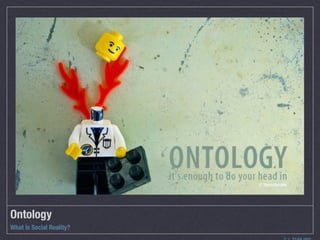
Ontology
Is reality objective?

External & independent of individuals? 

Is reality subjective?

Constructed by individuals
Ontology
What is Social Reality?
Epistemology
How do we know what we know?

What is knowledge?

How do we gain it? 

How do we communicate it?
Comparing
Epistemologies
Knowledge is
subjective

Meaning has action

Relies on interpretation

Social world different
to natural world
Knowledge is objective

Hard data

Can be measured

Natural and social
world are the same
Epistemology
How we know what we know
Positivism
Key Features
Scientific 

Objective

Robust

Involves identifying causes

Tests hypotheses

Uses the methods of the natural sciences
Auguste
Comte
Father of Sociology
Anti/Post Positivism
Interpretivism
Key Features
Social Action (can be anything, even inaction) has
meaning

The researcher’s job is to interpret social action

Verstehen
Max Weber
Known to his parents as Karl
Emile Maximilian Weber
Examples of Approaches
Positivist - Scientific
External reality - need to collect ‘facts’

Methods of natural sciences

Use of statistics (quantitative)

Experiments, surveys
Emile
Durkheim
Social Facts
Suicide
Suicide
Establish suicide as a social fact

Suicide rate not explained by individual acts

Rates remained (relatively) stable

Social causes
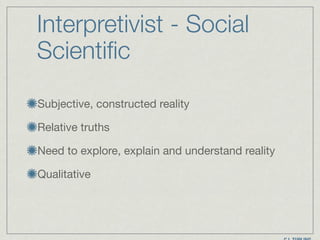
Interpretivist - Social
Scientific
Subjective, constructed reality

Relative truths

Need to explore, explain and understand reality

Qualitative
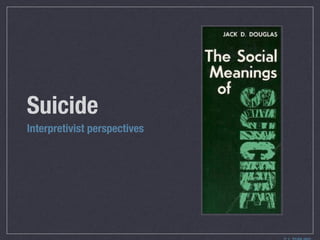
Suicide
Interpretivist perspectives
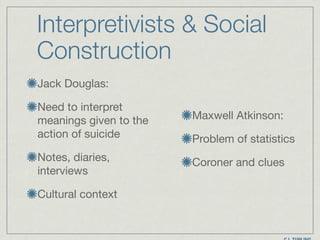
Interpretivists & Social
Construction
Jack Douglas:

Need to interpret
meanings given to the
action of suicide

Notes, diaries,
interviews

Cultural context
Maxwell Atkinson:

Problem of statistics

Coroner and clues
Methodologies
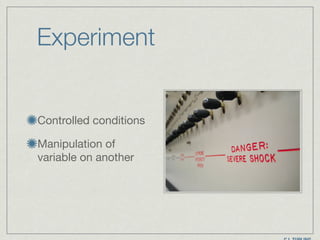
Experiment
Controlled conditions

Manipulation of
variable on another
Survey
Collection of data

Measure of a social
phenomenon

Description of group/
population

Testing theories
Ethnography
Description of people
and their cultures

Detailed accounts of
everyday life

Understanding of how
people see their world
Phenomenology
Understanding of the human experience

Subjective meanings

Attitudes and beliefs
Methods of Data
Collection
Questionnaires

Interviews

Observation

Documents

Positivist & Interpretivist approaches