THEORY
BUILDING
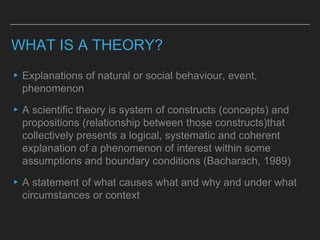
WHAT IS A THEORY?
▸Explanations of natural or social behaviour, event,
phenomenon
▸A scientific theory is system of constructs (concepts) and
propositions (relationship between those constructs)that
collectively presents a logical, systematic and coherent
explanation of a phenomenon of interest within some
assumptions and boundary conditions (Bacharach, 1989)
▸A statement of what causes what and why and under what
circumstances or context
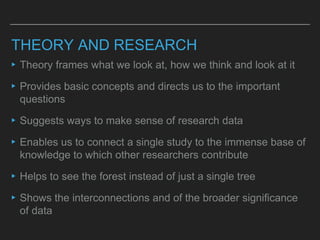
THEORY AND RESEARCH
▸Theory frames what we look at, how we think and look at it
▸Provides basic concepts and directs us to the important
questions
▸Suggests ways to make sense of research data
▸Enables us to connect a single study to the immense base of
knowledge to which other researchers contribute
▸Helps to see the forest instead of just a single tree
▸Shows the interconnections and of the broader significance
of data
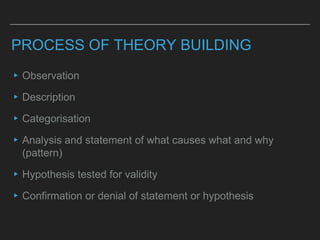
PROCESS OF THEORY BUILDING
▸Observation
▸Description
▸Categorisation
▸Analysis and statement of what causes what and why
(pattern)
▸Hypothesis tested for validity
▸Confirmation or denial of statement or hypothesis
PROCESS
▸If the statement is denied we need to decide if it is an
anomaly that expands the theory or whether it contradicts
the theory- theory building or testing???
▸Anomaly allows a new categorization to take place
▸The discovery of anomalies can make a theory useful
THEORY BUILDING AND THEORY
TESTING
▸Theory testing- as the name suggests, the process of testing
whether a certain theory of your choice is a plausible
explanation of a phenomenon you would like to investigate.
▸Theory building- it requires the synthesis of a broad range of
literature and studies to provide evidence or confirm
explanation to a given phenomenon
THEORY BUILDING
▸It is an attempt plausibly explain something in a different light
or perspective
▸This requires an awareness of what the plausible theories
explaining the phenomenon currently are and how they are
used in empirical research
▸You must understand all or most of the main theories that
attempt to explain a particular phenomenon before you can
build a theory to differently explain that
DIFFERENT APPROACHES IN THEORY
BUILDING
1. Grounded theory building
‣ Inductive approach
‣ Builds theory inductively based on observed patterns of
events or behaviours
‣ Researcher consistently providing explanations for the
observed patterns
2. Bottom-Up Conceptual Analysis
▸Builds theory by conducting a bottom up conceptual
analysis to identify different sets of predictors relevant to
phenomenon of interest using predefined framework.
▸One such framework may be a simple input-process-output
framework, where the researchers look for different
categories of inputs (individual, organisational or
technological factors) related to the output, and described the
underlying processes that link these factors to the output
3. Extend or modify existing theory
▸To explain a new context
▸Deductive approach
▸Certain concepts, propositions or boundary conditions of the
old theory may retained and others modified to fit the new
context
▸Redefining the context!
4. Apply existing theories in new context
▸By drawing upon the structural similarities between the
two context
▸Deductive approach that relies on reasoning by analogy
▸Eg.context of private schools & hospitals
REFERENCES
▸Battacharjee, Anol (2012) “social science
research:principles, methods and practices”
▸Colquitt, J.A., & Zapata (2007) trends in theory building and
testing:five decade study of academy of management journal
▸Neuman Lawrence (1997) social research methods:
qualitative and quantitative approaches, Boston:London

Social Research:Theory Building

  • 1.
  • 2.
    WHAT IS ATHEORY? ▸Explanations of natural or social behaviour, event, phenomenon ▸A scientific theory is system of constructs (concepts) and propositions (relationship between those constructs)that collectively presents a logical, systematic and coherent explanation of a phenomenon of interest within some assumptions and boundary conditions (Bacharach, 1989) ▸A statement of what causes what and why and under what circumstances or context
  • 3.
    THEORY AND RESEARCH ▸Theoryframes what we look at, how we think and look at it ▸Provides basic concepts and directs us to the important questions ▸Suggests ways to make sense of research data ▸Enables us to connect a single study to the immense base of knowledge to which other researchers contribute ▸Helps to see the forest instead of just a single tree ▸Shows the interconnections and of the broader significance of data
  • 4.
    PROCESS OF THEORYBUILDING ▸Observation ▸Description ▸Categorisation ▸Analysis and statement of what causes what and why (pattern) ▸Hypothesis tested for validity ▸Confirmation or denial of statement or hypothesis
  • 5.
    PROCESS ▸If the statementis denied we need to decide if it is an anomaly that expands the theory or whether it contradicts the theory- theory building or testing??? ▸Anomaly allows a new categorization to take place ▸The discovery of anomalies can make a theory useful
  • 6.
    THEORY BUILDING ANDTHEORY TESTING ▸Theory testing- as the name suggests, the process of testing whether a certain theory of your choice is a plausible explanation of a phenomenon you would like to investigate. ▸Theory building- it requires the synthesis of a broad range of literature and studies to provide evidence or confirm explanation to a given phenomenon
  • 7.
    THEORY BUILDING ▸It isan attempt plausibly explain something in a different light or perspective ▸This requires an awareness of what the plausible theories explaining the phenomenon currently are and how they are used in empirical research ▸You must understand all or most of the main theories that attempt to explain a particular phenomenon before you can build a theory to differently explain that
  • 8.
    DIFFERENT APPROACHES INTHEORY BUILDING 1. Grounded theory building ‣ Inductive approach ‣ Builds theory inductively based on observed patterns of events or behaviours ‣ Researcher consistently providing explanations for the observed patterns
  • 9.
    2. Bottom-Up ConceptualAnalysis ▸Builds theory by conducting a bottom up conceptual analysis to identify different sets of predictors relevant to phenomenon of interest using predefined framework. ▸One such framework may be a simple input-process-output framework, where the researchers look for different categories of inputs (individual, organisational or technological factors) related to the output, and described the underlying processes that link these factors to the output
  • 10.
    3. Extend ormodify existing theory ▸To explain a new context ▸Deductive approach ▸Certain concepts, propositions or boundary conditions of the old theory may retained and others modified to fit the new context ▸Redefining the context!
  • 11.
    4. Apply existingtheories in new context ▸By drawing upon the structural similarities between the two context ▸Deductive approach that relies on reasoning by analogy ▸Eg.context of private schools & hospitals
  • 12.
    REFERENCES ▸Battacharjee, Anol (2012)“social science research:principles, methods and practices” ▸Colquitt, J.A., & Zapata (2007) trends in theory building and testing:five decade study of academy of management journal ▸Neuman Lawrence (1997) social research methods: qualitative and quantitative approaches, Boston:London