Educational TechnologyParadigms, Theories and Modelsby Sarah Devereaux
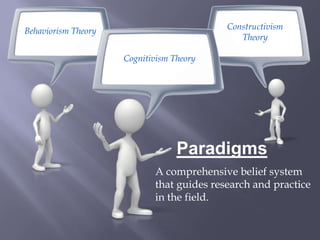
Constructivism TheoryBehaviorism TheoryCognitivism TheoryParadigmsA comprehensive belief system that guides research and practice in the field.
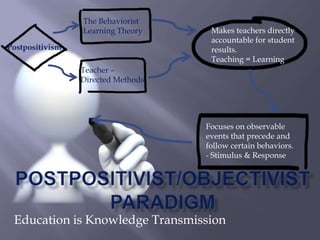
The Behaviorist Learning TheoryMakes teachers directly accountable for student results.Teaching = LearningPostpositivismTeacher – Directed MethodsFocuses on observable events that precede and follow certain behaviors.- Stimulus & ResponsePostpositivist/Objectivist ParadigmEducation is Knowledge Transmission
BehaviorismOperant Learning – contingent relationships among antecedents, operant, and consequences.Programmed instruction – the pedagogical organization of stimuli, responses, and reinforcers.Direct Instruction – scripted method that provides fast-paced, constant interaction between students and teachers.As hard technology advanced these frameworks were incorporated in digital formats like CAI (computer-assisted instruction) and online distance education.Behaviorism-based technologies show that it is possible to achieve dramatic test gains through careful control.
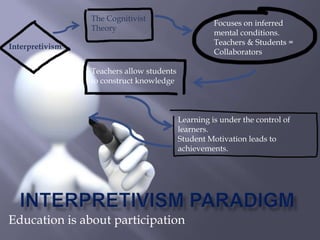
The Cognitivist TheoryFocuses on inferred mental conditions.Teachers & Students = CollaboratorsInterpretivismTeachers allow students to construct knowledgeLearning is under the control of learners. Student Motivation leads to achievements.Interpretivism ParadigmEducation is about participation
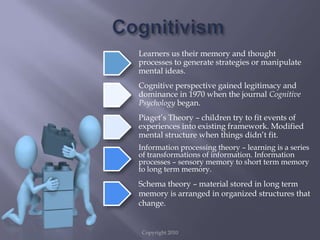
Copyright 2010CognitivismLearners us their memory and thought processes to generate strategies or manipulate mental ideas.Cognitive perspective gained legitimacy and dominance in 1970 when the journal Cognitive Psychology began.Piaget’s Theory – children try to fit events of experiences into existing framework. Modified mental structure when things didn’t fit.Information processing theory – learning is a series of transformations of information. Information processes – sensory memory to short term memory to long term memory.Schema theory – material stored in long term memory is arranged in organized structures that change.
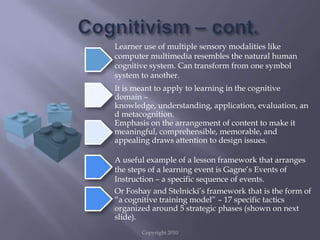
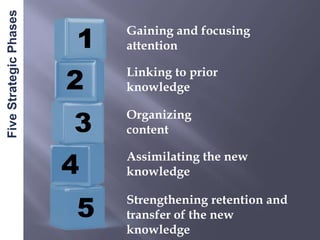
Copyright 2010Cognitivism – cont.Learner use of multiple sensory modalities like computer multimedia resembles the natural human cognitive system. Can transform from one symbol system to another.It is meant to apply to learning in the cognitive domain – knowledge, understanding, application, evaluation, and metacognition.Emphasis on the arrangement of content to make it meaningful, comprehensible, memorable, and appealing draws attention to design issues.A useful example of a lesson framework that arranges the steps of a learning event is Gagne’s Events of Instruction – a specific sequence of events.Or Foshay and Stelnicki’s framework that is the form of “a cognitive training model” – 17 specific tactics organized around 5 strategic phases (shown on next slide).
Five Strategic PhasesGaining and focusing attention12Linking to prior knowledgeOrganizing content3Assimilating the new knowledge4Strengthening retention and transfer of the new knowledge5
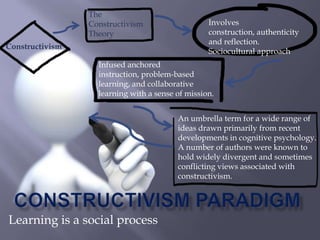
The Constructivism TheoryInvolves construction, authenticity and reflection. Sociocultural approachConstructivismInfused anchored instruction, problem-based learning, and collaborative learning with a sense of mission.An umbrella term for a wide range of ideas drawn primarily from recent developments in cognitive psychology.A number of authors were known to hold widely divergent and sometimes conflicting views associated with constructivism.Constructivism ParadigmLearning is a social process
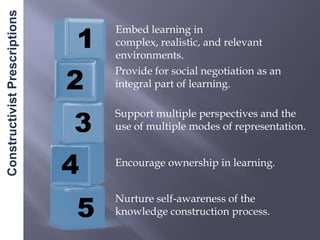
Constructivist PrescriptionsEmbed learning in complex, realistic, and relevant environments.12Provide for social negotiation as an integral part of learning.Support multiple perspectives and the use of multiple modes of representation.34Encourage ownership in learning.Nurture self-awareness of the knowledge construction process.5
ConstructivismTerhart concluded the difficulty to distinguish moderate constructivist principals of instruction from cognitivist principalsHe stated that “the ‘new’ constructivist didactics in the end is merely an assembly of long-known teaching methods.”The assumption “that knowledge is constructed by learners as they attempt to make sense of their experiences” (Driscoll, 2005, p.387) overlaps with cognitivists assumptions.Where constructivism differs is in that the constructions may not correspond to the external reality.Teachers are learning to plan activities that engage students in learning, are authentic and worthwhile, and involve constructivist principals while using educational technology as a tool for learning.
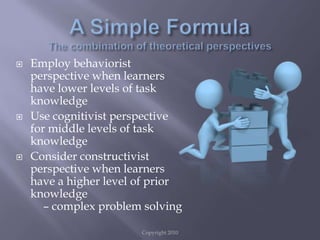
A Simple FormulaThe combination of theoretical perspectivesEmploy behaviorist perspective when learners have lower levels of task knowledgeUse cognitivist perspective for middle levels of task knowledgeConsider constructivist perspective when learners have a higher level of prior knowledge 				– complex problem solvingCopyright 2010
Copyright 2010Media vs MethodsSome enthusiasts for using media to improve learning assume that embedding content in the newest media will automatically improve the effectiveness of it.“The best current evidence is that media are mere vehicles that deliver instruction […] like a truck that delivers our groceries” (Clark, 1983, p.445).The use of media more and more comes to mean digital media.Clark (1983) concludes that “it seems not to be media but variables such as instructional methods that foster learning” (p.449).Different media formats only make a difference in time, not learning effectiveness.Different results could be expected if a different instructional paradigm might be used.Not learning from media, but instead with media.

Learning artifact on paradigms

  • 1.
    Educational TechnologyParadigms, Theoriesand Modelsby Sarah Devereaux
  • 2.
    Constructivism TheoryBehaviorism TheoryCognitivismTheoryParadigmsA comprehensive belief system that guides research and practice in the field.
  • 3.
    The Behaviorist LearningTheoryMakes teachers directly accountable for student results.Teaching = LearningPostpositivismTeacher – Directed MethodsFocuses on observable events that precede and follow certain behaviors.- Stimulus & ResponsePostpositivist/Objectivist ParadigmEducation is Knowledge Transmission
  • 4.
    BehaviorismOperant Learning –contingent relationships among antecedents, operant, and consequences.Programmed instruction – the pedagogical organization of stimuli, responses, and reinforcers.Direct Instruction – scripted method that provides fast-paced, constant interaction between students and teachers.As hard technology advanced these frameworks were incorporated in digital formats like CAI (computer-assisted instruction) and online distance education.Behaviorism-based technologies show that it is possible to achieve dramatic test gains through careful control.
  • 5.
    The Cognitivist TheoryFocuseson inferred mental conditions.Teachers & Students = CollaboratorsInterpretivismTeachers allow students to construct knowledgeLearning is under the control of learners. Student Motivation leads to achievements.Interpretivism ParadigmEducation is about participation
  • 6.
    Copyright 2010CognitivismLearners ustheir memory and thought processes to generate strategies or manipulate mental ideas.Cognitive perspective gained legitimacy and dominance in 1970 when the journal Cognitive Psychology began.Piaget’s Theory – children try to fit events of experiences into existing framework. Modified mental structure when things didn’t fit.Information processing theory – learning is a series of transformations of information. Information processes – sensory memory to short term memory to long term memory.Schema theory – material stored in long term memory is arranged in organized structures that change.
  • 7.
    Copyright 2010Cognitivism –cont.Learner use of multiple sensory modalities like computer multimedia resembles the natural human cognitive system. Can transform from one symbol system to another.It is meant to apply to learning in the cognitive domain – knowledge, understanding, application, evaluation, and metacognition.Emphasis on the arrangement of content to make it meaningful, comprehensible, memorable, and appealing draws attention to design issues.A useful example of a lesson framework that arranges the steps of a learning event is Gagne’s Events of Instruction – a specific sequence of events.Or Foshay and Stelnicki’s framework that is the form of “a cognitive training model” – 17 specific tactics organized around 5 strategic phases (shown on next slide).
  • 8.
    Five Strategic PhasesGainingand focusing attention12Linking to prior knowledgeOrganizing content3Assimilating the new knowledge4Strengthening retention and transfer of the new knowledge5
  • 9.
    The Constructivism TheoryInvolvesconstruction, authenticity and reflection. Sociocultural approachConstructivismInfused anchored instruction, problem-based learning, and collaborative learning with a sense of mission.An umbrella term for a wide range of ideas drawn primarily from recent developments in cognitive psychology.A number of authors were known to hold widely divergent and sometimes conflicting views associated with constructivism.Constructivism ParadigmLearning is a social process
  • 10.
    Constructivist PrescriptionsEmbed learningin complex, realistic, and relevant environments.12Provide for social negotiation as an integral part of learning.Support multiple perspectives and the use of multiple modes of representation.34Encourage ownership in learning.Nurture self-awareness of the knowledge construction process.5
  • 11.
    ConstructivismTerhart concluded thedifficulty to distinguish moderate constructivist principals of instruction from cognitivist principalsHe stated that “the ‘new’ constructivist didactics in the end is merely an assembly of long-known teaching methods.”The assumption “that knowledge is constructed by learners as they attempt to make sense of their experiences” (Driscoll, 2005, p.387) overlaps with cognitivists assumptions.Where constructivism differs is in that the constructions may not correspond to the external reality.Teachers are learning to plan activities that engage students in learning, are authentic and worthwhile, and involve constructivist principals while using educational technology as a tool for learning.
  • 12.
    A Simple FormulaThecombination of theoretical perspectivesEmploy behaviorist perspective when learners have lower levels of task knowledgeUse cognitivist perspective for middle levels of task knowledgeConsider constructivist perspective when learners have a higher level of prior knowledge – complex problem solvingCopyright 2010
  • 13.
    Copyright 2010Media vsMethodsSome enthusiasts for using media to improve learning assume that embedding content in the newest media will automatically improve the effectiveness of it.“The best current evidence is that media are mere vehicles that deliver instruction […] like a truck that delivers our groceries” (Clark, 1983, p.445).The use of media more and more comes to mean digital media.Clark (1983) concludes that “it seems not to be media but variables such as instructional methods that foster learning” (p.449).Different media formats only make a difference in time, not learning effectiveness.Different results could be expected if a different instructional paradigm might be used.Not learning from media, but instead with media.