The Writing Process
What is YOUR
writing process?
In other words,
what are the steps
you take to write
something?
The Writing Process
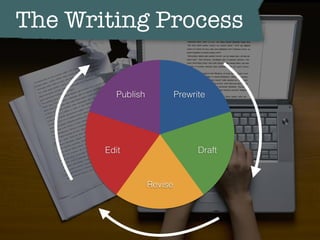
The Writing Process
Publish
Edit
Revise
Draft
Prewrite
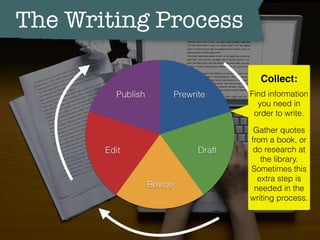
The Writing Process
Publish
Edit
Revise
Draft
Prewrite
Collect:
Find information
you need in
order to write.
Gather quotes
from a book, or
do research at
the library.
Sometimes this
extra step is
needed in the
writing process.
Prewrite
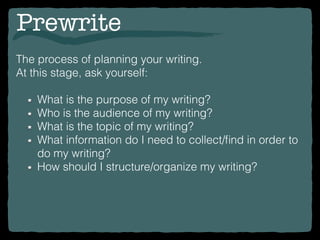
The process of planning your writing.
At this stage, ask yourself:
What is the purpose of my writing?
Who is the audience of my writing?
What is the topic of my writing?
What information do I need to collect/find in order to
do my writing?
How should I structure/organize my writing?
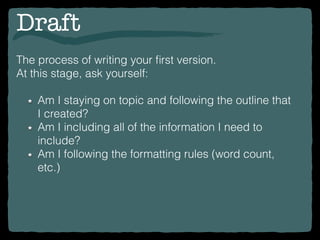
Draft
The process of writing your first version.
At this stage, ask yourself:
Am I staying on topic and following the outline that
I created?
Am I including all of the information I need to
include?
Am I following the formatting rules (word count,
etc.)
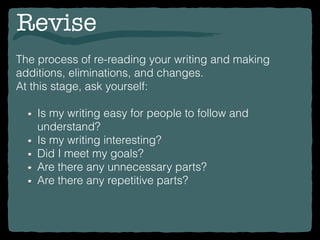
Revise
The process of re-reading your writing and making
additions, eliminations, and changes.
At this stage, ask yourself:
Is my writing easy for people to follow and
understand?
Is my writing interesting?
Did I meet my goals?
Are there any unnecessary parts?
Are there any repetitive parts?
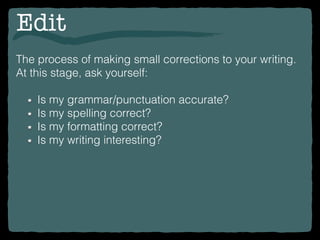
Edit
The process of making small corrections to your writing.
At this stage, ask yourself:
Is my grammar/punctuation accurate?
Is my spelling correct?
Is my formatting correct?
Is my writing interesting?
Publish!
The process of deciding that your final copy is finished
and ready for your audience to read.
Activity: Micro Writing Process!
Today in class you will go through the entire writing
process for a short piece of writing.
Prompt:
Write a story about a time when you learned something
important about yourself. (At least 7 sentences long).
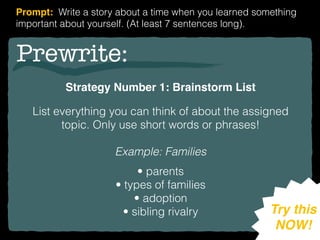
Prewrite:
Prompt: Write a story about a time when you learned something
important about yourself. (At least 7 sentences long).
Strategy Number 1: Brainstorm List
List everything you can think of about the assigned
topic. Only use short words or phrases!
Example: Families
• parents
• types of families
• adoption
• sibling rivalry Try this
NOW!
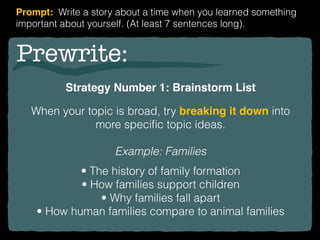
Prewrite:
Strategy Number 1: Brainstorm List
When your topic is broad, try breaking it down into
more specific topic ideas.
Example: Families
• The history of family formation
• How families support children
• Why families fall apart
• How human families compare to animal families
Prompt: Write a story about a time when you learned something
important about yourself. (At least 7 sentences long).
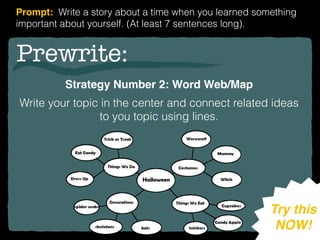
Prewrite:
Strategy Number 2: Word Web/Map
Write your topic in the center and connect related ideas
to you topic using lines.
Try this
NOW!
Prompt: Write a story about a time when you learned something
important about yourself. (At least 7 sentences long).
Prewrite:
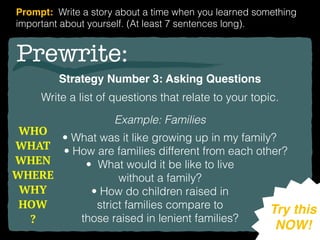
Strategy Number 3: Asking Questions
Write a list of questions that relate to your topic.
Example: Families
• What was it like growing up in my family?
• How are families different from each other?
• What would it be like to live
without a family?
• How do children raised in
strict families compare to
those raised in lenient families?
Try this
NOW!
Prompt: Write a story about a time when you learned something
important about yourself. (At least 7 sentences long).
WHO
WHAT
WHEN

WHERE

WHY 

HOW
?
Prewrite:
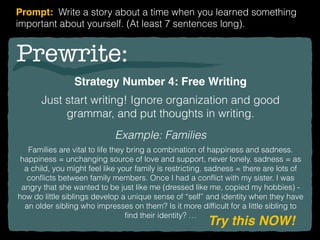
Strategy Number 4: Free Writing
Just start writing! Ignore organization and good
grammar, and put thoughts in writing.
Example: Families
Families are vital to life they bring a combination of happiness and sadness.
happiness = unchanging source of love and support, never lonely. sadness = as
a child, you might feel like your family is restricting. sadness = there are lots of
conflicts between family members. Once I had a conflict with my sister. I was
angry that she wanted to be just like me (dressed like me, copied my hobbies) -
how do little siblings develop a unique sense of “self” and identity when they have
an older sibling who impresses on them? Is it more difficult for a little sibling to
find their identity? …
Try this NOW!
Prompt: Write a story about a time when you learned something
important about yourself. (At least 7 sentences long).
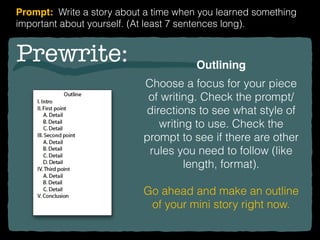
Prewrite: Outlining
Choose a focus for your piece
of writing. Check the prompt/
directions to see what style of
writing to use. Check the
prompt to see if there are other
rules you need to follow (like
length, format).
Go ahead and make an outline
of your mini story right now.
Prompt: Write a story about a time when you learned something
important about yourself. (At least 7 sentences long).
Draft:
Go ahead and write your mini story now!
Prompt: Write a story about a time when you learned something
important about yourself. (At least 7 sentences long).
Revise:
Re-read your story. Change
your story in some way to
make it better. Revision is not
about looking for little errors
like spelling mistakes: it’s
about altering sentences,
paragraphs, and structure.
Prompt: Write a story about a time when you learned something
important about yourself. (At least 7 sentences long).
Revise:
Change your story in some
way to make it better.
Ideas:
• Pick your worst-sounding
sentence, and re-write it.
• Pick a part that is unclear, and
make it clearer.
• Pick a part that lacks specific
details, and add some more.
• Change the order of events/
information in your writing.
Prompt: Write a story that is at least 7 sentences long. Your story
must be about a character facing a scary situation.
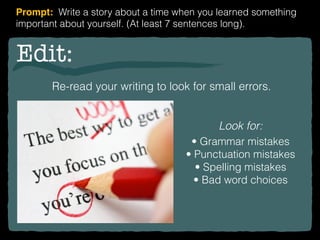
Edit:
Re-read your writing to look for small errors.
Look for:
• Grammar mistakes
• Punctuation mistakes
• Spelling mistakes
• Bad word choices
Prompt: Write a story about a time when you learned something
important about yourself. (At least 7 sentences long).
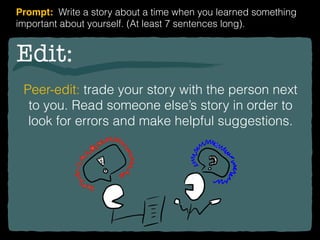
Edit:
Peer-edit: trade your story with the person next
to you. Read someone else’s story in order to
look for errors and make helpful suggestions.
Prompt: Write a story about a time when you learned something
important about yourself. (At least 7 sentences long).
Publish:
Turn your
story in!
Prompt: Write a story about a time when you learned something
important about yourself. (At least 7 sentences long).
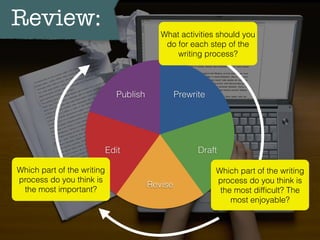
Review:
Publish
Edit
Revise
Draft
Prewrite
What activities should you
do for each step of the
writing process?
Which part of the writing
process do you think is
the most difficult? The
most enjoyable?
Which part of the writing
process do you think is
the most important?

The Writing Process

  • 1.
  • 2.
    What is YOUR writingprocess? In other words, what are the steps you take to write something? The Writing Process
  • 3.
  • 4.
    The Writing Process Publish Edit Revise Draft Prewrite Collect: Findinformation you need in order to write. Gather quotes from a book, or do research at the library. Sometimes this extra step is needed in the writing process.
  • 5.
    Prewrite The process ofplanning your writing. At this stage, ask yourself: What is the purpose of my writing? Who is the audience of my writing? What is the topic of my writing? What information do I need to collect/find in order to do my writing? How should I structure/organize my writing?
  • 6.
    Draft The process ofwriting your first version. At this stage, ask yourself: Am I staying on topic and following the outline that I created? Am I including all of the information I need to include? Am I following the formatting rules (word count, etc.)
  • 7.
    Revise The process ofre-reading your writing and making additions, eliminations, and changes. At this stage, ask yourself: Is my writing easy for people to follow and understand? Is my writing interesting? Did I meet my goals? Are there any unnecessary parts? Are there any repetitive parts?
  • 8.
    Edit The process ofmaking small corrections to your writing. At this stage, ask yourself: Is my grammar/punctuation accurate? Is my spelling correct? Is my formatting correct? Is my writing interesting?
  • 9.
    Publish! The process ofdeciding that your final copy is finished and ready for your audience to read.
  • 10.
    Activity: Micro WritingProcess! Today in class you will go through the entire writing process for a short piece of writing. Prompt: Write a story about a time when you learned something important about yourself. (At least 7 sentences long).
  • 11.
    Prewrite: Prompt: Write astory about a time when you learned something important about yourself. (At least 7 sentences long). Strategy Number 1: Brainstorm List List everything you can think of about the assigned topic. Only use short words or phrases! Example: Families • parents • types of families • adoption • sibling rivalry Try this NOW!
  • 12.
    Prewrite: Strategy Number 1:Brainstorm List When your topic is broad, try breaking it down into more specific topic ideas. Example: Families • The history of family formation • How families support children • Why families fall apart • How human families compare to animal families Prompt: Write a story about a time when you learned something important about yourself. (At least 7 sentences long).
  • 13.
    Prewrite: Strategy Number 2:Word Web/Map Write your topic in the center and connect related ideas to you topic using lines. Try this NOW! Prompt: Write a story about a time when you learned something important about yourself. (At least 7 sentences long).
  • 14.
    Prewrite: Strategy Number 3:Asking Questions Write a list of questions that relate to your topic. Example: Families • What was it like growing up in my family? • How are families different from each other? • What would it be like to live without a family? • How do children raised in strict families compare to those raised in lenient families? Try this NOW! Prompt: Write a story about a time when you learned something important about yourself. (At least 7 sentences long). WHO WHAT WHEN
 WHERE
 WHY 
 HOW ?
  • 15.
    Prewrite: Strategy Number 4:Free Writing Just start writing! Ignore organization and good grammar, and put thoughts in writing. Example: Families Families are vital to life they bring a combination of happiness and sadness. happiness = unchanging source of love and support, never lonely. sadness = as a child, you might feel like your family is restricting. sadness = there are lots of conflicts between family members. Once I had a conflict with my sister. I was angry that she wanted to be just like me (dressed like me, copied my hobbies) - how do little siblings develop a unique sense of “self” and identity when they have an older sibling who impresses on them? Is it more difficult for a little sibling to find their identity? … Try this NOW! Prompt: Write a story about a time when you learned something important about yourself. (At least 7 sentences long).
  • 16.
    Prewrite: Outlining Choose afocus for your piece of writing. Check the prompt/ directions to see what style of writing to use. Check the prompt to see if there are other rules you need to follow (like length, format). Go ahead and make an outline of your mini story right now. Prompt: Write a story about a time when you learned something important about yourself. (At least 7 sentences long).
  • 17.
    Draft: Go ahead andwrite your mini story now! Prompt: Write a story about a time when you learned something important about yourself. (At least 7 sentences long).
  • 18.
    Revise: Re-read your story.Change your story in some way to make it better. Revision is not about looking for little errors like spelling mistakes: it’s about altering sentences, paragraphs, and structure. Prompt: Write a story about a time when you learned something important about yourself. (At least 7 sentences long).
  • 19.
    Revise: Change your storyin some way to make it better. Ideas: • Pick your worst-sounding sentence, and re-write it. • Pick a part that is unclear, and make it clearer. • Pick a part that lacks specific details, and add some more. • Change the order of events/ information in your writing. Prompt: Write a story that is at least 7 sentences long. Your story must be about a character facing a scary situation.
  • 20.
    Edit: Re-read your writingto look for small errors. Look for: • Grammar mistakes • Punctuation mistakes • Spelling mistakes • Bad word choices Prompt: Write a story about a time when you learned something important about yourself. (At least 7 sentences long).
  • 21.
    Edit: Peer-edit: trade yourstory with the person next to you. Read someone else’s story in order to look for errors and make helpful suggestions. Prompt: Write a story about a time when you learned something important about yourself. (At least 7 sentences long).
  • 22.
    Publish: Turn your story in! Prompt:Write a story about a time when you learned something important about yourself. (At least 7 sentences long).
  • 23.
    Review: Publish Edit Revise Draft Prewrite What activities shouldyou do for each step of the writing process? Which part of the writing process do you think is the most difficult? The most enjoyable? Which part of the writing process do you think is the most important?