College English Writing
www.themegallery.comwww.themegallery.com Company LogoCompany Logo
To introduce the course
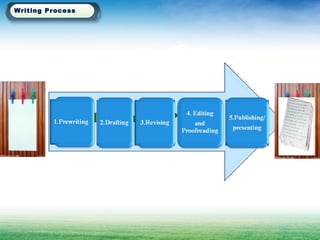
To learn the writing process
Teaching Objectives
11
22
How do you write?
Directions:
Write down your responses to the following
questions. When you are finished, compare your
responses with those of one classmate. (You will
report to the class.)
 1.When you sit down to write English
compositions, how do you start?
(For example, do you just write? Do you make an
outline first? Do you put off writing until the last
possible minute? Do you use some prewriting
techniques? )
 2.What do you do while you write?
(For instance, do you take breaks often? Do you
show a friend what you’re working on? Do you
look up a dictionary when you are not sure of
the meaning of a word?)
 3.How do you feel after you finish writing?
(Relieved? Satisfied? Happy with what you’ve
written? Just glad it’s over with?)
 4. What do you do with your first draft?
(Revise ? Throw it away? Ask your classmates to
comment on it?)
Share with the class
Go to the topic directly.
Write down whatever comes to my mind.
Think about the topic for several seconds.
Make a plan first.
I feel so relieved when I finish my writing work.
I never spend time on the finished copy.
I will read my manuscript several times to check
whether there are some errors.
…
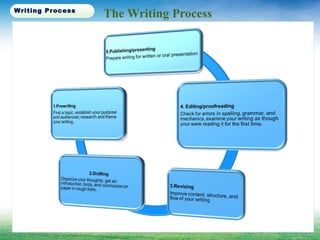
The Writing Process
The Writing Process
Writing Process
The Writing ProcessWriting Process
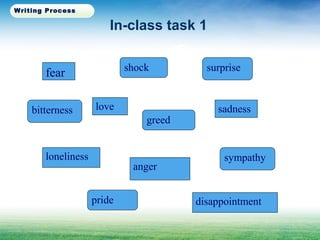
In-class task 1
fear
love
shock
sadness
loneliness
anger
sympathy
surprise
bitterness
greed
pride disappointment
Writing Process
In-class task 1
Directions:
 Think of an experience or event in your life in
which you felt a certain emotion---
disappointment, embarrassment,
happiness, frustration….
 Then spend ten minutes prewriting the
experience.
Writing Process
Writing Process
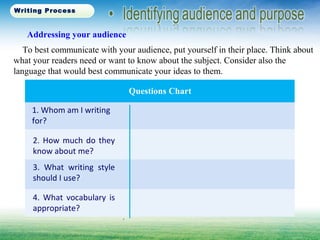
Addressing your audience
To best communicate with your audience, put yourself in their place. Think about
what your readers need or want to know about the subject. Consider also the
language that would best communicate your ideas to them.
Questions Chart
1. Whom am I writing
for?
2. How much do they
know about me?
3. What writing style
should I use?
.
4. What vocabulary is
appropriate?
Writing Process
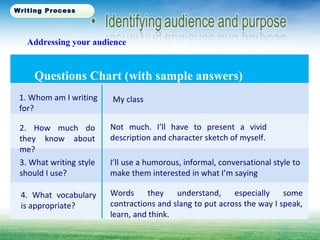
Addressing your audience
Questions Chart (with sample answers)
1. Whom am I writing
for?
My class
Not much. I’ll have to present a vivid
description and character sketch of myself.
2. How much do
they know about
me?
I’ll use a humorous, informal, conversational style to
make them interested in what I’m saying
3. What writing style
should I use?
Words they understand, especially some
contractions and slang to put across the way I speak,
learn, and think.
4. What vocabulary
is appropriate?
Writing Process
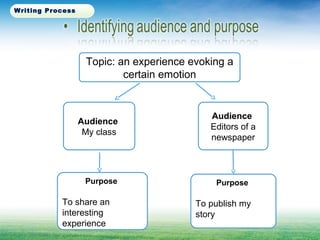
Topic: an experience evoking a
certain emotion
Audience
My class
Purpose
To share an
interesting
experience
Audience
Editors of a
newspaper
Purpose
To publish my
story
Writing Process
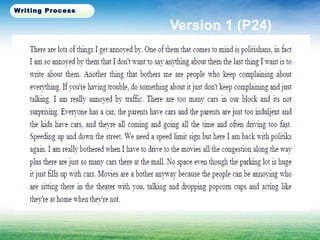
Version 1 (P24)
Writing Process
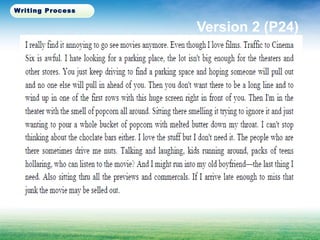
Version 2 (P24)
Writing Process
Freewriting
Freewriting, thinking on paper, means jotting
down in rough sentences or phrases everything
that comes to mind about a possible topic.
Writing Process
Freewriting session
Directions: You are given five minutes to write
down anything that comes to your mind about
the topic---an experience that evokes certain
emotions.
Writing Process
I’d like to write about my nervousness. There are
so many occasions about which I feel nervous.
For example, when I deliver a speech in public, I
feel nervous; when I attend an important
examination, I feel uneasy and nervous. But I
want to write about my bitter but sweet
experience. The summer of 2007 was a season I
will never forget. When I visited London, I was
pick pocketed and I nearly lost everything that I
needed to live in a foreign country----all the
money, ID card, and credit cards. You know what
I felt at that moment, desperate. Right!
Desperate!
Writing Process
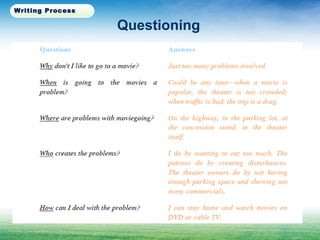
Questioning
In questioning, you generate ideas and details
by asking questions about your subject.
Writing Process
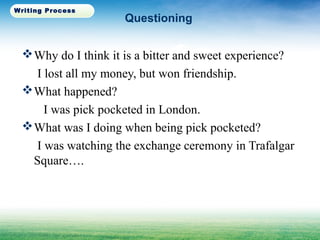
Questioning
Why do I think it is a bitter and sweet experience?
I lost all my money, but won friendship.
What happened?
I was pick pocketed in London.
What was I doing when being pick pocketed?
I was watching the exchange ceremony in Trafalgar
Square….
Writing Process
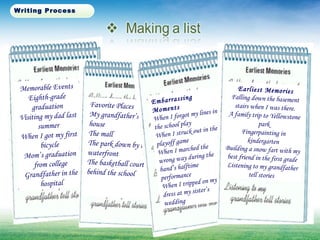
Memorable Events
Eighth-grade
graduation
Visiting my dad last
summer
When I got my first
bicycle
Mom’s graduation
from college
Grandfather in the
hospital
Favorite Places
My grandfather’s
house
The mall
The park down by the
waterfront
The basketball court
behind the school
Embarrassing
Moments
When I forgot my lines in
the school play
When I struck out in the
playoff game
When I marched the
wrong way during the
band’s halftime
performance
When I tripped on my
dress at my sister’s
wedding
Earliest Memories
Falling down the basement
stairs when I was there.
A family trip to Yellowstone
park
Fingerpainting in
kindergarten
Building a snow fart with my
best friend in the first grade
Listening to my grandfather
tell stories
Writing Process
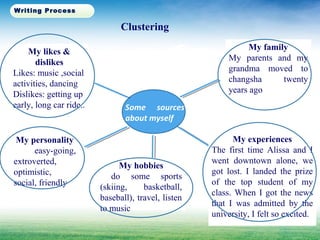
Some sources
about myself
My likes &
dislikes
Likes: music ,social
activities, dancing
Dislikes: getting up
early, long car ride..
My personality
easy-going,
extroverted,
optimistic,
social, friendly
My hobbies
do some sports
(skiing, basketball,
baseball), travel, listen
to music
My family
My parents and my
grandma moved to
changsha twenty
years ago
My experiences
The first time Alissa and I
went downtown alone, we
got lost. I landed the prize
of the top student of my
class. When I got the news
that I was admitted by the
university, I felt so excited.
Clustering
Writing Process
Writing Process
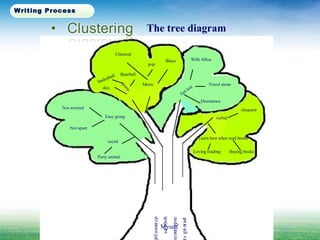
The tree diagram
Myself
personalit
hobbies
experience
learningst
Easy going
social
Not upset
Not worried
sports
basketball
skis
Music
pop
Classical
Get lost
Downtown
Travel alone
With Allisa
verbal
eloquent
Learn best when read books
Loving reading Buying books
Party animal
Baseball
Blues
Writing Process
Preparing a scratch outline
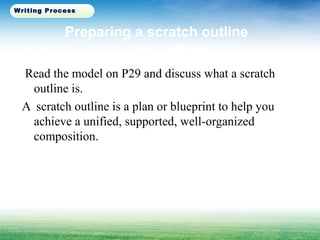
Read the model on P29 and discuss what a scratch
outline is.
A scratch outline is a plan or blueprint to help you
achieve a unified, supported, well-organized
composition.
Writing Process
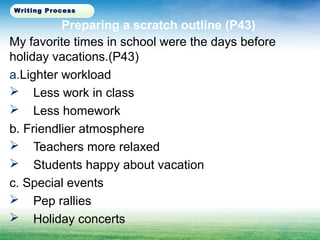
Preparing a scratch outline (P43)
My favorite times in school were the days before
holiday vacations.(P43)
a.Lighter workload
 Less work in class
 Less homework
b. Friendlier atmosphere
 Teachers more relaxed
 Students happy about vacation
c. Special events
 Pep rallies
 Holiday concerts
Writing Process
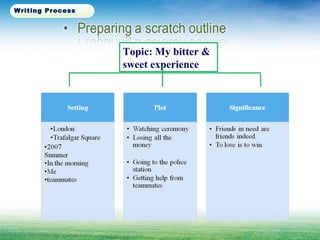
Topic: My bitter &
sweet experience
Writing Process
Prewriting
 Freewriting
 Questioning
 Making a list
 Clustering
 Preparing a scratch outline
 Identifying audience and purpose
Writing Process
Practice
P. 39 identify each technique by writing:
F-freewriting
Q-questionning
L-list-making
C-clustering
SO- the scratch outline
L, Q, SO, C, F
Writing Process
2. Drafting
Writing Process
For a piece of writing to achieve unity, each sentence
must support the main idea of each paragraph, and each
paragraph must support the main idea of the essay.
Writing Process
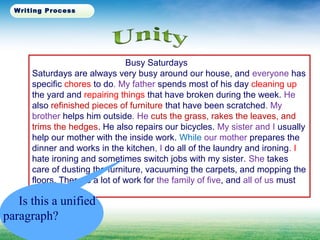
Busy Saturdays
Saturdays are always very busy around our house, and everyone has
specific chores to do. My father spends most of his day cleaning up
the yard and repairing things that have broken during the week. He
also refinished pieces of furniture that have been scratched. My
brother helps him outside. He cuts the grass, rakes the leaves, and
trims the hedges. He also repairs our bicycles. My sister and I usually
help our mother with the inside work. While our mother prepares the
dinner and works in the kitchen, I do all of the laundry and ironing. I
hate ironing and sometimes switch jobs with my sister. She takes
care of dusting the furniture, vacuuming the carpets, and mopping the
floors. There is a lot of work for the family of five, and all of us must
do our share.
Is this a unified
paragraph?
Writing Process
Writing Process
P.44 Unity and coherence
Activity 2
Writing Process
Thesis: More and more, the inventions of
modern technology seem to be cutting off
contact between ourselves and our fellow
human beings.
Writing Process
First topic sentence:The world of business is
one area in which technology is isolating us.
Support: 2. Workers’ salaries are automatically
credited to their bank accounts.
 3. Personal banking is becoming a
detached process.
 a. Customers interact with
machines rather than people.
 b. Some loans are accepted or
rejected by computers, not loan officers.
Writing Process
Second topic sentence: Another area where
technology is changing is entertainment.
Support: 1. For many people now, music is a
solitary experience.
 2. Fewer people go out to watch
movies.
Writing Process
Third topic sentence: Education is another
important area in which technology is separating
us from others.
Support: 1. Students sit alone in front of
computers.
 2. Students use technological devices
at home instead of interacting with others.
 3. Videolessons are replacing class
instructions.
Writing Process
3. Revising
Writing Process
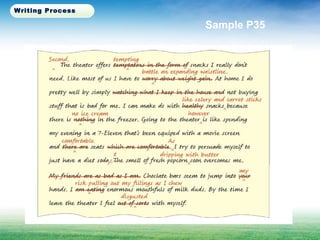
Sample P35
Writing Process
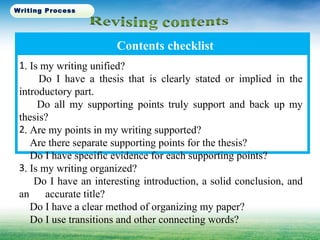
Contents checklist
1. Is my writing unified?
Do I have a thesis that is clearly stated or implied in the
introductory part.
Do all my supporting points truly support and back up my
thesis?
2. Are my points in my writing supported?
Are there separate supporting points for the thesis?
Do I have specific evidence for each supporting points?
3. Is my writing organized?
Do I have an interesting introduction, a solid conclusion, and
an accurate title?
Do I have a clear method of organizing my paper?
Do I use transitions and other connecting words?
Writing Process
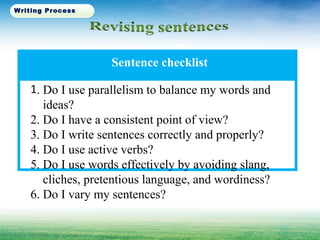
Sentence checklist
1. Do I use parallelism to balance my words and
ideas?
2. Do I have a consistent point of view?
3. Do I write sentences correctly and properly?
4. Do I use active verbs?
5. Do I use words effectively by avoiding slang,
cliches, pretentious language, and wordiness?
6. Do I vary my sentences?
Writing Process
P46 Revising Activity
Writing Process
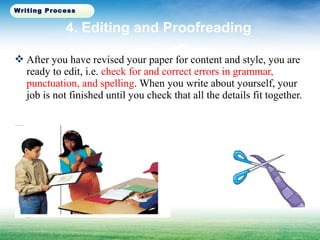
 After you have revised your paper for content and style, you are
ready to edit, i.e. check for and correct errors in grammar,
punctuation, and spelling. When you write about yourself, your
job is not finished until you check that all the details fit together.
4. Editing and Proofreading
Writing Process
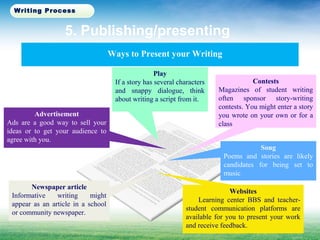
5. Publishing/presenting
Websites
Learning center BBS and teacher-
student communication platforms are
available for you to present your work
and receive feedback.
Song
Poems and stories are likely
candidates for being set to
music
Contests
Magazines of student writing
often sponsor story-writing
contests. You might enter a story
you wrote on your own or for a
class
Play
If a story has several characters
and snappy dialogue, think
about writing a script from it.
Advertisement
Ads are a good way to sell your
ideas or to get your audience to
agree with you.
Newspaper article
Informative writing might
appear as an article in a school
or community newspaper.
Ways to Present your Writing
Writing Process
Assignments
Read P 22-46
Finish the activities on P 40
Writing Process
课堂教学设计理念
1. 以学生为主
课堂教学时间分配:教师教 30 mins ,学生练
40 mins ,分享、讲评、讨论 20 mins
2. 教师协调、辅导、组织、讲评、选材、制定标
准、合作
3.workshop 的方式
4. 让学生保持写的状态
See You Next Time!

The Writing Process

  • 1.
  • 2.
    www.themegallery.comwww.themegallery.com Company LogoCompanyLogo To introduce the course To learn the writing process Teaching Objectives 11 22
  • 3.
    How do youwrite? Directions: Write down your responses to the following questions. When you are finished, compare your responses with those of one classmate. (You will report to the class.)
  • 4.
     1.When yousit down to write English compositions, how do you start? (For example, do you just write? Do you make an outline first? Do you put off writing until the last possible minute? Do you use some prewriting techniques? )
  • 5.
     2.What doyou do while you write? (For instance, do you take breaks often? Do you show a friend what you’re working on? Do you look up a dictionary when you are not sure of the meaning of a word?)
  • 6.
     3.How doyou feel after you finish writing? (Relieved? Satisfied? Happy with what you’ve written? Just glad it’s over with?)  4. What do you do with your first draft? (Revise ? Throw it away? Ask your classmates to comment on it?)
  • 7.
    Share with theclass Go to the topic directly. Write down whatever comes to my mind. Think about the topic for several seconds. Make a plan first. I feel so relieved when I finish my writing work. I never spend time on the finished copy. I will read my manuscript several times to check whether there are some errors. …
  • 8.
  • 9.
  • 10.
  • 11.
  • 12.
    In-class task 1 Directions: Think of an experience or event in your life in which you felt a certain emotion--- disappointment, embarrassment, happiness, frustration….  Then spend ten minutes prewriting the experience. Writing Process
  • 13.
  • 14.
    Addressing your audience Tobest communicate with your audience, put yourself in their place. Think about what your readers need or want to know about the subject. Consider also the language that would best communicate your ideas to them. Questions Chart 1. Whom am I writing for? 2. How much do they know about me? 3. What writing style should I use? . 4. What vocabulary is appropriate? Writing Process
  • 15.
    Addressing your audience QuestionsChart (with sample answers) 1. Whom am I writing for? My class Not much. I’ll have to present a vivid description and character sketch of myself. 2. How much do they know about me? I’ll use a humorous, informal, conversational style to make them interested in what I’m saying 3. What writing style should I use? Words they understand, especially some contractions and slang to put across the way I speak, learn, and think. 4. What vocabulary is appropriate? Writing Process
  • 16.
    Topic: an experienceevoking a certain emotion Audience My class Purpose To share an interesting experience Audience Editors of a newspaper Purpose To publish my story Writing Process
  • 17.
  • 18.
  • 19.
    Freewriting Freewriting, thinking onpaper, means jotting down in rough sentences or phrases everything that comes to mind about a possible topic. Writing Process
  • 20.
    Freewriting session Directions: Youare given five minutes to write down anything that comes to your mind about the topic---an experience that evokes certain emotions. Writing Process
  • 21.
    I’d like towrite about my nervousness. There are so many occasions about which I feel nervous. For example, when I deliver a speech in public, I feel nervous; when I attend an important examination, I feel uneasy and nervous. But I want to write about my bitter but sweet experience. The summer of 2007 was a season I will never forget. When I visited London, I was pick pocketed and I nearly lost everything that I needed to live in a foreign country----all the money, ID card, and credit cards. You know what I felt at that moment, desperate. Right! Desperate! Writing Process
  • 22.
    Questioning In questioning, yougenerate ideas and details by asking questions about your subject. Writing Process
  • 23.
    Questioning Why do Ithink it is a bitter and sweet experience? I lost all my money, but won friendship. What happened? I was pick pocketed in London. What was I doing when being pick pocketed? I was watching the exchange ceremony in Trafalgar Square…. Writing Process
  • 24.
    Memorable Events Eighth-grade graduation Visiting mydad last summer When I got my first bicycle Mom’s graduation from college Grandfather in the hospital Favorite Places My grandfather’s house The mall The park down by the waterfront The basketball court behind the school Embarrassing Moments When I forgot my lines in the school play When I struck out in the playoff game When I marched the wrong way during the band’s halftime performance When I tripped on my dress at my sister’s wedding Earliest Memories Falling down the basement stairs when I was there. A family trip to Yellowstone park Fingerpainting in kindergarten Building a snow fart with my best friend in the first grade Listening to my grandfather tell stories Writing Process
  • 25.
    Some sources about myself Mylikes & dislikes Likes: music ,social activities, dancing Dislikes: getting up early, long car ride.. My personality easy-going, extroverted, optimistic, social, friendly My hobbies do some sports (skiing, basketball, baseball), travel, listen to music My family My parents and my grandma moved to changsha twenty years ago My experiences The first time Alissa and I went downtown alone, we got lost. I landed the prize of the top student of my class. When I got the news that I was admitted by the university, I felt so excited. Clustering Writing Process
  • 26.
  • 27.
    The tree diagram Myself personalit hobbies experience learningst Easygoing social Not upset Not worried sports basketball skis Music pop Classical Get lost Downtown Travel alone With Allisa verbal eloquent Learn best when read books Loving reading Buying books Party animal Baseball Blues Writing Process
  • 28.
    Preparing a scratchoutline Read the model on P29 and discuss what a scratch outline is. A scratch outline is a plan or blueprint to help you achieve a unified, supported, well-organized composition. Writing Process
  • 29.
    Preparing a scratchoutline (P43) My favorite times in school were the days before holiday vacations.(P43) a.Lighter workload  Less work in class  Less homework b. Friendlier atmosphere  Teachers more relaxed  Students happy about vacation c. Special events  Pep rallies  Holiday concerts Writing Process
  • 30.
    Topic: My bitter& sweet experience Writing Process
  • 31.
    Prewriting  Freewriting  Questioning Making a list  Clustering  Preparing a scratch outline  Identifying audience and purpose Writing Process
  • 32.
    Practice P. 39 identifyeach technique by writing: F-freewriting Q-questionning L-list-making C-clustering SO- the scratch outline L, Q, SO, C, F Writing Process
  • 33.
  • 34.
    For a pieceof writing to achieve unity, each sentence must support the main idea of each paragraph, and each paragraph must support the main idea of the essay. Writing Process
  • 35.
    Busy Saturdays Saturdays arealways very busy around our house, and everyone has specific chores to do. My father spends most of his day cleaning up the yard and repairing things that have broken during the week. He also refinished pieces of furniture that have been scratched. My brother helps him outside. He cuts the grass, rakes the leaves, and trims the hedges. He also repairs our bicycles. My sister and I usually help our mother with the inside work. While our mother prepares the dinner and works in the kitchen, I do all of the laundry and ironing. I hate ironing and sometimes switch jobs with my sister. She takes care of dusting the furniture, vacuuming the carpets, and mopping the floors. There is a lot of work for the family of five, and all of us must do our share. Is this a unified paragraph? Writing Process
  • 36.
  • 37.
    P.44 Unity andcoherence Activity 2 Writing Process
  • 38.
    Thesis: More andmore, the inventions of modern technology seem to be cutting off contact between ourselves and our fellow human beings. Writing Process
  • 39.
    First topic sentence:Theworld of business is one area in which technology is isolating us. Support: 2. Workers’ salaries are automatically credited to their bank accounts.  3. Personal banking is becoming a detached process.  a. Customers interact with machines rather than people.  b. Some loans are accepted or rejected by computers, not loan officers. Writing Process
  • 40.
    Second topic sentence:Another area where technology is changing is entertainment. Support: 1. For many people now, music is a solitary experience.  2. Fewer people go out to watch movies. Writing Process
  • 41.
    Third topic sentence:Education is another important area in which technology is separating us from others. Support: 1. Students sit alone in front of computers.  2. Students use technological devices at home instead of interacting with others.  3. Videolessons are replacing class instructions. Writing Process
  • 42.
  • 43.
  • 44.
    Contents checklist 1. Ismy writing unified? Do I have a thesis that is clearly stated or implied in the introductory part. Do all my supporting points truly support and back up my thesis? 2. Are my points in my writing supported? Are there separate supporting points for the thesis? Do I have specific evidence for each supporting points? 3. Is my writing organized? Do I have an interesting introduction, a solid conclusion, and an accurate title? Do I have a clear method of organizing my paper? Do I use transitions and other connecting words? Writing Process
  • 45.
    Sentence checklist 1. DoI use parallelism to balance my words and ideas? 2. Do I have a consistent point of view? 3. Do I write sentences correctly and properly? 4. Do I use active verbs? 5. Do I use words effectively by avoiding slang, cliches, pretentious language, and wordiness? 6. Do I vary my sentences? Writing Process
  • 46.
  • 47.
     After youhave revised your paper for content and style, you are ready to edit, i.e. check for and correct errors in grammar, punctuation, and spelling. When you write about yourself, your job is not finished until you check that all the details fit together. 4. Editing and Proofreading Writing Process
  • 48.
    5. Publishing/presenting Websites Learning centerBBS and teacher- student communication platforms are available for you to present your work and receive feedback. Song Poems and stories are likely candidates for being set to music Contests Magazines of student writing often sponsor story-writing contests. You might enter a story you wrote on your own or for a class Play If a story has several characters and snappy dialogue, think about writing a script from it. Advertisement Ads are a good way to sell your ideas or to get your audience to agree with you. Newspaper article Informative writing might appear as an article in a school or community newspaper. Ways to Present your Writing Writing Process
  • 49.
    Assignments Read P 22-46 Finishthe activities on P 40 Writing Process
  • 50.
    课堂教学设计理念 1. 以学生为主 课堂教学时间分配:教师教 30mins ,学生练 40 mins ,分享、讲评、讨论 20 mins 2. 教师协调、辅导、组织、讲评、选材、制定标 准、合作 3.workshop 的方式 4. 让学生保持写的状态
  • 51.

Editor's Notes

  • #3 第一节课的重点在于,使学生了解本课程教学内容,学生和老师的职责,评分细则等大纲上的内容,第二个重点即了解写作过程,并会使用写前技能。
  • #4 在这部分之前还有大纲内容的学习讲解, 让学生了解本学期的任务,然后才是引入部分,即回答问题,注意回答问题是要学生在纸上写出答案来的,时间大约为五分钟。
  • #8 可能的答案如上,教师可以根据学生回答的情况进行总结然后引出话题:写作过程
  • #10 Today we are going to write to discover ourselves. When you write, you will move through a series of stages to create a finished product, namely, 1. Prewriting 2. Drafting 3. Revising 4. Editing and Proofreading 5. Publishing/presenting When you write, your own mind, methods, temperament, and interests will make your writing unique. Like all writers, however, you will move through a series of stages to create a finished product. Understanding the writing process, from prewriting through publishing/presenting, will help you know how to proceed, whether that means taking two steps forward or one step back.
  • #11 The diagram below shows the 5 stages and what a writer should do in the 5 stages. The diagram below shows that you cannot find a shortcut from start to finish, but you can follow many different paths. You may choose one that leads to a dead end. You may make a discovery that opens up new directions. At any point, you may decide to return to the prewriting stage. Even as they are revising or editing, successful writers often return to earlier stages to clarify or expand their thinking.
  • #13 学生写完之后,找出一个样本进行分析,提出下列问题,写作目的?写作对象? 写作方式?然后进入讲解如何鉴定目的和写作对象,再进入写作的几个策略
  • #14 jEvery successful piece of writing, whether it’s a newspaper editorial or a cartoon, has a particular purpose and audience. Look at the notice below.What could be the purpose, or reason, for this piece of writing? Who’s supposed to read it? You need to think about questions like these in the prewriting stage. Before you begin drafting, you need to decide whose attention you’re trying to get and why.
  • #15 串词:To make sure that your writing will reach its intended audience, you can ask yourself several questions. The questions below can help you determine how to address your audience.
  • #16 串词:To make sure that your writing will reach its intended audience, you can ask yourself several questions. The questions below can help you determine how to address your audience.
  • #17 串词:In fact, besides your audience, you must also pin down your purpose for writing at the same time. From the above slide we can see that your audience and purpose for writing are closely related. For different purposes, you might choose different writing styles, narrative, description, exposition, or argumentation. Throughout the writing process, take care to use ideas and language that are appropriate for your audience and your purpose. If you write a speech for your class, you might include lively anecdotes and use informal language. But if you’re presenting it to the local academic society, you might use more formal language and make absolutely certain that you have all the facts straight. Create a chart like this one to help you explore different audiences and purposes. Notice how your purposes might vary if you were writing for the first audience as opposed to the second one.
  • #18 让学生阅读24页内容,了解如何进行freewriting
  • #21 如果大多数学生采用这一策略,这时可以忽略这个练习了。
  • #22 这是个自己写的样本,老师可以根据自己的经历重新写。
  • #24 Asking personal questions is one way to get started writing about yourself. In the model on page 8,Momaday probably began with questions about his Kiowa heritage and then found answers as he recalled experiences, feelings, and observations. You can review elements of your own life to learn more about who you are, as the diagram below illustrates.
  • #25 串词:In making a list, also known as brainstorming, you collect ideas and details that relate to your subject. 串词:Pile these items up, one after another, without tying to sort out major details from minor ones or trying to put the details in any special order. Your goal is just to make a list of everything about yourself that occurs to you. 串词:Once you’ve finished your lists, look them over and underline the ideas that seem most interesting to you. Draw lines between related ideas. After that, maybe you can ask youself several questions. Did any unexpected ideas appear? Did you recall events you had not thought about for a long time? Did you learn something new about yourself? Then you maybe need to cluster your ideas about yourself to locate appropriate contents for your writing.
  • #26 My family My parents and my grandma, moved to changsha twenty years ago My learning style reflective, verbal and sequential, I learn best when I read books.   串词:Clustering can help you decide which part of yourself to write about. You can’t write about every idea, but you might discover surprising connections. Clustering can also help you organize your writing by showing you which idea about yourself is broader or narrower than other ideas.
  • #28 If you find your ideas cannot be shown clearly in the above mind map, you can cluster them in a tree diagram. After diagramming your ideas, you may need to make a scratch outline to help you achieve a unified, supported, well-organized composition.
  • #31 串词:When you are planning a traditional essay consisting of an introduction, several supporting paragraphs, and a conclusion, a scratch outline is especially important. It may be only a few words, but  well done, you need to still pay attention to another factor before drafting, i.e. determine your purpose and  the audience for your writing.  well  the audience for your writing
  • #34 串词:You’re now ready to write a first draft of your essay, story, or report. How should you begin? By drafting, you turn your lists, clusters, and other prewriting work into sentences and paragraphs. Your first draft will not be perfect. It’s your first try at presenting your ideas in an order that makes sense and shaping them into paragraphs, where you must achieve unity and coherence.
  • #35 串词: The main idea, yourself, determines which details, facts, and examples you include in that piece of writing. You should be able to express your main idea in a topic sentence when you write a paragraph, or in a thesis statement when you write an essay. If you are having trouble expressing your main idea, one strategy is to look at your prewriting notes and allow the idea to emerge from the specific details. Once you’ve pinned down a thesis statement, some of your details will become irrelevant. Other data may be missing, so you will have to return to prewriting and do more research on your topic.
  • #36 串词:Coherent writing develops connections between one sentence or paragraph and the next. Sentences and paragraphs must be arranged in a clear, logical order so that thoughts flow smoothly. You observe many of the rules of coherence automatically when you speak or write:
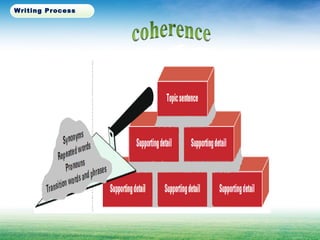
  • #37 串词:Focusing on yourself, sentences and paragraphs must be connected in a logical manner, i.e. write coherent paragraphs. In a coherent paragraph, all the sentences are clearly and logically connected to one another. Transition words and phrases, repeated words, synonyms, and pronouns are the “glue” or “mortar” you can use to link together sentences and build a better paragraph.
  • #43 Looking at the whole piece of writing rather than just its parts is important when you begin to evaluate and revise. Once your draft is finished, step back and look at it. Does it all go together, or do some parts not belong? Are any parts missing? Are all the parts in order?
  • #45 串词:To revise the content of your essay, ask these questions:
  • #46 To revise sentences in your writing, ask yourself:
  • #48  Just as when a sports car came off the assembly line, someone checked it to see that all its parts held together firmly and all its details were just right.
  • #49 串词:You’ve said everything you wanted to say in the best way possible. You’ve fixed all the errors in your writing. Now it’s time to make a clean, neat, legible version and to present your writing to its intended audience. You can find many ways to present your work.串词:The illustration here shows several ways of presenting your work to different audiences. Forms of presentation include a printed report, a speech, a letter, a submission to a school literary magazine, a written invitation, a press release, a dramatic reading, or a banner. Keeping your audience in mind, ask yourself, How can I present my writing to reach this audience? Will visuals help? Anyway, good luck with your presentation!
  • #50 还需要和陈菁协商阅读材料