THE WRITING
PROCESS
By Carmen V. Burgos Aponte
EDUC 2060
MAY 15TH, 2021
INTER AMERICAN UNIVERSITY OF PUERTO RICO
BARRANQUITAS CAMPUS
DEPARTMENT OF EDUCATION, SOCIAL SCIENCES, AND HUMANISTIC STUDIES
OBJECTIVES
By the end of this module, “The Writing Process, the student will:
• Learn what is writing
• Learn the reasons why we write
• Learn about The Writing Process and how to use it for personal
and academic purposes.
TABLE OF CONTENT
 Objectives
 What Is Writing?
• Why Do We Write?
• Writing for Academic Purposes
 The Writing Process
• Step #1: Planning and Prewriting
• Step #2: Drafting
• Step #3: Editing and Revising
• Step #4: Publishing/Evaluation
• Special Note
 Using The Writing Process In Our Lives as Writers
 References
WHAT IS WRITING?
Writing is both an art and a craft. When we write, we create
something new, either to share it with the rest of the world or to
keep for ourselves. Also, writing gives us a voice, it allows us to have
a say in the world, and it contributes to our identity. Writing is a
form of self-expression, and a form to know other people and to be
known, for we unmask ourselves and uncover knowledge.
WHY DO WE WRITE?
There are plenty of reasons why we write. We have been doing so
since our childhood, but writing is not just a practical task you use
to jot down the grosery list you need for later, nor is it only to
annotate the information teachers give you; we write because we
have something to say, experiences to share, and a world to look at
and reflect upon, which is constantly showing us the value of life.
WRITING FOR ACADEMIC
PURPOSES
When you are a student, you will find yourself writing academic
essays and reports constantly throughout your life at school. You will
be required to follow some specifications in your writing,
considering that it is for evaluation purposes; nevertheless, you can
also be creative at demonstrating your knowledge in your area of
expertise, for your writing represents you as a professional.
THE WRITING
PROCESS
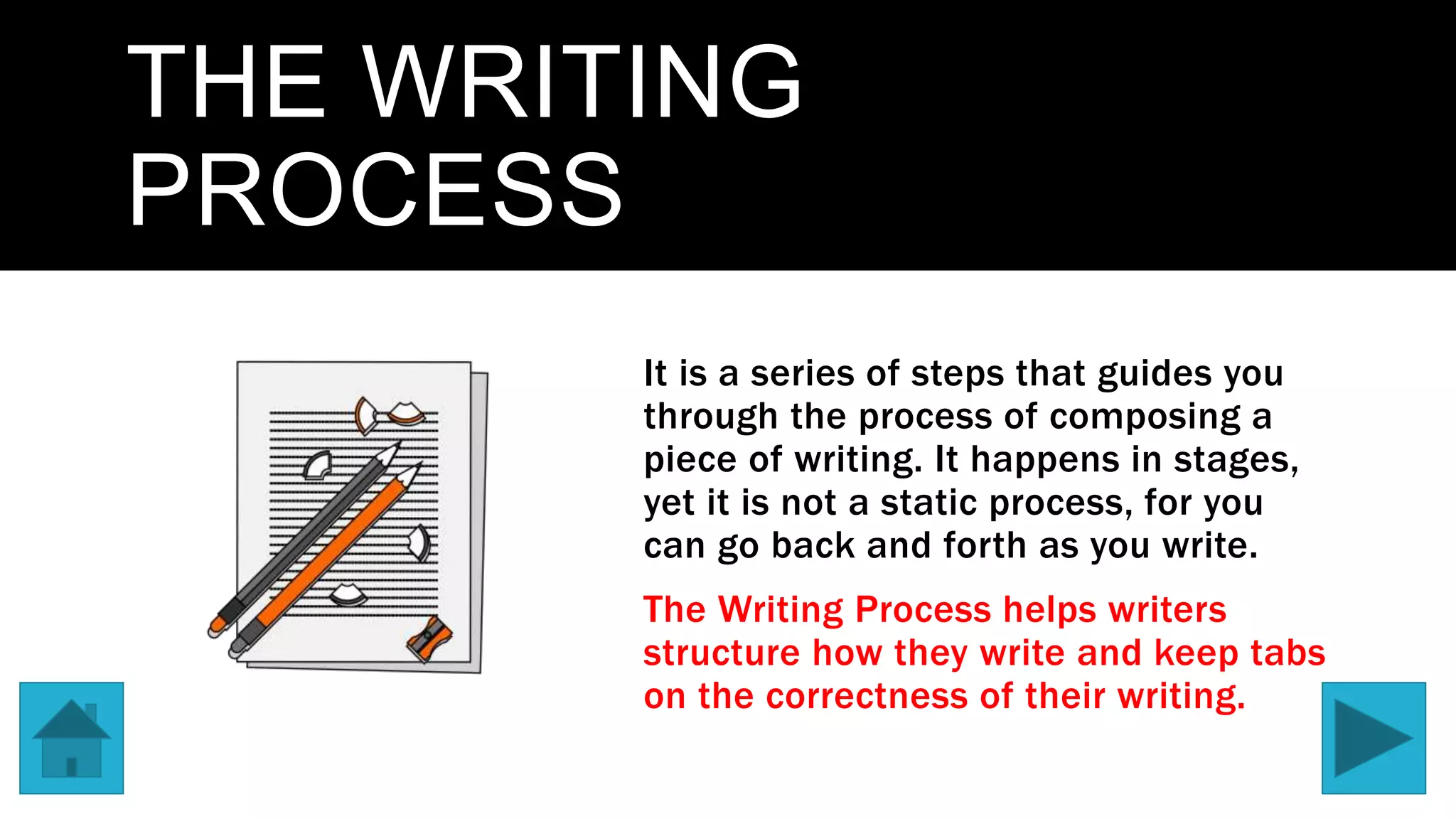
It is a series of steps that guides you
through the process of composing a
piece of writing. It happens in stages,
yet it is not a static process, for you
can go back and forth as you write.
The Writing Process helps writers
structure how they write and keep tabs
on the correctness of their writing.
STEP #1: PLANNING AND
PREWRITING
Before you write, you need to select a topic. Some topics are broad,
therefore, you will need to select specific aspects that you wish to
cover about a topic. For you to do that, you must plan your writing.
Some questions that pop up in our minds when we plan are:
What is my topic? Do I have an argument to share? Or do I wish to
inform people about something? Who is my audience?
STEP #1: PLANNING AND
PREWRITING
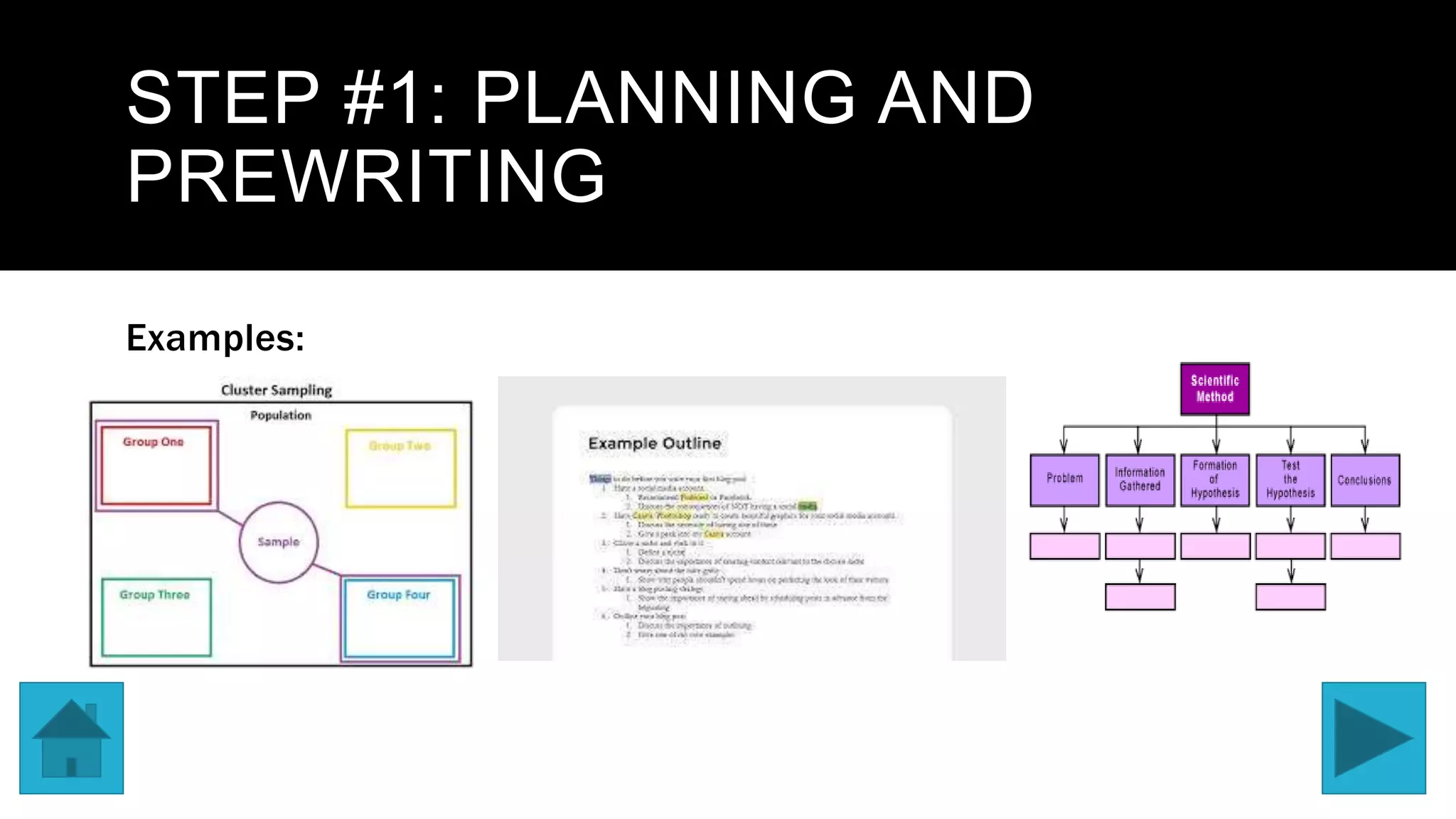
Tools we use to plan and prewrite:
Clusters
Outlines
Graphic Organizers
STEP #1: PLANNING AND
PREWRITING
Examples:
STEP #2: DRAFTING
Once you planned your topic, and you did your research or
brainstorm, you put into action the ideas you jotted down. In this
step you do one simple thing: Write, write, write…
Follow the structure you already planned, but write without
inhibitions. Do not pay attention to anything else that is not flooding
your paper with ideas.
STEP #2: DRAFTING
A great way to write nonstop is to FREEWRITE.
When you freewrite, you only focus on writing everything that you
know in regards to your topic. You can set a timer and see how
many ideas you can attach in a specific amount of time, but do not
pressure yourself. Write freely until you feel the need to stop.
STEP #3: EDITING AND
REVISING
Revising is rereading your paper multiple times. This is the step in
which you check for the quality of the content. Do it as much as it is
needed until the information meets your expectations.
Some questions you may ask are:
Did I include all the details I wanted? Does the information sound
coherent? Did I use the proper words to describe my topic?
STEP #3: EDITING AND
REVISING
When you revise, you:
• Rearrange words, sentences or paragraphs.
• Take out or add parts.
• Do more research if you think you should.
• Replace overused or unclear words.
• Read your writing aloud to be sure it flows smoothly.
STEP #3: EDITING AND
REVISING
When you edit, you:
• Check for grammar
• Check for spelling mistakes
• Check for punctuation and capitalization
• Check for correct style formatting
STEP #3: EDITING AND
REVISING
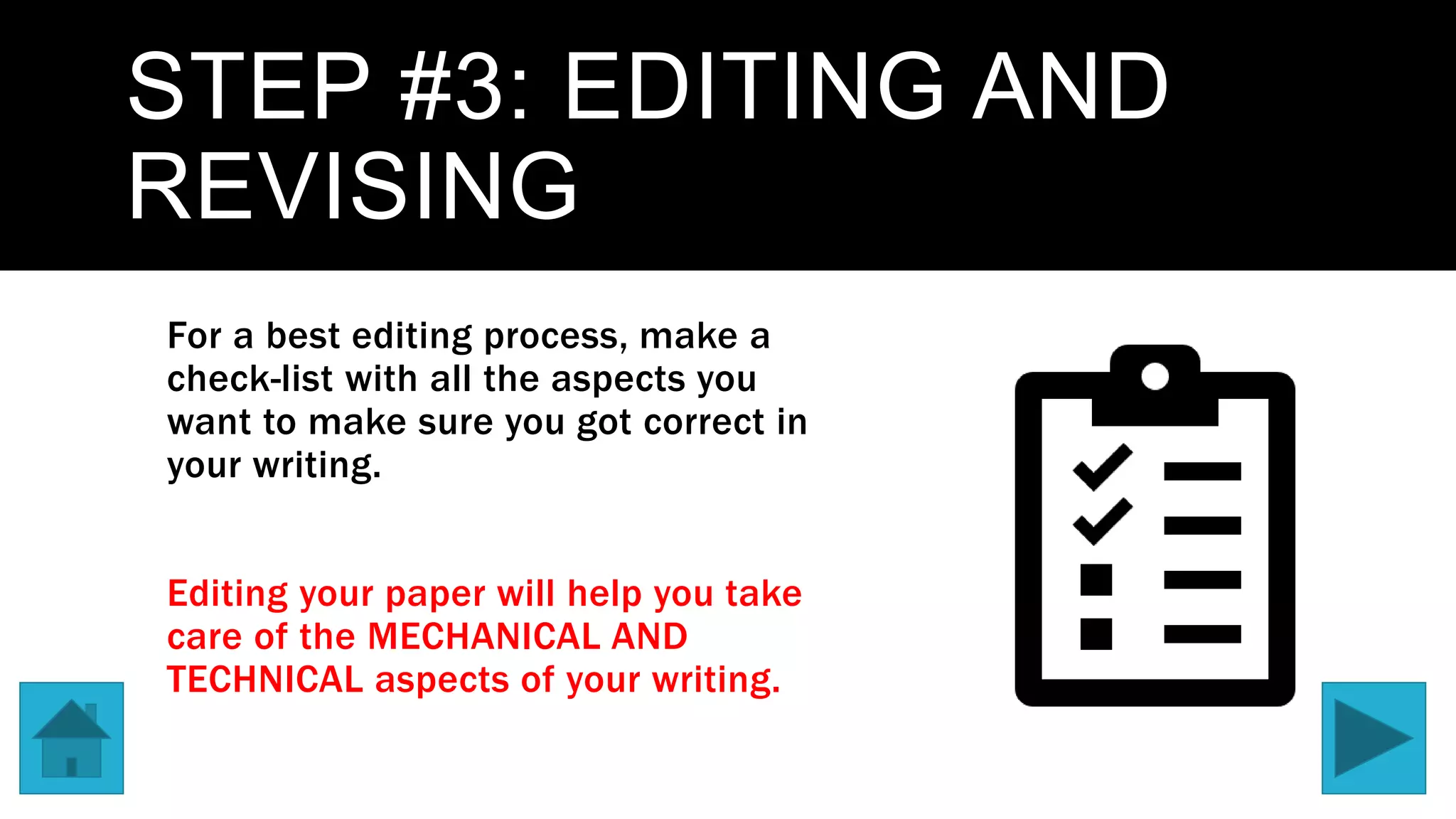
For a best editing process, make a
check-list with all the aspects you
want to make sure you got correct in
your writing.
Editing your paper will help you take
care of the MECHANICAL AND
TECHNICAL aspects of your writing.
STEP #4:
PUBLISHING/EVALUATION
This is our final stage. Your writing has been rightfully revised and
edited until it reached its desired form. It is now time to share your
writing with the world and receive their feedback. Also, if you submit
it for evaluation, you will receive the grading and feedback of your
instructor.
CELEBRATE THAT YOU SUCESSFULLY CONCLUDED THE WRITING
PROCESS!
SPECIAL NOTE
The Writing Process is versatile. You can go back and forth in
between steps as many times as you need. Writing takes time and
there is not one-size-fits-all way to manage our writing. The Writing
Process only serves as guidance, but you can manipulate the
process according to your own writing style and needs.
USING THE WRITING PROCESS
IN OUR LIVES AS WRITERS
As writers, we want to put into practice the best of our abilities in
our writings. Having no structure makes it hard for us to achieve our
level of perfection, which satisfy us and those who read us.
Whenever you write, use The Writing Process as your companion for
a much better and successful writing experience.
REFERENCES
Bunting, J. (2012). Why We Write: Four Reasons. The Write Practice.
https://thewritepractice.com/why-we-write/
Caulfield, J. (2020). A step-by-step guide to the writing process. Scribbr.com. Retrieved May 10,
2021
https://www.scribbr.com/academic-writing/writing-process/
Linn Probst, B. (2020, May 15). Why Do We Write? Artistry, Identity, And Legacy. Writers In The
Storm.
https://writersinthestormblog.com/2020/05/why-do-we-write-probst/
The Writing Process. (2018). KU Writing Center. Retrieved May 10, 2021
https://writing.ku.edu/writing-process
Weiland, K.M. (2018, January 15). 4 (Possible) Reasons Why We Write. Helpingwritersbecome
authors.com
https://www.helpingwritersbecomeauthors.com/why-we-write/
THANK YOU!
See you next time!
EXIT

The Writing Process

  • 1.
    THE WRITING PROCESS By CarmenV. Burgos Aponte EDUC 2060 MAY 15TH, 2021 INTER AMERICAN UNIVERSITY OF PUERTO RICO BARRANQUITAS CAMPUS DEPARTMENT OF EDUCATION, SOCIAL SCIENCES, AND HUMANISTIC STUDIES
  • 2.
    OBJECTIVES By the endof this module, “The Writing Process, the student will: • Learn what is writing • Learn the reasons why we write • Learn about The Writing Process and how to use it for personal and academic purposes.
  • 3.
    TABLE OF CONTENT Objectives  What Is Writing? • Why Do We Write? • Writing for Academic Purposes  The Writing Process • Step #1: Planning and Prewriting • Step #2: Drafting • Step #3: Editing and Revising • Step #4: Publishing/Evaluation • Special Note  Using The Writing Process In Our Lives as Writers  References
  • 4.
    WHAT IS WRITING? Writingis both an art and a craft. When we write, we create something new, either to share it with the rest of the world or to keep for ourselves. Also, writing gives us a voice, it allows us to have a say in the world, and it contributes to our identity. Writing is a form of self-expression, and a form to know other people and to be known, for we unmask ourselves and uncover knowledge.
  • 5.
    WHY DO WEWRITE? There are plenty of reasons why we write. We have been doing so since our childhood, but writing is not just a practical task you use to jot down the grosery list you need for later, nor is it only to annotate the information teachers give you; we write because we have something to say, experiences to share, and a world to look at and reflect upon, which is constantly showing us the value of life.
  • 6.
    WRITING FOR ACADEMIC PURPOSES Whenyou are a student, you will find yourself writing academic essays and reports constantly throughout your life at school. You will be required to follow some specifications in your writing, considering that it is for evaluation purposes; nevertheless, you can also be creative at demonstrating your knowledge in your area of expertise, for your writing represents you as a professional.
  • 7.
    THE WRITING PROCESS It isa series of steps that guides you through the process of composing a piece of writing. It happens in stages, yet it is not a static process, for you can go back and forth as you write. The Writing Process helps writers structure how they write and keep tabs on the correctness of their writing.
  • 8.
    STEP #1: PLANNINGAND PREWRITING Before you write, you need to select a topic. Some topics are broad, therefore, you will need to select specific aspects that you wish to cover about a topic. For you to do that, you must plan your writing. Some questions that pop up in our minds when we plan are: What is my topic? Do I have an argument to share? Or do I wish to inform people about something? Who is my audience?
  • 9.
    STEP #1: PLANNINGAND PREWRITING Tools we use to plan and prewrite: Clusters Outlines Graphic Organizers
  • 10.
    STEP #1: PLANNINGAND PREWRITING Examples:
  • 11.
    STEP #2: DRAFTING Onceyou planned your topic, and you did your research or brainstorm, you put into action the ideas you jotted down. In this step you do one simple thing: Write, write, write… Follow the structure you already planned, but write without inhibitions. Do not pay attention to anything else that is not flooding your paper with ideas.
  • 12.
    STEP #2: DRAFTING Agreat way to write nonstop is to FREEWRITE. When you freewrite, you only focus on writing everything that you know in regards to your topic. You can set a timer and see how many ideas you can attach in a specific amount of time, but do not pressure yourself. Write freely until you feel the need to stop.
  • 13.
    STEP #3: EDITINGAND REVISING Revising is rereading your paper multiple times. This is the step in which you check for the quality of the content. Do it as much as it is needed until the information meets your expectations. Some questions you may ask are: Did I include all the details I wanted? Does the information sound coherent? Did I use the proper words to describe my topic?
  • 14.
    STEP #3: EDITINGAND REVISING When you revise, you: • Rearrange words, sentences or paragraphs. • Take out or add parts. • Do more research if you think you should. • Replace overused or unclear words. • Read your writing aloud to be sure it flows smoothly.
  • 15.
    STEP #3: EDITINGAND REVISING When you edit, you: • Check for grammar • Check for spelling mistakes • Check for punctuation and capitalization • Check for correct style formatting
  • 16.
    STEP #3: EDITINGAND REVISING For a best editing process, make a check-list with all the aspects you want to make sure you got correct in your writing. Editing your paper will help you take care of the MECHANICAL AND TECHNICAL aspects of your writing.
  • 17.
    STEP #4: PUBLISHING/EVALUATION This isour final stage. Your writing has been rightfully revised and edited until it reached its desired form. It is now time to share your writing with the world and receive their feedback. Also, if you submit it for evaluation, you will receive the grading and feedback of your instructor. CELEBRATE THAT YOU SUCESSFULLY CONCLUDED THE WRITING PROCESS!
  • 18.
    SPECIAL NOTE The WritingProcess is versatile. You can go back and forth in between steps as many times as you need. Writing takes time and there is not one-size-fits-all way to manage our writing. The Writing Process only serves as guidance, but you can manipulate the process according to your own writing style and needs.
  • 19.
    USING THE WRITINGPROCESS IN OUR LIVES AS WRITERS As writers, we want to put into practice the best of our abilities in our writings. Having no structure makes it hard for us to achieve our level of perfection, which satisfy us and those who read us. Whenever you write, use The Writing Process as your companion for a much better and successful writing experience.
  • 20.
    REFERENCES Bunting, J. (2012).Why We Write: Four Reasons. The Write Practice. https://thewritepractice.com/why-we-write/ Caulfield, J. (2020). A step-by-step guide to the writing process. Scribbr.com. Retrieved May 10, 2021 https://www.scribbr.com/academic-writing/writing-process/ Linn Probst, B. (2020, May 15). Why Do We Write? Artistry, Identity, And Legacy. Writers In The Storm. https://writersinthestormblog.com/2020/05/why-do-we-write-probst/ The Writing Process. (2018). KU Writing Center. Retrieved May 10, 2021 https://writing.ku.edu/writing-process Weiland, K.M. (2018, January 15). 4 (Possible) Reasons Why We Write. Helpingwritersbecome authors.com https://www.helpingwritersbecomeauthors.com/why-we-write/
  • 21.
    THANK YOU! See younext time! EXIT