WRITING
DESCRIPTIONS
English for Academic Purposes
Prepared by Maria Ahmad
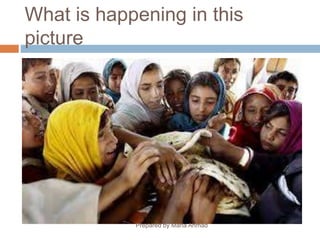
What is happening in this
picture
Prepared by Maria Ahmad
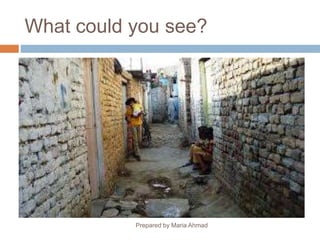
What could you see?
Prepared by Maria Ahmad
How are the son and the father
sleeping?
Prepared by Maria Ahmad
Despite the deplorable conditions, the children
of the area learn to read and write under small
cloth tents and find recreation in mud, bricks and
dirty water…
Prepared by Maria Ahmad
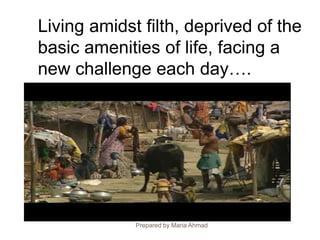
Living amidst filth, deprived of the
basic amenities of life, facing a
new challenge each day….
Prepared by Maria Ahmad
Read the Model Description
A THOUGHT-PROVOKING VISIT: THE SLUMS
OF LAHORE
By Danish Mughal
Prepared by Maria Ahmad
Descriptive Writing
 Descriptive writing provides an illustration of
people, places, events, situations, thoughts,
and feelings. Description presents sensory
information that makes writing come alive. It
expresses an experience that the reader can
actively participate in by using imagination.
Descriptive details aid in developing the overall
dominant impression
Prepared by Maria Ahmad
The Dominant Impression
The dominant impression is a basic idea or
theme that the writer wants to express from
the complexity of the story’s construction.
A city, for example, can be described as
exciting or scary depending on carefully
chosen words, or from a subtly crafted mood.
Prepared by Maria Ahmad
Characteristics of good
descriptive writing
1. Vivid sensory details
2. Precise language ( Use specific adjectives, nouns
and strong action verbs )
3. Order (spatial order, Climactic order, topical
order)
4. Figurative language (Analogies, Similes )
Prepared by Maria Ahmad
Sensory Details
1. Sight: colors, shapes, sizes, patterns
2. Sound: loud or soft; harmonious or harsh;
pleasant or unpleasant
3. Smell: sweet or sour, pleasant or unpleasant,
aromatic or stinky
4. Taste: sweet, bitter, burning, spicy, bland
5. Touch (feel or emotion): hard, soft, rough,
smooth, hot, cold, dry, oily, sticky, sandpapery
Prepared by Maria Ahmad
Order of organization
 Spatial order
 Climactic order (order of importance)
 Topical order
Prepared by Maria Ahmad
Write a phrase that describes each of the following
words in sensory terms. Then note whether you are
describing the word through sight, hearing, smell,
touch, or taste.
 1. Mountains
 ______________________________________________________
____
 2. Fire
 ______________________________________________________
____
 3. Smoke
 ______________________________________________________
____
 4. Dress
 ______________________________________________________
____
 5. Biscuits
 ______________________________________________________
Prepared by Maria Ahmad
Using Figurative Language
 Simile
 Analogies
Prepared by Maria Ahmad
Simile
 A simile uses the words “like” or “as” to
compare one object or idea with another to
suggest they are alike.
Example: busy as a bee
Prepared by Maria Ahmad
Analogy
 An analogy is a comparison between one
thing and another, typically for the purpose
of explanation or clarification.
Example : I feel like a fish out of water
Prepared by Maria Ahmad
Activity…
 Similes
 Analogies
Prepared by Maria Ahmad
Sample Description
 It was very early in the morning. The eastern mountains were
blue-black, but behind them the light stood up faintly colored
at the mountain rims with a washed red, growing colder,
grayer and darker as it went up and overhead until, at a place
near the west, it was merged with pure night. And it was cold,
not painfully so, but cold enough so that I rubbed my hands
and shoved them deep into my pockets, and I hunched my
shoulders up and scuffled my feet in the ground. Down in the
valley where I was, the earth was that lavender gray of dawn.
I walked along a country road and ahead of me I saw a tent
that was only a little lighter gray than the ground. Beside the
tent there was a flash of orange fire seeping out of the cracks
of an old rusty iron stove. Gray smoke spurted up and out of
the stubby stovepipe, spurted up a long way before it spread
out and dispersed.
Prepared by Maria Ahmad
Sample Description
 Then the tent flap jerked up and a young
man came out and an older man followed
him. They were dressed in new blue
dungarees and in new dungaree coats with
the brass buttons shining. They were sharp-
faced men, and they looked much alike. The
younger had a dark stubble beard and the
older had a gray stubble beard. Their heads
and faces were wet, their hair dripped with
water, and water stood on their stiff beards
and their cheeks shone with water.
Prepared by Maria Ahmad
Sample Description
Microcredit involves lending small amounts of money to
very poor people who have a plan for a small business.
Here are only a few types of small businesses that poor
people have started with the help of microcredit: husking
rice, making ice-cream sticks, repairing radios, making
mustard oil, cultivating jackfruit, weaving, opening a small
store, raising a few animals such as cows, chickens, or
pigs, sewing or mending clothes for people, and brewing
beer. Perhaps the greatest thing about microcredit is that it
allows people to immediately use skills that they already
have.
Prepared by Maria Ahmad
Descriptive Assignment
 Write a 300 words long description of ‘ Life
in slums of Pakistan”. You may use the
following words in your assignment:
hole
hovel
joint
mess
shack
shanty
slum
sty
abject
avaricious
base
black
calculated
corrupt
covetous
degenerate
degraded
Prepared by Maria Ahmad
Good Luck with Writing
Description
Prepared by Maria Ahmad

Descriptive writing

  • 1.
    WRITING DESCRIPTIONS English for AcademicPurposes Prepared by Maria Ahmad
  • 2.
    What is happeningin this picture Prepared by Maria Ahmad
  • 3.
    What could yousee? Prepared by Maria Ahmad
  • 4.
    How are theson and the father sleeping? Prepared by Maria Ahmad
  • 5.
    Despite the deplorableconditions, the children of the area learn to read and write under small cloth tents and find recreation in mud, bricks and dirty water… Prepared by Maria Ahmad
  • 6.
    Living amidst filth,deprived of the basic amenities of life, facing a new challenge each day…. Prepared by Maria Ahmad
  • 7.
    Read the ModelDescription A THOUGHT-PROVOKING VISIT: THE SLUMS OF LAHORE By Danish Mughal Prepared by Maria Ahmad
  • 8.
    Descriptive Writing  Descriptivewriting provides an illustration of people, places, events, situations, thoughts, and feelings. Description presents sensory information that makes writing come alive. It expresses an experience that the reader can actively participate in by using imagination. Descriptive details aid in developing the overall dominant impression Prepared by Maria Ahmad
  • 9.
    The Dominant Impression Thedominant impression is a basic idea or theme that the writer wants to express from the complexity of the story’s construction. A city, for example, can be described as exciting or scary depending on carefully chosen words, or from a subtly crafted mood. Prepared by Maria Ahmad
  • 10.
    Characteristics of good descriptivewriting 1. Vivid sensory details 2. Precise language ( Use specific adjectives, nouns and strong action verbs ) 3. Order (spatial order, Climactic order, topical order) 4. Figurative language (Analogies, Similes ) Prepared by Maria Ahmad
  • 11.
    Sensory Details 1. Sight:colors, shapes, sizes, patterns 2. Sound: loud or soft; harmonious or harsh; pleasant or unpleasant 3. Smell: sweet or sour, pleasant or unpleasant, aromatic or stinky 4. Taste: sweet, bitter, burning, spicy, bland 5. Touch (feel or emotion): hard, soft, rough, smooth, hot, cold, dry, oily, sticky, sandpapery Prepared by Maria Ahmad
  • 12.
    Order of organization Spatial order  Climactic order (order of importance)  Topical order Prepared by Maria Ahmad
  • 13.
    Write a phrasethat describes each of the following words in sensory terms. Then note whether you are describing the word through sight, hearing, smell, touch, or taste.  1. Mountains  ______________________________________________________ ____  2. Fire  ______________________________________________________ ____  3. Smoke  ______________________________________________________ ____  4. Dress  ______________________________________________________ ____  5. Biscuits  ______________________________________________________ Prepared by Maria Ahmad
  • 14.
    Using Figurative Language Simile  Analogies Prepared by Maria Ahmad
  • 15.
    Simile  A simileuses the words “like” or “as” to compare one object or idea with another to suggest they are alike. Example: busy as a bee Prepared by Maria Ahmad
  • 16.
    Analogy  An analogyis a comparison between one thing and another, typically for the purpose of explanation or clarification. Example : I feel like a fish out of water Prepared by Maria Ahmad
  • 17.
  • 18.
    Sample Description  Itwas very early in the morning. The eastern mountains were blue-black, but behind them the light stood up faintly colored at the mountain rims with a washed red, growing colder, grayer and darker as it went up and overhead until, at a place near the west, it was merged with pure night. And it was cold, not painfully so, but cold enough so that I rubbed my hands and shoved them deep into my pockets, and I hunched my shoulders up and scuffled my feet in the ground. Down in the valley where I was, the earth was that lavender gray of dawn. I walked along a country road and ahead of me I saw a tent that was only a little lighter gray than the ground. Beside the tent there was a flash of orange fire seeping out of the cracks of an old rusty iron stove. Gray smoke spurted up and out of the stubby stovepipe, spurted up a long way before it spread out and dispersed. Prepared by Maria Ahmad
  • 19.
    Sample Description  Thenthe tent flap jerked up and a young man came out and an older man followed him. They were dressed in new blue dungarees and in new dungaree coats with the brass buttons shining. They were sharp- faced men, and they looked much alike. The younger had a dark stubble beard and the older had a gray stubble beard. Their heads and faces were wet, their hair dripped with water, and water stood on their stiff beards and their cheeks shone with water. Prepared by Maria Ahmad
  • 20.
    Sample Description Microcredit involveslending small amounts of money to very poor people who have a plan for a small business. Here are only a few types of small businesses that poor people have started with the help of microcredit: husking rice, making ice-cream sticks, repairing radios, making mustard oil, cultivating jackfruit, weaving, opening a small store, raising a few animals such as cows, chickens, or pigs, sewing or mending clothes for people, and brewing beer. Perhaps the greatest thing about microcredit is that it allows people to immediately use skills that they already have. Prepared by Maria Ahmad
  • 21.
    Descriptive Assignment  Writea 300 words long description of ‘ Life in slums of Pakistan”. You may use the following words in your assignment: hole hovel joint mess shack shanty slum sty abject avaricious base black calculated corrupt covetous degenerate degraded Prepared by Maria Ahmad
  • 22.
    Good Luck withWriting Description Prepared by Maria Ahmad