The writing processThe writing process
No one can just sit down and in one stepNo one can just sit down and in one step
compose a polished piece of writing .Insteadcompose a polished piece of writing .Instead
,writers go through a number of steps as they,writers go through a number of steps as they
write. These steps or stages make up the writingwrite. These steps or stages make up the writing
process .The steps in the writing process areprocess .The steps in the writing process are
somewhat like dance steps. Instead of movingsomewhat like dance steps. Instead of moving
forward in a straight line ,writers go forward aforward in a straight line ,writers go forward a
little and then back and then forward again. Inlittle and then back and then forward again. In
other words, they think and collect ideas and thenother words, they think and collect ideas and then
write and then go back and think again. As youwrite and then go back and think again. As you
can see in the diagram below, writing is acan see in the diagram below, writing is a
recursive or nonlinear processrecursive or nonlinear process
Prewriting TechniquesPrewriting Techniques
• ` I don’t know what I think until I see what I have` I don’t know what I think until I see what I have
said`said`
• E.M ForsterE.M Forster
• `I write to find out what I `m talking about``I write to find out what I `m talking about`
• Edward AlbeeEdward Albee
• Prewriting is the first stage in the writing process.Prewriting is the first stage in the writing process.
Its also the most important and the most interestingIts also the most important and the most interesting
part. The purpose of the prewriting stage is to find apart. The purpose of the prewriting stage is to find a
topic for writing to collect ideas and informationtopic for writing to collect ideas and information
and to do research if necessary. By the time youand to do research if necessary. By the time you
have finished prewriting a lot of the hard work hashave finished prewriting a lot of the hard work has
already been done. Its not unusual for a writer toalready been done. Its not unusual for a writer to
spend more time in the prewriting stage than in thespend more time in the prewriting stage than in the
writing stage. Its also common to return to thewriting stage. Its also common to return to the
prewriting stage at various times during the writingprewriting stage at various times during the writing
process when you need to collect more ideas. Onprocess when you need to collect more ideas. On
the following pages are some common strategiesthe following pages are some common strategies
that writers use to collect and organize their ideasthat writers use to collect and organize their ideas
Think about your purpose ofThink about your purpose of
writingwriting
• As you write keep it in your mind that you areAs you write keep it in your mind that you are
going to accomplish some task .So workgoing to accomplish some task .So work
according to your purposeaccording to your purpose
• External MotivationExternal Motivation
• Internal MotivationInternal Motivation
Determine Your GoalsDetermine Your Goals
• Communicating to PersuadeCommunicating to Persuade
• Communicating to InstructCommunicating to Instruct
• Communicating to InformCommunicating to Inform
• Communicating to Build TrustCommunicating to Build Trust
audience audience 
• As you prepare to write about your topic, it isAs you prepare to write about your topic, it is
important to consider the audience for whom youimportant to consider the audience for whom you
are writing. If your audience is only yourare writing. If your audience is only your
professor, for example, he or she may not requireprofessor, for example, he or she may not require
as much background information about a topic asas much background information about a topic as
would be required for a more general audience ofwould be required for a more general audience of
your peers. Knowing who your audience is willyour peers. Knowing who your audience is will
help you decide how much information to present,help you decide how much information to present,
and in what manner to present it. Be sure to askand in what manner to present it. Be sure to ask
your professor if you are unsure about theyour professor if you are unsure about the
audience your paper should be intended for.audience your paper should be intended for.
Gather Your DataGather Your Data
• Answer the Reporter’s QuestionAnswer the Reporter’s Question
• Mind MappingMind Mapping
• Brain Storming/Listing/Quick WritingBrain Storming/Listing/Quick Writing
• OutliningOutlining
• StoryboardingStoryboarding
• Creating Organization ChartCreating Organization Chart
• FlowchartingFlowcharting
• ResearchingResearching
Answer the Reporter’sAnswer the Reporter’s
QuestionQuestion
• Forming questions can help you come up withForming questions can help you come up with
ideas for writing. Just think about your topicideas for writing. Just think about your topic
and write down any questions that come toand write down any questions that come to
mind .After ward you can go back andmind .After ward you can go back and
underline the questions that you would like tounderline the questions that you would like to
explore furtherexplore further
Who, what, when, where, how,Who, what, when, where, how,
etcetc
• You are writing an incident report about anYou are writing an incident report about an
accident in the company's boiler room whichaccident in the company's boiler room which
must include the date , location , time ,must include the date , location , time ,
personnel involved, causes and financial losspersonnel involved, causes and financial loss
BrainstormingBrainstorming
• Brainstorming is a good way to collect ideas forBrainstorming is a good way to collect ideas for
writing. To brainstorm think about your topic andwriting. To brainstorm think about your topic and
write down every idea that comes to mind. Don'twrite down every idea that comes to mind. Don't
evaluate your ideas. Brain Storming can beevaluate your ideas. Brain Storming can be
performed either individually or with groupperformed either individually or with group
Variations of BrainstormingVariations of Brainstorming
• On paper or out loud.On paper or out loud. You could either write downYou could either write down
your list of ideas or record yourself listing ideas (oryour list of ideas or record yourself listing ideas (or
simply talking to yourself) out loud.simply talking to yourself) out loud.
• Groups.Groups. Brainstorming often occurs in groups ofBrainstorming often occurs in groups of
people working on a collaborative project. Even ifpeople working on a collaborative project. Even if
you’re working by yourself, you could still ask a friendyou’re working by yourself, you could still ask a friend
(or a whole group of friends) to brainstorm with you,(or a whole group of friends) to brainstorm with you,
either by sharing lists of ideas or simply talking abouteither by sharing lists of ideas or simply talking about
the topic. Conversation never fails to spark an idea orthe topic. Conversation never fails to spark an idea or
two!two!
• Time limit.Time limit. Some find that a time limit helps theSome find that a time limit helps the
brainstorming process, while others prefer to press onbrainstorming process, while others prefer to press on
until they run out of ideas.until they run out of ideas.
• Example we spent a minute brainstorming a listExample we spent a minute brainstorming a list
of things to do when you feel sad or depressed.of things to do when you feel sad or depressed.
You can see that some of our ideas were prettyYou can see that some of our ideas were pretty
silly but we wrote them down anyway. When wesilly but we wrote them down anyway. When we
finished brainstorming we went back and put afinished brainstorming we went back and put a
check mark next to the ideas we liked best.check mark next to the ideas we liked best.
• Things to do when you areThings to do when you are
depressed or sad ?????depressed or sad ?????
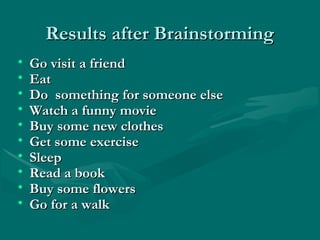
Results after BrainstormingResults after Brainstorming
• Go visit a friendGo visit a friend
• EatEat
• Do something for someone elseDo something for someone else
• Watch a funny movieWatch a funny movie
• Buy some new clothesBuy some new clothes
• Get some exerciseGet some exercise
• SleepSleep
• Read a bookRead a book
• Buy some flowersBuy some flowers
• Go for a walkGo for a walk
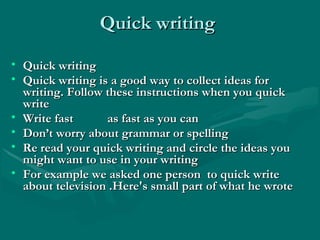
Quick writingQuick writing
• Quick writingQuick writing
• Quick writing is a good way to collect ideas forQuick writing is a good way to collect ideas for
writing. Follow these instructions when you quickwriting. Follow these instructions when you quick
writewrite
• Write fast as fast as you canWrite fast as fast as you can
• Don’t worry about grammar or spellingDon’t worry about grammar or spelling
• Re read your quick writing and circle the ideas youRe read your quick writing and circle the ideas you
might want to use in your writingmight want to use in your writing
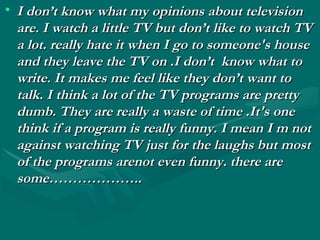
• For example we asked one person to quick writeFor example we asked one person to quick write
about television .Here's small part of what he wroteabout television .Here's small part of what he wrote
• I don’t know what my opinions about televisionI don’t know what my opinions about television
are. I watch a little TV but don’t like to watch TVare. I watch a little TV but don’t like to watch TV
a lot. really hate it when I go to someone's housea lot. really hate it when I go to someone's house
and they leave the TV on .I don’t know what toand they leave the TV on .I don’t know what to
write. It makes me feel like they don’t want towrite. It makes me feel like they don’t want to
talk. I think a lot of the TV programs are prettytalk. I think a lot of the TV programs are pretty
dumb. They are really a waste of time .It's onedumb. They are really a waste of time .It's one
think if a program is really funny. I mean I m notthink if a program is really funny. I mean I m not
against watching TV just for the laughs but mostagainst watching TV just for the laughs but most
of the programs arenot even funny. there areof the programs arenot even funny. there are
some………………..some………………..
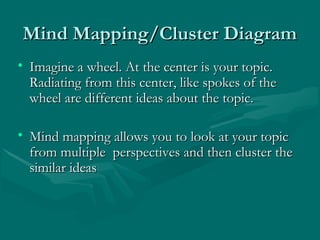
Mind Mapping/Cluster DiagramMind Mapping/Cluster Diagram
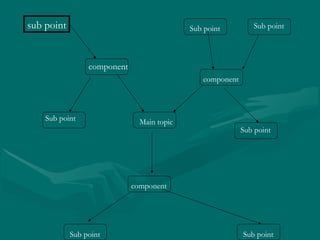
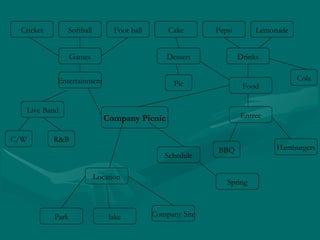
• Imagine a wheel. At the center is your topic.Imagine a wheel. At the center is your topic.
Radiating from this center, like spokes of theRadiating from this center, like spokes of the
wheel are different ideas about the topic.wheel are different ideas about the topic.
• Mind mapping allows you to look at your topicMind mapping allows you to look at your topic
from multiple perspectives and then cluster thefrom multiple perspectives and then cluster the
similar ideassimilar ideas
Making a cluster diagramMaking a cluster diagram
• Making a cluster diagram is a useful way to collectMaking a cluster diagram is a useful way to collect
ideas and details to use in your writing. you canideas and details to use in your writing. you can
also use a cluster diagram to explore differentalso use a cluster diagram to explore different
ways to organize your ideas. Follow these steps toways to organize your ideas. Follow these steps to
make a cluster diagrammake a cluster diagram
• Step 1 write your topic in the center of your paperStep 1 write your topic in the center of your paper
and circle itand circle it
• Step 2 think about your topic and write down anyStep 2 think about your topic and write down any
words that come to mind. Circle each word andwords that come to mind. Circle each word and
connect it to the closest related word in yourconnect it to the closest related word in your
cluster diagram.cluster diagram.
• Step 3 Study your cluster diagram to find ideas toStep 3 Study your cluster diagram to find ideas to
use in your writing.use in your writing.
sub point
component
Sub point Main topic
component
Sub point Sub point
component
Sub point Sub point
Sub point
Cricket Softball Foot ball Cake Pepsi Lemonade
Games
Entertainment
Live Band
C/W R&B
Company Picnic
Dessert
BBQ
Drinks
Food
Entree
Hamburgers
Schedule
Spring
Pie
Location
Park lake
Cola
Company Site
OutliningOutlining
• Outlining is the process of organizingOutlining is the process of organizing
information in a hierarchical list. I’ve foundinformation in a hierarchical list. I’ve found
that outlining works especially well afterthat outlining works especially well after
doing another prewriting technique.doing another prewriting technique.
Variations of OutliningVariations of Outlining
• Numbers, letters, or bullet points.Numbers, letters, or bullet points. Outlines canOutlines can
use Roman numerals, capital letters, lower-caseuse Roman numerals, capital letters, lower-case
letters, numbers, But if you have a complex outlineletters, numbers, But if you have a complex outline
that needs a certain number of paragraphs orthat needs a certain number of paragraphs or
supporting details, you might want to use numbers.supporting details, you might want to use numbers.
• General ideas or specific factsGeneral ideas or specific facts. Depending on. Depending on
what you’re writing, you could either make a generalwhat you’re writing, you could either make a general
outline of the order in which you’ll address youroutline of the order in which you’ll address your
ideas, or you could include details likeideas, or you could include details like arguments,arguments,
facts, quotes, or anecdotesfacts, quotes, or anecdotes. The more detailed the. The more detailed the
outline, the quicker you’ll write your first draft.outline, the quicker you’ll write your first draft.
• Full sentencesFull sentences. Some writers like to include a topic. Some writers like to include a topic
sentence for each paragraph or even a sentence forsentence for each paragraph or even a sentence for
every subsection of the outline. This can make the firstevery subsection of the outline. This can make the first
draft easier to write, but it also makes the outliningdraft easier to write, but it also makes the outlining
process much more time consuming.process much more time consuming.
• Changeability.Changeability. If you simply write out your outlineIf you simply write out your outline
on a piece of paper, you might end up needing toon a piece of paper, you might end up needing to
rewrite the whole thing if you decide to change it. Torewrite the whole thing if you decide to change it. To
save time, use sticky notes or separate strips of papersave time, use sticky notes or separate strips of paper
for each element of your outline; you can rearrangefor each element of your outline; you can rearrange
them as many times as you need to without wastingthem as many times as you need to without wasting
more ink. You can also do this on the computer, ofmore ink. You can also do this on the computer, of
course, but there’s just something nice about beingcourse, but there’s just something nice about being
able to physically rearrange your ideas.able to physically rearrange your ideas.
After OutliningAfter Outlining
• Fill in the gaps. You’ll likely find a few holes inFill in the gaps. You’ll likely find a few holes in
your outline, like arguments without enoughyour outline, like arguments without enough
support, missing examples, or incompletesupport, missing examples, or incomplete
ideas.ideas.
• Completing the outline is usually the last stepCompleting the outline is usually the last step
before writing the first draft, but sometimesbefore writing the first draft, but sometimes
you just don’t feel ready..you just don’t feel ready..
• Save your outline. Like all prewritingSave your outline. Like all prewriting
exercises, outlines can inspire new ideas laterexercises, outlines can inspire new ideas later
— even for other writing projects— even for other writing projects
StoryboardingStoryboarding
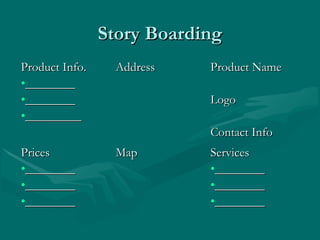
• Storyboarding is a visual planning technique thatStoryboarding is a visual planning technique that
lets you graphically sketch each page or screen oflets you graphically sketch each page or screen of
your text. This allows you to see what youryour text. This allows you to see what your
document might look likedocument might look like
Story BoardingStory Boarding
Product Info.Product Info.
•________________
•________________
•__________________
AddressAddress Product NameProduct Name
LogoLogo
Contact InfoContact Info
PricesPrices
•________________
•________________
•________________
MapMap ServicesServices
•________________
•________________
•________________
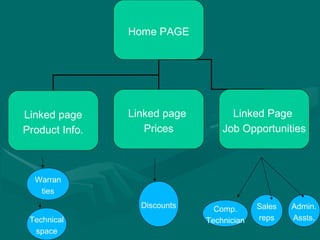
Creating Organization ChartsCreating Organization Charts
• This graphic allows you to see the overallThis graphic allows you to see the overall
organization of a document as well as theorganization of a document as well as the
subdivisions to be discussedsubdivisions to be discussed
Home PAGE
Linked page
Product Info.
Linked page
Prices
Linked Page
Job Opportunities
Warran
ties
Technical
space
Discounts Comp.
Technician
Sales
reps
Admin.
Assts.
ResearchingResearching
• You can search different search engines forYou can search different search engines for
collection of datacollection of data
• For example yahoo.comFor example yahoo.com
• Google.comGoogle.com
• etcetc
Determine how the content willDetermine how the content will
be providedbe provided
• After you have determined your adudience, yourAfter you have determined your adudience, your
goals and your content the last sage in prewritinggoals and your content the last sage in prewriting
is to decide how best to convey your message.is to decide how best to convey your message.
• Will you write a letter, a memo, a report, anWill you write a letter, a memo, a report, an
email, a web site, a proposal, an instructionalemail, a web site, a proposal, an instructional
procedure, a flier or a brochureprocedure, a flier or a brochure
Writing a draftWriting a draft
• Draft is a piece of writing, which will probablyDraft is a piece of writing, which will probably
be changed and improved ,not the final copybe changed and improved ,not the final copy
• As the dictionary definition shows, a draft isAs the dictionary definition shows, a draft is
preliminary piece of writing. Writing more thanpreliminary piece of writing. Writing more than
one draft allows you to develop your ideas andone draft allows you to develop your ideas and
to find the best way to present your ideas toto find the best way to present your ideas to
your reader.your reader.
Think about how to organizeThink about how to organize
your ideasyour ideas
• Ask yourself questions as you experiment withAsk yourself questions as you experiment with
different ways to organize your ideasdifferent ways to organize your ideas
• How can I group my ideas in paragraphs?How can I group my ideas in paragraphs?
• What is the focus and purpose of eachWhat is the focus and purpose of each
paragraph?paragraph?
• In what order should I present my ideas?In what order should I present my ideas?
• Some writers are not comfortable thinkingSome writers are not comfortable thinking
about the order of their ideas before they writeabout the order of their ideas before they write
them. They may prefer to write a rough draftthem. They may prefer to write a rough draft
of their paper by letting their ideas flow freelyof their paper by letting their ideas flow freely
and then crafting a structure for theirand then crafting a structure for their
thoughts. This can produce excellent writing.thoughts. This can produce excellent writing.
• However, keep in mind that whether you startHowever, keep in mind that whether you start
your paper by working from a specificyour paper by working from a specific
structure or whether you start by writing freelystructure or whether you start by writing freely
and then restructuring your ideas to follow aand then restructuring your ideas to follow a
certain order, it is still important to have acertain order, it is still important to have a
strong sense of organization in your paper thatstrong sense of organization in your paper that
works to support your main idea.works to support your main idea.
• In your final draft your ideas should not justIn your final draft your ideas should not just
flow randomly; the reader should sense thatflow randomly; the reader should sense that
there is a reason why you have chosen tothere is a reason why you have chosen to
structure your ideas the way you have. structure your ideas the way you have. 
organizationorganization
• 1-Spatial1-Spatial
• If you are describing the parts of a machine or aIf you are describing the parts of a machine or a
plot of ground, you might organize your textplot of ground, you might organize your text
spatially. you would describe what you see ,as itspatially. you would describe what you see ,as it
appears in space ,left to right ,top to bottomappears in space ,left to right ,top to bottom
inside to outside or clockwise. These spatialinside to outside or clockwise. These spatial
sequences help your readers visualize what yousequences help your readers visualize what you
see and therefore better understand the physicalsee and therefore better understand the physical
qualities of the subject matter.qualities of the subject matter.
ExampleExample
• At the basement’s north wall, I will build aAt the basement’s north wall, I will build a
window seat 7’long by 2’ wide by 2’ high. To thewindow seat 7’long by 2’ wide by 2’ high. To the
right of this seat, on the east wall, I will build aright of this seat, on the east wall, I will build a
desk 4’ high by 5’ long by 3’ wide. On the southdesk 4’ high by 5’ long by 3’ wide. On the south
wall, to the left of the door, I will build anwall, to the left of the door, I will build an
entertainment unit the height of the wallentertainment unit the height of the wall
including four, 4’ high by 4’ wide by 2’ deepincluding four, 4’ high by 4’ wide by 2’ deep
shelving compartments. The west wall willshelving compartments. The west wall will
contain no built-ins. You can use this space tocontain no built-ins. You can use this space to
display pictures and to place furnituredisplay pictures and to place furniture
• Note how this text is written clockwise, usesNote how this text is written clockwise, uses
points of the compass to orient the reader andpoints of the compass to orient the reader and
includes the transitional phrases to the right andincludes the transitional phrases to the right and
to the left to help the reader visualize what youto the left to help the reader visualize what you
will build. That's spatial organizationwill build. That's spatial organization
ChronologicalChronological
• At 1.15 P.M we arrived at the site and assessedAt 1.15 P.M we arrived at the site and assessed
the patient's condition, taking vitals (pulse,the patient's condition, taking vitals (pulse,
respiration etc) .At 1.17 P.M after stabilizing therespiration etc) .At 1.17 P.M after stabilizing the
patient we contacted the hospital and relayed thepatient we contacted the hospital and relayed the
vitals. By 1.20 P.M The patient was on an IVvitals. By 1.20 P.M The patient was on an IV
drip. Our vehicle arrived at the hospital at 1.35drip. Our vehicle arrived at the hospital at 1.35
P.M and hospital staff took over the patient'sP.M and hospital staff took over the patient's
carecare
ImportanceImportance
• If you bury key data on the bottom of a pageIf you bury key data on the bottom of a page
your reader might not see the informationyour reader might not see the information
• Knowing this you can decide which ideas youKnowing this you can decide which ideas you
want to emphasize and then place thatwant to emphasize and then place that
information on the page accordingly.information on the page accordingly.
• Organize your ideas by importanceOrganize your ideas by importance
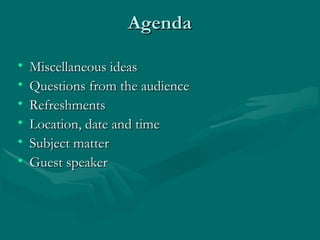
AgendaAgenda
• Miscellaneous ideasMiscellaneous ideas
• Questions from the audienceQuestions from the audience
• RefreshmentsRefreshments
• Location, date and timeLocation, date and time
• Subject matterSubject matter
• Guest speakerGuest speaker
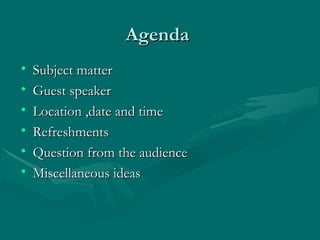
AgendaAgenda
• Subject matterSubject matter
• Guest speakerGuest speaker
• Location ,date and timeLocation ,date and time
• RefreshmentsRefreshments
• Question from the audienceQuestion from the audience
• Miscellaneous ideasMiscellaneous ideas
Comparison/ContrastComparison/Contrast
• Many times in business, you will need toMany times in business, you will need to
document options and ways in which you surpassdocument options and ways in which you surpass
a competitor. These require that you organizea competitor. These require that you organize
your text by comparison/contrast. You compareyour text by comparison/contrast. You compare
similarities and contrast differences. For example,similarities and contrast differences. For example,
if you are writing a sales brochure you might wantif you are writing a sales brochure you might want
to present your potential client alternativesto present your potential client alternatives
regarding services, personnel, timetables and feeregarding services, personnel, timetables and fee
structuresstructures
Housing CostsHousing Costs
ItemItem FeaturesFeatures CostCost
Problem/SolutionProblem/Solution
• Every proposal and sales letter isEvery proposal and sales letter is
problem/solution oriented. When you write aproblem/solution oriented. When you write a
proposal for instance you are proposing aproposal for instance you are proposing a
solution to an existing problem. similarly if yoursolution to an existing problem. similarly if your
sales letter promotes a new product, yoursales letter promotes a new product, your
customers will purchase it only if their currentcustomers will purchase it only if their current
product is inferiorproduct is inferior
RewritingRewriting
• Add any missing detail for clarityAdd any missing detail for clarity
• Delete dead words and phrases for concisenessDelete dead words and phrases for conciseness
• Simplify unnecessarily complex words andSimplify unnecessarily complex words and
phrases to allow for easier understandingphrases to allow for easier understanding
• Move information around( cut and paste) toMove information around( cut and paste) to
ensure that your most important ideas areensure that your most important ideas are
emphasizedemphasized
• Reformat (using highlighting techniques) toReformat (using highlighting techniques) to
ensure reader friendly ease of accessensure reader friendly ease of access
• Enhance the tone and style of the textEnhance the tone and style of the text
• Correct any errors to ensure accurate grammarCorrect any errors to ensure accurate grammar
and contentand content
• Remember that revision is not something youRemember that revision is not something you
dodo after your paper is finished. It is a continuingafter your paper is finished. It is a continuing
process duringprocess during
• which you consider the logic and clarity of yourwhich you consider the logic and clarity of your
ideas as well asideas as well as
• their effective and correct expression. Thus,their effective and correct expression. Thus,
revision is morerevision is more
• than proofreading or editing, crossing out onethan proofreading or editing, crossing out one
word andword and
• substituting another. It may involve extensivesubstituting another. It may involve extensive
addition,addition,
• deletion, and reordering what you want todeletion, and reordering what you want to
communicate to yourcommunicate to your
•
• Next, look at your body paragraphs to see ifNext, look at your body paragraphs to see if
they needthey need
• strengthening. Are they unified? Coherent?strengthening. Are they unified? Coherent?
Well developed? DoWell developed? Do
• the points you make support your topicthe points you make support your topic
sentences and your thesis?sentences and your thesis?
• You might have to add more facts or examplesYou might have to add more facts or examples
to one paragraph toto one paragraph to
• make it as strong as the others. Consider yourmake it as strong as the others. Consider your
introductory andintroductory and
• concluding strategies. Are they appropriate forconcluding strategies. Are they appropriate for
your material,your material,
• your audience, and your purpose? Do theyyour audience, and your purpose? Do they
reinforce your thesis?reinforce your thesis?
• Now look over your sentences. Are theyNow look over your sentences. Are they
correct? Effective?correct? Effective?
• Interesting? Are there any sentences that mightInteresting? Are there any sentences that might
be added orbe added or
• deleted or relocated? Then consider the wordsdeleted or relocated? Then consider the words
you use. Areyou use. Are
• there any additions or substitutions you feel youthere any additions or substitutions you feel you
should make?should make?
• Only now, after doing all your revision, shouldOnly now, after doing all your revision, should
you go back andyou go back and
• edit your writing. Polish your sentence structure, checkedit your writing. Polish your sentence structure, check
youryour
• spelling, and make sure your punctuation and grammarspelling, and make sure your punctuation and grammar
are correct.are correct.
• How you revise--what specific strategies you decide toHow you revise--what specific strategies you decide to
use--use--
• depends upon your preference, your instructor'sdepends upon your preference, your instructor's
directions, anddirections, and
• the time you have.the time you have.
• When you are ready to revise, you can start byWhen you are ready to revise, you can start by
setting up asetting up a
• revision checklist and applying it to your essay. Asrevision checklist and applying it to your essay. As
you moveyou move
• systematically from the whole writing to thesystematically from the whole writing to the
individual paragraphsindividual paragraphs
• to the sentences and words, you can assess yourto the sentences and words, you can assess your
paper'spaper's
• effectiveness. First, check your thesis statement toeffectiveness. First, check your thesis statement to
see if itsee if it
• is still accurate. If you departed from your originalis still accurate. If you departed from your original
goal whilegoal while
• you were writing, you will need either to reviseyou were writing, you will need either to revise
the thesis sothe thesis so
• that it accurately sums up the ideas andthat it accurately sums up the ideas and
information contained ininformation contained in
• your essay or to remove any unrelated section--your essay or to remove any unrelated section--
or to revise themor to revise them
• so that they are relevant to your thesis.so that they are relevant to your thesis.
• Writing and RevisionWriting and Revision
• making sure as you revise that each part does whatmaking sure as you revise that each part does what
• it should When you finally begin drafting your essay,it should When you finally begin drafting your essay,
• your major concern should be getting your ideas down onyour major concern should be getting your ideas down on
paper.paper.
• At this point, you should not let worries about sentenceAt this point, you should not let worries about sentence
proportion or word choice interfere with your flow of ideas.proportion or word choice interfere with your flow of ideas.
• All you want to do is to keep your momentum until youAll you want to do is to keep your momentum until you
finish the first draft.finish the first draft.
• Later, when you write the second or third draft, you canLater, when you write the second or third draft, you can
polishpolish
• your writing,o.your writing,o.
AccuracyAccuracy
• Accuracy in technical writing requires that youAccuracy in technical writing requires that you
proof read your text.proof read your text.
• Tips of proofreadingTips of proofreading
• Let someone else read itLet someone else read it
• Use the delay approachUse the delay approach
• Read one line at a timeRead one line at a time
• Read long words syllable by syllableRead long words syllable by syllable
• Use technologyUse technology
• Check figures scientific and technical equationsCheck figures scientific and technical equations
and abbreviationsand abbreviations
• Read it aloudRead it aloud
• Use a dictionaryUse a dictionary
• Try scattershot proofingTry scattershot proofing

The writing process

  • 1.
    The writing processThewriting process No one can just sit down and in one stepNo one can just sit down and in one step compose a polished piece of writing .Insteadcompose a polished piece of writing .Instead ,writers go through a number of steps as they,writers go through a number of steps as they write. These steps or stages make up the writingwrite. These steps or stages make up the writing process .The steps in the writing process areprocess .The steps in the writing process are somewhat like dance steps. Instead of movingsomewhat like dance steps. Instead of moving forward in a straight line ,writers go forward aforward in a straight line ,writers go forward a little and then back and then forward again. Inlittle and then back and then forward again. In other words, they think and collect ideas and thenother words, they think and collect ideas and then write and then go back and think again. As youwrite and then go back and think again. As you can see in the diagram below, writing is acan see in the diagram below, writing is a recursive or nonlinear processrecursive or nonlinear process
  • 2.
    Prewriting TechniquesPrewriting Techniques •` I don’t know what I think until I see what I have` I don’t know what I think until I see what I have said`said` • E.M ForsterE.M Forster • `I write to find out what I `m talking about``I write to find out what I `m talking about` • Edward AlbeeEdward Albee
  • 3.
    • Prewriting isthe first stage in the writing process.Prewriting is the first stage in the writing process. Its also the most important and the most interestingIts also the most important and the most interesting part. The purpose of the prewriting stage is to find apart. The purpose of the prewriting stage is to find a topic for writing to collect ideas and informationtopic for writing to collect ideas and information and to do research if necessary. By the time youand to do research if necessary. By the time you have finished prewriting a lot of the hard work hashave finished prewriting a lot of the hard work has already been done. Its not unusual for a writer toalready been done. Its not unusual for a writer to spend more time in the prewriting stage than in thespend more time in the prewriting stage than in the writing stage. Its also common to return to thewriting stage. Its also common to return to the prewriting stage at various times during the writingprewriting stage at various times during the writing process when you need to collect more ideas. Onprocess when you need to collect more ideas. On the following pages are some common strategiesthe following pages are some common strategies that writers use to collect and organize their ideasthat writers use to collect and organize their ideas
  • 4.
    Think about yourpurpose ofThink about your purpose of writingwriting • As you write keep it in your mind that you areAs you write keep it in your mind that you are going to accomplish some task .So workgoing to accomplish some task .So work according to your purposeaccording to your purpose • External MotivationExternal Motivation • Internal MotivationInternal Motivation
  • 5.
    Determine Your GoalsDetermineYour Goals • Communicating to PersuadeCommunicating to Persuade • Communicating to InstructCommunicating to Instruct • Communicating to InformCommunicating to Inform • Communicating to Build TrustCommunicating to Build Trust
  • 6.
    audience audience  • As youprepare to write about your topic, it isAs you prepare to write about your topic, it is important to consider the audience for whom youimportant to consider the audience for whom you are writing. If your audience is only yourare writing. If your audience is only your professor, for example, he or she may not requireprofessor, for example, he or she may not require as much background information about a topic asas much background information about a topic as would be required for a more general audience ofwould be required for a more general audience of your peers. Knowing who your audience is willyour peers. Knowing who your audience is will help you decide how much information to present,help you decide how much information to present, and in what manner to present it. Be sure to askand in what manner to present it. Be sure to ask your professor if you are unsure about theyour professor if you are unsure about the audience your paper should be intended for.audience your paper should be intended for.
  • 7.
    Gather Your DataGatherYour Data • Answer the Reporter’s QuestionAnswer the Reporter’s Question • Mind MappingMind Mapping • Brain Storming/Listing/Quick WritingBrain Storming/Listing/Quick Writing • OutliningOutlining • StoryboardingStoryboarding • Creating Organization ChartCreating Organization Chart • FlowchartingFlowcharting • ResearchingResearching
  • 8.
    Answer the Reporter’sAnswerthe Reporter’s QuestionQuestion • Forming questions can help you come up withForming questions can help you come up with ideas for writing. Just think about your topicideas for writing. Just think about your topic and write down any questions that come toand write down any questions that come to mind .After ward you can go back andmind .After ward you can go back and underline the questions that you would like tounderline the questions that you would like to explore furtherexplore further
  • 9.
    Who, what, when,where, how,Who, what, when, where, how, etcetc • You are writing an incident report about anYou are writing an incident report about an accident in the company's boiler room whichaccident in the company's boiler room which must include the date , location , time ,must include the date , location , time , personnel involved, causes and financial losspersonnel involved, causes and financial loss
  • 10.
    BrainstormingBrainstorming • Brainstorming isa good way to collect ideas forBrainstorming is a good way to collect ideas for writing. To brainstorm think about your topic andwriting. To brainstorm think about your topic and write down every idea that comes to mind. Don'twrite down every idea that comes to mind. Don't evaluate your ideas. Brain Storming can beevaluate your ideas. Brain Storming can be performed either individually or with groupperformed either individually or with group
  • 11.
    Variations of BrainstormingVariationsof Brainstorming • On paper or out loud.On paper or out loud. You could either write downYou could either write down your list of ideas or record yourself listing ideas (oryour list of ideas or record yourself listing ideas (or simply talking to yourself) out loud.simply talking to yourself) out loud. • Groups.Groups. Brainstorming often occurs in groups ofBrainstorming often occurs in groups of people working on a collaborative project. Even ifpeople working on a collaborative project. Even if you’re working by yourself, you could still ask a friendyou’re working by yourself, you could still ask a friend (or a whole group of friends) to brainstorm with you,(or a whole group of friends) to brainstorm with you, either by sharing lists of ideas or simply talking abouteither by sharing lists of ideas or simply talking about the topic. Conversation never fails to spark an idea orthe topic. Conversation never fails to spark an idea or two!two!
  • 12.
    • Time limit.Timelimit. Some find that a time limit helps theSome find that a time limit helps the brainstorming process, while others prefer to press onbrainstorming process, while others prefer to press on until they run out of ideas.until they run out of ideas. • Example we spent a minute brainstorming a listExample we spent a minute brainstorming a list of things to do when you feel sad or depressed.of things to do when you feel sad or depressed. You can see that some of our ideas were prettyYou can see that some of our ideas were pretty silly but we wrote them down anyway. When wesilly but we wrote them down anyway. When we finished brainstorming we went back and put afinished brainstorming we went back and put a check mark next to the ideas we liked best.check mark next to the ideas we liked best.
  • 13.
    • Things todo when you areThings to do when you are depressed or sad ?????depressed or sad ?????
  • 14.
    Results after BrainstormingResultsafter Brainstorming • Go visit a friendGo visit a friend • EatEat • Do something for someone elseDo something for someone else • Watch a funny movieWatch a funny movie • Buy some new clothesBuy some new clothes • Get some exerciseGet some exercise • SleepSleep • Read a bookRead a book • Buy some flowersBuy some flowers • Go for a walkGo for a walk
  • 15.
    Quick writingQuick writing •Quick writingQuick writing • Quick writing is a good way to collect ideas forQuick writing is a good way to collect ideas for writing. Follow these instructions when you quickwriting. Follow these instructions when you quick writewrite • Write fast as fast as you canWrite fast as fast as you can • Don’t worry about grammar or spellingDon’t worry about grammar or spelling • Re read your quick writing and circle the ideas youRe read your quick writing and circle the ideas you might want to use in your writingmight want to use in your writing • For example we asked one person to quick writeFor example we asked one person to quick write about television .Here's small part of what he wroteabout television .Here's small part of what he wrote
  • 16.
    • I don’tknow what my opinions about televisionI don’t know what my opinions about television are. I watch a little TV but don’t like to watch TVare. I watch a little TV but don’t like to watch TV a lot. really hate it when I go to someone's housea lot. really hate it when I go to someone's house and they leave the TV on .I don’t know what toand they leave the TV on .I don’t know what to write. It makes me feel like they don’t want towrite. It makes me feel like they don’t want to talk. I think a lot of the TV programs are prettytalk. I think a lot of the TV programs are pretty dumb. They are really a waste of time .It's onedumb. They are really a waste of time .It's one think if a program is really funny. I mean I m notthink if a program is really funny. I mean I m not against watching TV just for the laughs but mostagainst watching TV just for the laughs but most of the programs arenot even funny. there areof the programs arenot even funny. there are some………………..some………………..
  • 17.
    Mind Mapping/Cluster DiagramMindMapping/Cluster Diagram • Imagine a wheel. At the center is your topic.Imagine a wheel. At the center is your topic. Radiating from this center, like spokes of theRadiating from this center, like spokes of the wheel are different ideas about the topic.wheel are different ideas about the topic. • Mind mapping allows you to look at your topicMind mapping allows you to look at your topic from multiple perspectives and then cluster thefrom multiple perspectives and then cluster the similar ideassimilar ideas
  • 18.
    Making a clusterdiagramMaking a cluster diagram • Making a cluster diagram is a useful way to collectMaking a cluster diagram is a useful way to collect ideas and details to use in your writing. you canideas and details to use in your writing. you can also use a cluster diagram to explore differentalso use a cluster diagram to explore different ways to organize your ideas. Follow these steps toways to organize your ideas. Follow these steps to make a cluster diagrammake a cluster diagram • Step 1 write your topic in the center of your paperStep 1 write your topic in the center of your paper and circle itand circle it • Step 2 think about your topic and write down anyStep 2 think about your topic and write down any words that come to mind. Circle each word andwords that come to mind. Circle each word and connect it to the closest related word in yourconnect it to the closest related word in your cluster diagram.cluster diagram. • Step 3 Study your cluster diagram to find ideas toStep 3 Study your cluster diagram to find ideas to use in your writing.use in your writing.
  • 19.
    sub point component Sub pointMain topic component Sub point Sub point component Sub point Sub point Sub point
  • 20.
    Cricket Softball Football Cake Pepsi Lemonade Games Entertainment Live Band C/W R&B Company Picnic Dessert BBQ Drinks Food Entree Hamburgers Schedule Spring Pie Location Park lake Cola Company Site
  • 22.
    OutliningOutlining • Outlining isthe process of organizingOutlining is the process of organizing information in a hierarchical list. I’ve foundinformation in a hierarchical list. I’ve found that outlining works especially well afterthat outlining works especially well after doing another prewriting technique.doing another prewriting technique.
  • 23.
    Variations of OutliningVariationsof Outlining • Numbers, letters, or bullet points.Numbers, letters, or bullet points. Outlines canOutlines can use Roman numerals, capital letters, lower-caseuse Roman numerals, capital letters, lower-case letters, numbers, But if you have a complex outlineletters, numbers, But if you have a complex outline that needs a certain number of paragraphs orthat needs a certain number of paragraphs or supporting details, you might want to use numbers.supporting details, you might want to use numbers. • General ideas or specific factsGeneral ideas or specific facts. Depending on. Depending on what you’re writing, you could either make a generalwhat you’re writing, you could either make a general outline of the order in which you’ll address youroutline of the order in which you’ll address your ideas, or you could include details likeideas, or you could include details like arguments,arguments, facts, quotes, or anecdotesfacts, quotes, or anecdotes. The more detailed the. The more detailed the outline, the quicker you’ll write your first draft.outline, the quicker you’ll write your first draft.
  • 24.
    • Full sentencesFullsentences. Some writers like to include a topic. Some writers like to include a topic sentence for each paragraph or even a sentence forsentence for each paragraph or even a sentence for every subsection of the outline. This can make the firstevery subsection of the outline. This can make the first draft easier to write, but it also makes the outliningdraft easier to write, but it also makes the outlining process much more time consuming.process much more time consuming. • Changeability.Changeability. If you simply write out your outlineIf you simply write out your outline on a piece of paper, you might end up needing toon a piece of paper, you might end up needing to rewrite the whole thing if you decide to change it. Torewrite the whole thing if you decide to change it. To save time, use sticky notes or separate strips of papersave time, use sticky notes or separate strips of paper for each element of your outline; you can rearrangefor each element of your outline; you can rearrange them as many times as you need to without wastingthem as many times as you need to without wasting more ink. You can also do this on the computer, ofmore ink. You can also do this on the computer, of course, but there’s just something nice about beingcourse, but there’s just something nice about being able to physically rearrange your ideas.able to physically rearrange your ideas.
  • 25.
    After OutliningAfter Outlining •Fill in the gaps. You’ll likely find a few holes inFill in the gaps. You’ll likely find a few holes in your outline, like arguments without enoughyour outline, like arguments without enough support, missing examples, or incompletesupport, missing examples, or incomplete ideas.ideas. • Completing the outline is usually the last stepCompleting the outline is usually the last step before writing the first draft, but sometimesbefore writing the first draft, but sometimes you just don’t feel ready..you just don’t feel ready.. • Save your outline. Like all prewritingSave your outline. Like all prewriting exercises, outlines can inspire new ideas laterexercises, outlines can inspire new ideas later — even for other writing projects— even for other writing projects
  • 26.
    StoryboardingStoryboarding • Storyboarding isa visual planning technique thatStoryboarding is a visual planning technique that lets you graphically sketch each page or screen oflets you graphically sketch each page or screen of your text. This allows you to see what youryour text. This allows you to see what your document might look likedocument might look like
  • 27.
    Story BoardingStory Boarding ProductInfo.Product Info. •________________ •________________ •__________________ AddressAddress Product NameProduct Name LogoLogo Contact InfoContact Info PricesPrices •________________ •________________ •________________ MapMap ServicesServices •________________ •________________ •________________
  • 28.
    Creating Organization ChartsCreatingOrganization Charts • This graphic allows you to see the overallThis graphic allows you to see the overall organization of a document as well as theorganization of a document as well as the subdivisions to be discussedsubdivisions to be discussed
  • 29.
    Home PAGE Linked page ProductInfo. Linked page Prices Linked Page Job Opportunities Warran ties Technical space Discounts Comp. Technician Sales reps Admin. Assts.
  • 30.
    ResearchingResearching • You cansearch different search engines forYou can search different search engines for collection of datacollection of data • For example yahoo.comFor example yahoo.com • Google.comGoogle.com • etcetc
  • 31.
    Determine how thecontent willDetermine how the content will be providedbe provided • After you have determined your adudience, yourAfter you have determined your adudience, your goals and your content the last sage in prewritinggoals and your content the last sage in prewriting is to decide how best to convey your message.is to decide how best to convey your message. • Will you write a letter, a memo, a report, anWill you write a letter, a memo, a report, an email, a web site, a proposal, an instructionalemail, a web site, a proposal, an instructional procedure, a flier or a brochureprocedure, a flier or a brochure
  • 32.
    Writing a draftWritinga draft • Draft is a piece of writing, which will probablyDraft is a piece of writing, which will probably be changed and improved ,not the final copybe changed and improved ,not the final copy • As the dictionary definition shows, a draft isAs the dictionary definition shows, a draft is preliminary piece of writing. Writing more thanpreliminary piece of writing. Writing more than one draft allows you to develop your ideas andone draft allows you to develop your ideas and to find the best way to present your ideas toto find the best way to present your ideas to your reader.your reader.
  • 33.
    Think about howto organizeThink about how to organize your ideasyour ideas • Ask yourself questions as you experiment withAsk yourself questions as you experiment with different ways to organize your ideasdifferent ways to organize your ideas • How can I group my ideas in paragraphs?How can I group my ideas in paragraphs? • What is the focus and purpose of eachWhat is the focus and purpose of each paragraph?paragraph? • In what order should I present my ideas?In what order should I present my ideas?
  • 34.
    • Some writersare not comfortable thinkingSome writers are not comfortable thinking about the order of their ideas before they writeabout the order of their ideas before they write them. They may prefer to write a rough draftthem. They may prefer to write a rough draft of their paper by letting their ideas flow freelyof their paper by letting their ideas flow freely and then crafting a structure for theirand then crafting a structure for their thoughts. This can produce excellent writing.thoughts. This can produce excellent writing. • However, keep in mind that whether you startHowever, keep in mind that whether you start your paper by working from a specificyour paper by working from a specific structure or whether you start by writing freelystructure or whether you start by writing freely and then restructuring your ideas to follow aand then restructuring your ideas to follow a certain order, it is still important to have acertain order, it is still important to have a strong sense of organization in your paper thatstrong sense of organization in your paper that works to support your main idea.works to support your main idea. • In your final draft your ideas should not justIn your final draft your ideas should not just flow randomly; the reader should sense thatflow randomly; the reader should sense that there is a reason why you have chosen tothere is a reason why you have chosen to structure your ideas the way you have. structure your ideas the way you have. 
  • 35.
    organizationorganization • 1-Spatial1-Spatial • Ifyou are describing the parts of a machine or aIf you are describing the parts of a machine or a plot of ground, you might organize your textplot of ground, you might organize your text spatially. you would describe what you see ,as itspatially. you would describe what you see ,as it appears in space ,left to right ,top to bottomappears in space ,left to right ,top to bottom inside to outside or clockwise. These spatialinside to outside or clockwise. These spatial sequences help your readers visualize what yousequences help your readers visualize what you see and therefore better understand the physicalsee and therefore better understand the physical qualities of the subject matter.qualities of the subject matter.
  • 36.
    ExampleExample • At thebasement’s north wall, I will build aAt the basement’s north wall, I will build a window seat 7’long by 2’ wide by 2’ high. To thewindow seat 7’long by 2’ wide by 2’ high. To the right of this seat, on the east wall, I will build aright of this seat, on the east wall, I will build a desk 4’ high by 5’ long by 3’ wide. On the southdesk 4’ high by 5’ long by 3’ wide. On the south wall, to the left of the door, I will build anwall, to the left of the door, I will build an entertainment unit the height of the wallentertainment unit the height of the wall including four, 4’ high by 4’ wide by 2’ deepincluding four, 4’ high by 4’ wide by 2’ deep shelving compartments. The west wall willshelving compartments. The west wall will contain no built-ins. You can use this space tocontain no built-ins. You can use this space to display pictures and to place furnituredisplay pictures and to place furniture
  • 37.
    • Note howthis text is written clockwise, usesNote how this text is written clockwise, uses points of the compass to orient the reader andpoints of the compass to orient the reader and includes the transitional phrases to the right andincludes the transitional phrases to the right and to the left to help the reader visualize what youto the left to help the reader visualize what you will build. That's spatial organizationwill build. That's spatial organization
  • 38.
    ChronologicalChronological • At 1.15P.M we arrived at the site and assessedAt 1.15 P.M we arrived at the site and assessed the patient's condition, taking vitals (pulse,the patient's condition, taking vitals (pulse, respiration etc) .At 1.17 P.M after stabilizing therespiration etc) .At 1.17 P.M after stabilizing the patient we contacted the hospital and relayed thepatient we contacted the hospital and relayed the vitals. By 1.20 P.M The patient was on an IVvitals. By 1.20 P.M The patient was on an IV drip. Our vehicle arrived at the hospital at 1.35drip. Our vehicle arrived at the hospital at 1.35 P.M and hospital staff took over the patient'sP.M and hospital staff took over the patient's carecare
  • 39.
    ImportanceImportance • If youbury key data on the bottom of a pageIf you bury key data on the bottom of a page your reader might not see the informationyour reader might not see the information • Knowing this you can decide which ideas youKnowing this you can decide which ideas you want to emphasize and then place thatwant to emphasize and then place that information on the page accordingly.information on the page accordingly. • Organize your ideas by importanceOrganize your ideas by importance
  • 40.
    AgendaAgenda • Miscellaneous ideasMiscellaneousideas • Questions from the audienceQuestions from the audience • RefreshmentsRefreshments • Location, date and timeLocation, date and time • Subject matterSubject matter • Guest speakerGuest speaker
  • 41.
    AgendaAgenda • Subject matterSubjectmatter • Guest speakerGuest speaker • Location ,date and timeLocation ,date and time • RefreshmentsRefreshments • Question from the audienceQuestion from the audience • Miscellaneous ideasMiscellaneous ideas
  • 42.
    Comparison/ContrastComparison/Contrast • Many timesin business, you will need toMany times in business, you will need to document options and ways in which you surpassdocument options and ways in which you surpass a competitor. These require that you organizea competitor. These require that you organize your text by comparison/contrast. You compareyour text by comparison/contrast. You compare similarities and contrast differences. For example,similarities and contrast differences. For example, if you are writing a sales brochure you might wantif you are writing a sales brochure you might want to present your potential client alternativesto present your potential client alternatives regarding services, personnel, timetables and feeregarding services, personnel, timetables and fee structuresstructures
  • 43.
    Housing CostsHousing Costs ItemItemFeaturesFeatures CostCost
  • 44.
    Problem/SolutionProblem/Solution • Every proposaland sales letter isEvery proposal and sales letter is problem/solution oriented. When you write aproblem/solution oriented. When you write a proposal for instance you are proposing aproposal for instance you are proposing a solution to an existing problem. similarly if yoursolution to an existing problem. similarly if your sales letter promotes a new product, yoursales letter promotes a new product, your customers will purchase it only if their currentcustomers will purchase it only if their current product is inferiorproduct is inferior
  • 45.
    RewritingRewriting • Add anymissing detail for clarityAdd any missing detail for clarity • Delete dead words and phrases for concisenessDelete dead words and phrases for conciseness • Simplify unnecessarily complex words andSimplify unnecessarily complex words and phrases to allow for easier understandingphrases to allow for easier understanding • Move information around( cut and paste) toMove information around( cut and paste) to ensure that your most important ideas areensure that your most important ideas are emphasizedemphasized
  • 46.
    • Reformat (usinghighlighting techniques) toReformat (using highlighting techniques) to ensure reader friendly ease of accessensure reader friendly ease of access • Enhance the tone and style of the textEnhance the tone and style of the text • Correct any errors to ensure accurate grammarCorrect any errors to ensure accurate grammar and contentand content
  • 47.
    • Remember thatrevision is not something youRemember that revision is not something you dodo after your paper is finished. It is a continuingafter your paper is finished. It is a continuing process duringprocess during • which you consider the logic and clarity of yourwhich you consider the logic and clarity of your ideas as well asideas as well as • their effective and correct expression. Thus,their effective and correct expression. Thus, revision is morerevision is more • than proofreading or editing, crossing out onethan proofreading or editing, crossing out one word andword and • substituting another. It may involve extensivesubstituting another. It may involve extensive addition,addition, • deletion, and reordering what you want todeletion, and reordering what you want to communicate to yourcommunicate to your •
  • 48.
    • Next, lookat your body paragraphs to see ifNext, look at your body paragraphs to see if they needthey need • strengthening. Are they unified? Coherent?strengthening. Are they unified? Coherent? Well developed? DoWell developed? Do • the points you make support your topicthe points you make support your topic sentences and your thesis?sentences and your thesis? • You might have to add more facts or examplesYou might have to add more facts or examples to one paragraph toto one paragraph to • make it as strong as the others. Consider yourmake it as strong as the others. Consider your introductory andintroductory and • concluding strategies. Are they appropriate forconcluding strategies. Are they appropriate for your material,your material, • your audience, and your purpose? Do theyyour audience, and your purpose? Do they reinforce your thesis?reinforce your thesis?
  • 49.
    • Now lookover your sentences. Are theyNow look over your sentences. Are they correct? Effective?correct? Effective? • Interesting? Are there any sentences that mightInteresting? Are there any sentences that might be added orbe added or • deleted or relocated? Then consider the wordsdeleted or relocated? Then consider the words you use. Areyou use. Are • there any additions or substitutions you feel youthere any additions or substitutions you feel you should make?should make? • Only now, after doing all your revision, shouldOnly now, after doing all your revision, should you go back andyou go back and
  • 50.
    • edit yourwriting. Polish your sentence structure, checkedit your writing. Polish your sentence structure, check youryour • spelling, and make sure your punctuation and grammarspelling, and make sure your punctuation and grammar are correct.are correct. • How you revise--what specific strategies you decide toHow you revise--what specific strategies you decide to use--use-- • depends upon your preference, your instructor'sdepends upon your preference, your instructor's directions, anddirections, and • the time you have.the time you have.
  • 51.
    • When youare ready to revise, you can start byWhen you are ready to revise, you can start by setting up asetting up a • revision checklist and applying it to your essay. Asrevision checklist and applying it to your essay. As you moveyou move • systematically from the whole writing to thesystematically from the whole writing to the individual paragraphsindividual paragraphs • to the sentences and words, you can assess yourto the sentences and words, you can assess your paper'spaper's • effectiveness. First, check your thesis statement toeffectiveness. First, check your thesis statement to see if itsee if it • is still accurate. If you departed from your originalis still accurate. If you departed from your original goal whilegoal while
  • 52.
    • you werewriting, you will need either to reviseyou were writing, you will need either to revise the thesis sothe thesis so • that it accurately sums up the ideas andthat it accurately sums up the ideas and information contained ininformation contained in • your essay or to remove any unrelated section--your essay or to remove any unrelated section-- or to revise themor to revise them • so that they are relevant to your thesis.so that they are relevant to your thesis.
  • 53.
    • Writing andRevisionWriting and Revision • making sure as you revise that each part does whatmaking sure as you revise that each part does what • it should When you finally begin drafting your essay,it should When you finally begin drafting your essay, • your major concern should be getting your ideas down onyour major concern should be getting your ideas down on paper.paper. • At this point, you should not let worries about sentenceAt this point, you should not let worries about sentence proportion or word choice interfere with your flow of ideas.proportion or word choice interfere with your flow of ideas. • All you want to do is to keep your momentum until youAll you want to do is to keep your momentum until you finish the first draft.finish the first draft. • Later, when you write the second or third draft, you canLater, when you write the second or third draft, you can polishpolish • your writing,o.your writing,o.
  • 54.
    AccuracyAccuracy • Accuracy intechnical writing requires that youAccuracy in technical writing requires that you proof read your text.proof read your text. • Tips of proofreadingTips of proofreading • Let someone else read itLet someone else read it • Use the delay approachUse the delay approach • Read one line at a timeRead one line at a time • Read long words syllable by syllableRead long words syllable by syllable
  • 55.
    • Use technologyUsetechnology • Check figures scientific and technical equationsCheck figures scientific and technical equations and abbreviationsand abbreviations • Read it aloudRead it aloud • Use a dictionaryUse a dictionary • Try scattershot proofingTry scattershot proofing