Writing an
Essay
By ALEXIS JOHN
B. BENEDICTO
For more info visit my
FB Page: “alexis art
and perception” and
leave a message.
Writing is Not A Skill….Writing is Not A Skill….
It Is An Art!It Is An Art!
Painters need a brush, musicians needPainters need a brush, musicians need
notes, and writers need words. Carefullynotes, and writers need words. Carefully
selected words are the tools that a writerselected words are the tools that a writer
uses to turn his average writing intouses to turn his average writing into
beautiful works of art.beautiful works of art.
Types of EssaysTypes of Essays
There are three types of essays:There are three types of essays:
 NarrativeNarrative
 ExpositoryExpository
 PersuasivePersuasive
We will be focusing on the first two:We will be focusing on the first two:
Narrative and Expository for Florida WritesNarrative and Expository for Florida Writes
NARRATIVE ESSAYS
Telling a Story
Narrative EssaysNarrative Essays
 A narrative essay is a STORY.A narrative essay is a STORY.
 The prompt, or writing topic, they give youThe prompt, or writing topic, they give you
will most likely have this key word in it:will most likely have this key word in it:
TELL.TELL.
 For example, “Tell about a time you wentFor example, “Tell about a time you went
on a special trip.”on a special trip.”
This is a narrative, because of the wordThis is a narrative, because of the word
TELL.TELL.
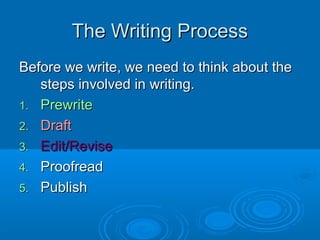
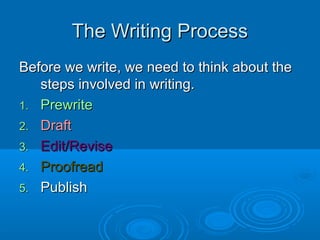
The Writing ProcessThe Writing Process
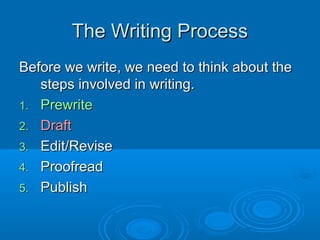
Before we write, we need to think about theBefore we write, we need to think about the
steps involved in writing.steps involved in writing.
1.1. PrewritePrewrite
2.2. DraftDraft
3.3. Edit/ReviseEdit/Revise
4.4. ProofreedProofreed
5.5. PublishPublish
Prewrite - NarrativePrewrite - Narrative
 Have you ever seen a cartoon movie?Have you ever seen a cartoon movie?
 They use a Story Board to sketch their ideasThey use a Story Board to sketch their ideas
before they do the whole movie and includebefore they do the whole movie and include
each detail! This helps them get their ideaseach detail! This helps them get their ideas
flowing and keeps them on track.flowing and keeps them on track.
 For a narrative essay, when you see the wordsFor a narrative essay, when you see the words
TELL on a prompt, sketch a STORY BOARDTELL on a prompt, sketch a STORY BOARD
Narrative Story BoardsNarrative Story Boards
1.1. Draw 5 or 6 boxes (you can do more,Draw 5 or 6 boxes (you can do more,
but I would suggest at least 4).but I would suggest at least 4).
2.2. In each box you will draw a picture of aIn each box you will draw a picture of a
scene, in order, in your story.scene, in order, in your story.
3.3. Each box will then be used to help youEach box will then be used to help you
describe a paragraph on your essay.describe a paragraph on your essay.
Narrative Story BoardsNarrative Story Boards
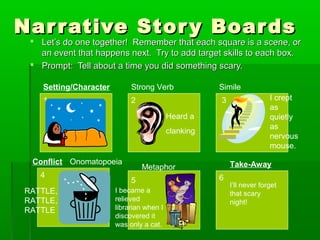
 Let’s do one together! Remember that each square is a scene, orLet’s do one together! Remember that each square is a scene, or
an event that happens next. Try to add target skills to each box.an event that happens next. Try to add target skills to each box.
 Prompt: Tell about a time you did something scary.Prompt: Tell about a time you did something scary.
1 2 3
4
5 6
Setting/Character Strong Verb
Conflict
Simile
Metaphor Take-Away
Heard a
clanking
I crept
as
quietly
as
nervous
mouse.
RATTLE,
RATTLE,
RATTLE
I became a
relieved
librarian when I
discovered it
was only a cat.
I’ll never forget
that scary
night!
Onomatopoeia
Prewrite - ExpositoryPrewrite - Expository
 For an expository essay we are asked toFor an expository essay we are asked to
EXPLAIN an idea or thought we have.EXPLAIN an idea or thought we have.
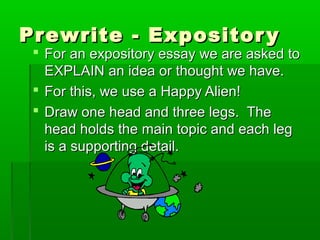
 For this, we use a Happy Alien!For this, we use a Happy Alien!
 Draw one head and three legs. TheDraw one head and three legs. The
head holds the main topic and each leghead holds the main topic and each leg
is a supporting detail.is a supporting detail.
Happy AlienHappy Alien
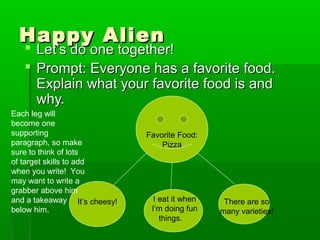
 Let’s do one together!Let’s do one together!
 Prompt: Everyone has a favorite food.Prompt: Everyone has a favorite food.
Explain what your favorite food is andExplain what your favorite food is and
why.why.
Favorite Food:
Pizza
It’s cheesy! I eat it when
I’m doing fun
things.
There are so
many varieties!
Each leg will
become one
supporting
paragraph, so make
sure to think of lots
of target skills to add
when you write! You
may want to write a
grabber above him
and a takeaway
below him.
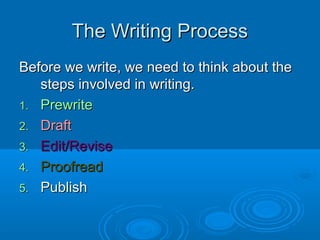
The Writing ProcessThe Writing Process
Before we write, we need to think about theBefore we write, we need to think about the
steps involved in writing.steps involved in writing.
1.1. PrewritePrewrite
2.2. DraftDraft
3.3. Edit/ReviseEdit/Revise
4.4. ProofreadProofread
5.5. PublishPublish
Narrative Draft:
Writing Paragraphs
After you write your Story Board, it’s time to add
paragraphs. Remember, each paragraph is a
block on your story board.
When you write, you need to keep in mind that you
need these things:
You are ON TOPIC
It has a BEGINNING, MIDDLE, and END
You wrote CONTENT
You included CREATIVITY skills
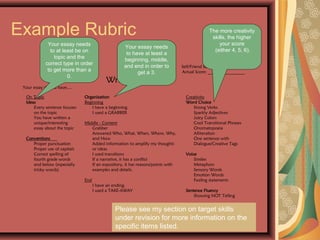
Example Rubric
Self/Friend Score:______________
Actual Score: _________________
Writing Rubric
Your essay should have….
Organization
Beginning
I have a beginning.
I used a GRABBER
Middle - Content
Grabber
Answered Who, What, When, Where, Why,
and How
Added information to amplify my thoughts
or ideas
I used transitions
If a narrative, it has a conflict
If an expository, it has reasons/points with
examples and details.
End
I have an ending.
I used a TAKE-AWAY
Creativity
Word Choice
Strong Verbs
Sparkly Adjectives
Juicy Colors
Cool Transitional Phrases
Onomatopoeia
Alliteration
One sentence with
Dialogue/Creative Tags
Voice
Similes
Metaphors
Sensory Words
Emotion Words
Feeling statements
Sentence Fluency
Showing NOT Telling
On Topic
Ideas
Every sentence focuses
on the topic
You have written a
unique/interesting
essay about the topic
Conventions
Proper punctuation
Proper use of capitals
Correct spelling of
fourth grade words
and below (especially
tricky words)
Your essay needs
to at least be on
topic and the
correct type in order
to get more than a
0.
Your essay needs
to have at least a
beginning, middle,
and end in order to
get a 3.
The more creativity
skills, the higher
your score
(either 4, 5, 6).
Please see my section on target skills
under revision for more information on the
specific items listed.
The Writing ProcessThe Writing Process
Before we write, we need to think about theBefore we write, we need to think about the
steps involved in writing.steps involved in writing.
1.1. PrewritePrewrite
2.2. DraftDraft
3.3. Edit/ReviseEdit/Revise
4.4. ProofreadProofread
5.5. PublishPublish
Narrative- Edit/ReviseNarrative- Edit/Revise
When you are done writing your 1When you are done writing your 1stst
draft. Godraft. Go
back and REVISE, REVISE, REVISE! Reviseback and REVISE, REVISE, REVISE! Revise
until time is up.until time is up.
Revise means to “see again.” Literally, look atRevise means to “see again.” Literally, look at
your paper as if you were someone else andyour paper as if you were someone else and
read it with a critical eye. What can you add andread it with a critical eye. What can you add and
change? THIS IS NOT JUST A ‘FIX THEchange? THIS IS NOT JUST A ‘FIX THE
GRAMMAR/SPELLING’ TIME!GRAMMAR/SPELLING’ TIME!
Make huge changes to your word choice,Make huge changes to your word choice,
organization, and sentence structure.organization, and sentence structure.
The Writing ProcessThe Writing Process
Before we write, we need to think about theBefore we write, we need to think about the
steps involved in writing.steps involved in writing.
1.1. PrewritePrewrite
2.2. DraftDraft
3.3. Edit/ReviseEdit/Revise
4.4. ProofreadProofread
5.5. PublishPublish
ProofreadProofread
 After revising, go back and proofread yourAfter revising, go back and proofread your
essay for grammar and spelling errors. Allessay for grammar and spelling errors. All
fourth grade level words should be spelledfourth grade level words should be spelled
correctly.correctly.
 Play close attention to tricky words! ClickPlay close attention to tricky words! Click
onon tricky wordstricky words for a list.for a list.
The Writing ProcessThe Writing Process
Before we write, we need to think about theBefore we write, we need to think about the
steps involved in writing.steps involved in writing.
1.1. PrewritePrewrite
2.2. DraftDraft
3.3. Edit/ReviseEdit/Revise
4.4. ProofreadProofread
5.5. PublishPublish
PublishPublish
 In the classroom, stories and other writingIn the classroom, stories and other writing
can be written into a final draft withcan be written into a final draft with
pictures!pictures!
 However, for Florida Writes, the studentsHowever, for Florida Writes, the students
are EXPECTED to turn in rough drafts.are EXPECTED to turn in rough drafts.
They won’t look pretty! THEYThey won’t look pretty! THEY
SHOULDN’T! Just make sure it is legible.SHOULDN’T! Just make sure it is legible.


Alexis John B. Benedicto-Writing an essay

  • 1.
    Writing an Essay By ALEXISJOHN B. BENEDICTO For more info visit my FB Page: “alexis art and perception” and leave a message.
  • 2.
    Writing is NotA Skill….Writing is Not A Skill…. It Is An Art!It Is An Art! Painters need a brush, musicians needPainters need a brush, musicians need notes, and writers need words. Carefullynotes, and writers need words. Carefully selected words are the tools that a writerselected words are the tools that a writer uses to turn his average writing intouses to turn his average writing into beautiful works of art.beautiful works of art.
  • 3.
    Types of EssaysTypesof Essays There are three types of essays:There are three types of essays:  NarrativeNarrative  ExpositoryExpository  PersuasivePersuasive We will be focusing on the first two:We will be focusing on the first two: Narrative and Expository for Florida WritesNarrative and Expository for Florida Writes
  • 4.
  • 5.
    Narrative EssaysNarrative Essays A narrative essay is a STORY.A narrative essay is a STORY.  The prompt, or writing topic, they give youThe prompt, or writing topic, they give you will most likely have this key word in it:will most likely have this key word in it: TELL.TELL.  For example, “Tell about a time you wentFor example, “Tell about a time you went on a special trip.”on a special trip.” This is a narrative, because of the wordThis is a narrative, because of the word TELL.TELL.
  • 6.
    The Writing ProcessTheWriting Process Before we write, we need to think about theBefore we write, we need to think about the steps involved in writing.steps involved in writing. 1.1. PrewritePrewrite 2.2. DraftDraft 3.3. Edit/ReviseEdit/Revise 4.4. ProofreedProofreed 5.5. PublishPublish
  • 7.
    Prewrite - NarrativePrewrite- Narrative  Have you ever seen a cartoon movie?Have you ever seen a cartoon movie?  They use a Story Board to sketch their ideasThey use a Story Board to sketch their ideas before they do the whole movie and includebefore they do the whole movie and include each detail! This helps them get their ideaseach detail! This helps them get their ideas flowing and keeps them on track.flowing and keeps them on track.  For a narrative essay, when you see the wordsFor a narrative essay, when you see the words TELL on a prompt, sketch a STORY BOARDTELL on a prompt, sketch a STORY BOARD
  • 8.
    Narrative Story BoardsNarrativeStory Boards 1.1. Draw 5 or 6 boxes (you can do more,Draw 5 or 6 boxes (you can do more, but I would suggest at least 4).but I would suggest at least 4). 2.2. In each box you will draw a picture of aIn each box you will draw a picture of a scene, in order, in your story.scene, in order, in your story. 3.3. Each box will then be used to help youEach box will then be used to help you describe a paragraph on your essay.describe a paragraph on your essay.
  • 9.
    Narrative Story BoardsNarrativeStory Boards  Let’s do one together! Remember that each square is a scene, orLet’s do one together! Remember that each square is a scene, or an event that happens next. Try to add target skills to each box.an event that happens next. Try to add target skills to each box.  Prompt: Tell about a time you did something scary.Prompt: Tell about a time you did something scary. 1 2 3 4 5 6 Setting/Character Strong Verb Conflict Simile Metaphor Take-Away Heard a clanking I crept as quietly as nervous mouse. RATTLE, RATTLE, RATTLE I became a relieved librarian when I discovered it was only a cat. I’ll never forget that scary night! Onomatopoeia
  • 10.
    Prewrite - ExpositoryPrewrite- Expository  For an expository essay we are asked toFor an expository essay we are asked to EXPLAIN an idea or thought we have.EXPLAIN an idea or thought we have.  For this, we use a Happy Alien!For this, we use a Happy Alien!  Draw one head and three legs. TheDraw one head and three legs. The head holds the main topic and each leghead holds the main topic and each leg is a supporting detail.is a supporting detail.
  • 11.
    Happy AlienHappy Alien Let’s do one together!Let’s do one together!  Prompt: Everyone has a favorite food.Prompt: Everyone has a favorite food. Explain what your favorite food is andExplain what your favorite food is and why.why. Favorite Food: Pizza It’s cheesy! I eat it when I’m doing fun things. There are so many varieties! Each leg will become one supporting paragraph, so make sure to think of lots of target skills to add when you write! You may want to write a grabber above him and a takeaway below him.
  • 12.
    The Writing ProcessTheWriting Process Before we write, we need to think about theBefore we write, we need to think about the steps involved in writing.steps involved in writing. 1.1. PrewritePrewrite 2.2. DraftDraft 3.3. Edit/ReviseEdit/Revise 4.4. ProofreadProofread 5.5. PublishPublish
  • 13.
    Narrative Draft: Writing Paragraphs Afteryou write your Story Board, it’s time to add paragraphs. Remember, each paragraph is a block on your story board. When you write, you need to keep in mind that you need these things: You are ON TOPIC It has a BEGINNING, MIDDLE, and END You wrote CONTENT You included CREATIVITY skills
  • 14.
    Example Rubric Self/Friend Score:______________ ActualScore: _________________ Writing Rubric Your essay should have…. Organization Beginning I have a beginning. I used a GRABBER Middle - Content Grabber Answered Who, What, When, Where, Why, and How Added information to amplify my thoughts or ideas I used transitions If a narrative, it has a conflict If an expository, it has reasons/points with examples and details. End I have an ending. I used a TAKE-AWAY Creativity Word Choice Strong Verbs Sparkly Adjectives Juicy Colors Cool Transitional Phrases Onomatopoeia Alliteration One sentence with Dialogue/Creative Tags Voice Similes Metaphors Sensory Words Emotion Words Feeling statements Sentence Fluency Showing NOT Telling On Topic Ideas Every sentence focuses on the topic You have written a unique/interesting essay about the topic Conventions Proper punctuation Proper use of capitals Correct spelling of fourth grade words and below (especially tricky words) Your essay needs to at least be on topic and the correct type in order to get more than a 0. Your essay needs to have at least a beginning, middle, and end in order to get a 3. The more creativity skills, the higher your score (either 4, 5, 6). Please see my section on target skills under revision for more information on the specific items listed.
  • 15.
    The Writing ProcessTheWriting Process Before we write, we need to think about theBefore we write, we need to think about the steps involved in writing.steps involved in writing. 1.1. PrewritePrewrite 2.2. DraftDraft 3.3. Edit/ReviseEdit/Revise 4.4. ProofreadProofread 5.5. PublishPublish
  • 16.
    Narrative- Edit/ReviseNarrative- Edit/Revise Whenyou are done writing your 1When you are done writing your 1stst draft. Godraft. Go back and REVISE, REVISE, REVISE! Reviseback and REVISE, REVISE, REVISE! Revise until time is up.until time is up. Revise means to “see again.” Literally, look atRevise means to “see again.” Literally, look at your paper as if you were someone else andyour paper as if you were someone else and read it with a critical eye. What can you add andread it with a critical eye. What can you add and change? THIS IS NOT JUST A ‘FIX THEchange? THIS IS NOT JUST A ‘FIX THE GRAMMAR/SPELLING’ TIME!GRAMMAR/SPELLING’ TIME! Make huge changes to your word choice,Make huge changes to your word choice, organization, and sentence structure.organization, and sentence structure.
  • 17.
    The Writing ProcessTheWriting Process Before we write, we need to think about theBefore we write, we need to think about the steps involved in writing.steps involved in writing. 1.1. PrewritePrewrite 2.2. DraftDraft 3.3. Edit/ReviseEdit/Revise 4.4. ProofreadProofread 5.5. PublishPublish
  • 18.
    ProofreadProofread  After revising,go back and proofread yourAfter revising, go back and proofread your essay for grammar and spelling errors. Allessay for grammar and spelling errors. All fourth grade level words should be spelledfourth grade level words should be spelled correctly.correctly.  Play close attention to tricky words! ClickPlay close attention to tricky words! Click onon tricky wordstricky words for a list.for a list.
  • 19.
    The Writing ProcessTheWriting Process Before we write, we need to think about theBefore we write, we need to think about the steps involved in writing.steps involved in writing. 1.1. PrewritePrewrite 2.2. DraftDraft 3.3. Edit/ReviseEdit/Revise 4.4. ProofreadProofread 5.5. PublishPublish
  • 20.
    PublishPublish  In theclassroom, stories and other writingIn the classroom, stories and other writing can be written into a final draft withcan be written into a final draft with pictures!pictures!  However, for Florida Writes, the studentsHowever, for Florida Writes, the students are EXPECTED to turn in rough drafts.are EXPECTED to turn in rough drafts. They won’t look pretty! THEYThey won’t look pretty! THEY SHOULDN’T! Just make sure it is legible.SHOULDN’T! Just make sure it is legible. 