Pre-Writing Strategies
Pre-Writing 
• First stage of the writing process 
• Helps us discover our initial ideas about a 
subject and put them on paper, though not 
usually in organized form
Common Pre-Writing Strategies 
1. Freewriting 
2. Brainstorming/Listing 
3. Clustering/Mapping 
4. Journalistic Questions
1. Freewriting 
• Jotting down all ideas on a particular topic on 
paper even before researching about it 
• Does not require complete sentences, proper 
spelling, or correct punctuation and grammar 
• About 10 to 15 minutes to write everything 
that comes to mind even if it doesn’t 
necessarily make sense yet.
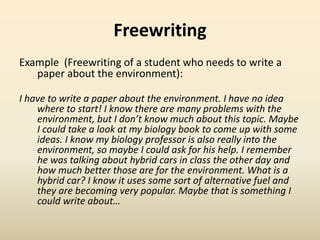
Freewriting 
Example (Freewriting of a student who needs to write a 
paper about the environment): 
I have to write a paper about the environment. I have no idea 
where to start! I know there are many problems with the 
environment, but I don’t know much about this topic. Maybe 
I could take a look at my biology book to come up with some 
ideas. I know my biology professor is also really into the 
environment, so maybe I could ask for his help. I remember 
he was talking about hybrid cars in class the other day and 
how much better those are for the environment. What is a 
hybrid car? I know it uses some sort of alternative fuel and 
they are becoming very popular. Maybe that is something I 
could write about…
2. Brainstorming/Listing 
• Capturing all thoughts, ideas, and fragments 
in one’s head and writing them down on 
paper 
• Similar to freewriting, but: 
 Freewriting = paragraph 
 Brainstorming = list
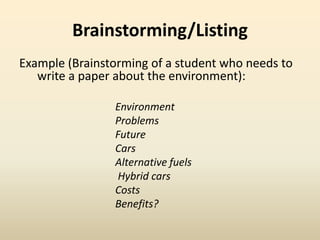
Brainstorming/Listing 
Example (Brainstorming of a student who needs to 
write a paper about the environment): 
Environment 
Problems 
Future 
Cars 
Alternative fuels 
Hybrid cars 
Costs 
Benefits?
3. Clustering/Mapping 
a. Placing the general subject in a circle in the 
middle of a blank sheet of paper 
b. Draw other lines or circles that shoot out 
from the original topic. 
c. Grouping the ideas that seem to go together
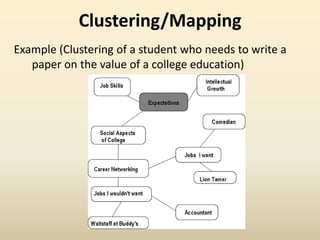
Clustering/Mapping 
Example (Clustering of a student who needs to write a 
paper on the value of a college education)
4. Journalistic Questions 
• Asking and answering who, what, when, 
where, why, and how questions about the 
subject 
• Especially useful when describing a event or 
writing an information report/essay
Journalistic Questions 
Example (Questions of a student who needs to write a report 
on the political conflict in the Middle East): 
• Who is involved in the conflict? 
• What issues most clearly divide those engaged in this 
dispute? 
• When did the troubles in the Middle East begin, and how 
have they developed over time? 
• Where does the conflict seem most heated or violent? 
• Why have those living in this area found it so difficult to 
resolve the situation? 
• How might this conflict be resolved?
REMEMBER! 
• Save all of your prewriting work. 
• Your prewriting will look very different from 
your final work.

Pre-Writing Strategies

  • 1.
  • 2.
    Pre-Writing • Firststage of the writing process • Helps us discover our initial ideas about a subject and put them on paper, though not usually in organized form
  • 3.
    Common Pre-Writing Strategies 1. Freewriting 2. Brainstorming/Listing 3. Clustering/Mapping 4. Journalistic Questions
  • 4.
    1. Freewriting •Jotting down all ideas on a particular topic on paper even before researching about it • Does not require complete sentences, proper spelling, or correct punctuation and grammar • About 10 to 15 minutes to write everything that comes to mind even if it doesn’t necessarily make sense yet.
  • 5.
    Freewriting Example (Freewritingof a student who needs to write a paper about the environment): I have to write a paper about the environment. I have no idea where to start! I know there are many problems with the environment, but I don’t know much about this topic. Maybe I could take a look at my biology book to come up with some ideas. I know my biology professor is also really into the environment, so maybe I could ask for his help. I remember he was talking about hybrid cars in class the other day and how much better those are for the environment. What is a hybrid car? I know it uses some sort of alternative fuel and they are becoming very popular. Maybe that is something I could write about…
  • 6.
    2. Brainstorming/Listing •Capturing all thoughts, ideas, and fragments in one’s head and writing them down on paper • Similar to freewriting, but:  Freewriting = paragraph  Brainstorming = list
  • 7.
    Brainstorming/Listing Example (Brainstormingof a student who needs to write a paper about the environment): Environment Problems Future Cars Alternative fuels Hybrid cars Costs Benefits?
  • 8.
    3. Clustering/Mapping a.Placing the general subject in a circle in the middle of a blank sheet of paper b. Draw other lines or circles that shoot out from the original topic. c. Grouping the ideas that seem to go together
  • 9.
    Clustering/Mapping Example (Clusteringof a student who needs to write a paper on the value of a college education)
  • 10.
    4. Journalistic Questions • Asking and answering who, what, when, where, why, and how questions about the subject • Especially useful when describing a event or writing an information report/essay
  • 11.
    Journalistic Questions Example(Questions of a student who needs to write a report on the political conflict in the Middle East): • Who is involved in the conflict? • What issues most clearly divide those engaged in this dispute? • When did the troubles in the Middle East begin, and how have they developed over time? • Where does the conflict seem most heated or violent? • Why have those living in this area found it so difficult to resolve the situation? • How might this conflict be resolved?
  • 12.
    REMEMBER! • Saveall of your prewriting work. • Your prewriting will look very different from your final work.