The Writing Process
Let's get ready... Build schema. Go the the library. Read, read, read Select a topic. Go the the library. Read, read, read--take notes Narrow the topic and begin the writing process.
Warm Up Before You Write List of Details T-Charts Graphic Organizer Pre-Writing
What’s next?
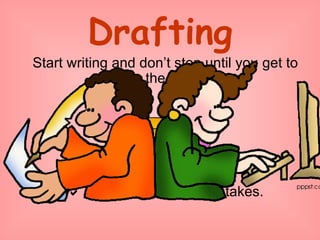
Start writing and don’t stop until you get to the end!    It’s ok if you make mistakes. Drafting
Are you finished with your writing after your first draft? What’s next?
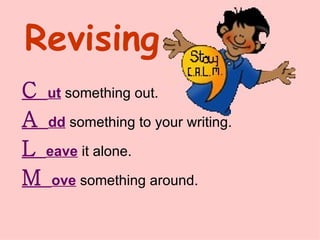
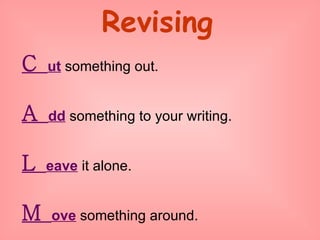
C  ut  something out. A  dd  something to your writing. L  eave  it alone. M  ove  something around. Revising
Revision Tips Revision Checklist __ Do I have an effective lead? __ Did I include enough details and zoom in? __ Is my conclusion logical? __ Can new ideas be added? __ Should some ideas be moved around? __ Do I stay on one topic or do I have many ideas? __ Did I answer all my reader’s questions?
Revision Tips Use a different color when you make your revisions. Read over your revisions to make sure they make sense in your writing.
Are you finished with your writing after your first draft? What’s next?
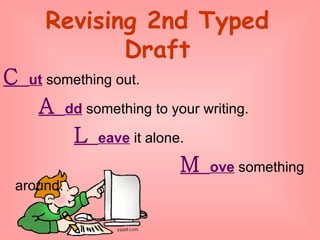
Revising 2nd Typed Draft C  ut  something out. A  dd  something to your writing. L  eave  it alone. M  ove  something around.
Are you finished with your writing after your second typed draft? What’s next?
Sharing Share your writing many times to friends, family, or teachers. Why? Get feedback on your writing to become a better writer.
How do we share our writing? * My piece is called…. * I’d like you to listen for…. * Tell me what you think.
ARE WE DONE YET?!?!
Revising   C  ut  something out. A  dd  something to your writing. L  eave  it alone. M  ove  something around.
What do you do after you revise your writing? Compare the changes you made to your first copy. Does it make sense?  Should I revise it again?
After you revise your writing…. MAKE A CLEAN COPY  Don’t forget to double space!
It’s All Typed… Now What??
Editing: Share Again! Ask a teacher, friend, or family member to read over your revisions on your second draft. Read your writing over   again and again and again and again and again and again and again and again and again and again and again and again and again and again and again and again and again and again and again and again and again and again …..   until you believe it is the best piece of writing you can create.
Publishing Prepare a piece of writing so it can be enjoyed and shared by the  public .
Assessing After you publish a piece of writing, let it “chill out” for a while…then read it again.  Write down some thoughts about what you did. Think to Yourself:   Are there parts you like more than others? Did you learn something new? What does this piece say about you as a writer?
Why do we assess our writing? To see our progress….it’s important!
Where are we at in the writing process? Building Schema Pre-writing Drafting: First Copy Drafting: Second Typed Copy Sharing Revision Sharing Editing Publishing Assessing

Process Of Writing

  • 1.
  • 2.
    Let's get ready...Build schema. Go the the library. Read, read, read Select a topic. Go the the library. Read, read, read--take notes Narrow the topic and begin the writing process.
  • 3.
    Warm Up BeforeYou Write List of Details T-Charts Graphic Organizer Pre-Writing
  • 4.
  • 5.
    Start writing anddon’t stop until you get to the end!  It’s ok if you make mistakes. Drafting
  • 6.
    Are you finishedwith your writing after your first draft? What’s next?
  • 7.
    C ut something out. A dd something to your writing. L eave it alone. M ove something around. Revising
  • 8.
    Revision Tips RevisionChecklist __ Do I have an effective lead? __ Did I include enough details and zoom in? __ Is my conclusion logical? __ Can new ideas be added? __ Should some ideas be moved around? __ Do I stay on one topic or do I have many ideas? __ Did I answer all my reader’s questions?
  • 9.
    Revision Tips Usea different color when you make your revisions. Read over your revisions to make sure they make sense in your writing.
  • 10.
    Are you finishedwith your writing after your first draft? What’s next?
  • 11.
    Revising 2nd TypedDraft C ut something out. A dd something to your writing. L eave it alone. M ove something around.
  • 12.
    Are you finishedwith your writing after your second typed draft? What’s next?
  • 13.
    Sharing Share yourwriting many times to friends, family, or teachers. Why? Get feedback on your writing to become a better writer.
  • 14.
    How do weshare our writing? * My piece is called…. * I’d like you to listen for…. * Tell me what you think.
  • 15.
    ARE WE DONEYET?!?!
  • 16.
    Revising C ut something out. A dd something to your writing. L eave it alone. M ove something around.
  • 17.
    What do youdo after you revise your writing? Compare the changes you made to your first copy. Does it make sense? Should I revise it again?
  • 18.
    After you reviseyour writing…. MAKE A CLEAN COPY Don’t forget to double space!
  • 19.
  • 20.
    Editing: Share Again!Ask a teacher, friend, or family member to read over your revisions on your second draft. Read your writing over again and again and again and again and again and again and again and again and again and again and again and again and again and again and again and again and again and again and again and again and again and again ….. until you believe it is the best piece of writing you can create.
  • 21.
    Publishing Prepare apiece of writing so it can be enjoyed and shared by the public .
  • 22.
    Assessing After youpublish a piece of writing, let it “chill out” for a while…then read it again. Write down some thoughts about what you did. Think to Yourself: Are there parts you like more than others? Did you learn something new? What does this piece say about you as a writer?
  • 23.
    Why do weassess our writing? To see our progress….it’s important!
  • 24.
    Where are weat in the writing process? Building Schema Pre-writing Drafting: First Copy Drafting: Second Typed Copy Sharing Revision Sharing Editing Publishing Assessing