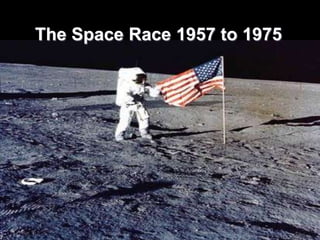
The Space Race 1957 to 1975
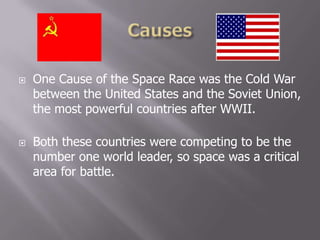
 One Cause of the Space Race was the Cold War
between the United States and the Soviet Union,
the most powerful countries after WWII.
 Both these countries were competing to be the
number one world leader, so space was a critical
area for battle.
The Space Race started when Russia sent
Sputnik and the first man into space. The U.S.
got the people thinking, “If Russia can send
satellites into space, then they can send
nuclear weapons from space to the U.S. and
destroy the U.S."
It also showed that Russia had better educated
students to take Russia into space, and the
U.S. was falling behind in education.
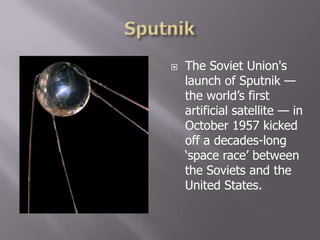
 The Soviet Union's
launch of Sputnik —
the world‟s first
artificial satellite — in
October 1957 kicked
off a decades-long
„space race‟ between
the Soviets and the
United States.
 Both sides, the United States and the U.S.S.R.,
tried to show the world its superiority by being
ahead in rocketry and spaceflight.
 At the end of the Cold War, they both agreed to
build a space station and pursue other joint
ventures in space. A competition that began in
fear and hatred had turned into a partnership.
 At the start of the Space Race, there were no set rules
for it. There wasn‟t a set goal, and nobody knew how
to win it.
 For Americans, President Kennedy's declaration focused
the Space Race on one clear goal: landing people on
the Moon before the Soviets, so for the Americans, the
Space Race became a race to get to the Moon.
 For years, the Soviets officially denied trying to get or
“race” to the Moon. Now there is good evidence, that
shows that they did actually compete to try to reach
the Moon first.
 The Space Race became a symbol of the political
contest between two enemy world powers. The way
the two competitors arranged to achieve their goals in
space showed their basic differences.
 The United States had different civilian and military
agencies, and only the military space programs were
secret. Civilian space activities, like the race to the
Moon, were widely publicized for the world to see.
 In the Soviet Union, all space programs were put into a
secret military-industrial bureaucracy. Launches were
not announced previous to the launch, and only
successful missions were publicized.
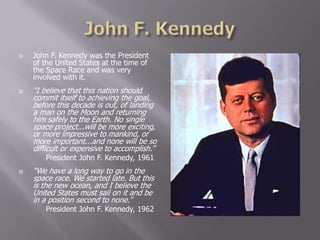
 John F. Kennedy was the President
of the United States at the time of
the Space Race and was very
involved with it.
 "I believe that this nation should
commit itself to achieving the goal,
before this decade is out, of landing
a man on the Moon and returning
him safely to the Earth. No single
space project...will be more exciting,
or more impressive to mankind, or
more important...and none will be so
difficult or expensive to accomplish.”
President John F. Kennedy, 1961
 “We have a long way to go in the
space race. We started late. But this
is the new ocean, and I believe the
United States must sail on it and be
in a position second to none.”
President John F. Kennedy, 1962
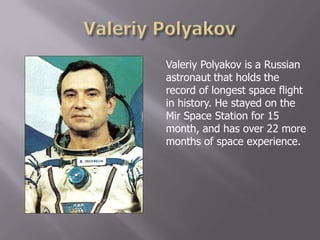
Valeriy Polyakov is a Russian
astronaut that holds the
record of longest space flight
in history. He stayed on the
Mir Space Station for 15
month, and has over 22 more
months of space experience.
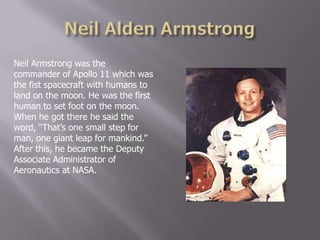
Neil Armstrong was the
commander of Apollo 11 which was
the fist spacecraft with humans to
land on the moon. He was the first
human to set foot on the moon.
When he got there he said the
word, “That‟s one small step for
man, one giant leap for mankind.”
After this, he became the Deputy
Associate Administrator of
Aeronautics at NASA.
Technology, in aerospace engineering and electronic
communication, advanced a lot during this period. The effects of
the Space Race went way beyond rocketry, physics, and astronomy.
"Space age technology" extended to fields as different as home
economics and forest defoliation studies, and the desire to win the
race changed the ways in which students learned science.
American concerns that they had fallen so quickly behind the
Soviets in the race to space led to a push by legislators and
educators for greater emphasis on math and physical sciences in
American schools. The United States' National Defense Education
Act of 1958 increased funding for these goals from childhood
education through the post-graduate level. To this day over twelve
hundred American high schools have their own planetarium
installations, a direct effect of the Space Race.
Scientists helped develop space exploration technologies whose uses
range from the kitchen to athletic fields. Dried watermelon and ready-to-
eat foods, in particular food sterilization, package sealing techniques,
stay-dry clothing, and even no-fog ski goggles have their roots in space
science.
Today over a thousand artificial satellites orbit earth, relaying
communications data around the planet and facilitating remote sensing of
data on weather, vegetation, and human movements to nations who own
them. Also, much of the micro-technology which drives everyday activities
from time-keeping to enjoying music derives from research initially driven
by the Space Race.
With all these advances since the first Sputnik was launched, the former
Soviet Union's R-7 rocket, that marked the beginning the space race, is
still in use today, servicing the ISS.
Although the pace of space exploration has slowed, it
continues to advance long after the end of the Space
Race. The United States launched the first reusable space
shuttle on the 20th anniversary of Gagarin's flight, April
12, 1981. On November 15, 1988, the Soviet Union
launched Buran, their first and only reusable spacecraft.
These and many other nations continue to launch probes,
many types of satellites, and large space telescopes.
 October 4, 1957 - Sputnik 1, the first man-made object to orbit
the Earth, is launched by the U.S.S.R., and stays in orbit until
January 4, 1958.
 January 31, 1958 - Explorer 1, the first U.S. satellite in orbit, lifts
off at Cape Canaveral using a modified Jupiter-C rocket. It carries a
scientific experiment of James A. Van Allen, and discovers the
Earth's radiation belt.
 October 1, 1958 - N.A.S.A. is founded, taking over existing
National Advisory Committee on Aeronautics.
 October 11, 1958 - Pioneer 1, U.S. - IGY space probe, launched
to a height of 70,700 miles.
 January 2, 1959 - Luna 1, first man-made satellite to orbit the
sun, is launched by the U.S.S.R.
 April 1, 1960 - Tiros 1, the first successful weather satellite, is
launched by the U.S.
 April 12, 1961- Vostok 1 is launched by the U.S.S.R., carrying Cosmonaut
Yuri A. Gargarin, the first man in space. He orbits the Earth once.
 March 18, 1965- The first space walk is made from Soviet Voskhod 2 by
Cosmonaut Alexei A. Leonov. Duration is 12 minutes.
 March 1, 1966- Soviet Venera 3 impacts on Venus, the first spacecraft to
reach another planet. It fails to return data.
 1968- The United States launches Apollo 8, the first manned space
mission to orbit the moon.
 July 20, 1969- Neil Armstrong and Edwin Aldrin, Jr. make the first
manned soft landing on the Moon, and the first moonwalk, using Apollo
11.
 April 11, 1970- Apollo 13 is launched, suffering an explosion in its SM
oxygen tanks. Its Moon landing is aborted, and the crew, James A. Lovell,
Jr., John L. Swigert, Jr. and Fred W. Haise, Jr., return safely.
 June 24, 1974- Soviet Salyut 3, their first military space station, is
launched. It remains in orbit until January 1975.
 Space Race. 2002. Smithsonian National Air and Space Museum. 29
Apr. 2008
<http://www.nasm.si.edu/exhibitions/gal114/gal114.htm>.
 The Space Race. 31 July 2007. 29 Apr. 2008
<http://www.thespacerace.com/>.
 "Space Race." Wikipedia. 8 May 2008. 9 May 2008
<http://en.wikipedia.org/wiki/Space_race#Cold_War_roots>.
 "Sputnik and the Space Race." Eisenhower Archives. Dwight D.
Eisenhower Presidential Library & Museum. 9 May 2008
<http://www.eisenhower.archives.gov/dl/Sputnik/Sputnikdocuments
.html>.

The Space Race

  • 1.
    The Space Race1957 to 1975
  • 2.
     One Causeof the Space Race was the Cold War between the United States and the Soviet Union, the most powerful countries after WWII.  Both these countries were competing to be the number one world leader, so space was a critical area for battle.
  • 3.
    The Space Racestarted when Russia sent Sputnik and the first man into space. The U.S. got the people thinking, “If Russia can send satellites into space, then they can send nuclear weapons from space to the U.S. and destroy the U.S." It also showed that Russia had better educated students to take Russia into space, and the U.S. was falling behind in education.
  • 4.
     The SovietUnion's launch of Sputnik — the world‟s first artificial satellite — in October 1957 kicked off a decades-long „space race‟ between the Soviets and the United States.
  • 5.
     Both sides,the United States and the U.S.S.R., tried to show the world its superiority by being ahead in rocketry and spaceflight.  At the end of the Cold War, they both agreed to build a space station and pursue other joint ventures in space. A competition that began in fear and hatred had turned into a partnership.
  • 6.
     At thestart of the Space Race, there were no set rules for it. There wasn‟t a set goal, and nobody knew how to win it.  For Americans, President Kennedy's declaration focused the Space Race on one clear goal: landing people on the Moon before the Soviets, so for the Americans, the Space Race became a race to get to the Moon.  For years, the Soviets officially denied trying to get or “race” to the Moon. Now there is good evidence, that shows that they did actually compete to try to reach the Moon first.
  • 7.
     The SpaceRace became a symbol of the political contest between two enemy world powers. The way the two competitors arranged to achieve their goals in space showed their basic differences.  The United States had different civilian and military agencies, and only the military space programs were secret. Civilian space activities, like the race to the Moon, were widely publicized for the world to see.  In the Soviet Union, all space programs were put into a secret military-industrial bureaucracy. Launches were not announced previous to the launch, and only successful missions were publicized.
  • 8.
     John F.Kennedy was the President of the United States at the time of the Space Race and was very involved with it.  "I believe that this nation should commit itself to achieving the goal, before this decade is out, of landing a man on the Moon and returning him safely to the Earth. No single space project...will be more exciting, or more impressive to mankind, or more important...and none will be so difficult or expensive to accomplish.” President John F. Kennedy, 1961  “We have a long way to go in the space race. We started late. But this is the new ocean, and I believe the United States must sail on it and be in a position second to none.” President John F. Kennedy, 1962
  • 9.
    Valeriy Polyakov isa Russian astronaut that holds the record of longest space flight in history. He stayed on the Mir Space Station for 15 month, and has over 22 more months of space experience.
  • 10.
    Neil Armstrong wasthe commander of Apollo 11 which was the fist spacecraft with humans to land on the moon. He was the first human to set foot on the moon. When he got there he said the word, “That‟s one small step for man, one giant leap for mankind.” After this, he became the Deputy Associate Administrator of Aeronautics at NASA.
  • 11.
    Technology, in aerospaceengineering and electronic communication, advanced a lot during this period. The effects of the Space Race went way beyond rocketry, physics, and astronomy. "Space age technology" extended to fields as different as home economics and forest defoliation studies, and the desire to win the race changed the ways in which students learned science. American concerns that they had fallen so quickly behind the Soviets in the race to space led to a push by legislators and educators for greater emphasis on math and physical sciences in American schools. The United States' National Defense Education Act of 1958 increased funding for these goals from childhood education through the post-graduate level. To this day over twelve hundred American high schools have their own planetarium installations, a direct effect of the Space Race.
  • 12.
    Scientists helped developspace exploration technologies whose uses range from the kitchen to athletic fields. Dried watermelon and ready-to- eat foods, in particular food sterilization, package sealing techniques, stay-dry clothing, and even no-fog ski goggles have their roots in space science. Today over a thousand artificial satellites orbit earth, relaying communications data around the planet and facilitating remote sensing of data on weather, vegetation, and human movements to nations who own them. Also, much of the micro-technology which drives everyday activities from time-keeping to enjoying music derives from research initially driven by the Space Race. With all these advances since the first Sputnik was launched, the former Soviet Union's R-7 rocket, that marked the beginning the space race, is still in use today, servicing the ISS.
  • 13.
    Although the paceof space exploration has slowed, it continues to advance long after the end of the Space Race. The United States launched the first reusable space shuttle on the 20th anniversary of Gagarin's flight, April 12, 1981. On November 15, 1988, the Soviet Union launched Buran, their first and only reusable spacecraft. These and many other nations continue to launch probes, many types of satellites, and large space telescopes.
  • 14.
     October 4,1957 - Sputnik 1, the first man-made object to orbit the Earth, is launched by the U.S.S.R., and stays in orbit until January 4, 1958.  January 31, 1958 - Explorer 1, the first U.S. satellite in orbit, lifts off at Cape Canaveral using a modified Jupiter-C rocket. It carries a scientific experiment of James A. Van Allen, and discovers the Earth's radiation belt.  October 1, 1958 - N.A.S.A. is founded, taking over existing National Advisory Committee on Aeronautics.  October 11, 1958 - Pioneer 1, U.S. - IGY space probe, launched to a height of 70,700 miles.  January 2, 1959 - Luna 1, first man-made satellite to orbit the sun, is launched by the U.S.S.R.  April 1, 1960 - Tiros 1, the first successful weather satellite, is launched by the U.S.
  • 15.
     April 12,1961- Vostok 1 is launched by the U.S.S.R., carrying Cosmonaut Yuri A. Gargarin, the first man in space. He orbits the Earth once.  March 18, 1965- The first space walk is made from Soviet Voskhod 2 by Cosmonaut Alexei A. Leonov. Duration is 12 minutes.  March 1, 1966- Soviet Venera 3 impacts on Venus, the first spacecraft to reach another planet. It fails to return data.  1968- The United States launches Apollo 8, the first manned space mission to orbit the moon.  July 20, 1969- Neil Armstrong and Edwin Aldrin, Jr. make the first manned soft landing on the Moon, and the first moonwalk, using Apollo 11.  April 11, 1970- Apollo 13 is launched, suffering an explosion in its SM oxygen tanks. Its Moon landing is aborted, and the crew, James A. Lovell, Jr., John L. Swigert, Jr. and Fred W. Haise, Jr., return safely.  June 24, 1974- Soviet Salyut 3, their first military space station, is launched. It remains in orbit until January 1975.
  • 16.
     Space Race.2002. Smithsonian National Air and Space Museum. 29 Apr. 2008 <http://www.nasm.si.edu/exhibitions/gal114/gal114.htm>.  The Space Race. 31 July 2007. 29 Apr. 2008 <http://www.thespacerace.com/>.  "Space Race." Wikipedia. 8 May 2008. 9 May 2008 <http://en.wikipedia.org/wiki/Space_race#Cold_War_roots>.  "Sputnik and the Space Race." Eisenhower Archives. Dwight D. Eisenhower Presidential Library & Museum. 9 May 2008 <http://www.eisenhower.archives.gov/dl/Sputnik/Sputnikdocuments .html>.