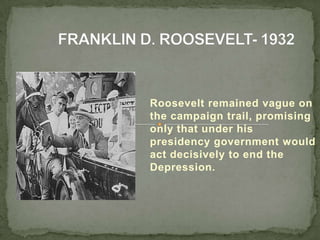
Roosevelt remained vague on
the campaign trail, promising
only that under his
presidency government would
act decisively to end the
Depression.
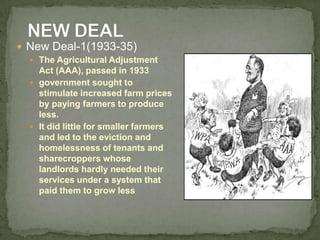
ď‚— New Deal-1(1933-35)
ď‚— The Agricultural Adjustment
Act (AAA), passed in 1933
ď‚— government sought to
stimulate increased farm prices
by paying farmers to produce
less.
ď‚— It did little for smaller farmers
and led to the eviction and
homelessness of tenants and
sharecroppers whose
landlords hardly needed their
services under a system that
paid them to grow less
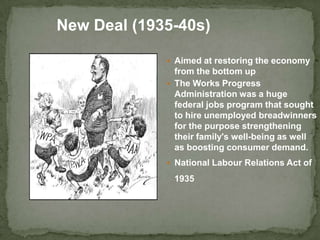
ď‚— Aimed at restoring the economy
from the bottom up
ď‚— The Works Progress
Administration was a huge
federal jobs program that sought
to hire unemployed breadwinners
for the purpose strengthening
their family's well-being as well
as boosting consumer demand.
ď‚— National Labour Relations Act of
1935
New Deal (1935-40s)
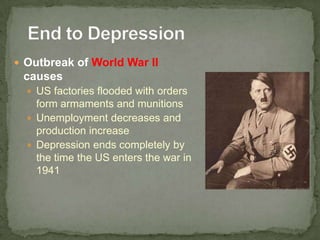
ď‚— Outbreak of World War II
causes
ď‚— US factories flooded with orders
form armaments and munitions
ď‚— Unemployment decreases and
production increase
ď‚— Depression ends completely by
the time the US enters the war in
1941

New deal

  • 1.
    Roosevelt remained vagueon the campaign trail, promising only that under his presidency government would act decisively to end the Depression.
  • 2.
    ď‚— New Deal-1(1933-35) ď‚—The Agricultural Adjustment Act (AAA), passed in 1933 ď‚— government sought to stimulate increased farm prices by paying farmers to produce less. ď‚— It did little for smaller farmers and led to the eviction and homelessness of tenants and sharecroppers whose landlords hardly needed their services under a system that paid them to grow less
  • 3.
    ď‚— Aimed atrestoring the economy from the bottom up ď‚— The Works Progress Administration was a huge federal jobs program that sought to hire unemployed breadwinners for the purpose strengthening their family's well-being as well as boosting consumer demand. ď‚— National Labour Relations Act of 1935 New Deal (1935-40s)
  • 4.
    ď‚— Outbreak ofWorld War II causes ď‚— US factories flooded with orders form armaments and munitions ď‚— Unemployment decreases and production increase ď‚— Depression ends completely by the time the US enters the war in 1941