BIG BUSINESS AND LABOR

            • Andrew Carnegie was
              one of the first
              industrial moguls
            • He entered the steel
              industry in 1873
            • By 1899, the Carnegie
              Steel Company
              manufactured more
              steel than all the
              factories in Great
              Britain combined
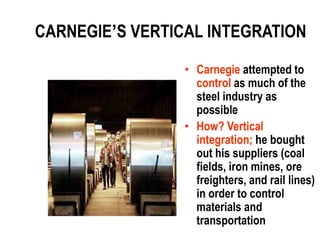
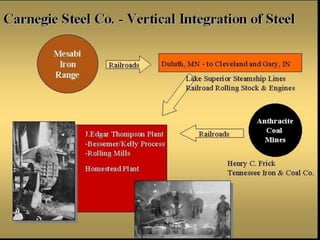
CARNEGIE’S VERTICAL INTEGRATION

                 • Carnegie attempted to
                   control as much of the
                   steel industry as
                   possible
                 • How? Vertical
                   integration; he bought
                   out his suppliers (coal
                   fields, iron mines, ore
                   freighters, and rail lines)
                   in order to control
                   materials and
                   transportation
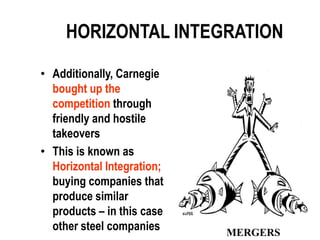
HORIZONTAL INTEGRATION

• Additionally, Carnegie
  bought up the
  competition through
  friendly and hostile
  takeovers
• This is known as
  Horizontal Integration;
  buying companies that
  produce similar
  products – in this case
  other steel companies     MERGERS
BUSINESS GROWTH &
              CONSOLIDATION
• Mergers could result in a
  monopoly (Trust)
• A monopoly is complete
  control over an industry
• An example of
  consolidation: In 1870,
  Rockefeller Standard Oil
  Company owned 2% of the
  country’s crude oil
• By 1880 – it controlled 90%
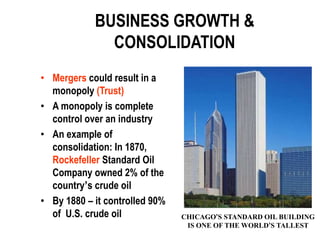
  of U.S. crude oil             CHICAGO’S STANDARD OIL BUILDING
                                 IS ONE OF THE WORLD’S TALLEST
ROBBER BARONS

                   • Alarmed at the cut-
                     throat tactics of
                     industrialists, critics
                     began to call them
                     “Robber Barons”
                   • Famous “Robber
                     Barons” included
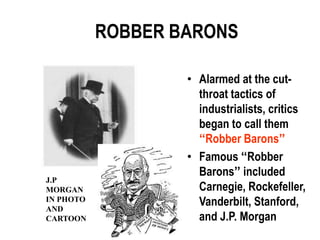
J.P
MORGAN               Carnegie, Rockefeller,
IN PHOTO
AND
                     Vanderbilt, Stanford,
CARTOON              and J.P. Morgan
ROBBER BARONS WERE
             GENEROUS, TOO
• Despite being labeled as
  greedy barons, rich
  industrialists did have a
  generous side
• When very rich people give
  away lots of money it is
  called “Philanthropy”
• Carnegie built libraries,
  Rockefeller, Leland
  Stanford, and Cornelius
  Vanderbilt built schools
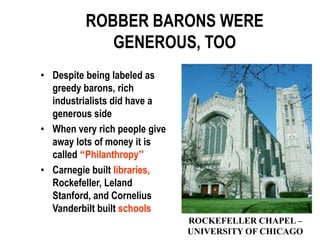
                               ROCKEFELLER CHAPEL –
                               UNIVERSITY OF CHICAGO
SHERMAN ANTI-TRUST ACT

           • In 1890, the Sherman Anti-
             Trust Act made it illegal to
             form a monopoly (Trust)
           • Prosecuting companies under
             the Act was not easy – a
             business would simply
             reorganize into single
             companies to avoid
             prosecution
           • Seven of eight cases brought
             before the Supreme Court
             were thrown out

Big buisness

  • 1.
    BIG BUSINESS ANDLABOR • Andrew Carnegie was one of the first industrial moguls • He entered the steel industry in 1873 • By 1899, the Carnegie Steel Company manufactured more steel than all the factories in Great Britain combined
  • 2.
    CARNEGIE’S VERTICAL INTEGRATION • Carnegie attempted to control as much of the steel industry as possible • How? Vertical integration; he bought out his suppliers (coal fields, iron mines, ore freighters, and rail lines) in order to control materials and transportation
  • 4.
    HORIZONTAL INTEGRATION • Additionally,Carnegie bought up the competition through friendly and hostile takeovers • This is known as Horizontal Integration; buying companies that produce similar products – in this case other steel companies MERGERS
  • 5.
    BUSINESS GROWTH & CONSOLIDATION • Mergers could result in a monopoly (Trust) • A monopoly is complete control over an industry • An example of consolidation: In 1870, Rockefeller Standard Oil Company owned 2% of the country’s crude oil • By 1880 – it controlled 90% of U.S. crude oil CHICAGO’S STANDARD OIL BUILDING IS ONE OF THE WORLD’S TALLEST
  • 6.
    ROBBER BARONS • Alarmed at the cut- throat tactics of industrialists, critics began to call them “Robber Barons” • Famous “Robber Barons” included J.P MORGAN Carnegie, Rockefeller, IN PHOTO AND Vanderbilt, Stanford, CARTOON and J.P. Morgan
  • 7.
    ROBBER BARONS WERE GENEROUS, TOO • Despite being labeled as greedy barons, rich industrialists did have a generous side • When very rich people give away lots of money it is called “Philanthropy” • Carnegie built libraries, Rockefeller, Leland Stanford, and Cornelius Vanderbilt built schools ROCKEFELLER CHAPEL – UNIVERSITY OF CHICAGO
  • 8.
    SHERMAN ANTI-TRUST ACT • In 1890, the Sherman Anti- Trust Act made it illegal to form a monopoly (Trust) • Prosecuting companies under the Act was not easy – a business would simply reorganize into single companies to avoid prosecution • Seven of eight cases brought before the Supreme Court were thrown out