R C S D I T
Landmark Supreme
Court Cases
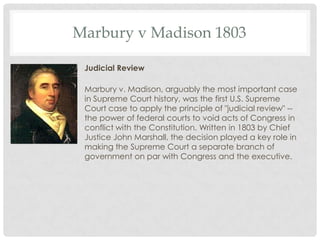
Marbury v Madison 1803
Judicial Review
Marbury v. Madison, arguably the most important case
in Supreme Court history, was the first U.S. Supreme
Court case to apply the principle of "judicial review" --
the power of federal courts to void acts of Congress in
conflict with the Constitution. Written in 1803 by Chief
Justice John Marshall, the decision played a key role in
making the Supreme Court a separate branch of
government on par with Congress and the executive.
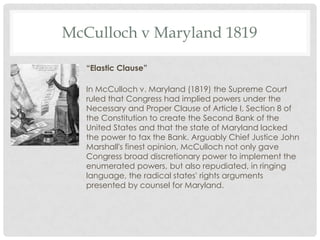
McCulloch v Maryland 1819
“Elastic Clause”
In McCulloch v. Maryland (1819) the Supreme Court
ruled that Congress had implied powers under the
Necessary and Proper Clause of Article I, Section 8 of
the Constitution to create the Second Bank of the
United States and that the state of Maryland lacked
the power to tax the Bank. Arguably Chief Justice John
Marshall's finest opinion, McCulloch not only gave
Congress broad discretionary power to implement the
enumerated powers, but also repudiated, in ringing
language, the radical states' rights arguments
presented by counsel for Maryland.
Gibbons v Ogden 1824
Supremacy of National Laws
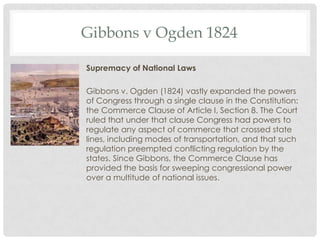
Gibbons v. Ogden (1824) vastly expanded the powers
of Congress through a single clause in the Constitution:
the Commerce Clause of Article I, Section 8. The Court
ruled that under that clause Congress had powers to
regulate any aspect of commerce that crossed state
lines, including modes of transportation, and that such
regulation preempted conflicting regulation by the
states. Since Gibbons, the Commerce Clause has
provided the basis for sweeping congressional power
over a multitude of national issues.
Dred Scott v Sanford 1857
Slaves are property
Blacks are not citizens
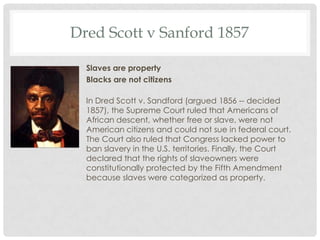
In Dred Scott v. Sandford (argued 1856 -- decided
1857), the Supreme Court ruled that Americans of
African descent, whether free or slave, were not
American citizens and could not sue in federal court.
The Court also ruled that Congress lacked power to
ban slavery in the U.S. territories. Finally, the Court
declared that the rights of slaveowners were
constitutionally protected by the Fifth Amendment
because slaves were categorized as property.
Plessy v Ferguson 1896
Separate but Equal
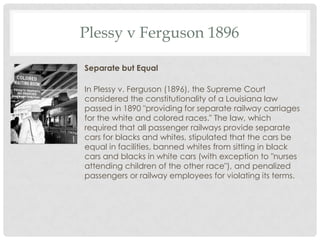
In Plessy v. Ferguson (1896), the Supreme Court
considered the constitutionality of a Louisiana law
passed in 1890 "providing for separate railway carriages
for the white and colored races." The law, which
required that all passenger railways provide separate
cars for blacks and whites, stipulated that the cars be
equal in facilities, banned whites from sitting in black
cars and blacks in white cars (with exception to "nurses
attending children of the other race"), and penalized
passengers or railway employees for violating its terms.
Schenck v US 1919
Limits Free Speech
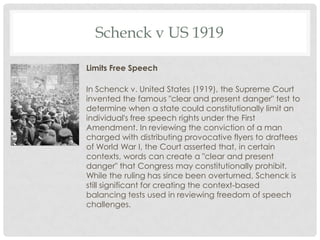
In Schenck v. United States (1919), the Supreme Court
invented the famous "clear and present danger" test to
determine when a state could constitutionally limit an
individual's free speech rights under the First
Amendment. In reviewing the conviction of a man
charged with distributing provocative flyers to draftees
of World War I, the Court asserted that, in certain
contexts, words can create a "clear and present
danger" that Congress may constitutionally prohibit.
While the ruling has since been overturned, Schenck is
still significant for creating the context-based
balancing tests used in reviewing freedom of speech
challenges.
Korematsu v US 1944
Limit Civil Liberties During War
Early in World War II, on February 19, 1942, President
Franklin Roosevelt issued Executive Order 9066, granting
the U.S. military the power to ban tens of thousands of
American citizens of Japanese ancestry from areas
deemed critical to domestic security. Promptly exercising
the power so bestowed, the military then issued an order
banning "all persons of Japanese ancestry, both alien and
non-alien" from a designated coastal area stretching from
Washington State to southern Arizona, and hastily set up
internment camps to hold the Japanese Americans for
the duration of the war. In defiance of the order, Fred
Korematsu, an American-born citizen of Japanese
descent, refused to leave his home in San Leandro,
California. Duly convicted, he appealed, and in 1944 his
case reached the Supreme Court. A 6-3 majority on the
Court upheld Korematsu's conviction.
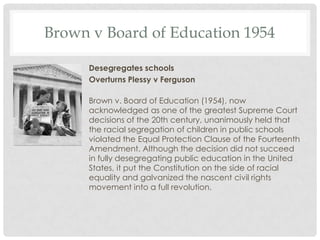
Brown v Board of Education 1954
Desegregates schools
Overturns Plessy v Ferguson
Brown v. Board of Education (1954), now
acknowledged as one of the greatest Supreme Court
decisions of the 20th century, unanimously held that
the racial segregation of children in public schools
violated the Equal Protection Clause of the Fourteenth
Amendment. Although the decision did not succeed
in fully desegregating public education in the United
States, it put the Constitution on the side of racial
equality and galvanized the nascent civil rights
movement into a full revolution.
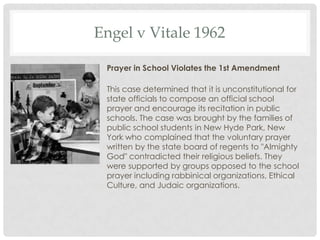
Engel v Vitale 1962
Prayer in School Violates the 1st Amendment
This case determined that it is unconstitutional for
state officials to compose an official school
prayer and encourage its recitation in public
schools. The case was brought by the families of
public school students in New Hyde Park, New
York who complained that the voluntary prayer
written by the state board of regents to "Almighty
God" contradicted their religious beliefs. They
were supported by groups opposed to the school
prayer including rabbinical organizations, Ethical
Culture, and Judaic organizations.
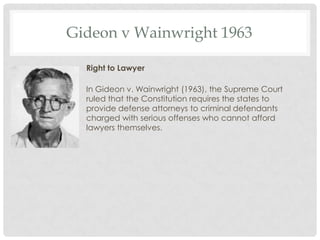
Gideon v Wainwright 1963
Right to Lawyer
In Gideon v. Wainwright (1963), the Supreme Court
ruled that the Constitution requires the states to
provide defense attorneys to criminal defendants
charged with serious offenses who cannot afford
lawyers themselves.
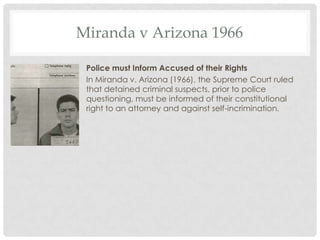
Miranda v Arizona 1966
Police must Inform Accused of their Rights
In Miranda v. Arizona (1966), the Supreme Court ruled
that detained criminal suspects, prior to police
questioning, must be informed of their constitutional
right to an attorney and against self-incrimination.
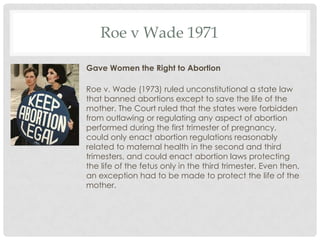
Roe v Wade 1971
Gave Women the Right to Abortion
Roe v. Wade (1973) ruled unconstitutional a state law
that banned abortions except to save the life of the
mother. The Court ruled that the states were forbidden
from outlawing or regulating any aspect of abortion
performed during the first trimester of pregnancy,
could only enact abortion regulations reasonably
related to maternal health in the second and third
trimesters, and could enact abortion laws protecting
the life of the fetus only in the third trimester. Even then,
an exception had to be made to protect the life of the
mother.
New York Times v US
Freedom of the press
National security not threatened by Pentagon Papers
This ruling made it possible for the New York Times
and Washington Post newspapers to publish the
then-classified Pentagon Papers without risk of
government censorship or punishment.
President Richard Nixon had claimed executive
authority to force the Times to suspend publication
of classified information in its possession. The question
before the court was whether the constitutional
freedom of the press, guaranteed by the First
Amendment, was subordinate to a claimed need of
the executive branch of government to maintain the
secrecy of information. The Supreme Court ruled that
the First Amendment did protect the right of the New
York Times to print the materials.
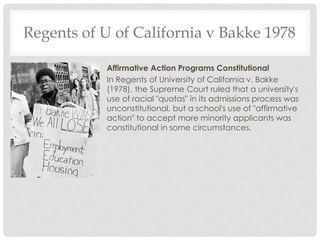
Regents of U of California v Bakke 1978
Affirmative Action Programs Constitutional
In Regents of University of California v. Bakke
(1978), the Supreme Court ruled that a university's
use of racial "quotas" in its admissions process was
unconstitutional, but a school's use of "affirmative
action" to accept more minority applicants was
constitutional in some circumstances.

Supreme court Landmark Cases

  • 1.
    R C SD I T Landmark Supreme Court Cases
  • 2.
    Marbury v Madison1803 Judicial Review Marbury v. Madison, arguably the most important case in Supreme Court history, was the first U.S. Supreme Court case to apply the principle of "judicial review" -- the power of federal courts to void acts of Congress in conflict with the Constitution. Written in 1803 by Chief Justice John Marshall, the decision played a key role in making the Supreme Court a separate branch of government on par with Congress and the executive.
  • 3.
    McCulloch v Maryland1819 “Elastic Clause” In McCulloch v. Maryland (1819) the Supreme Court ruled that Congress had implied powers under the Necessary and Proper Clause of Article I, Section 8 of the Constitution to create the Second Bank of the United States and that the state of Maryland lacked the power to tax the Bank. Arguably Chief Justice John Marshall's finest opinion, McCulloch not only gave Congress broad discretionary power to implement the enumerated powers, but also repudiated, in ringing language, the radical states' rights arguments presented by counsel for Maryland.
  • 4.
    Gibbons v Ogden1824 Supremacy of National Laws Gibbons v. Ogden (1824) vastly expanded the powers of Congress through a single clause in the Constitution: the Commerce Clause of Article I, Section 8. The Court ruled that under that clause Congress had powers to regulate any aspect of commerce that crossed state lines, including modes of transportation, and that such regulation preempted conflicting regulation by the states. Since Gibbons, the Commerce Clause has provided the basis for sweeping congressional power over a multitude of national issues.
  • 5.
    Dred Scott vSanford 1857 Slaves are property Blacks are not citizens In Dred Scott v. Sandford (argued 1856 -- decided 1857), the Supreme Court ruled that Americans of African descent, whether free or slave, were not American citizens and could not sue in federal court. The Court also ruled that Congress lacked power to ban slavery in the U.S. territories. Finally, the Court declared that the rights of slaveowners were constitutionally protected by the Fifth Amendment because slaves were categorized as property.
  • 6.
    Plessy v Ferguson1896 Separate but Equal In Plessy v. Ferguson (1896), the Supreme Court considered the constitutionality of a Louisiana law passed in 1890 "providing for separate railway carriages for the white and colored races." The law, which required that all passenger railways provide separate cars for blacks and whites, stipulated that the cars be equal in facilities, banned whites from sitting in black cars and blacks in white cars (with exception to "nurses attending children of the other race"), and penalized passengers or railway employees for violating its terms.
  • 7.
    Schenck v US1919 Limits Free Speech In Schenck v. United States (1919), the Supreme Court invented the famous "clear and present danger" test to determine when a state could constitutionally limit an individual's free speech rights under the First Amendment. In reviewing the conviction of a man charged with distributing provocative flyers to draftees of World War I, the Court asserted that, in certain contexts, words can create a "clear and present danger" that Congress may constitutionally prohibit. While the ruling has since been overturned, Schenck is still significant for creating the context-based balancing tests used in reviewing freedom of speech challenges.
  • 8.
    Korematsu v US1944 Limit Civil Liberties During War Early in World War II, on February 19, 1942, President Franklin Roosevelt issued Executive Order 9066, granting the U.S. military the power to ban tens of thousands of American citizens of Japanese ancestry from areas deemed critical to domestic security. Promptly exercising the power so bestowed, the military then issued an order banning "all persons of Japanese ancestry, both alien and non-alien" from a designated coastal area stretching from Washington State to southern Arizona, and hastily set up internment camps to hold the Japanese Americans for the duration of the war. In defiance of the order, Fred Korematsu, an American-born citizen of Japanese descent, refused to leave his home in San Leandro, California. Duly convicted, he appealed, and in 1944 his case reached the Supreme Court. A 6-3 majority on the Court upheld Korematsu's conviction.
  • 9.
    Brown v Boardof Education 1954 Desegregates schools Overturns Plessy v Ferguson Brown v. Board of Education (1954), now acknowledged as one of the greatest Supreme Court decisions of the 20th century, unanimously held that the racial segregation of children in public schools violated the Equal Protection Clause of the Fourteenth Amendment. Although the decision did not succeed in fully desegregating public education in the United States, it put the Constitution on the side of racial equality and galvanized the nascent civil rights movement into a full revolution.
  • 10.
    Engel v Vitale1962 Prayer in School Violates the 1st Amendment This case determined that it is unconstitutional for state officials to compose an official school prayer and encourage its recitation in public schools. The case was brought by the families of public school students in New Hyde Park, New York who complained that the voluntary prayer written by the state board of regents to "Almighty God" contradicted their religious beliefs. They were supported by groups opposed to the school prayer including rabbinical organizations, Ethical Culture, and Judaic organizations.
  • 11.
    Gideon v Wainwright1963 Right to Lawyer In Gideon v. Wainwright (1963), the Supreme Court ruled that the Constitution requires the states to provide defense attorneys to criminal defendants charged with serious offenses who cannot afford lawyers themselves.
  • 12.
    Miranda v Arizona1966 Police must Inform Accused of their Rights In Miranda v. Arizona (1966), the Supreme Court ruled that detained criminal suspects, prior to police questioning, must be informed of their constitutional right to an attorney and against self-incrimination.
  • 13.
    Roe v Wade1971 Gave Women the Right to Abortion Roe v. Wade (1973) ruled unconstitutional a state law that banned abortions except to save the life of the mother. The Court ruled that the states were forbidden from outlawing or regulating any aspect of abortion performed during the first trimester of pregnancy, could only enact abortion regulations reasonably related to maternal health in the second and third trimesters, and could enact abortion laws protecting the life of the fetus only in the third trimester. Even then, an exception had to be made to protect the life of the mother.
  • 14.
    New York Timesv US Freedom of the press National security not threatened by Pentagon Papers This ruling made it possible for the New York Times and Washington Post newspapers to publish the then-classified Pentagon Papers without risk of government censorship or punishment. President Richard Nixon had claimed executive authority to force the Times to suspend publication of classified information in its possession. The question before the court was whether the constitutional freedom of the press, guaranteed by the First Amendment, was subordinate to a claimed need of the executive branch of government to maintain the secrecy of information. The Supreme Court ruled that the First Amendment did protect the right of the New York Times to print the materials.
  • 15.
    Regents of Uof California v Bakke 1978 Affirmative Action Programs Constitutional In Regents of University of California v. Bakke (1978), the Supreme Court ruled that a university's use of racial "quotas" in its admissions process was unconstitutional, but a school's use of "affirmative action" to accept more minority applicants was constitutional in some circumstances.