The Space Race
BY: LOGAN GRIMM
Main Point
The main point of this presentation is to inform anyone that wants to learn
about the space race. It can also be helpful for students that have school
related work on this topic.
Dates of the Space Race 1955 – 1975
NASA was born
Cold War in was also going on. The space race had some play in it too.
Present during most of the space race was John F. Kennedy.
Overview
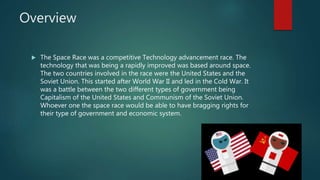
 The Space Race was a competitive Technology advancement race. The
technology that was being a rapidly improved was based around space.
The two countries involved in the race were the United States and the
Soviet Union. This started after World War II and led in the Cold War. It
was a battle between the two different types of government being
Capitalism of the United States and Communism of the Soviet Union.
Whoever one the space race would be able to have bragging rights for
their type of government and economic system.
Beginning
 Oct. 4, 1957
 This date marks the start of the Space Race between United States and Russia.
Both countries were in the cold war with each other during the race.
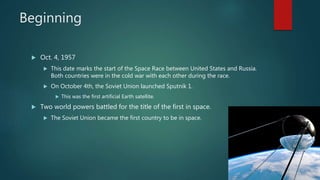
 On October 4th, the Soviet Union launched Sputnik 1.
 This was the first artificial Earth satellite.
 Two world powers battled for the title of the first in space.
 The Soviet Union became the first country to be in space.
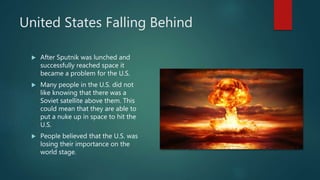
United States Falling Behind
 After Sputnik was lunched and
successfully reached space it
became a problem for the U.S.
 Many people in the U.S. did not
like knowing that there was a
Soviet satellite above them. This
could mean that they are able to
put a nuke up in space to hit the
U.S.
 People believed that the U.S. was
losing their importance on the
world stage.
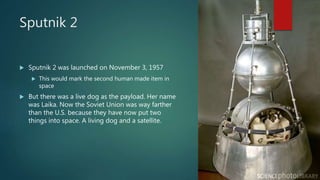
Sputnik 2
 Sputnik 2 was launched on November 3, 1957
 This would mark the second human made item in
space
 But there was a live dog as the payload. Her name
was Laika. Now the Soviet Union was way farther
than the U.S. because they have now put two
things into space. A living dog and a satellite.
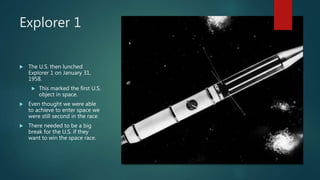
Explorer 1
 The U.S. then lunched
Explorer 1 on January 31,
1958.
 This marked the first U.S.
object in space.
 Even thought we were able
to achieve to enter space we
were still second in the race.
 There needed to be a big
break for the U.S. if they
want to win the space race.
NASA
 NASA or also known as (National Aeronautics and Space Administration).
This was made in 1958.
 It was the United States Agency that is devoted to space exploration.
 The founder was Dwight D. Eisenhower
 Lead rocket engineer was Wernher von Braun
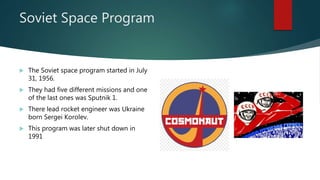
Soviet Space Program
 The Soviet space program started in July
31, 1956.
 They had five different missions and one
of the last ones was Sputnik 1.
 There lead rocket engineer was Ukraine
born Sergei Korolev.
 This program was later shut down in
1991
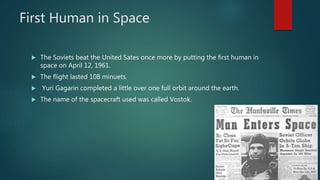
First Human in Space
 The Soviets beat the United Sates once more by putting the first human in
space on April 12, 1961.
 The flight lasted 108 minuets.
 Yuri Gagarin completed a little over one full orbit around the earth.
 The name of the spacecraft used was called Vostok.
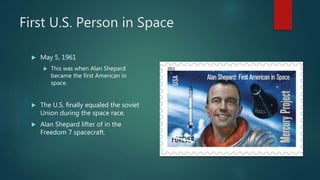
First U.S. Person in Space
 May 5, 1961
 This was when Alan Shepard
became the first American in
space.
 The U.S. finally equaled the soviet
Union during the space race.
 Alan Shepard lifter of in the
Freedom 7 spacecraft.
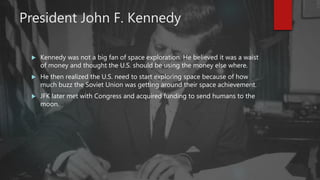
President John F. Kennedy
 Kennedy was not a big fan of space exploration. He believed it was a waist
of money and thought the U.S. should be using the money else where.
 He then realized the U.S. need to start exploring space because of how
much buzz the Soviet Union was getting around their space achievement.
 JFK later met with Congress and acquired funding to send humans to the
moon.
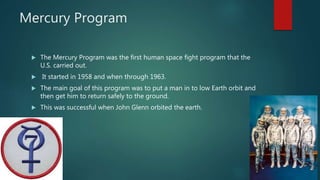
Mercury Program
 The Mercury Program was the first human space fight program that the
U.S. carried out.
 It started in 1958 and when through 1963.
 The main goal of this program was to put a man in to low Earth orbit and
then get him to return safely to the ground.
 This was successful when John Glenn orbited the earth.
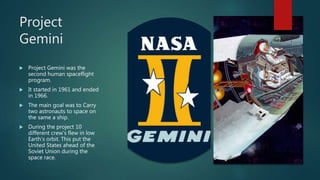
Project
Gemini
 Project Gemini was the
second human spaceflight
program.
 It started in 1961 and ended
in 1966.
 The main goal was to Carry
two astronauts to space on
the same a ship.
 During the project 10
different crew’s flew in low
Earth’s orbit. This put the
United States ahead of the
Soviet Union during the
space race.
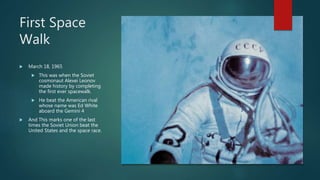
First Space
Walk
 March 18, 1965
 This was when the Soviet
cosmonaut Alexei Leonov
made history by completing
the first ever spacewalk.
 He beat the American rival
whose name was Ed White
aboard the Gemini 4
 And This marks one of the last
times the Soviet Union beat the
United States and the space race.
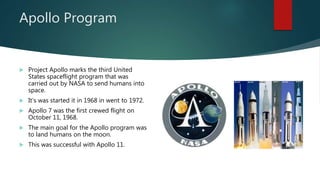
Apollo Program
 Project Apollo marks the third United
States spaceflight program that was
carried out by NASA to send humans into
space.
 It’s was started it in 1968 in went to 1972.
 Apollo 7 was the first crewed flight on
October 11, 1968.
 The main goal for the Apollo program was
to land humans on the moon.
 This was successful with Apollo 11.
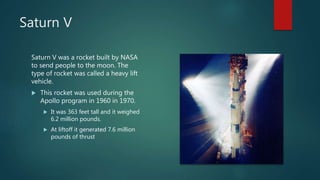
Saturn V
Saturn V was a rocket built by NASA
to send people to the moon. The
type of rocket was called a heavy lift
vehicle.
 This rocket was used during the
Apollo program in 1960 in 1970.
 It was 363 feet tall and it weighed
6.2 million pounds.
 At liftoff it generated 7.6 million
pounds of thrust
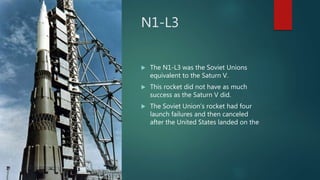
N1-L3
 The N1-L3 was the Soviet Unions
equivalent to the Saturn V.
 This rocket did not have as much
success as the Saturn V did.
 The Soviet Union’s rocket had four
launch failures and then canceled
after the United States landed on the
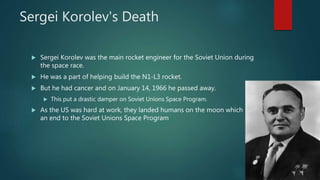
Sergei Korolev's Death
 Sergei Korolev was the main rocket engineer for the Soviet Union during
the space race.
 He was a part of helping build the N1-L3 rocket.
 But he had cancer and on January 14, 1966 he passed away.
 This put a drastic damper on Soviet Unions Space Program.
 As the US was hard at work, they landed humans on the moon which put
an end to the Soviet Unions Space Program
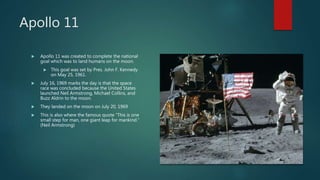
Apollo 11
 Apollo 11 was created to complete the national
goal which was to land humans on the moon.
 This goal was set by Pres. John F. Kennedy
on May 25, 1961.
 July 16, 1969 marks the day is that the space
race was concluded because the United States
launched Neil Armstrong, Michael Collins, and
Buzz Aldrin to the moon.
 They landed on the moon on July 20, 1969
 This is also where the famous quote ”This is one
small step for man, one giant leap for mankind.”
(Neil Armstrong)
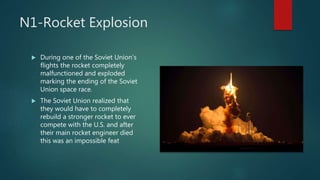
N1-Rocket Explosion
 During one of the Soviet Union's
flights the rocket completely
malfunctioned and exploded
marking the ending of the Soviet
Union space race.
 The Soviet Union realized that
they would have to completely
rebuild a stronger rocket to ever
compete with the U.S. and after
their main rocket engineer died
this was an impossible feat
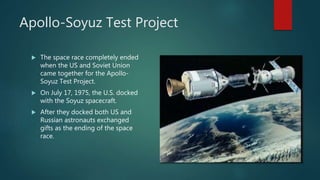
Apollo-Soyuz Test Project
 The space race completely ended
when the US and Soviet Union
came together for the Apollo-
Soyuz Test Project.
 On July 17, 1975, the U.S. docked
with the Soyuz spacecraft.
 After they docked both US and
Russian astronauts exchanged
gifts as the ending of the space
race.
Questions
1. My topic of the space race was incorporated in everybody’s life because people were so
fearful that the Soviet Union would beat U.S. This became known as the space race.
Americans thought that the Soviet's would drop nukes on the U.S.
2. This topic was unique because nothing in the world’s history ever had anything to do with
space. It was a new fascinating topic to think about during this time and people were drawn
to it.
3. If I was living at during this era, I would be extremely worried about what the Soviet Union
could do from space. It would also have been an exciting time to see the first man on the
moon.
4. My topic was just a starting point for the incredible feats that have been accomplished by
the United States and that their space programs. They’re now expanding to private space
companies. They are dominating the industry and one of the biggest ones is known as
SpaceX which is ran by Elon Musk.
5. I learned that this topic was incredibly important to the United States. Now I understand that
if we failed during the space race the United States would not have been respected as we are
today.
Fun Facts (EC)
 Russians called their people in space cosmonauts because it means sailors
of the universe.
 The Americans nicknamed the people in space astronauts because it
means star sailors.
 The dog that was sent up in the space only lived for a few hours before
dying of overheating, but the Russians said she lived for weeks.
 January 31, 1958 is when the US officially enter the space race.
 In 1960 the US landed the first successful weather satellite.
Conclusion
 Overall, the United States ended up with the ultimate victory in the space
race. We were able to achieve putting men on the moon which was the
biggest achievement in space flight history. The Soviet Union had a good
lead on the U.S. in the start of the space race. The lead did not last too
long after NASA was formed. Not only did this prove to the world the the
U.S. was still the superpower, but it also helped advance space technology
rapidly. Since the space race many other missions were carried out by
NASA. One of these missions that stands out in the Space Shuttle Program.
In the end, the U.S. won and proved them selves to the world.
Works Cited
 History.com Editors. “The Space Race.” History.com, A&E Television Networks,
22 Feb. 2010, www.history.com/topics/cold-war/space-race.
 Mann, Adam. “What Was the Space Race?” Space.com, Space, 7 Aug. 2019,
www.space.com/space-race.html.
 Redd, Nola Taylor. “Alan Shepard: First American in Space.” Space.com, Space,
10 Oct. 2018, www.space.com/17385-alan-shepard-first-american-in-
space.html.
 Leonov, Alexei. “The Nightmare of Voskhod 2.” Air & Space Magazine, Air &
Space Magazine, 1 Jan. 2005, www.airspacemag.com/space/the-nightmare-of-
voskhod-2-8655378/.
 Dunbar, Brian. “What Was the Saturn V?” NASA, NASA, 2 June 2015,
www.nasa.gov/audience/forstudents/5-8/features/nasa-knows/what-was-the-
saturn-v-58.html.

Five p project

  • 1.
    The Space Race BY:LOGAN GRIMM
  • 2.
    Main Point The mainpoint of this presentation is to inform anyone that wants to learn about the space race. It can also be helpful for students that have school related work on this topic. Dates of the Space Race 1955 – 1975 NASA was born Cold War in was also going on. The space race had some play in it too. Present during most of the space race was John F. Kennedy.
  • 3.
    Overview  The SpaceRace was a competitive Technology advancement race. The technology that was being a rapidly improved was based around space. The two countries involved in the race were the United States and the Soviet Union. This started after World War II and led in the Cold War. It was a battle between the two different types of government being Capitalism of the United States and Communism of the Soviet Union. Whoever one the space race would be able to have bragging rights for their type of government and economic system.
  • 4.
    Beginning  Oct. 4,1957  This date marks the start of the Space Race between United States and Russia. Both countries were in the cold war with each other during the race.  On October 4th, the Soviet Union launched Sputnik 1.  This was the first artificial Earth satellite.  Two world powers battled for the title of the first in space.  The Soviet Union became the first country to be in space.
  • 5.
    United States FallingBehind  After Sputnik was lunched and successfully reached space it became a problem for the U.S.  Many people in the U.S. did not like knowing that there was a Soviet satellite above them. This could mean that they are able to put a nuke up in space to hit the U.S.  People believed that the U.S. was losing their importance on the world stage.
  • 6.
    Sputnik 2  Sputnik2 was launched on November 3, 1957  This would mark the second human made item in space  But there was a live dog as the payload. Her name was Laika. Now the Soviet Union was way farther than the U.S. because they have now put two things into space. A living dog and a satellite.
  • 7.
    Explorer 1  TheU.S. then lunched Explorer 1 on January 31, 1958.  This marked the first U.S. object in space.  Even thought we were able to achieve to enter space we were still second in the race.  There needed to be a big break for the U.S. if they want to win the space race.
  • 8.
    NASA  NASA oralso known as (National Aeronautics and Space Administration). This was made in 1958.  It was the United States Agency that is devoted to space exploration.  The founder was Dwight D. Eisenhower  Lead rocket engineer was Wernher von Braun
  • 9.
    Soviet Space Program The Soviet space program started in July 31, 1956.  They had five different missions and one of the last ones was Sputnik 1.  There lead rocket engineer was Ukraine born Sergei Korolev.  This program was later shut down in 1991
  • 10.
    First Human inSpace  The Soviets beat the United Sates once more by putting the first human in space on April 12, 1961.  The flight lasted 108 minuets.  Yuri Gagarin completed a little over one full orbit around the earth.  The name of the spacecraft used was called Vostok.
  • 11.
    First U.S. Personin Space  May 5, 1961  This was when Alan Shepard became the first American in space.  The U.S. finally equaled the soviet Union during the space race.  Alan Shepard lifter of in the Freedom 7 spacecraft.
  • 12.
    President John F.Kennedy  Kennedy was not a big fan of space exploration. He believed it was a waist of money and thought the U.S. should be using the money else where.  He then realized the U.S. need to start exploring space because of how much buzz the Soviet Union was getting around their space achievement.  JFK later met with Congress and acquired funding to send humans to the moon.
  • 13.
    Mercury Program  TheMercury Program was the first human space fight program that the U.S. carried out.  It started in 1958 and when through 1963.  The main goal of this program was to put a man in to low Earth orbit and then get him to return safely to the ground.  This was successful when John Glenn orbited the earth.
  • 14.
    Project Gemini  Project Geminiwas the second human spaceflight program.  It started in 1961 and ended in 1966.  The main goal was to Carry two astronauts to space on the same a ship.  During the project 10 different crew’s flew in low Earth’s orbit. This put the United States ahead of the Soviet Union during the space race.
  • 15.
    First Space Walk  March18, 1965  This was when the Soviet cosmonaut Alexei Leonov made history by completing the first ever spacewalk.  He beat the American rival whose name was Ed White aboard the Gemini 4  And This marks one of the last times the Soviet Union beat the United States and the space race.
  • 16.
    Apollo Program  ProjectApollo marks the third United States spaceflight program that was carried out by NASA to send humans into space.  It’s was started it in 1968 in went to 1972.  Apollo 7 was the first crewed flight on October 11, 1968.  The main goal for the Apollo program was to land humans on the moon.  This was successful with Apollo 11.
  • 17.
    Saturn V Saturn Vwas a rocket built by NASA to send people to the moon. The type of rocket was called a heavy lift vehicle.  This rocket was used during the Apollo program in 1960 in 1970.  It was 363 feet tall and it weighed 6.2 million pounds.  At liftoff it generated 7.6 million pounds of thrust
  • 18.
    N1-L3  The N1-L3was the Soviet Unions equivalent to the Saturn V.  This rocket did not have as much success as the Saturn V did.  The Soviet Union’s rocket had four launch failures and then canceled after the United States landed on the
  • 19.
    Sergei Korolev's Death Sergei Korolev was the main rocket engineer for the Soviet Union during the space race.  He was a part of helping build the N1-L3 rocket.  But he had cancer and on January 14, 1966 he passed away.  This put a drastic damper on Soviet Unions Space Program.  As the US was hard at work, they landed humans on the moon which put an end to the Soviet Unions Space Program
  • 20.
    Apollo 11  Apollo11 was created to complete the national goal which was to land humans on the moon.  This goal was set by Pres. John F. Kennedy on May 25, 1961.  July 16, 1969 marks the day is that the space race was concluded because the United States launched Neil Armstrong, Michael Collins, and Buzz Aldrin to the moon.  They landed on the moon on July 20, 1969  This is also where the famous quote ”This is one small step for man, one giant leap for mankind.” (Neil Armstrong)
  • 21.
    N1-Rocket Explosion  Duringone of the Soviet Union's flights the rocket completely malfunctioned and exploded marking the ending of the Soviet Union space race.  The Soviet Union realized that they would have to completely rebuild a stronger rocket to ever compete with the U.S. and after their main rocket engineer died this was an impossible feat
  • 22.
    Apollo-Soyuz Test Project The space race completely ended when the US and Soviet Union came together for the Apollo- Soyuz Test Project.  On July 17, 1975, the U.S. docked with the Soyuz spacecraft.  After they docked both US and Russian astronauts exchanged gifts as the ending of the space race.
  • 23.
    Questions 1. My topicof the space race was incorporated in everybody’s life because people were so fearful that the Soviet Union would beat U.S. This became known as the space race. Americans thought that the Soviet's would drop nukes on the U.S. 2. This topic was unique because nothing in the world’s history ever had anything to do with space. It was a new fascinating topic to think about during this time and people were drawn to it. 3. If I was living at during this era, I would be extremely worried about what the Soviet Union could do from space. It would also have been an exciting time to see the first man on the moon. 4. My topic was just a starting point for the incredible feats that have been accomplished by the United States and that their space programs. They’re now expanding to private space companies. They are dominating the industry and one of the biggest ones is known as SpaceX which is ran by Elon Musk. 5. I learned that this topic was incredibly important to the United States. Now I understand that if we failed during the space race the United States would not have been respected as we are today.
  • 24.
    Fun Facts (EC) Russians called their people in space cosmonauts because it means sailors of the universe.  The Americans nicknamed the people in space astronauts because it means star sailors.  The dog that was sent up in the space only lived for a few hours before dying of overheating, but the Russians said she lived for weeks.  January 31, 1958 is when the US officially enter the space race.  In 1960 the US landed the first successful weather satellite.
  • 25.
    Conclusion  Overall, theUnited States ended up with the ultimate victory in the space race. We were able to achieve putting men on the moon which was the biggest achievement in space flight history. The Soviet Union had a good lead on the U.S. in the start of the space race. The lead did not last too long after NASA was formed. Not only did this prove to the world the the U.S. was still the superpower, but it also helped advance space technology rapidly. Since the space race many other missions were carried out by NASA. One of these missions that stands out in the Space Shuttle Program. In the end, the U.S. won and proved them selves to the world.
  • 26.
    Works Cited  History.comEditors. “The Space Race.” History.com, A&E Television Networks, 22 Feb. 2010, www.history.com/topics/cold-war/space-race.  Mann, Adam. “What Was the Space Race?” Space.com, Space, 7 Aug. 2019, www.space.com/space-race.html.  Redd, Nola Taylor. “Alan Shepard: First American in Space.” Space.com, Space, 10 Oct. 2018, www.space.com/17385-alan-shepard-first-american-in- space.html.  Leonov, Alexei. “The Nightmare of Voskhod 2.” Air & Space Magazine, Air & Space Magazine, 1 Jan. 2005, www.airspacemag.com/space/the-nightmare-of- voskhod-2-8655378/.  Dunbar, Brian. “What Was the Saturn V?” NASA, NASA, 2 June 2015, www.nasa.gov/audience/forstudents/5-8/features/nasa-knows/what-was-the- saturn-v-58.html.