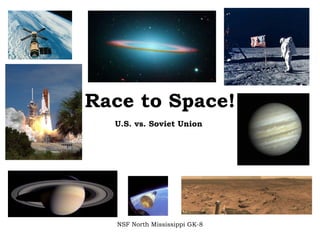
Race to Space! U.S. vs. Soviet Union NSF North Mississippi GK-8
Wernher von Braun: Father of Space Exploration Along with other German scientists, developed the first rockets during and after World War II Came to the U.S. after WWII, lived and worked in Huntsville, AL from 1950 – 1970 Work provided the basis for all early NASA missions First director of NASA NSF North Mississippi GK-8
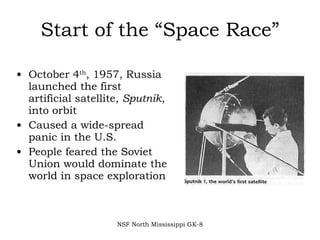
Start of the “Space Race” October 4 th , 1957, Russia launched the first artificial satellite,  Sputnik , into orbit Caused a wide-spread panic in the U.S.  People feared the Soviet Union would dominate the world in space exploration NSF North Mississippi GK-8
Formation of NASA Founded 1958 after Congress passed the National Aeronautics and Space Act Formed in direct response to the launch of Sputnik Purpose to provide organization and direction of U.S. space program First missions focused on getting humans into space, studying effects of space on humans, and returning astronauts safely to Earth NSF North Mississippi GK-8
Competitors in the Space Race After the launch of Sputnik, the U.S. and U.S.S.R. were in direct competition to have most advanced space program Viewed as contest between communism and capitalism National pride and fears for national defense played large roles in motivating space race NSF North Mississippi GK-8 United States Soviet Union
First Human in Space NSF North Mississippi GK-8 Yuri and his spacecraft,  Vostok 1 On April 12, 1961, the Soviets succeeded in launching the first human into space, Yuri Gagarin, and returning him safely to Earth
First American in Space Alan Shepard becomes the first American astronaut to enter space, aboard the Freedom 7 spacecraft, on May 5, 1961 NSF North Mississippi GK-8 Alan and his spacecraft, Freedom 7
The Mercury Project NASA’s first mission Mission goals:  getting an astronaut into space completing an orbit returning astronaut to Earth safely Several preliminary Mercury launches were unmanned NSF North Mississippi GK-8 The Mercury - Atlas I spacecraft Enos the chimpanzee, crew of the Mercury – Atlas V spacecraft
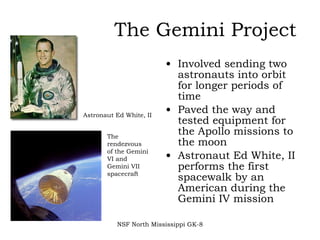
The Gemini Project Involved sending two astronauts into orbit for longer periods of time  Paved the way and tested equipment for the Apollo missions to the moon  Astronaut Ed White, II performs the first spacewalk by an American during the Gemini IV mission NSF North Mississippi GK-8 Astronaut Ed White, II The rendezvous of the Gemini VI and Gemini VII spacecraft
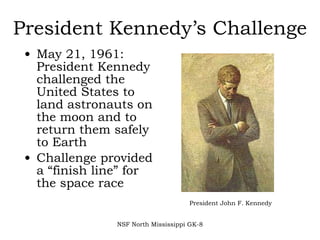
President Kennedy’s Challenge May 21, 1961: President Kennedy challenged the United States to land astronauts on the moon and to return them safely to Earth Challenge provided a “finish line” for the space race NSF North Mississippi GK-8 President John F. Kennedy
The Apollo Missions Apollo 11-17 involved landing men on the moon; Apollo 13 was aborted due to a malfunction July 20, 1969, Buzz Aldrin and Neil Armstrong of Apollo 11 were first men on the moon Each mission consisted of three astronauts: one stayed on Command Module in lunar orbit, two descended in Lunar Module to moon’s surface Total of 12 men have walked on the moon NSF North Mississippi GK-8 Buzz Aldrin, in Apollo 11 and on the moon (above and right) The Apollo 11 launch Neil Armstrong
When did the space race end? Some historians believe the Space Race ended when Apollo 11 returned safely from the Moon Others believe that the Race ended when the United States’ Apollo 18 spacecraft docked with a Russian Soyuz spacecraft in 1975 NSF North Mississippi GK-8 A drawing of the Apollo – Soyuz rendezvous (Apollo 18 is on the left)
Skylab: The First Space Station Launched by the U.S. in 1973 Built from a modified Apollo command module Occupied by 3 different teams of astronauts for a total of 171 days Purposely burned up in the Earth’s atmosphere in 1979 Over 2,000 hours of scientific and medical experiments performed onboard NSF North Mississippi GK-8 Two photographs of Skylab, taken by astronauts on their approach to the space station
Space Shuttles Originally spacecraft were used only once In the 1980s, NASA developed reusable spacecraft, the space shuttles Launched like rockets but land like modern-day airplanes Considered the most complex machines ever built Used to take satellites and instruments into space Originally five shuttles, two of which have been destroyed ( Challenger, Columbia ), three remaining in service ( Atlantis, Endeavor, Discovery ) Fleet of shuttles scheduled to be retired in 2010 NSF North Mississippi GK-8
The International Space Station (ISS) 15 nations participating Assembly began in 1998; should be completed by 2010 Teams of astronauts have lived aboard the ISS since 2001 Provides a permanent laboratory for conducting experiments in space NSF North Mississippi GK-8 Images of the ISS
Unmanned Missions: Space Probes and Landers Besides manned missions like Mercury, Gemini, and Apollo, NASA launched a series of unmanned missions Probes sent to study the outer planets and to land on planets of the inner solar system like Mercury, Venus, and Mars Probes also sent to gather information about the moon before astronauts ventured there NSF North Mississippi GK-8
Why send robotic probes instead of human? Benefits: Cheaper: there’s no need to send along food, air, and living space for astronauts or fuel for a round-trip Safer: there’s no danger to human life Drawbacks: Robotic probes can only do what they’re programmed to do; they cannot grow or adapt to face unforeseen changes Robotic probes often must be controlled remotely from Earth Some feel that robotic missions lack the romance of discovery and experience of manned missions NSF North Mississippi GK-8
Voyager Launched in 1977, first spacecraft to visit the outer planets of our solar system and send back pictures of Jupiter, Saturn, Uranus, and Neptune Continue to function to this day Now the farthest man-made objects in the solar system NSF North Mississippi GK-8 Images of Saturn (left) and Jupiter (below) from the Voyager spacecraft
The Hubble Telescope In 1990, the Hubble Space Telescope was placed in orbit by the shuttle  Discovery Example of scientific instrument in space Used to measure the age and size of the universe  Able to take extremely clear images that are undistorted by Earth’s atmosphere NSF North Mississippi GK-8 From left: Images from the Hubble telescope of the Sombrero Galaxy, Orion Nebula, Messier 101 Galaxy
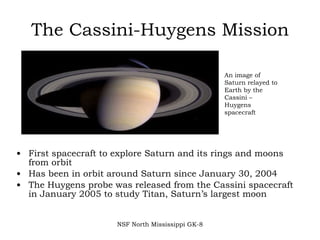
The Cassini-Huygens Mission First spacecraft to explore Saturn and its rings and moons from orbit Has been in orbit around Saturn since January 30, 2004 The Huygens probe was released from the Cassini spacecraft in January 2005 to study Titan, Saturn’s largest moon NSF North Mississippi GK-8 An image of Saturn relayed to Earth by the Cassini – Huygens spacecraft
Mars Rovers Probes launched to Mars with robotic rovers to explore surface Spirit  landed on Mars January 4, 2004;  Opportunity  landed December 12, 2004 Primary mission scheduled to last ~ 3 months, but mission has been active over two Earth years Rovers remotely controlled by scientists on Earth NSF North Mississippi GK-8 Top and bottom: images of Mars from the rovers. Left: an artist’s vision of Spirit on Mars
President Bush’s Vision for Space Exploration Presented plan to NASA January 2004 ISS to be completed by 2010 Space shuttles to be retired from service by 2010 Develop new manned spacecraft by 2008 and complete manned mission by 2014 Return to the moon by 2020 Eventually send humans to Mars NSF North Mississippi GK-8
Image Sources http://liftoff.msfc.nasa.gov/academy/history/VonBraun/VonBraun.html http://www.cohsoft.com.au/cohsoft/gene/images/1950map.png http://www.bbc.co.uk/science/space/exploration/missiontimeline/vostok1.shtml http://www.jsc.nasa.gov/Bios/htmlbios/shepard-alan.html http://www.nasm.si.edu/galleries/ATTM/atmimages/S61-01928.f.jpg http://www.nasa.gov/home/index.html http://en.wikipedia.org/wiki/Mercury-Atlas_5 http://www.aerospaceguide.net/spaceexploration/gemini.html http://www.jsc.nasa.gov/Bios/htmlbios/white-eh.html http://www.nasa.gov/home/index.html http://en.wikipedia.org/wiki/Mercury-Atlas_5 http://www.aerospaceguide.net/spaceexploration/gemini.html http://www.jsc.nasa.gov/Bios/htmlbios/white-eh.html http://grin.hq.nasa.gov/ABSTRACTS/GPN-2000-001488.html http://www.hbci.com/~tgort/moon.htm http://earthobservatory.nasa.gov/Library/Giants/vonBraun/vonbraun_4.html http://grin.hq.nasa.gov/ABSTRACTS/GPN-2000-001488.html http://www.hbci.com/~tgort/moon.htm http://www.historyplace.com/unitedstates/apollo11/ NSF North Mississippi GK-8
Sources Continued: NSF North Mississippi GK-8 http://en.wikipedia.org/wiki/Apollo_Soyuz_Test_Project http://heasarc.gsfc.nasa.gov/Images/skylab/ http://en.wikipedia.org/wiki/Skylab http://www.ed.arizona.edu/ward/Sonic/shuttle.jpg http://www.clipartgallery.com/travel_trans/space/space_shuttle_blastoff2.html http://voyager.jpl.nasa.gov/science/ http://hubblesite.org/newscenter/newsdesk/archive/releases/2006/01/ http://hubblesite.org/gallery/album/galaxy_collection/pr2003028b/ http://hubblesite.org/newscenter/newsdesk/archive/releases/2006/10/image/a http://www.pbs.org/spacestation/station/issfactsheet.htm http://hubblesite.org/newscenter/newsdesk/archive/releases/2006/01/ http://hubblesite.org/gallery/album/galaxy_collection/pr2003028b/ http://hubblesite.org/newscenter/newsdesk/archive/releases/2006/10/image/a http://www.pbs.org/spacestation/station/issfactsheet.htm http://www.space.gc.ca/asc/eng/iss/facts.asp http://www.issbabylon.com/html/cool_iss_pictures.html http://www.nasa.gov/mission_pages/station/expeditions/expedition13/exp13_dock.html http://saturn.jpl.nasa.gov/overview/index.cfm http://www.nasa.gov/images/content/54572main_rover1_br.jpg http://en.wikipedia.org/wiki/Image:Mars_from_Spirit.jpg http://marsrovers.nasa.gov/spotlight/20060302.html http://www.astro.cz/clanek/tisk/1667 http://www.whitehouse.gov/news/releases/2004/01/images/20040114-3_nasa1-515h.html

Race to space

  • 1.
    Race to Space!U.S. vs. Soviet Union NSF North Mississippi GK-8
  • 2.
    Wernher von Braun:Father of Space Exploration Along with other German scientists, developed the first rockets during and after World War II Came to the U.S. after WWII, lived and worked in Huntsville, AL from 1950 – 1970 Work provided the basis for all early NASA missions First director of NASA NSF North Mississippi GK-8
  • 3.
    Start of the“Space Race” October 4 th , 1957, Russia launched the first artificial satellite, Sputnik , into orbit Caused a wide-spread panic in the U.S. People feared the Soviet Union would dominate the world in space exploration NSF North Mississippi GK-8
  • 4.
    Formation of NASAFounded 1958 after Congress passed the National Aeronautics and Space Act Formed in direct response to the launch of Sputnik Purpose to provide organization and direction of U.S. space program First missions focused on getting humans into space, studying effects of space on humans, and returning astronauts safely to Earth NSF North Mississippi GK-8
  • 5.
    Competitors in theSpace Race After the launch of Sputnik, the U.S. and U.S.S.R. were in direct competition to have most advanced space program Viewed as contest between communism and capitalism National pride and fears for national defense played large roles in motivating space race NSF North Mississippi GK-8 United States Soviet Union
  • 6.
    First Human inSpace NSF North Mississippi GK-8 Yuri and his spacecraft, Vostok 1 On April 12, 1961, the Soviets succeeded in launching the first human into space, Yuri Gagarin, and returning him safely to Earth
  • 7.
    First American inSpace Alan Shepard becomes the first American astronaut to enter space, aboard the Freedom 7 spacecraft, on May 5, 1961 NSF North Mississippi GK-8 Alan and his spacecraft, Freedom 7
  • 8.
    The Mercury ProjectNASA’s first mission Mission goals: getting an astronaut into space completing an orbit returning astronaut to Earth safely Several preliminary Mercury launches were unmanned NSF North Mississippi GK-8 The Mercury - Atlas I spacecraft Enos the chimpanzee, crew of the Mercury – Atlas V spacecraft
  • 9.
    The Gemini ProjectInvolved sending two astronauts into orbit for longer periods of time Paved the way and tested equipment for the Apollo missions to the moon Astronaut Ed White, II performs the first spacewalk by an American during the Gemini IV mission NSF North Mississippi GK-8 Astronaut Ed White, II The rendezvous of the Gemini VI and Gemini VII spacecraft
  • 10.
    President Kennedy’s ChallengeMay 21, 1961: President Kennedy challenged the United States to land astronauts on the moon and to return them safely to Earth Challenge provided a “finish line” for the space race NSF North Mississippi GK-8 President John F. Kennedy
  • 11.
    The Apollo MissionsApollo 11-17 involved landing men on the moon; Apollo 13 was aborted due to a malfunction July 20, 1969, Buzz Aldrin and Neil Armstrong of Apollo 11 were first men on the moon Each mission consisted of three astronauts: one stayed on Command Module in lunar orbit, two descended in Lunar Module to moon’s surface Total of 12 men have walked on the moon NSF North Mississippi GK-8 Buzz Aldrin, in Apollo 11 and on the moon (above and right) The Apollo 11 launch Neil Armstrong
  • 12.
    When did thespace race end? Some historians believe the Space Race ended when Apollo 11 returned safely from the Moon Others believe that the Race ended when the United States’ Apollo 18 spacecraft docked with a Russian Soyuz spacecraft in 1975 NSF North Mississippi GK-8 A drawing of the Apollo – Soyuz rendezvous (Apollo 18 is on the left)
  • 13.
    Skylab: The FirstSpace Station Launched by the U.S. in 1973 Built from a modified Apollo command module Occupied by 3 different teams of astronauts for a total of 171 days Purposely burned up in the Earth’s atmosphere in 1979 Over 2,000 hours of scientific and medical experiments performed onboard NSF North Mississippi GK-8 Two photographs of Skylab, taken by astronauts on their approach to the space station
  • 14.
    Space Shuttles Originallyspacecraft were used only once In the 1980s, NASA developed reusable spacecraft, the space shuttles Launched like rockets but land like modern-day airplanes Considered the most complex machines ever built Used to take satellites and instruments into space Originally five shuttles, two of which have been destroyed ( Challenger, Columbia ), three remaining in service ( Atlantis, Endeavor, Discovery ) Fleet of shuttles scheduled to be retired in 2010 NSF North Mississippi GK-8
  • 15.
    The International SpaceStation (ISS) 15 nations participating Assembly began in 1998; should be completed by 2010 Teams of astronauts have lived aboard the ISS since 2001 Provides a permanent laboratory for conducting experiments in space NSF North Mississippi GK-8 Images of the ISS
  • 16.
    Unmanned Missions: SpaceProbes and Landers Besides manned missions like Mercury, Gemini, and Apollo, NASA launched a series of unmanned missions Probes sent to study the outer planets and to land on planets of the inner solar system like Mercury, Venus, and Mars Probes also sent to gather information about the moon before astronauts ventured there NSF North Mississippi GK-8
  • 17.
    Why send roboticprobes instead of human? Benefits: Cheaper: there’s no need to send along food, air, and living space for astronauts or fuel for a round-trip Safer: there’s no danger to human life Drawbacks: Robotic probes can only do what they’re programmed to do; they cannot grow or adapt to face unforeseen changes Robotic probes often must be controlled remotely from Earth Some feel that robotic missions lack the romance of discovery and experience of manned missions NSF North Mississippi GK-8
  • 18.
    Voyager Launched in1977, first spacecraft to visit the outer planets of our solar system and send back pictures of Jupiter, Saturn, Uranus, and Neptune Continue to function to this day Now the farthest man-made objects in the solar system NSF North Mississippi GK-8 Images of Saturn (left) and Jupiter (below) from the Voyager spacecraft
  • 19.
    The Hubble TelescopeIn 1990, the Hubble Space Telescope was placed in orbit by the shuttle Discovery Example of scientific instrument in space Used to measure the age and size of the universe Able to take extremely clear images that are undistorted by Earth’s atmosphere NSF North Mississippi GK-8 From left: Images from the Hubble telescope of the Sombrero Galaxy, Orion Nebula, Messier 101 Galaxy
  • 20.
    The Cassini-Huygens MissionFirst spacecraft to explore Saturn and its rings and moons from orbit Has been in orbit around Saturn since January 30, 2004 The Huygens probe was released from the Cassini spacecraft in January 2005 to study Titan, Saturn’s largest moon NSF North Mississippi GK-8 An image of Saturn relayed to Earth by the Cassini – Huygens spacecraft
  • 21.
    Mars Rovers Probeslaunched to Mars with robotic rovers to explore surface Spirit landed on Mars January 4, 2004; Opportunity landed December 12, 2004 Primary mission scheduled to last ~ 3 months, but mission has been active over two Earth years Rovers remotely controlled by scientists on Earth NSF North Mississippi GK-8 Top and bottom: images of Mars from the rovers. Left: an artist’s vision of Spirit on Mars
  • 22.
    President Bush’s Visionfor Space Exploration Presented plan to NASA January 2004 ISS to be completed by 2010 Space shuttles to be retired from service by 2010 Develop new manned spacecraft by 2008 and complete manned mission by 2014 Return to the moon by 2020 Eventually send humans to Mars NSF North Mississippi GK-8
  • 23.
    Image Sources http://liftoff.msfc.nasa.gov/academy/history/VonBraun/VonBraun.htmlhttp://www.cohsoft.com.au/cohsoft/gene/images/1950map.png http://www.bbc.co.uk/science/space/exploration/missiontimeline/vostok1.shtml http://www.jsc.nasa.gov/Bios/htmlbios/shepard-alan.html http://www.nasm.si.edu/galleries/ATTM/atmimages/S61-01928.f.jpg http://www.nasa.gov/home/index.html http://en.wikipedia.org/wiki/Mercury-Atlas_5 http://www.aerospaceguide.net/spaceexploration/gemini.html http://www.jsc.nasa.gov/Bios/htmlbios/white-eh.html http://www.nasa.gov/home/index.html http://en.wikipedia.org/wiki/Mercury-Atlas_5 http://www.aerospaceguide.net/spaceexploration/gemini.html http://www.jsc.nasa.gov/Bios/htmlbios/white-eh.html http://grin.hq.nasa.gov/ABSTRACTS/GPN-2000-001488.html http://www.hbci.com/~tgort/moon.htm http://earthobservatory.nasa.gov/Library/Giants/vonBraun/vonbraun_4.html http://grin.hq.nasa.gov/ABSTRACTS/GPN-2000-001488.html http://www.hbci.com/~tgort/moon.htm http://www.historyplace.com/unitedstates/apollo11/ NSF North Mississippi GK-8
  • 24.
    Sources Continued: NSFNorth Mississippi GK-8 http://en.wikipedia.org/wiki/Apollo_Soyuz_Test_Project http://heasarc.gsfc.nasa.gov/Images/skylab/ http://en.wikipedia.org/wiki/Skylab http://www.ed.arizona.edu/ward/Sonic/shuttle.jpg http://www.clipartgallery.com/travel_trans/space/space_shuttle_blastoff2.html http://voyager.jpl.nasa.gov/science/ http://hubblesite.org/newscenter/newsdesk/archive/releases/2006/01/ http://hubblesite.org/gallery/album/galaxy_collection/pr2003028b/ http://hubblesite.org/newscenter/newsdesk/archive/releases/2006/10/image/a http://www.pbs.org/spacestation/station/issfactsheet.htm http://hubblesite.org/newscenter/newsdesk/archive/releases/2006/01/ http://hubblesite.org/gallery/album/galaxy_collection/pr2003028b/ http://hubblesite.org/newscenter/newsdesk/archive/releases/2006/10/image/a http://www.pbs.org/spacestation/station/issfactsheet.htm http://www.space.gc.ca/asc/eng/iss/facts.asp http://www.issbabylon.com/html/cool_iss_pictures.html http://www.nasa.gov/mission_pages/station/expeditions/expedition13/exp13_dock.html http://saturn.jpl.nasa.gov/overview/index.cfm http://www.nasa.gov/images/content/54572main_rover1_br.jpg http://en.wikipedia.org/wiki/Image:Mars_from_Spirit.jpg http://marsrovers.nasa.gov/spotlight/20060302.html http://www.astro.cz/clanek/tisk/1667 http://www.whitehouse.gov/news/releases/2004/01/images/20040114-3_nasa1-515h.html