   By the 1950. the US and the USSR were the
    two most powerful nations in the world.
   The conflicting ideologies and goals of these
    rival nations to led to the worldwide struggle
    for influence.
   The policies followed by the two
    superpowers helped shape the modern
    history of much the world, from Latin
    America to the middle east.
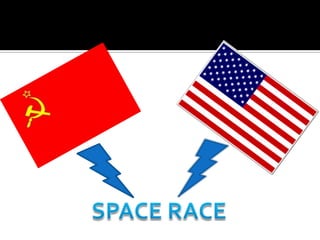
   The Space Race was a mid-to-late 20th
    century competition between the Soviet
    Union (USSR) and the United States (US) for
    supremacy in space exploration. Between
    1957 and 1975, Cold War rivalry between the
    two nations focused on attaining firsts in
    space exploration, which were seen as
    necessary for national security and symbolic
    of technological and ideological advantage.
   The Space Race had its origins in the missile-
    based arms race that occurred just after the
    end of the World War II, when both the Soviet
    Union and the United States captured
    advanced German rocket technology and
    workers.
1.   attaining firsts in space exploration, which
     were seen as necessary for save the nation
     and a symbol of technological and
     ideological power.
2.   To see which nation that have more
     technology and the ability to explore the
     space.
3.   explore outer space with artificial
     satellites, to send humans into space, and to
     land them on the Moon.
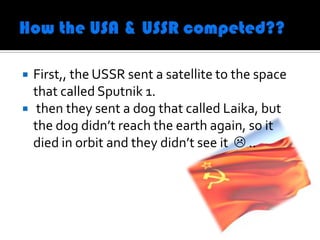
   First,, the USSR sent a satellite to the space
    that called Sputnik 1.
    then they sent a dog that called Laika, but
    the dog didn’t reach the earth again, so it
    died in orbit and they didn’t see it  ..
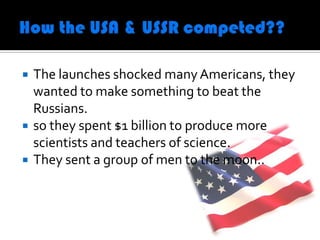
   The launches shocked many Americans, they
    wanted to make something to beat the
    Russians.
   so they spent $1 billion to produce more
    scientists and teachers of science.
   They sent a group of men to the moon..
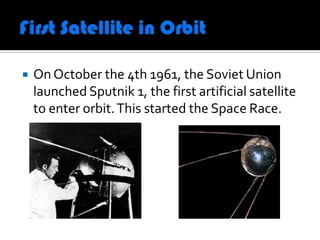
   On October the 4th 1961, the Soviet Union
    launched Sputnik 1, the first artificial satellite
    to enter orbit. This started the Space Race.
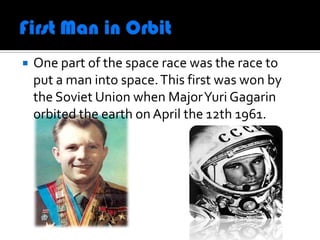
   One part of the space race was the race to
    put a man into space. This first was won by
    the Soviet Union when Major Yuri Gagarin
    orbited the earth on April the 12th 1961.
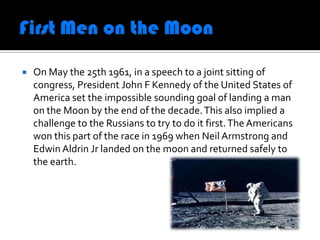
   On May the 25th 1961, in a speech to a joint sitting of
    congress, President John F Kennedy of the United States of
    America set the impossible sounding goal of landing a man
    on the Moon by the end of the decade. This also implied a
    challenge to the Russians to try to do it first. The Americans
    won this part of the race in 1969 when Neil Armstrong and
    Edwin Aldrin Jr landed on the moon and returned safely to
    the earth.
The long term effects of the space race on
 Nebraska and other regions of the country
 came in the way the space race changed the
 educational system and the imaginations of
 our people. Shortly after Sputnik, lawmakers
 and the public began calling for a greater
 emphasis on math and science in the nation's
 schools. Governments put in more money, and
 the educational system responded. Students
 began to get more math and science courses.

Space race by alaa

  • 3.
    By the 1950. the US and the USSR were the two most powerful nations in the world.  The conflicting ideologies and goals of these rival nations to led to the worldwide struggle for influence.  The policies followed by the two superpowers helped shape the modern history of much the world, from Latin America to the middle east.
  • 4.
    The Space Race was a mid-to-late 20th century competition between the Soviet Union (USSR) and the United States (US) for supremacy in space exploration. Between 1957 and 1975, Cold War rivalry between the two nations focused on attaining firsts in space exploration, which were seen as necessary for national security and symbolic of technological and ideological advantage.
  • 5.
    The Space Race had its origins in the missile- based arms race that occurred just after the end of the World War II, when both the Soviet Union and the United States captured advanced German rocket technology and workers.
  • 6.
    1. attaining firsts in space exploration, which were seen as necessary for save the nation and a symbol of technological and ideological power. 2. To see which nation that have more technology and the ability to explore the space. 3. explore outer space with artificial satellites, to send humans into space, and to land them on the Moon.
  • 7.
    First,, the USSR sent a satellite to the space that called Sputnik 1.  then they sent a dog that called Laika, but the dog didn’t reach the earth again, so it died in orbit and they didn’t see it  ..
  • 8.
    The launches shocked many Americans, they wanted to make something to beat the Russians.  so they spent $1 billion to produce more scientists and teachers of science.  They sent a group of men to the moon..
  • 9.
    On October the 4th 1961, the Soviet Union launched Sputnik 1, the first artificial satellite to enter orbit. This started the Space Race.
  • 10.
    One part of the space race was the race to put a man into space. This first was won by the Soviet Union when Major Yuri Gagarin orbited the earth on April the 12th 1961.
  • 11.
    On May the 25th 1961, in a speech to a joint sitting of congress, President John F Kennedy of the United States of America set the impossible sounding goal of landing a man on the Moon by the end of the decade. This also implied a challenge to the Russians to try to do it first. The Americans won this part of the race in 1969 when Neil Armstrong and Edwin Aldrin Jr landed on the moon and returned safely to the earth.
  • 12.
    The long termeffects of the space race on Nebraska and other regions of the country came in the way the space race changed the educational system and the imaginations of our people. Shortly after Sputnik, lawmakers and the public began calling for a greater emphasis on math and science in the nation's schools. Governments put in more money, and the educational system responded. Students began to get more math and science courses.