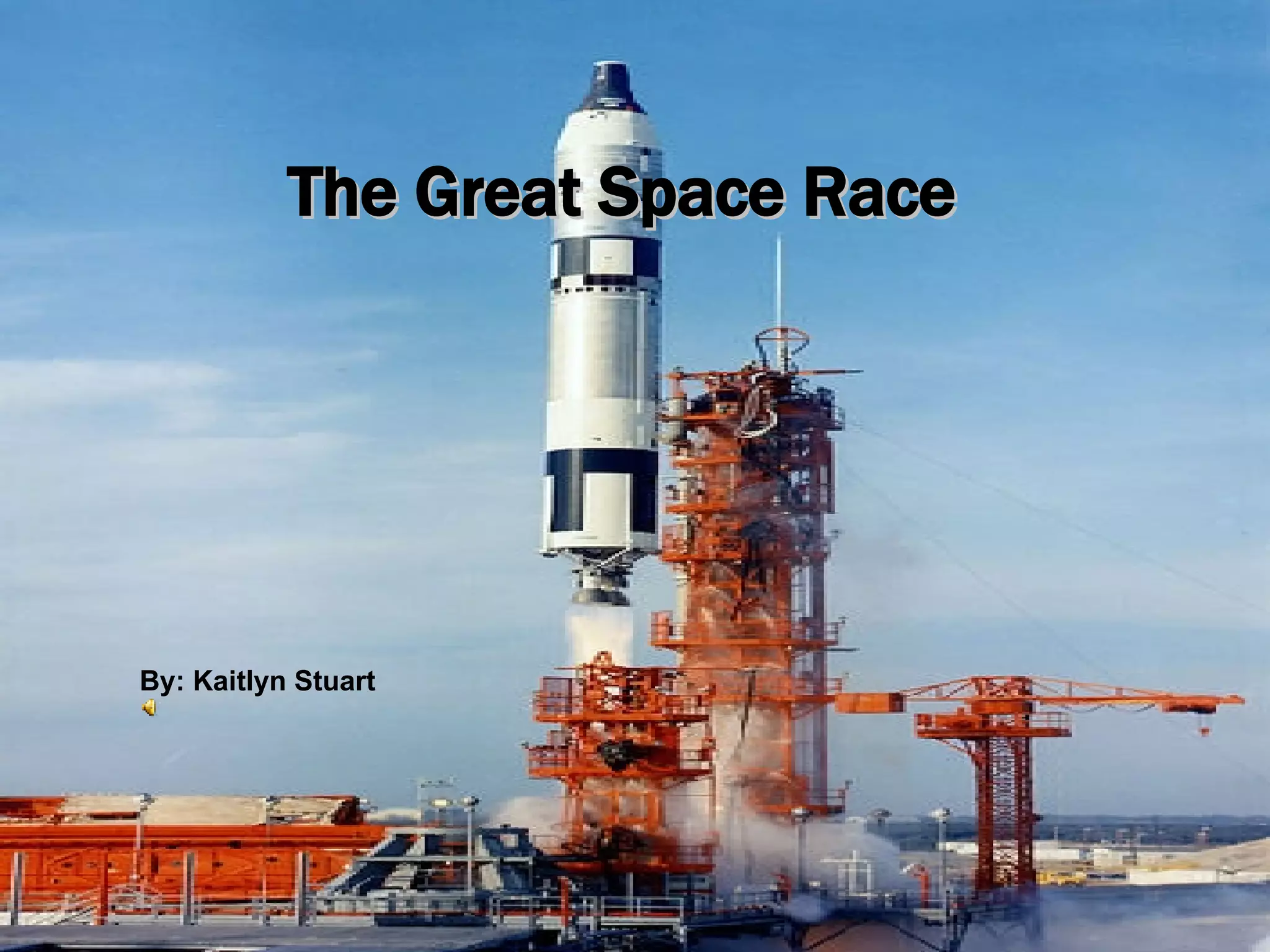
The Great Space Race By: Kaitlyn Stuart
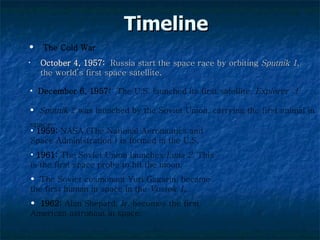
Timeline October 4, 1957:   Russia start the space race by orbiting  Sputnik 1 , the world’s first space satellite.  December 6, 1957:  The U.S. launched its first satellite,  Explorer  1 Sputnik 2  was launched by the Soviet Union, carrying the first animal in space     1959:  NASA (The National Aeronautics and Space Administration ) is formed in the U.S.  1961:  The Soviet Union launches  Luna 2 . This is the first space probe to hit the moon.  The Soviet cosmonaut Yuri Gagarin, became the first human in space in the  Vostok 1.   1962:  Alan Shepard, Jr. becomes the first American astronaut in space.  The Cold War
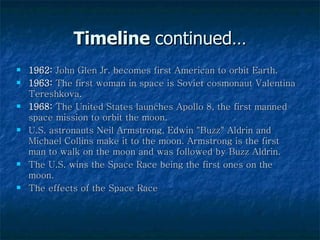
Timeline   continued… 1962:  John Glen Jr. becomes first American to orbit Earth. 1963:  The first woman in space is Soviet cosmonaut Valentina Tereshkova.  1968:  The United States launches Apollo 8, the first manned space mission to orbit the moon.  U.S. astronauts Neil Armstrong, Edwin "Buzz" Aldrin and Michael Collins make it to the moon. Armstrong is the first man to walk on the moon and was followed by Buzz Aldrin.  The U.S. wins the Space Race being the first ones on the moon. The effects of the Space Race
The   Cause The United States and the Soviet Union were rivals during the Cold War. Space technology became an important thing during this war. Space technology could spy on the enemy or drop atomic bombs on the rival country. This technology was also important for demonstrating the superiority of the ideology of that country. The Germans were able to build V-2 Rockets in 1942 during the war. These rockets were only used as a warhead at this time. As the war ended the Soviet Union and the United States used these rockets as building blocks for the development of rocketry for outer space.
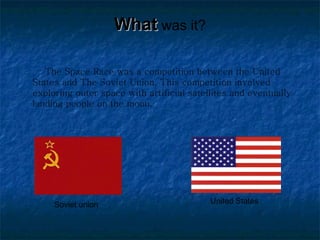
What   was it? The Space Race was a competition between the United States and The Soviet Union. This competition involved exploring outer space with artificial satellites and eventually landing people on the moon.  Soviet union United States
What  happened? In October 1957, The world's first artificial satellite was launched,  Sputnik 1 . It showed the technical abilities of the Soviet Union. The United States feared they would be attacked and they formed the National Aeronautics and Space Administration, (NASA). About four months after the launch of Sputnik 1, the U.S. launched their first successful satellite,  Explorer 1 .  Also, in 1957 the Soviet Union launched  Sputnik 2 , which carried the first animal in space, a dog named Laika. In 1961 the Soviet Union launched Luna 2, which was the first space craft to land on the moon On April 12, 1961, the Soviet cosmonaut Yuri Gagarin, became the first human in space in the  Vostok 1.  A few days later Alan Shepard became the first U.S. man in space on mission Freedom 7. John Glenn became the first man to orbit the earth for the U.S.
Continued… On June 16, 1963, the Soviet Union’s Valentine Tereshkova became the first woman in outer space while on the Vostok 6.  Apollo 8 was launched December 21, 1968. It orbited the moon eight times and astronauts took pictures of its surface. The Apollo 8 astronauts were the first men to journey to the moon.
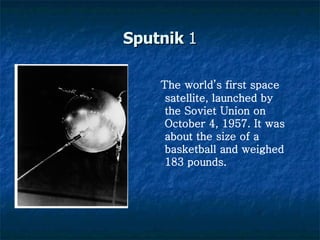
Sputnik  1 The world’s first space satellite, launched by the Soviet Union on October 4, 1957. It was about the size of a basketball and weighed 183 pounds.
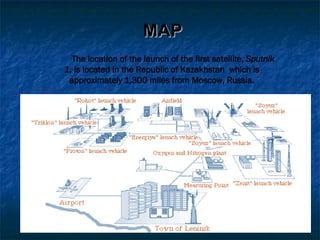
The location of the launch of the first satellite,  Sputnik 1 , is located in the Republic of Kazakhstan  which is approximately 1,300 miles from Moscow, Russia. MAP
Who   was important? Yuri Gagarin Valentina   Tereshkova John Glenn Jr. Neil Armstrong
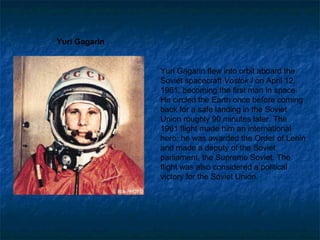
Yuri Gagarin flew into orbit aboard the Soviet spacecraft  Vostok I  on April 12, 1961, becoming the first man in space. He circled the Earth once before coming back for a safe landing in the Soviet Union roughly 90 minutes later. The 1961 flight made him an international hero; he was awarded the Order of Lenin and made a deputy of the Soviet parliament, the Supreme Soviet. The flight was also considered a political victory for the Soviet Union. Yuri Gagarin
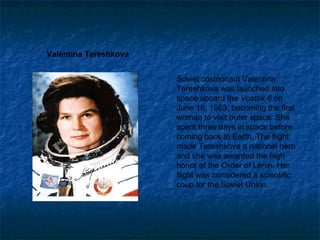
Soviet cosmonaut Valentina Tereshkova was launched into space aboard the  Vostok 6  on June 16, 1963, becoming the first woman to visit outer space. She spent three days in space before coming back to Earth. The flight made Tereshkova a national hero and she was awarded the high honor of the Order of Lenin. Her flight was considered a scientific coup for the Soviet Union. Valentina   Tereshkova
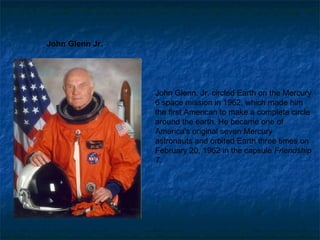
John Glenn Jr.  John Glenn, Jr. circled Earth on the Mercury 6 space mission in 1962, which made him the first American to make a complete circle around the earth. He became one of America's original seven Mercury astronauts and orbited Earth three times on February 20, 1962 in the capsule  Friendship 7 .
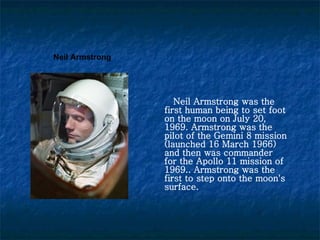
Neil Armstrong was the first human being to set foot on the moon on July 20, 1969. Armstrong was the pilot of the Gemini 8 mission (launched 16 March 1966) and then was commander for the Apollo 11 mission of 1969. .  Armstrong was the first to step onto the moon's surface. Neil Armstrong
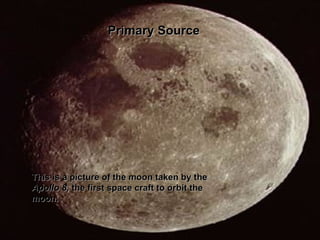
This is a picture of the moon taken by the  Apollo 8,  the first space craft to orbit the moon. Primary Source
The  Result On July 1969, Neil Armstrong became the first man to set foot on the moon. He traveled to the moon on the Apollo 11. A lunar module camera made it possible for there to be live footage on television. Since the U.S. were the first to set foot on the moon, they won the race. This was the end of the race, but the beginning of future discoveries.
The   Effects The long term effects of the space race in regions of the country was the way the space race changed the educational system and the imaginations of our people. A little while after Sputnik, lawmakers and the public began calling for a greater emphasis on math and science in the nation's schools. Governments put in more money, and the educational system started letting students get more math and science courses.  In addition, we began to realize that there was a new place to be explored. Putting a man on the moon became an official governmental priority. On July 20, 1969, astronauts Neil Armstrong and Buzz Aldrin were the first humans to walk on something in outer space. Space flight became a real possibility.
Cite Page 2 December 2007 http://www.cnn.com/SPECIALS/cold.war/experience/technology/ Wikipedia Foundation Inc.   27 Nov. 2007. 2 December 2007 http://en.wikipedia.org/wiki/Space_Race#Cold_War_roots Rit Nosotro. 3 December 2007. 2 December 2007. http://www.hyperhistory.net/apwh/essays/comp/c43tecja.htm National Aeronautics and Space Administration.   2 December 2007. http://spacerace1959-1962.blogspot.com/

The Last One!

  • 1.
    The Great SpaceRace By: Kaitlyn Stuart
  • 2.
    Timeline October 4,1957: Russia start the space race by orbiting Sputnik 1 , the world’s first space satellite. December 6, 1957: The U.S. launched its first satellite, Explorer 1 Sputnik 2 was launched by the Soviet Union, carrying the first animal in space 1959: NASA (The National Aeronautics and Space Administration ) is formed in the U.S. 1961: The Soviet Union launches Luna 2 . This is the first space probe to hit the moon. The Soviet cosmonaut Yuri Gagarin, became the first human in space in the Vostok 1. 1962: Alan Shepard, Jr. becomes the first American astronaut in space. The Cold War
  • 3.
    Timeline continued… 1962: John Glen Jr. becomes first American to orbit Earth. 1963: The first woman in space is Soviet cosmonaut Valentina Tereshkova. 1968: The United States launches Apollo 8, the first manned space mission to orbit the moon. U.S. astronauts Neil Armstrong, Edwin "Buzz" Aldrin and Michael Collins make it to the moon. Armstrong is the first man to walk on the moon and was followed by Buzz Aldrin. The U.S. wins the Space Race being the first ones on the moon. The effects of the Space Race
  • 4.
    The Cause The United States and the Soviet Union were rivals during the Cold War. Space technology became an important thing during this war. Space technology could spy on the enemy or drop atomic bombs on the rival country. This technology was also important for demonstrating the superiority of the ideology of that country. The Germans were able to build V-2 Rockets in 1942 during the war. These rockets were only used as a warhead at this time. As the war ended the Soviet Union and the United States used these rockets as building blocks for the development of rocketry for outer space.
  • 5.
    What was it? The Space Race was a competition between the United States and The Soviet Union. This competition involved exploring outer space with artificial satellites and eventually landing people on the moon. Soviet union United States
  • 6.
    What happened?In October 1957, The world's first artificial satellite was launched, Sputnik 1 . It showed the technical abilities of the Soviet Union. The United States feared they would be attacked and they formed the National Aeronautics and Space Administration, (NASA). About four months after the launch of Sputnik 1, the U.S. launched their first successful satellite, Explorer 1 . Also, in 1957 the Soviet Union launched Sputnik 2 , which carried the first animal in space, a dog named Laika. In 1961 the Soviet Union launched Luna 2, which was the first space craft to land on the moon On April 12, 1961, the Soviet cosmonaut Yuri Gagarin, became the first human in space in the Vostok 1. A few days later Alan Shepard became the first U.S. man in space on mission Freedom 7. John Glenn became the first man to orbit the earth for the U.S.
  • 7.
    Continued… On June16, 1963, the Soviet Union’s Valentine Tereshkova became the first woman in outer space while on the Vostok 6. Apollo 8 was launched December 21, 1968. It orbited the moon eight times and astronauts took pictures of its surface. The Apollo 8 astronauts were the first men to journey to the moon.
  • 8.
    Sputnik 1The world’s first space satellite, launched by the Soviet Union on October 4, 1957. It was about the size of a basketball and weighed 183 pounds.
  • 9.
    The location ofthe launch of the first satellite, Sputnik 1 , is located in the Republic of Kazakhstan which is approximately 1,300 miles from Moscow, Russia. MAP
  • 10.
    Who was important? Yuri Gagarin Valentina Tereshkova John Glenn Jr. Neil Armstrong
  • 11.
    Yuri Gagarin flewinto orbit aboard the Soviet spacecraft Vostok I on April 12, 1961, becoming the first man in space. He circled the Earth once before coming back for a safe landing in the Soviet Union roughly 90 minutes later. The 1961 flight made him an international hero; he was awarded the Order of Lenin and made a deputy of the Soviet parliament, the Supreme Soviet. The flight was also considered a political victory for the Soviet Union. Yuri Gagarin
  • 12.
    Soviet cosmonaut ValentinaTereshkova was launched into space aboard the Vostok 6 on June 16, 1963, becoming the first woman to visit outer space. She spent three days in space before coming back to Earth. The flight made Tereshkova a national hero and she was awarded the high honor of the Order of Lenin. Her flight was considered a scientific coup for the Soviet Union. Valentina Tereshkova
  • 13.
    John Glenn Jr. John Glenn, Jr. circled Earth on the Mercury 6 space mission in 1962, which made him the first American to make a complete circle around the earth. He became one of America's original seven Mercury astronauts and orbited Earth three times on February 20, 1962 in the capsule Friendship 7 .
  • 14.
    Neil Armstrong wasthe first human being to set foot on the moon on July 20, 1969. Armstrong was the pilot of the Gemini 8 mission (launched 16 March 1966) and then was commander for the Apollo 11 mission of 1969. . Armstrong was the first to step onto the moon's surface. Neil Armstrong
  • 15.
    This is apicture of the moon taken by the Apollo 8, the first space craft to orbit the moon. Primary Source
  • 16.
    The ResultOn July 1969, Neil Armstrong became the first man to set foot on the moon. He traveled to the moon on the Apollo 11. A lunar module camera made it possible for there to be live footage on television. Since the U.S. were the first to set foot on the moon, they won the race. This was the end of the race, but the beginning of future discoveries.
  • 17.
    The Effects The long term effects of the space race in regions of the country was the way the space race changed the educational system and the imaginations of our people. A little while after Sputnik, lawmakers and the public began calling for a greater emphasis on math and science in the nation's schools. Governments put in more money, and the educational system started letting students get more math and science courses. In addition, we began to realize that there was a new place to be explored. Putting a man on the moon became an official governmental priority. On July 20, 1969, astronauts Neil Armstrong and Buzz Aldrin were the first humans to walk on something in outer space. Space flight became a real possibility.
  • 18.
    Cite Page 2December 2007 http://www.cnn.com/SPECIALS/cold.war/experience/technology/ Wikipedia Foundation Inc. 27 Nov. 2007. 2 December 2007 http://en.wikipedia.org/wiki/Space_Race#Cold_War_roots Rit Nosotro. 3 December 2007. 2 December 2007. http://www.hyperhistory.net/apwh/essays/comp/c43tecja.htm National Aeronautics and Space Administration. 2 December 2007. http://spacerace1959-1962.blogspot.com/