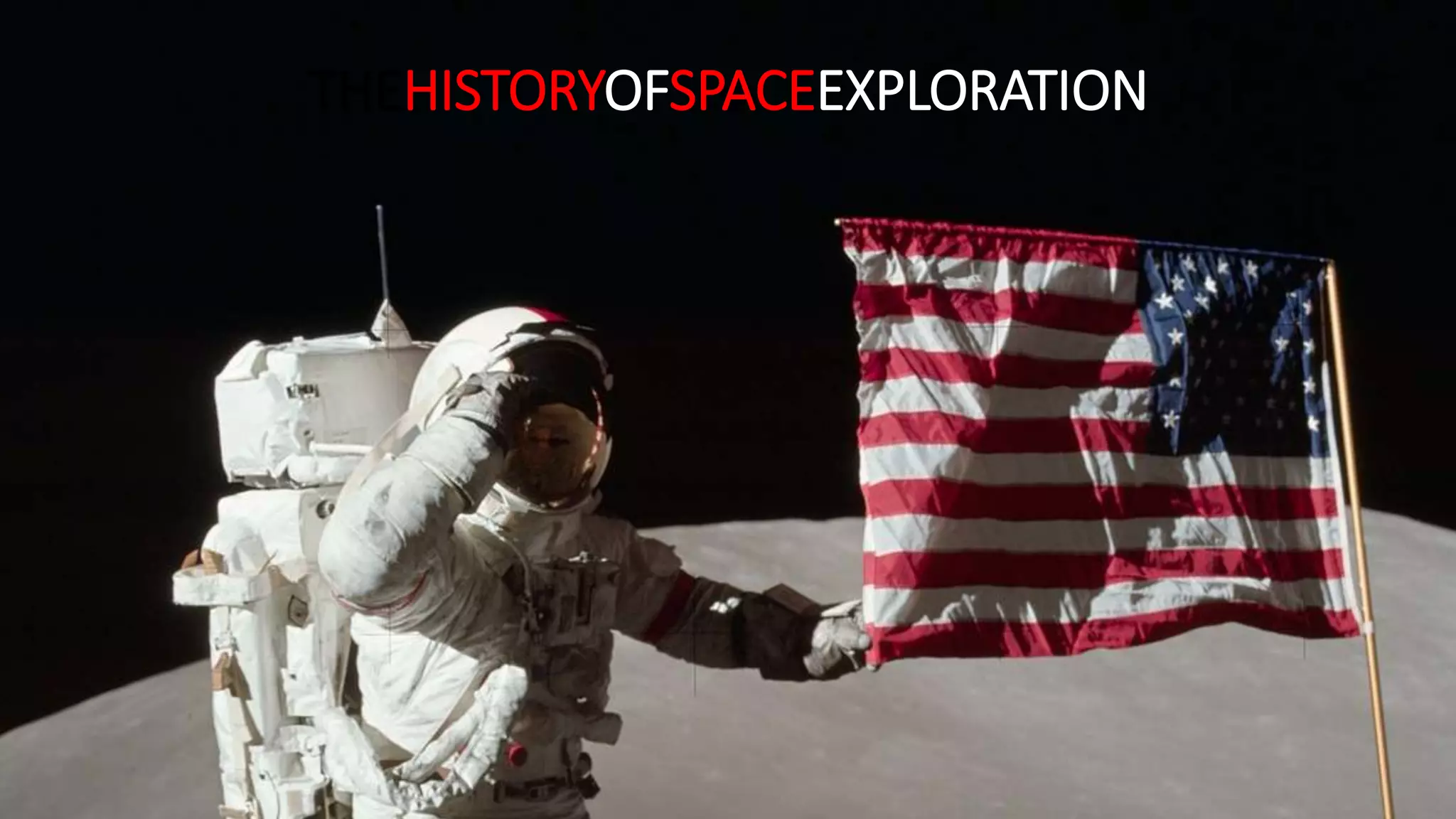
THEHISTORYOFSPACEEXPLORATION
SPACEEXPLORATION
Space exploration is the discovery and exploration of our Cosmos, in
the space, with the help of the advanced technology.
The study of space is carried out by astronomers with telescopes, and
the physical exploration of space is conducted both by unmanned
robotic probes and human spaceflight.
THESPACERACE
Space exploration has often been used as a competition for
geopolitical rivalries during the Cold War. The early era of space
exploration was defined as a "Space Race" between the Soviet Union
and the United States.
THERUSSIANCONTRIBUTION
The Soviet space program achieved many of the first milestones,
including the first living being in orbit in 1957, the first human
spaceflight (Yuri Gagarin aboard Vostok 1) in 1961, the first spacewalk
(by Aleksei Leonov) on 18 March 1965, the first automatic landing on
another celestial body in 1966, and the launch of the first space
station (Salyut 1) in 1971.
SPACESHUTTLEPROGRAM
After the first 20 years of exploration, focus shifted from one-off flights
to renewable hardware, such as the Space Shuttle program, and from
competition to cooperation as with the International Space Station.
FIRSTLIVINGBEINGONORBIT
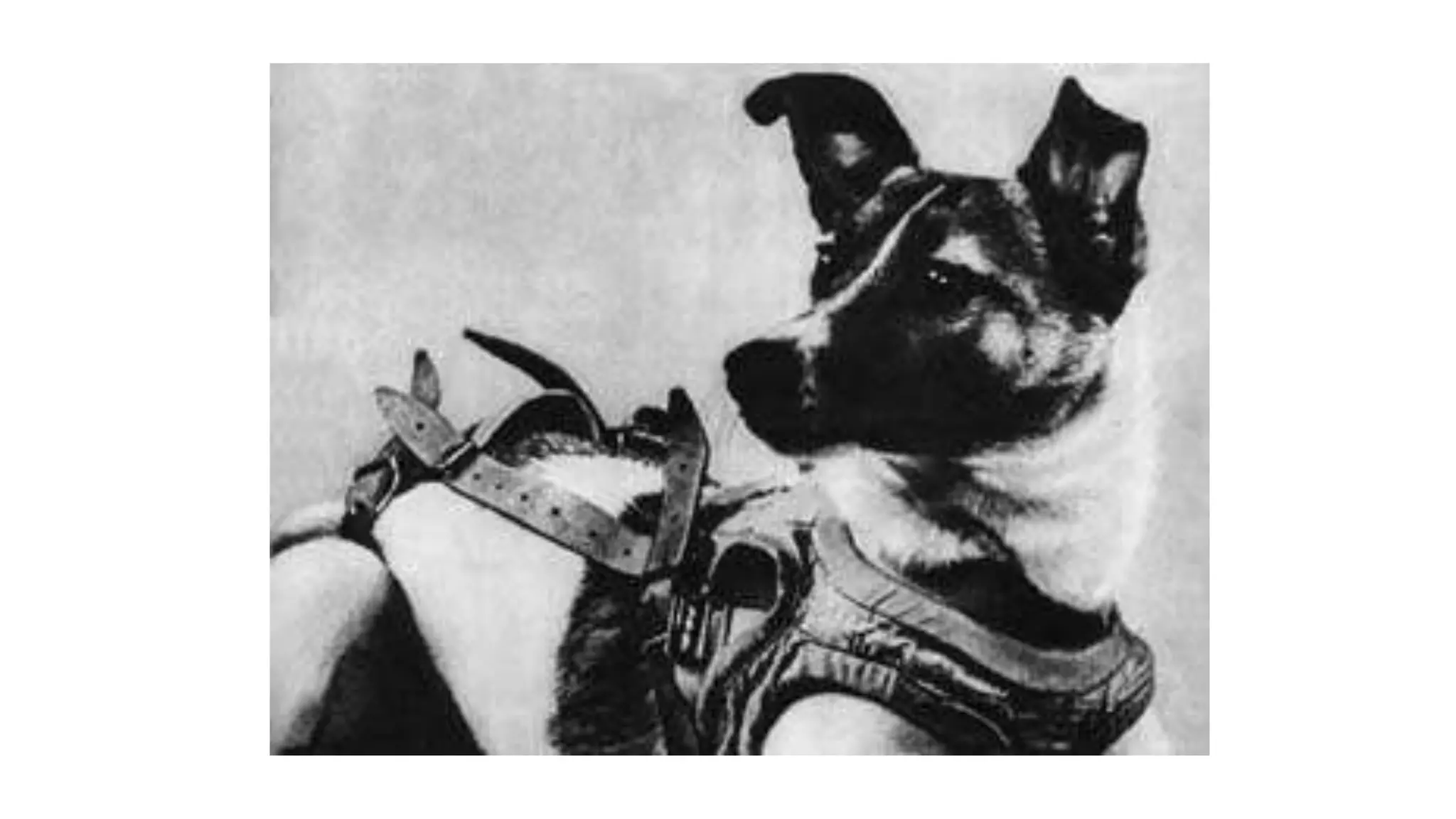
Laika was a 3 yo Soviet space dog who became the first animal to orbit
the Earth. Laika was a stray dog from the streets of Moscow, and she
was launched into space on November 3, 1957.
Laika died within hours from overheating, possibly caused by a failure
of the central system of Sputnik.
IURIGAGARIN
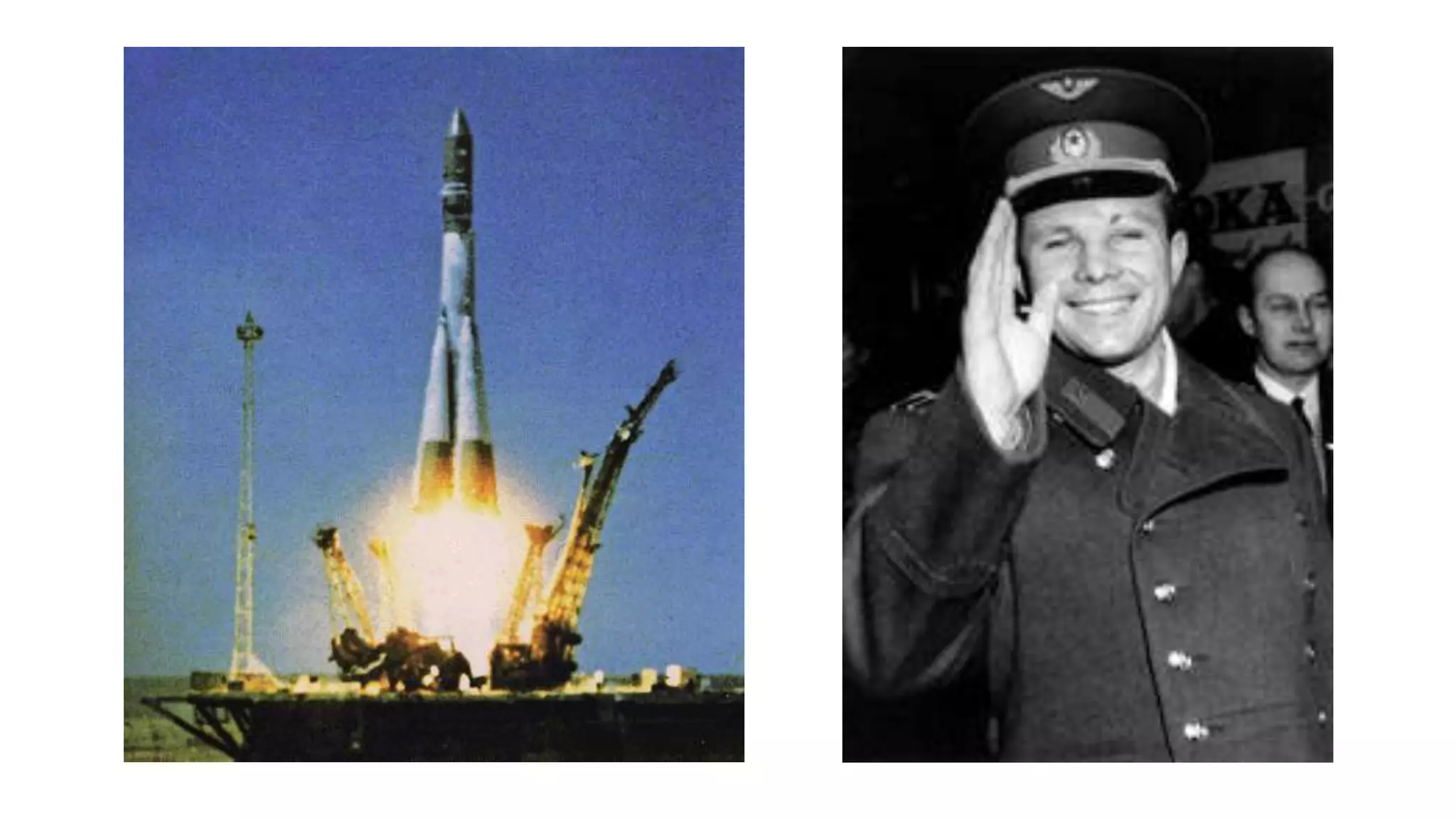
The first successful human spaceflight was Vostok 1 ("East 1"), carrying
27 year old Russian cosmonaut Yuri Gagarin on 12 April 1961.
The spacecraft completed one orbit around the globe, lasting about 1
hour and 48 minutes.
THEUSARESPONSE
The U.S. first launched a person into space within a month of Vostok 1
with Alan Shepard's suborbital flight in Mercury-Redstone 3. Orbital
flight was achieved by the United States when John Glenn's Mercury-
Atlas 6 orbited the Earth on 20 February 1962.
MOONLANDING
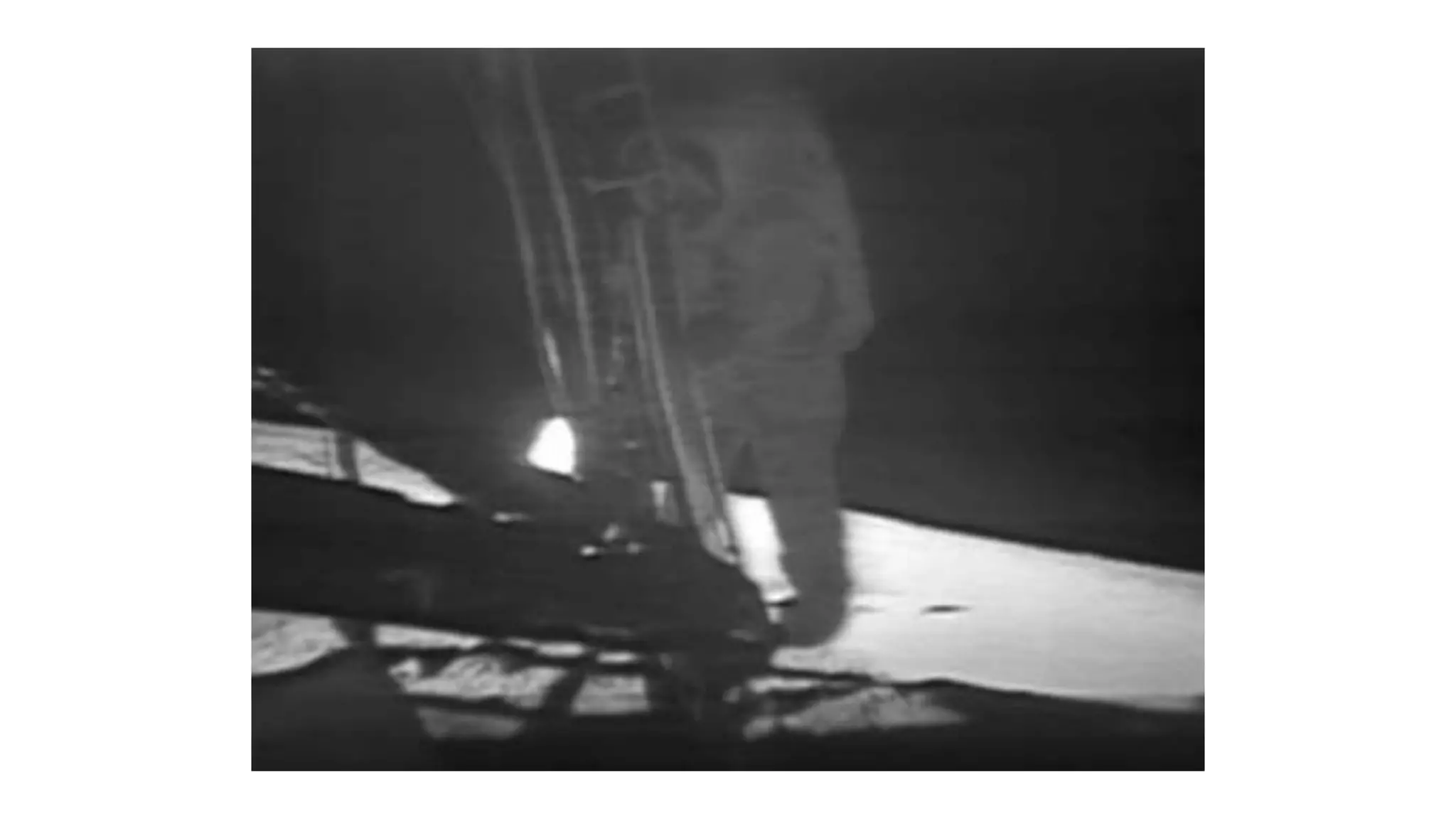
Apollo 11 was the spaceflight that landed the first humans on the
Moon, Americans Neil Armstrong and Buzz Aldrin, on July 20, 1969, at
20:18 pm.
Armstrong became the first to step onto the lunar surface six hours
later on July 21 at 02:56 am. Armstrong spent about two and a half
hours outside the spacecraft, Aldrin slightly less, and together they
collected 21.5 kg of lunar material for return to Earth.
TARGETSOFEXPLORATION - THESUN
While the Sun will probably not be physically explored in the close
future, the study of the Sun has been a major focus of space
exploration.
TARGETSOFEXPLORATION - MERCURY
Mercury remains the least explored of the inner planets. As of May
2013, the Mariner 10 and MESSENGER missions have been the only
missions that have made close observations of Mercury.
A third mission to Mercury, scheduled to arrive in 2020, BepiColombo
is to include two probes.
The first successful Venus flyby was the American Mariner 2
spacecraft, which flew past Venus in 1962.
In 1967 Venera 4 became the first probe to enter and examine the
atmosphere of Venus. In 1970 Venera 7 became the first successful
lander to reach the surface of Venus.
TARGETSOFEXPLORATION - VENUS
As of 24 September 2014, there are two scientific rovers on the
surface of Mars beaming signals back to Earth (Opportunity and
Curiosity), and five orbiters currently surveying the planet: Odyssey,
Express, Orbiter, MOM and MAVEN.
TARGETSOFEXPLORATION - VENUS
The exploration of Jupiter has consisted automated NASA spacecraft
visiting the planet since 1973. The missions have been "flybys", in
which detailed observations are taken without the probe landing or
entering orbit; the Galileo spacecraft is the only one to have orbited
the planet. As Jupiter is believed to have only a small rocky core and no
solid surface, a landing mission is impossible.
TARGETSOFEXPLORATION – JUPITER
Saturn has been explored only by unmanned spacecraft launched by
NASA, in the mission Cassini–Huygens.
Flybys: in 1979 by Pioneer 11, in 1980 by Voyager 1, in 1982 by Voyager
2 and an orbital mission by the Cassini spacecraft, which entered orbit
in 2004 and is expected to continue its mission well into 2017.
TARGETSOFEXPLORATION – SATURN
The exploration of Uranus has been entirely through the Voyager 2
spacecraft, with no other visits currently planned. The closest approach
to Uranus occurred on 24 January 1986 when Voyager 2 studied the
planet's unique atmosphere and magnetosphere.
TARGETSOFEXPLORATION – URANUS
The exploration of Neptune began with the 25 August 1989 Voyager 2
flyby, the sole visit to the system as of 2014. The possibility of a
Neptune Orbiter has been discussed, but no other missions have been
given serious thought.
TARGETSOFEXPLORATION – NEPTUNE
The exploration of Neptune began with the 25 August 1989 Voyager 2
flyby, the sole visit to the system as of 2014. The possibility of a
Neptune Orbiter has been discussed, but no other missions have been
given serious thought.
TARGETSOFEXPLORATION – NEPTUNE

GEOGRAPHY YEAR 9: THE HISTORY OF SPACE EXPLORATION

  • 1.
  • 2.
    SPACEEXPLORATION Space exploration isthe discovery and exploration of our Cosmos, in the space, with the help of the advanced technology. The study of space is carried out by astronomers with telescopes, and the physical exploration of space is conducted both by unmanned robotic probes and human spaceflight.
  • 3.
    THESPACERACE Space exploration hasoften been used as a competition for geopolitical rivalries during the Cold War. The early era of space exploration was defined as a "Space Race" between the Soviet Union and the United States.
  • 4.
    THERUSSIANCONTRIBUTION The Soviet spaceprogram achieved many of the first milestones, including the first living being in orbit in 1957, the first human spaceflight (Yuri Gagarin aboard Vostok 1) in 1961, the first spacewalk (by Aleksei Leonov) on 18 March 1965, the first automatic landing on another celestial body in 1966, and the launch of the first space station (Salyut 1) in 1971.
  • 5.
    SPACESHUTTLEPROGRAM After the first20 years of exploration, focus shifted from one-off flights to renewable hardware, such as the Space Shuttle program, and from competition to cooperation as with the International Space Station.
  • 6.
    FIRSTLIVINGBEINGONORBIT Laika was a3 yo Soviet space dog who became the first animal to orbit the Earth. Laika was a stray dog from the streets of Moscow, and she was launched into space on November 3, 1957. Laika died within hours from overheating, possibly caused by a failure of the central system of Sputnik.
  • 8.
    IURIGAGARIN The first successfulhuman spaceflight was Vostok 1 ("East 1"), carrying 27 year old Russian cosmonaut Yuri Gagarin on 12 April 1961. The spacecraft completed one orbit around the globe, lasting about 1 hour and 48 minutes.
  • 10.
    THEUSARESPONSE The U.S. firstlaunched a person into space within a month of Vostok 1 with Alan Shepard's suborbital flight in Mercury-Redstone 3. Orbital flight was achieved by the United States when John Glenn's Mercury- Atlas 6 orbited the Earth on 20 February 1962.
  • 11.
    MOONLANDING Apollo 11 wasthe spaceflight that landed the first humans on the Moon, Americans Neil Armstrong and Buzz Aldrin, on July 20, 1969, at 20:18 pm. Armstrong became the first to step onto the lunar surface six hours later on July 21 at 02:56 am. Armstrong spent about two and a half hours outside the spacecraft, Aldrin slightly less, and together they collected 21.5 kg of lunar material for return to Earth.
  • 13.
    TARGETSOFEXPLORATION - THESUN Whilethe Sun will probably not be physically explored in the close future, the study of the Sun has been a major focus of space exploration.
  • 14.
    TARGETSOFEXPLORATION - MERCURY Mercuryremains the least explored of the inner planets. As of May 2013, the Mariner 10 and MESSENGER missions have been the only missions that have made close observations of Mercury. A third mission to Mercury, scheduled to arrive in 2020, BepiColombo is to include two probes.
  • 15.
    The first successfulVenus flyby was the American Mariner 2 spacecraft, which flew past Venus in 1962. In 1967 Venera 4 became the first probe to enter and examine the atmosphere of Venus. In 1970 Venera 7 became the first successful lander to reach the surface of Venus. TARGETSOFEXPLORATION - VENUS
  • 16.
    As of 24September 2014, there are two scientific rovers on the surface of Mars beaming signals back to Earth (Opportunity and Curiosity), and five orbiters currently surveying the planet: Odyssey, Express, Orbiter, MOM and MAVEN. TARGETSOFEXPLORATION - VENUS
  • 17.
    The exploration ofJupiter has consisted automated NASA spacecraft visiting the planet since 1973. The missions have been "flybys", in which detailed observations are taken without the probe landing or entering orbit; the Galileo spacecraft is the only one to have orbited the planet. As Jupiter is believed to have only a small rocky core and no solid surface, a landing mission is impossible. TARGETSOFEXPLORATION – JUPITER
  • 18.
    Saturn has beenexplored only by unmanned spacecraft launched by NASA, in the mission Cassini–Huygens. Flybys: in 1979 by Pioneer 11, in 1980 by Voyager 1, in 1982 by Voyager 2 and an orbital mission by the Cassini spacecraft, which entered orbit in 2004 and is expected to continue its mission well into 2017. TARGETSOFEXPLORATION – SATURN
  • 19.
    The exploration ofUranus has been entirely through the Voyager 2 spacecraft, with no other visits currently planned. The closest approach to Uranus occurred on 24 January 1986 when Voyager 2 studied the planet's unique atmosphere and magnetosphere. TARGETSOFEXPLORATION – URANUS
  • 20.
    The exploration ofNeptune began with the 25 August 1989 Voyager 2 flyby, the sole visit to the system as of 2014. The possibility of a Neptune Orbiter has been discussed, but no other missions have been given serious thought. TARGETSOFEXPLORATION – NEPTUNE
  • 21.
    The exploration ofNeptune began with the 25 August 1989 Voyager 2 flyby, the sole visit to the system as of 2014. The possibility of a Neptune Orbiter has been discussed, but no other missions have been given serious thought. TARGETSOFEXPLORATION – NEPTUNE