
The Shifting Education Landscape:
       Networked Learning

Lee Rainie, Director, Pew Internet Project
3.26.12
Monterey Institute
Email: Lrainie@pewinternet.org
Twitter: @Lrainie


                                             PewInternet.org
Broadband
facilitates
networked
information
Social media
aids peer-to-
peer learning
by doing
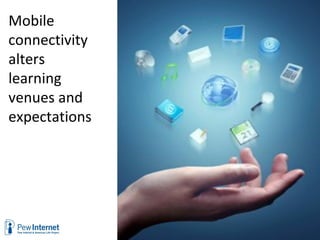
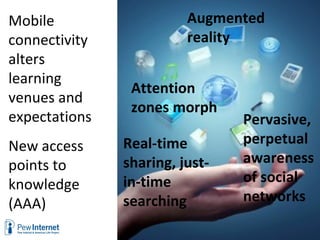
Mobile
connectivity
alters
learning
venues and
expectations
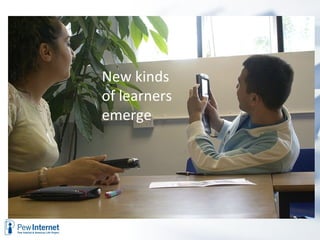
New kinds
of learners
emerge
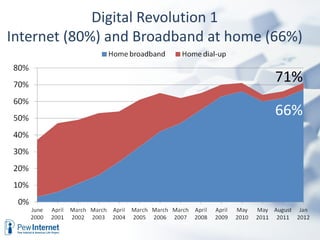
Digital Revolution 1
Internet (80%) and Broadband at home (66%)

                                      71%

                                      66%
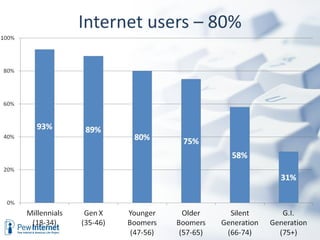
Internet users – 80%
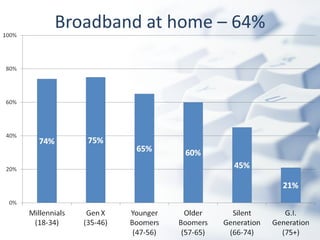
Broadband at home – 64%
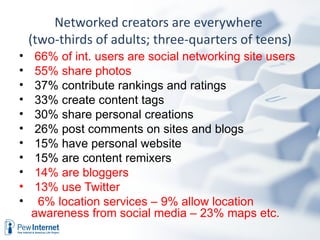
Networked creators are everywhere
    (two-thirds of adults; three-quarters of teens)
•    66% of int. users are social networking site users
•    55% share photos
•    37% contribute rankings and ratings
•    33% create content tags
•    30% share personal creations
•    26% post comments on sites and blogs
•    15% have personal website
•    15% are content remixers
•    14% are bloggers
•    13% use Twitter
•     6% location services – 9% allow location
    awareness from social media – 23% maps etc.
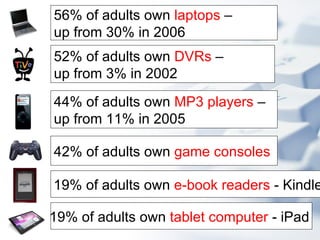
56% of adults own laptops –
up from 30% in 2006
52% of adults own DVRs –
up from 3% in 2002
44% of adults own MP3 players –
up from 11% in 2005

42% of adults own game consoles

19% of adults own e-book readers - Kindle

19% of adults own tablet computer - iPad
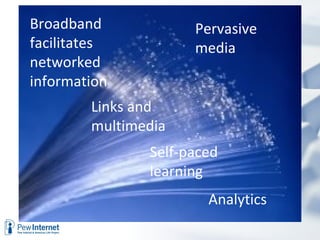
Broadband            Pervasive
facilitates          media
networked
information
        Links and
        multimedia
               Self-paced
               learning
                       Analytics
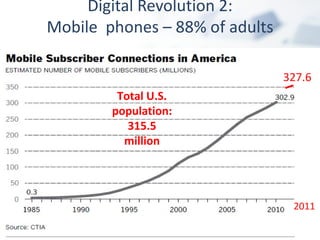
Digital Revolution 2:
Mobile phones – 88% of adults

                                327.6
         Total U.S.
        population:
           315.5
          million


                                 2011
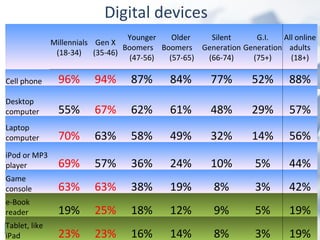
Digital devices
                                  Younger   Older   Silent     G.I.   All online
               Millennials Gen X
                                 Boomers Boomers Generation Generation adults
                (18-34) (35-46)
                                   (47-56) (57-65) (66-74)    (75+)     (18+)

Cell phone      96%      94%      87%       84%       77%       52%      88%
Desktop
computer        55%      67%      62%       61%       48%       29%      57%
Laptop
computer        70%      63%      58%       49%       32%       14%      56%
iPod or MP3
player          69%      57%      36%       24%       10%        5%      44%
Game
console         63%      63%      38%       19%        8%        3%      42%
e-Book
reader          19%      25%      18%       12%        9%        5%      19%
Tablet, like
iPad            23%      23%      16%       14%        8%        3%      19%
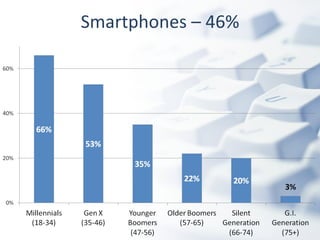
Smartphones – 46%
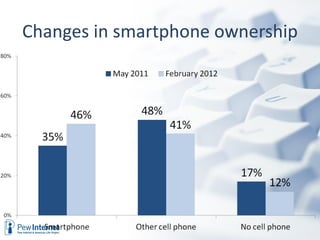
Changes in smartphone ownership
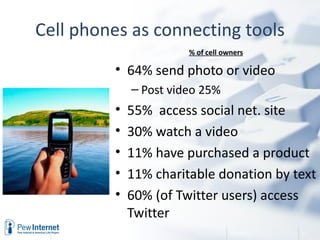
Cell phones as connecting tools
                       % of cell owners

         • 64% send photo or video
             – Post video 25%
         •   55% access social net. site
         •   30% watch a video
         •   11% have purchased a product
         •   11% charitable donation by text
         •   60% (of Twitter users) access
             Twitter
                                   2/22/2011   17
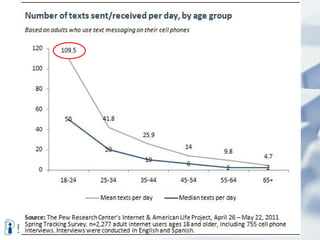
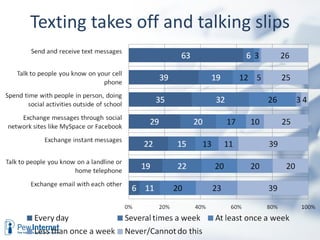
Texting takes off and talking slips
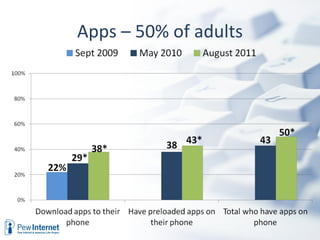
Apps – 50% of adults
Mobile                   Augmented
connectivity             reality
alters
learning
                Attention
venues and
                zones morph
expectations                    Pervasive,
New access     Real-time        perpetual
points to      sharing, just-   awareness
knowledge      in-time          of social
(AAA)          searching        networks
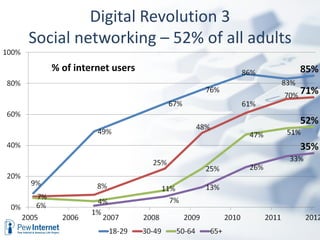
Digital Revolution 3
Social networking – 52% of all adults
   % of internet users
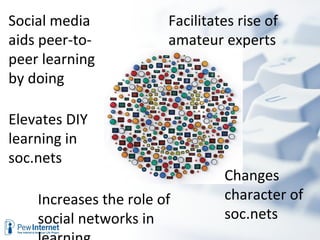
Social media            Facilitates rise of
aids peer-to-           amateur experts
peer learning
by doing

Elevates DIY
learning in
soc.nets
                                 Changes
    Increases the role of        character of
    social networks in           soc.nets
In the midst of all
    this, what’s
  happening with
     learning?
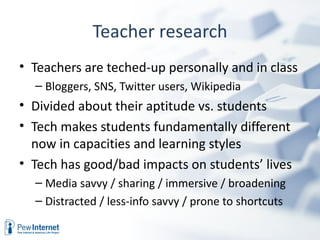
Teacher research
• Teachers are teched-up personally and in class
  – Bloggers, SNS, Twitter users, Wikipedia
• Divided about their aptitude vs. students
• Tech makes students fundamentally different
  now in capacities and learning styles
• Tech has good/bad impacts on students’ lives
  – Media savvy / sharing / immersive / broadening
  – Distracted / less-info savvy / prone to shortcuts
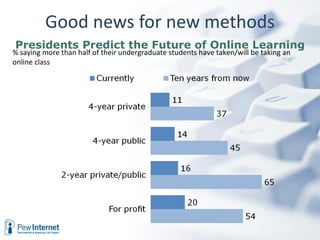
Good news for new methods
Presidents Predict the Future of Online Learning
% saying more than half of their undergraduate students have taken/will be taking an
online class
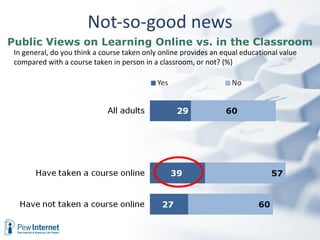
Not-so-good news
Public Views on Learning Online vs. in the Classroom
 In general, do you think a course taken only online provides an equal educational value
 compared with a course taken in person in a classroom, or not? (%)
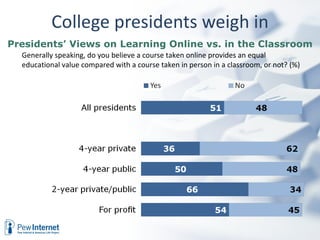
College presidents weigh in
Presidents’ Views on Learning Online vs. in the Classroom
  Generally speaking, do you believe a course taken online provides an equal
  educational value compared with a course taken in person in a classroom, or not? (%)
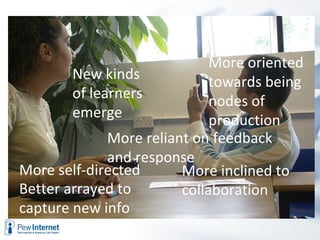
More oriented
        New kinds             towards being
        of learners           nodes of
        emerge                production
              More reliant on feedback
              and response
More self-directed       More inclined to
Better arrayed to        collaboration
capture new info
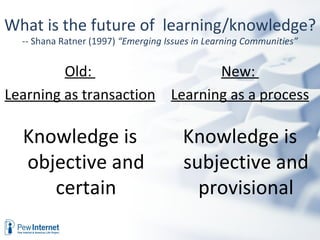
What is the future of learning/knowledge?
  -- Shana Ratner (1997) “Emerging Issues in Learning Communities”


         Old:                  New:
Learning as transaction Learning as a process

  Knowledge is                         Knowledge is
  objective and                        subjective and
     certain                             provisional
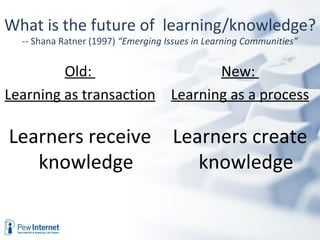
What is the future of learning/knowledge?
  -- Shana Ratner (1997) “Emerging Issues in Learning Communities”


         Old:                  New:
Learning as transaction Learning as a process

Learners receive                    Learners create
   knowledge                           knowledge
What is the future of learning/knowledge?
  -- Shana Ratner (1997) “Emerging Issues in Learning Communities”


         Old:                  New:
Learning as transaction Learning as a process

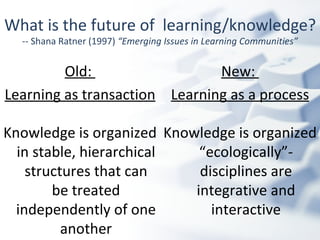
Knowledge is organized Knowledge is organized
  in stable, hierarchical   “ecologically”-
    structures that can     disciplines are
        be treated         integrative and
  independently of one        interactive
          another
What is the future of learning/knowledge?
  -- Shana Ratner (1997) “Emerging Issues in Learning Communities”


         Old:                  New:
Learning as transaction Learning as a process

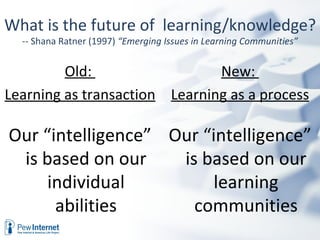
Our “intelligence” Our “intelligence”
 is based on our    is based on our
     individual          learning
      abilities       communities
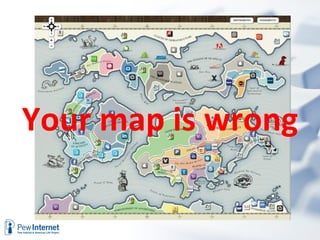
Your map is wrong
Thank you!
• Stanford CS221 – Introduction to Artificial
  Intelligence
• Sebastian Thrun and Peter Norvig
• Google X, a lab created to incubate the
  company’s most ambitious and secretive
  projects. He was also free to pursue outside
  ventures.
• In a few slides, he’d spelled out the nine essential
  components of a university education:
  admissions, lectures, peer interaction, professor
  interaction, problem-solving, assignments,
  exams, deadlines, and certification.

The shifting Education Landscape: Networked Learning

  • 1.
    The Shifting EducationLandscape: Networked Learning Lee Rainie, Director, Pew Internet Project 3.26.12 Monterey Institute Email: Lrainie@pewinternet.org Twitter: @Lrainie PewInternet.org
  • 3.
  • 4.
  • 5.
  • 6.
  • 7.
    Digital Revolution 1 Internet(80%) and Broadband at home (66%) 71% 66%
  • 8.
  • 9.
  • 10.
    Networked creators areeverywhere (two-thirds of adults; three-quarters of teens) • 66% of int. users are social networking site users • 55% share photos • 37% contribute rankings and ratings • 33% create content tags • 30% share personal creations • 26% post comments on sites and blogs • 15% have personal website • 15% are content remixers • 14% are bloggers • 13% use Twitter • 6% location services – 9% allow location awareness from social media – 23% maps etc.
  • 11.
    56% of adultsown laptops – up from 30% in 2006 52% of adults own DVRs – up from 3% in 2002 44% of adults own MP3 players – up from 11% in 2005 42% of adults own game consoles 19% of adults own e-book readers - Kindle 19% of adults own tablet computer - iPad
  • 12.
    Broadband Pervasive facilitates media networked information Links and multimedia Self-paced learning Analytics
  • 13.
    Digital Revolution 2: Mobilephones – 88% of adults 327.6 Total U.S. population: 315.5 million 2011
  • 14.
    Digital devices Younger Older Silent G.I. All online Millennials Gen X Boomers Boomers Generation Generation adults (18-34) (35-46) (47-56) (57-65) (66-74) (75+) (18+) Cell phone 96% 94% 87% 84% 77% 52% 88% Desktop computer 55% 67% 62% 61% 48% 29% 57% Laptop computer 70% 63% 58% 49% 32% 14% 56% iPod or MP3 player 69% 57% 36% 24% 10% 5% 44% Game console 63% 63% 38% 19% 8% 3% 42% e-Book reader 19% 25% 18% 12% 9% 5% 19% Tablet, like iPad 23% 23% 16% 14% 8% 3% 19%
  • 15.
  • 16.
  • 17.
    Cell phones asconnecting tools % of cell owners • 64% send photo or video – Post video 25% • 55% access social net. site • 30% watch a video • 11% have purchased a product • 11% charitable donation by text • 60% (of Twitter users) access Twitter 2/22/2011 17
  • 19.
    Texting takes offand talking slips
  • 20.
    Apps – 50%of adults
  • 21.
    Mobile Augmented connectivity reality alters learning Attention venues and zones morph expectations Pervasive, New access Real-time perpetual points to sharing, just- awareness knowledge in-time of social (AAA) searching networks
  • 22.
    Digital Revolution 3 Socialnetworking – 52% of all adults % of internet users
  • 24.
    Social media Facilitates rise of aids peer-to- amateur experts peer learning by doing Elevates DIY learning in soc.nets Changes Increases the role of character of social networks in soc.nets
  • 25.
    In the midstof all this, what’s happening with learning?
  • 26.
    Teacher research • Teachersare teched-up personally and in class – Bloggers, SNS, Twitter users, Wikipedia • Divided about their aptitude vs. students • Tech makes students fundamentally different now in capacities and learning styles • Tech has good/bad impacts on students’ lives – Media savvy / sharing / immersive / broadening – Distracted / less-info savvy / prone to shortcuts
  • 27.
    Good news fornew methods Presidents Predict the Future of Online Learning % saying more than half of their undergraduate students have taken/will be taking an online class
  • 28.
    Not-so-good news Public Viewson Learning Online vs. in the Classroom In general, do you think a course taken only online provides an equal educational value compared with a course taken in person in a classroom, or not? (%)
  • 29.
    College presidents weighin Presidents’ Views on Learning Online vs. in the Classroom Generally speaking, do you believe a course taken online provides an equal educational value compared with a course taken in person in a classroom, or not? (%)
  • 30.
    More oriented New kinds towards being of learners nodes of emerge production More reliant on feedback and response More self-directed More inclined to Better arrayed to collaboration capture new info
  • 31.
    What is thefuture of learning/knowledge? -- Shana Ratner (1997) “Emerging Issues in Learning Communities” Old: New: Learning as transaction Learning as a process Knowledge is Knowledge is objective and subjective and certain provisional
  • 32.
    What is thefuture of learning/knowledge? -- Shana Ratner (1997) “Emerging Issues in Learning Communities” Old: New: Learning as transaction Learning as a process Learners receive Learners create knowledge knowledge
  • 33.
    What is thefuture of learning/knowledge? -- Shana Ratner (1997) “Emerging Issues in Learning Communities” Old: New: Learning as transaction Learning as a process Knowledge is organized Knowledge is organized in stable, hierarchical “ecologically”- structures that can disciplines are be treated integrative and independently of one interactive another
  • 34.
    What is thefuture of learning/knowledge? -- Shana Ratner (1997) “Emerging Issues in Learning Communities” Old: New: Learning as transaction Learning as a process Our “intelligence” Our “intelligence” is based on our is based on our individual learning abilities communities
  • 35.
  • 36.
  • 37.
    • Stanford CS221– Introduction to Artificial Intelligence • Sebastian Thrun and Peter Norvig • Google X, a lab created to incubate the company’s most ambitious and secretive projects. He was also free to pursue outside ventures. • In a few slides, he’d spelled out the nine essential components of a university education: admissions, lectures, peer interaction, professor interaction, problem-solving, assignments, exams, deadlines, and certification.

Editor's Notes

  • #2 The Shifting Education Landscape: Networked Learning
  • #38 http://www.wired.com/wiredscience/2012/03/ff_aiclass/all/1