Trust, Facts, Democracy
Lee Rainie
Director, Internet and Technology Research
Trust
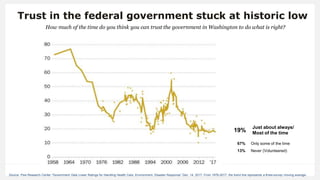
Trust in the federal government stuck at historic low
Source: Pew Research Center “Government Gets Lower Ratings for Handling Health Care, Environment, Disaster Response” Dec. 14, 2017. From 1976-2017, the trend line represents a three-survey moving average.
How much of the time do you think you can trust the government in Washington to do what is right?
Just about always/
Most of the time19%
67% Only some of the time
13% Never (Volunteered)
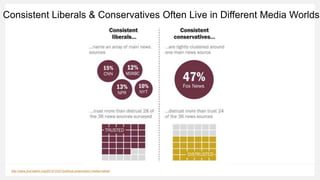
Consistent Liberals & Conservatives Often Live in Different Media Worlds
http://www.journalism.org/2014/10/21/political-polarization-media-habits/
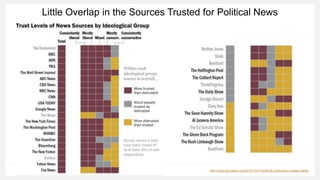
Little Overlap in the Sources Trusted for Political News
http://www.journalism.org/2014/10/21/political-polarization-media-habits/
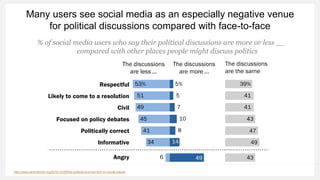
Many users see social media as an especially negative venue
for political discussions compared with face-to-face
% of social media users who say their political discussions are more or less __
compared with other places people might discuss politics
http://www.pewinternet.org/2016/10/25/the-political-environment-on-social-media/
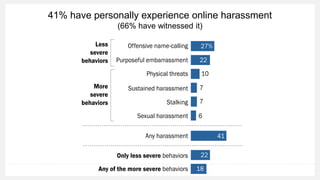
41% have personally experience online harassment
(66% have witnessed it)
Facts
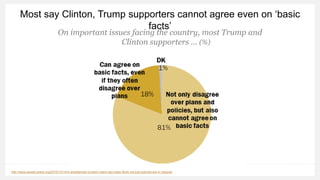
Most say Clinton, Trump supporters cannot agree even on ‘basic
facts’
On important issues facing the country, most Trump and
Clinton supporters … (%)
http://www.people-press.org/2016/10/14/in-presidential-contest-voters-say-basic-facts-not-just-policies-are-in-dispute/
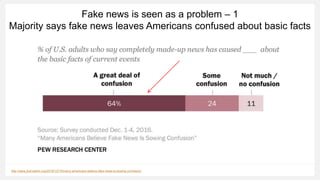
Fake news is seen as a problem – 1
Majority says fake news leaves Americans confused about basic facts
http://www.journalism.org/2016/12/15/many-americans-believe-fake-news-is-sowing-confusion/
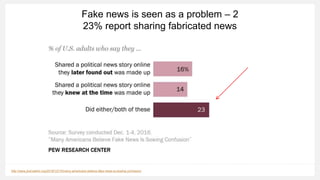
Fake news is seen as a problem – 2
23% report sharing fabricated news
http://www.journalism.org/2016/12/15/many-americans-believe-fake-news-is-sowing-confusion/
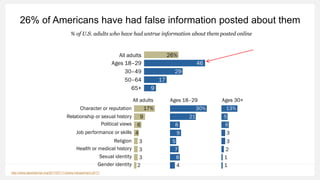
26% of Americans have had false information posted about them
% of U.S. adults who have had untrue information about them posted online
http://www.pewinternet.org/2017/07/11/online-harassment-2017/
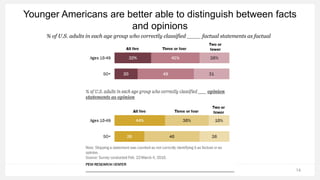
14
Younger Americans are better able to distinguish between facts
and opinions
% of U.S. adults in each age group who correctly classified ____ factual statements as factual
Democracy
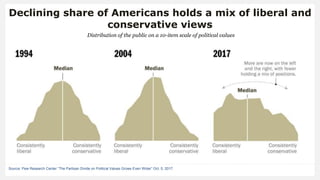
Declining share of Americans holds a mix of liberal and
conservative views
Distribution of the public on a 10-item scale of political values
Source: Pew Research Center “The Partisan Divide on Political Values Grows Even Wider” Oct. 5, 2017.
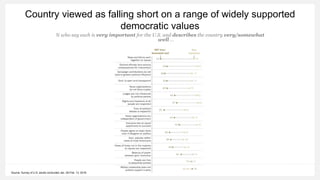
Country viewed as falling short on a range of widely supported
democratic values
% who say each is very important for the U.S. and describes the country very/somewhat
well …
Source: Survey of U.S. adults conducted Jan. 29-Feb. 13, 2018.
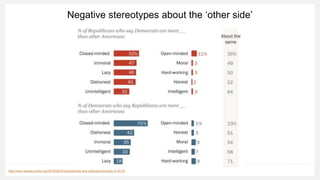
Negative stereotypes about the ‘other side’
http://www.people-press.org/2016/06/22/partisanship-and-political-animosity-in-2016/
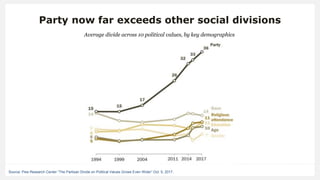
Party now far exceeds other social divisions
Average divide across 10 political values, by key demographics
Source: Pew Research Center “The Partisan Divide on Political Values Grows Even Wider” Oct. 5, 2017.
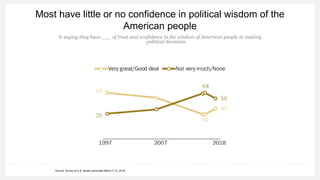
Most have little or no confidence in political wisdom of the
American people
% saying they have ___ of trust and confidence in the wisdom of American people in making
political decisions
Source: Survey of U.S. adults conducted March 7-14, 2018.
21
The reckoning for tech companies
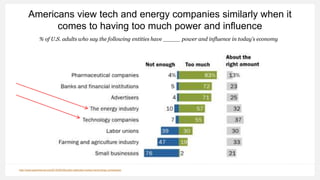
Americans view tech and energy companies similarly when it
comes to having too much power and influence
http://www.pewinternet.org/2018/06/28/public-attitudes-toward-technology-companies/
% of U.S. adults who say the following entities have _____ power and influence in today’s economy
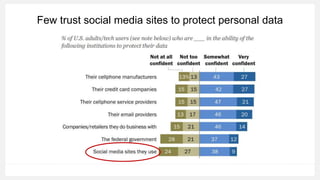
Few trust social media sites to protect personal data
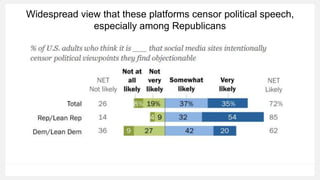
Widespread view that these platforms censor political speech,
especially among Republicans
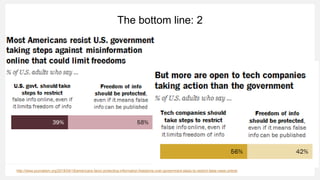
http://www.journalism.org/2018/04/19/americans-favor-protecting-information-freedoms-over-government-steps-to-restrict-false-news-online/
The bottom line: 2
Thank you!
Email: lrainie@pewresearch.org
Twitter: @lrainie
@pewinternet
@pewresearch

Trust, Facts, Democracy

  • 1.
    Trust, Facts, Democracy LeeRainie Director, Internet and Technology Research
  • 2.
  • 3.
    Trust in thefederal government stuck at historic low Source: Pew Research Center “Government Gets Lower Ratings for Handling Health Care, Environment, Disaster Response” Dec. 14, 2017. From 1976-2017, the trend line represents a three-survey moving average. How much of the time do you think you can trust the government in Washington to do what is right? Just about always/ Most of the time19% 67% Only some of the time 13% Never (Volunteered)
  • 4.
    Consistent Liberals &Conservatives Often Live in Different Media Worlds http://www.journalism.org/2014/10/21/political-polarization-media-habits/
  • 5.
    Little Overlap inthe Sources Trusted for Political News http://www.journalism.org/2014/10/21/political-polarization-media-habits/
  • 6.
    Many users seesocial media as an especially negative venue for political discussions compared with face-to-face % of social media users who say their political discussions are more or less __ compared with other places people might discuss politics http://www.pewinternet.org/2016/10/25/the-political-environment-on-social-media/
  • 7.
    41% have personallyexperience online harassment (66% have witnessed it)
  • 8.
  • 9.
    Most say Clinton,Trump supporters cannot agree even on ‘basic facts’ On important issues facing the country, most Trump and Clinton supporters … (%) http://www.people-press.org/2016/10/14/in-presidential-contest-voters-say-basic-facts-not-just-policies-are-in-dispute/
  • 10.
    Fake news isseen as a problem – 1 Majority says fake news leaves Americans confused about basic facts http://www.journalism.org/2016/12/15/many-americans-believe-fake-news-is-sowing-confusion/
  • 11.
    Fake news isseen as a problem – 2 23% report sharing fabricated news http://www.journalism.org/2016/12/15/many-americans-believe-fake-news-is-sowing-confusion/
  • 12.
    26% of Americanshave had false information posted about them % of U.S. adults who have had untrue information about them posted online http://www.pewinternet.org/2017/07/11/online-harassment-2017/
  • 14.
    14 Younger Americans arebetter able to distinguish between facts and opinions % of U.S. adults in each age group who correctly classified ____ factual statements as factual
  • 15.
  • 16.
    Declining share ofAmericans holds a mix of liberal and conservative views Distribution of the public on a 10-item scale of political values Source: Pew Research Center “The Partisan Divide on Political Values Grows Even Wider” Oct. 5, 2017.
  • 17.
    Country viewed asfalling short on a range of widely supported democratic values % who say each is very important for the U.S. and describes the country very/somewhat well … Source: Survey of U.S. adults conducted Jan. 29-Feb. 13, 2018.
  • 18.
    Negative stereotypes aboutthe ‘other side’ http://www.people-press.org/2016/06/22/partisanship-and-political-animosity-in-2016/
  • 19.
    Party now farexceeds other social divisions Average divide across 10 political values, by key demographics Source: Pew Research Center “The Partisan Divide on Political Values Grows Even Wider” Oct. 5, 2017.
  • 20.
    Most have littleor no confidence in political wisdom of the American people % saying they have ___ of trust and confidence in the wisdom of American people in making political decisions Source: Survey of U.S. adults conducted March 7-14, 2018.
  • 21.
  • 22.
    The reckoning fortech companies
  • 23.
    Americans view techand energy companies similarly when it comes to having too much power and influence http://www.pewinternet.org/2018/06/28/public-attitudes-toward-technology-companies/ % of U.S. adults who say the following entities have _____ power and influence in today’s economy
  • 24.
    Few trust socialmedia sites to protect personal data
  • 25.
    Widespread view thatthese platforms censor political speech, especially among Republicans
  • 26.
  • 27.
    Thank you! Email: lrainie@pewresearch.org Twitter:@lrainie @pewinternet @pewresearch

Editor's Notes

  • #5 2014 report: look at relationship b/t current pol env’t in Amer & people’s pol news habits Shed light on pol polarization: looks at ways people get info abt gov’t & pol in news media, social media & interpersonally Overall, those w/ most consistent ideological views on left & right have info streams distinct from indiv w/ more mixed pol views – & very distinct from each other. Can be overstated. Study also suggests that virtually impossible to live in ideo bubble. Most Americans rely on array of outlets, & most hear dissenting political views Consis cons (furthest on right): tightly clustered around 1 news source, far more than any other ideo group About ½ cite Fox News as main political news source Asked about 36 news sources: expressed greater distrust than trust of 24 Consis Libs (furthest on left): Not as tightly clustered around 1 source; a greater range of news outlets named as main source – like NPR & NYT Express more trust than distrust of 28 of 36 news outlets
  • #6 At least as impt as where turn for news is who they trust (strong ideo diff). Chart: levels of trust to distrust for each source (overall & by ideological group) Purple: more trusted than distrusted Yellow: more distrusted than trusted Grey: about equally trusted and distrusted As already suggested, libs trust much larger mix of news outlets. Of 36, 28 more trusted than distrusted by consis libs. Among consis cons, 24 draw more distrust than trust. Of 8 outlets more trusted than distrusted by consis cons, all but one more distrusted by consis libs.