Sharing knowledge, resources and conversations is critical to the
development of one’s ICT capabilities.

Collaboration underpins effective ICT frameworks and is a means of
sustaining pedagogical practices capable of evolving with change.
Influence how one - perceives
                  - uses
                  - talks about technology
Which one are you ...

   a digital native or

       a digital immigrant?
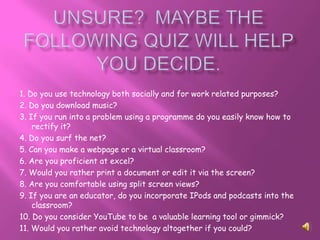
1. Do you use technology both socially and for work related purposes?
2. Do you download music?
3. If you run into a problem using a programme do you easily know how to
    rectify it?
4. Do you surf the net?
5. Can you make a webpage or a virtual classroom?
6. Are you proficient at excel?
7. Would you rather print a document or edit it via the screen?
8. Are you comfortable using split screen views?
9. If you are an educator, do you incorporate IPods and podcasts into the
    classroom?
10. Do you consider YouTube to be a valuable learning tool or gimmick?
11. Would you rather avoid technology altogether if you could?
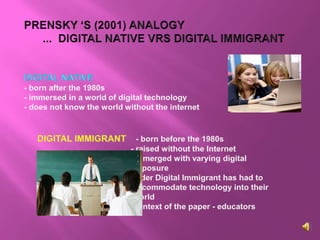
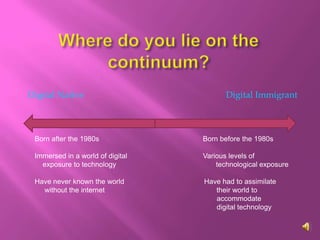
Digital Native                          Digital Immigrant


 Born after the 1980s             Born before the 1980s

 Immersed in a world of digital   Various levels of
   exposure to technology             technological exposure

 Have never known the world       Have had to assimilate
   without the internet              their world to
                                     accommodate
                                     digital technology
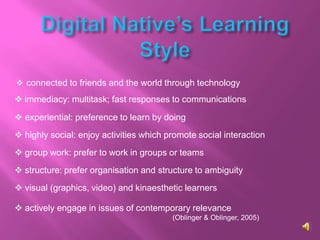
 connected to friends and the world through technology
 immediacy: multitask; fast responses to communications

 experiential: preference to learn by doing
 highly social: enjoy activities which promote social interaction
 group work: prefer to work in groups or teams
 structure: prefer organisation and structure to ambiguity
 visual (graphics, video) and kinaesthetic learners

 actively engage in issues of contemporary relevance
                                         (Oblinger & Oblinger, 2005)
[ The teacher ]


•   can be 30, 40, 50 or 60 years of age

•   educated by traditional teaching methods – authoritarian

    style, structured, textbook, rote learning, disseminating

    information, little opportunity for innovation and social

    interaction

•   grown up without the INTERNET
   according to Prensky (2001) the different levels of ICT
    acculturation has resulted in the creation of a digital
    divide; especially in the way the Digital Native and the
    Digital Immigrant perceive, use and talk about
    technology

   divide is so great that traditional styles of
    teaching no longer meet the needs of
    students (Prensky, 2001)
… read my paper and decide for yourself
   Greater exposure to digital media

   Immersed in technology since birth


   93% own a computer (Bennett, Maton, Kervin, 2008, p. 778)

   82% own a mobile phone (Bennett et al, 2008, p. 778)

   Multi-task

   Search via the internet / power browse

   Socially connected through social media profiles
Research indicates today’s Australian students tend to be
  highly proficient at low level Web 2.0 applications such
  as surfing the net and social networking.

In contrast, their skills in emerging applications such as
   podcasts or designing web-pages is not as extensive
   (Bennett et al, 2008).


Read my paper to see if patterns in ICT use across
Australian students meet global trends.
   implement constructivist learning styles

 adopt an eLearning paradigm

 bridge the gap between how students
  use technology out of school with
  their in school practices ie wikis,
  forums, YouTube

 address personal inadequacies
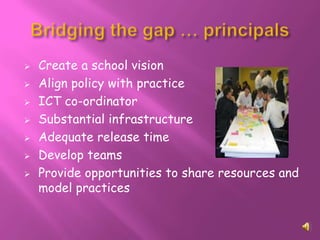
   Create a school vision
   Align policy with practice
   ICT co-ordinator
   Substantial infrastructure
   Adequate release time
   Develop teams
   Provide opportunities to share resources and
    model practices
… none of this is possible without
  substantial sharing of information,
  knowledge and resources
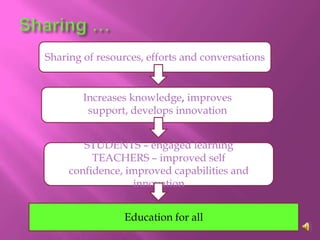
Sharing of resources, efforts and conversations


        Increases knowledge, improves
         support, develops innovation


        STUDENTS – engaged learning
          TEACHERS – improved self
     confidence, improved capabilities and
                  innovation


                 Education for all
Provides a means of sustaining
  pedagogical practices capable of
  evolving with change
If you have found my preview
interesting maybe you would enjoy
reading the full paper:
     The Value of Collaborative
     Learning in Educating the Digital
     Native Student.
Bennett, S., Maton, K. & Kervin, L. (2008). The ‘digital natives’
        debate: A critical review of the evidence. British Journal of
        Educational         Technology,       39(5),        775-786.
        doi:10.1111/j.1467-8535.2007.00793.x

Oblinger, D., & Oblinger, J. (2005). Educating the net generation. [Ele
        ctronic version]. Available from http:/net.educause.edu/i
        r/library/pdf

Prensky, M. (2001, October). Digital natives, digital
        immigrants.     On the Horizon, 9(5). Retrieved March 22,
        2012 from http://www.markprensky.com/writing/pren
        sky.com/writing/prensky%20-%20 digital%20natives,%d
        igital%20immigrants%20%20part1.pdf pp

The value of collaborative learning in educating the

  • 1.
    Sharing knowledge, resourcesand conversations is critical to the development of one’s ICT capabilities. Collaboration underpins effective ICT frameworks and is a means of sustaining pedagogical practices capable of evolving with change.
  • 3.
    Influence how one- perceives - uses - talks about technology
  • 4.
    Which one areyou ... a digital native or a digital immigrant?
  • 5.
    1. Do youuse technology both socially and for work related purposes? 2. Do you download music? 3. If you run into a problem using a programme do you easily know how to rectify it? 4. Do you surf the net? 5. Can you make a webpage or a virtual classroom? 6. Are you proficient at excel? 7. Would you rather print a document or edit it via the screen? 8. Are you comfortable using split screen views? 9. If you are an educator, do you incorporate IPods and podcasts into the classroom? 10. Do you consider YouTube to be a valuable learning tool or gimmick? 11. Would you rather avoid technology altogether if you could?
  • 6.
    Digital Native Digital Immigrant Born after the 1980s Born before the 1980s Immersed in a world of digital Various levels of exposure to technology technological exposure Have never known the world Have had to assimilate without the internet their world to accommodate digital technology
  • 7.
     connected tofriends and the world through technology  immediacy: multitask; fast responses to communications  experiential: preference to learn by doing  highly social: enjoy activities which promote social interaction  group work: prefer to work in groups or teams  structure: prefer organisation and structure to ambiguity  visual (graphics, video) and kinaesthetic learners  actively engage in issues of contemporary relevance (Oblinger & Oblinger, 2005)
  • 8.
    [ The teacher] • can be 30, 40, 50 or 60 years of age • educated by traditional teaching methods – authoritarian style, structured, textbook, rote learning, disseminating information, little opportunity for innovation and social interaction • grown up without the INTERNET
  • 9.
    according to Prensky (2001) the different levels of ICT acculturation has resulted in the creation of a digital divide; especially in the way the Digital Native and the Digital Immigrant perceive, use and talk about technology  divide is so great that traditional styles of teaching no longer meet the needs of students (Prensky, 2001)
  • 10.
    … read mypaper and decide for yourself
  • 11.
    Greater exposure to digital media  Immersed in technology since birth  93% own a computer (Bennett, Maton, Kervin, 2008, p. 778)  82% own a mobile phone (Bennett et al, 2008, p. 778)  Multi-task  Search via the internet / power browse  Socially connected through social media profiles
  • 12.
    Research indicates today’sAustralian students tend to be highly proficient at low level Web 2.0 applications such as surfing the net and social networking. In contrast, their skills in emerging applications such as podcasts or designing web-pages is not as extensive (Bennett et al, 2008). Read my paper to see if patterns in ICT use across Australian students meet global trends.
  • 13.
    implement constructivist learning styles  adopt an eLearning paradigm  bridge the gap between how students use technology out of school with their in school practices ie wikis, forums, YouTube  address personal inadequacies
  • 14.
    Create a school vision  Align policy with practice  ICT co-ordinator  Substantial infrastructure  Adequate release time  Develop teams  Provide opportunities to share resources and model practices
  • 15.
    … none ofthis is possible without substantial sharing of information, knowledge and resources
  • 16.
    Sharing of resources,efforts and conversations Increases knowledge, improves support, develops innovation STUDENTS – engaged learning TEACHERS – improved self confidence, improved capabilities and innovation Education for all
  • 17.
    Provides a meansof sustaining pedagogical practices capable of evolving with change
  • 18.
    If you havefound my preview interesting maybe you would enjoy reading the full paper: The Value of Collaborative Learning in Educating the Digital Native Student.
  • 19.
    Bennett, S., Maton,K. & Kervin, L. (2008). The ‘digital natives’ debate: A critical review of the evidence. British Journal of Educational Technology, 39(5), 775-786. doi:10.1111/j.1467-8535.2007.00793.x Oblinger, D., & Oblinger, J. (2005). Educating the net generation. [Ele ctronic version]. Available from http:/net.educause.edu/i r/library/pdf Prensky, M. (2001, October). Digital natives, digital immigrants. On the Horizon, 9(5). Retrieved March 22, 2012 from http://www.markprensky.com/writing/pren sky.com/writing/prensky%20-%20 digital%20natives,%d igital%20immigrants%20%20part1.pdf pp