
Communicative
competence
MONTSE IRUN
MIRUN@DAL.UDL.CAT
Index
(c) Montse Irun
 Communicative competence
 Definition
 components
 Communication
 Communication in the classroom
Communicative
competence
(c) Montse Irun
Definition
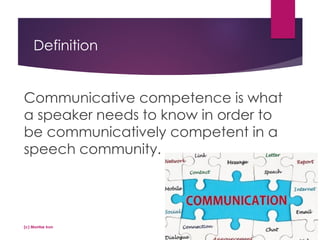
Communicative competence is what
a speaker needs to know in order to
be communicatively competent in a
speech community.
(c) Montse Irun
Communicative
competence
(c) Montse Irun
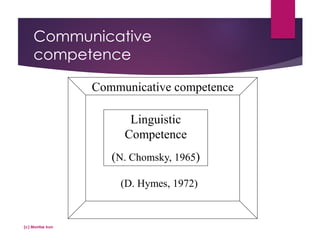
Linguistic
Competence
(N. Chomsky, 1965)
Communicative competence
(D. Hymes, 1972)
Components of the
communicative competence
(c) Montse Irun
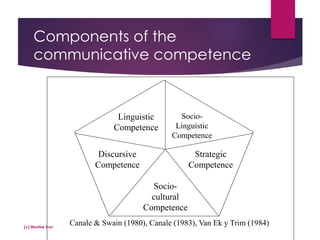
Linguistic
Competence
Socio-
Linguistic
Competence
Discursive
Competence
Strategic
Competence
Socio-
cultural
Competence
Canale & Swain (1980), Canale (1983), Van Ek y Trim (1984)
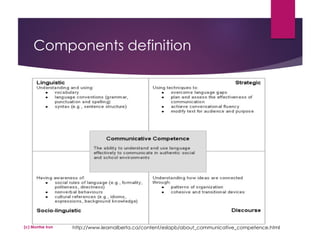
Components definition
(c) Montse Irun http://www.learnalberta.ca/content/eslapb/about_communicative_competence.html
Communication
(c) Montse Irun
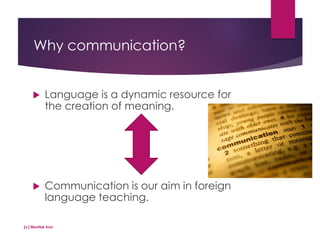
Why communication?
 Language is a dynamic resource for
the creation of meaning.
 Communication is our aim in foreign
language teaching.
(c) Montse Irun
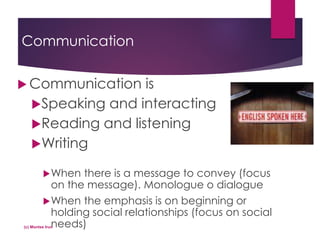
Communication
 Communication is
Speaking and interacting
Reading and listening
Writing
When there is a message to convey (focus
on the message). Monologue o dialogue
When the emphasis is on beginning or
holding social relationships (focus on social
needs)(c) Montse Irun
(c) Montse Irun
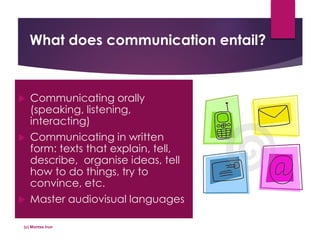
What does communication entail?
 Communicating orally
(speaking, listening,
interacting)
 Communicating in written
form: texts that explain, tell,
describe, organise ideas, tell
how to do things, try to
convince, etc.
 Master audiovisual languages
(c) Montse Irun
Communication
in the classroom
(c) Montse Irun
Overview
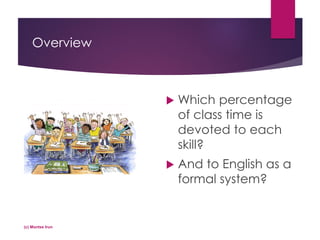
 Which percentage
of class time is
devoted to each
skill?
 And to English as a
formal system?
(c) Montse Irun
Overview
 “L’objectiu bàsic és la comunicació. Si el
que s’ha de saber sobre la llengua és en
profit de la comunicació, endevant.[ ..]. Jo
els hi dic que el que m’interessa és que
utilitzin la llengua, no que la coneguin. No
em serveix de res que em diguin que el
present continuous es fa amb un verb amb –
ing i precedit del to be.” (Teacher 3)
(Cots, Irun, Llurda, 2002)
(c) Montse Irun
Overview
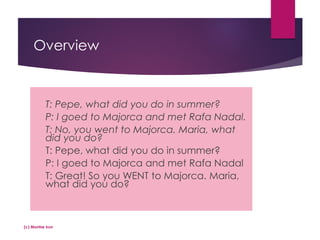
T: Pepe, what did you do in summer?
P: I goed to Majorca and met Rafa Nadal.
T: No, you went to Majorca. Maria, what
did you do?
T: Pepe, what did you do in summer?
P: I goed to Majorca and met Rafa Nadal
T: Great! So you WENT to Majorca. Maria,
what did you do?
(c) Montse Irun
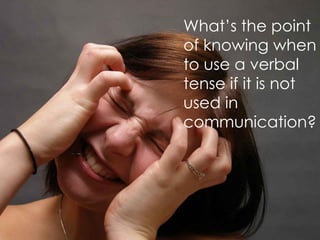
 There si no point in learning how to use the verbal
tenses if they don’t know how to use them
communicatively
What’s the point
of knowing when
to use a verbal
tense if it is not
used in
communication?
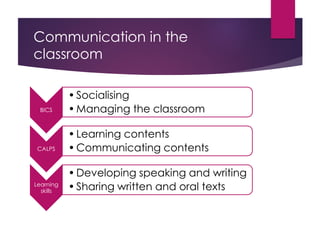
Communication in the
classroom
BICS
•Socialising
•Managing the classroom
CALPS
•Learning contents
•Communicating contents
Learning
skills
•Developing speaking and writing
•Sharing written and oral texts
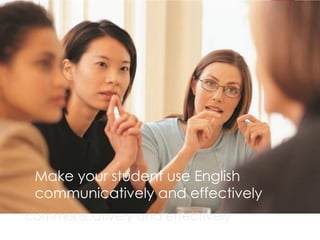
Make your students use English
communicatively and effectively
Make your student use English
communicatively and effectively
Three principles
 the communication principle:
Activities that involve
communication promote lg
learning.
 the task principle: Activities
that involve the completion of
real-world tasks promote
learning.
 the meaningfulness principle:
Learners must be engaged in
meaningful and authentic
language use for learning to
take place.
Influences
 The primary function of language is for
interaction and communication.
 Language is a system for the expression of
meaning.
 Authentic materials should be used.
 True communication is purposeful.
 Activities are better carried out in small
groups in which interaction among students
are maximized.
Characteristics of communicative
activities
 communicative purpose
 communicative desire
 content (what) not form
 variety of language
 no teacher intervention
 no materials control
(Rod Ellis)
(c) Montse Irun
The activities that truly
communicative have features
of information gap, choice,
and feedback; they must be
guided by the teacher for
unrehearsed situations.
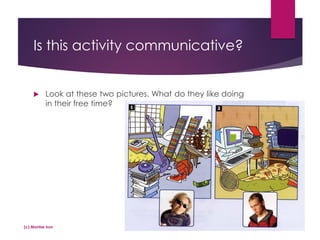
Is this activity communicative?
 Look at these two pictures. What do they like doing
in their free time?
(c) Montse Irun
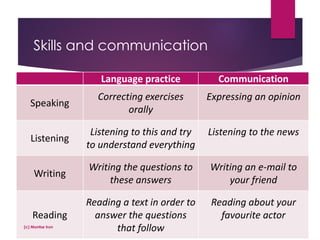
Skills and communication
Language practice Communication
Speaking
Correcting exercises
orally
Expressing an opinion
Listening
Listening to this and try
to understand everything
Listening to the news
Writing
Writing the questions to
these answers
Writing an e-mail to
your friend
Reading
Reading a text in order to
answer the questions
that follow
Reading about your
favourite actor
(c) Montse Irun
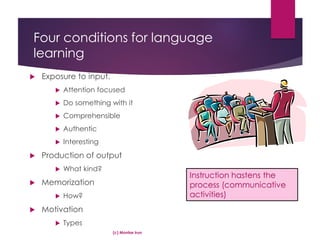
Four conditions for language
learning
 Exposure to input.
 Attention focused
 Do something with it
 Comprehensible
 Authentic
 Interesting
 Production of output
 What kind?
 Memorization
 How?
 Motivation
 Types
(c) Montse Irun
Instruction hastens the
process (communicative
activities)
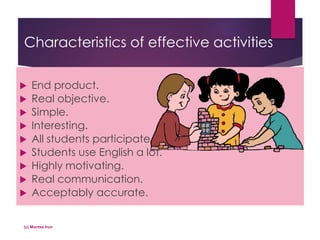
Characteristics of effective activities
 End product.
 Real objective.
 Simple.
 Interesting.
 All students participate.
 Students use English a lot.
 Highly motivating.
 Real communication.
 Acceptably accurate.
(c) Montse Irun
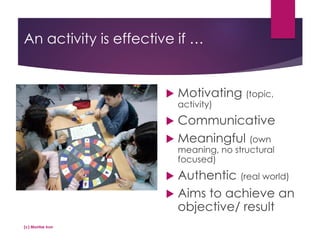
An activity is effective if …
 Motivating (topic,
activity)
 Communicative
 Meaningful (own
meaning, no structural
focused)
 Authentic (real world)
 Aims to achieve an
objective/ result
(c) Montse Irun
Implications in the class
 Use English for practical aims (tasks)
 Don’t avoid communicative obstacles.
 Solve problems through interaction.
 Make students responsible for the activity
management
(c) Montse Irun
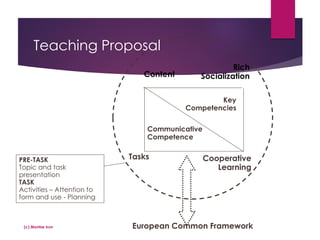
Key
Competencies
Content
Tasks Cooperative
Learning
European Common Framework
Communicative
Competence
PRE-TASK
Topic and task
presentation
TASK
Activities – Attention to
form and use - Planning
Rich
Socialization
Teaching Proposal
(c) Montse Irun
Task
 Meaning
 End Product
 Real world activity
 Assessment according to the result.
(c) Montse Irun
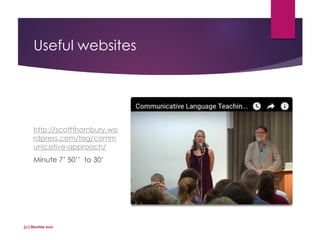
Useful websites
http://scottthornbury.wo
rdpress.com/tag/comm
unicative-approach/
Minute 7’ 50’’ to 30’
(c) Montse Irun
(c) Montse Irun

Communicative competence

  • 1.
  • 2.
    Index (c) Montse Irun Communicative competence  Definition  components  Communication  Communication in the classroom
  • 3.
  • 4.
    Definition Communicative competence iswhat a speaker needs to know in order to be communicatively competent in a speech community. (c) Montse Irun
  • 5.
    Communicative competence (c) Montse Irun Linguistic Competence (N.Chomsky, 1965) Communicative competence (D. Hymes, 1972)
  • 6.
    Components of the communicativecompetence (c) Montse Irun Linguistic Competence Socio- Linguistic Competence Discursive Competence Strategic Competence Socio- cultural Competence Canale & Swain (1980), Canale (1983), Van Ek y Trim (1984)
  • 7.
    Components definition (c) MontseIrun http://www.learnalberta.ca/content/eslapb/about_communicative_competence.html
  • 8.
  • 9.
    Why communication?  Languageis a dynamic resource for the creation of meaning.  Communication is our aim in foreign language teaching. (c) Montse Irun
  • 10.
    Communication  Communication is Speakingand interacting Reading and listening Writing When there is a message to convey (focus on the message). Monologue o dialogue When the emphasis is on beginning or holding social relationships (focus on social needs)(c) Montse Irun
  • 11.
    (c) Montse Irun Whatdoes communication entail?  Communicating orally (speaking, listening, interacting)  Communicating in written form: texts that explain, tell, describe, organise ideas, tell how to do things, try to convince, etc.  Master audiovisual languages
  • 12.
  • 13.
  • 14.
    Overview  Which percentage ofclass time is devoted to each skill?  And to English as a formal system? (c) Montse Irun
  • 15.
    Overview  “L’objectiu bàsicés la comunicació. Si el que s’ha de saber sobre la llengua és en profit de la comunicació, endevant.[ ..]. Jo els hi dic que el que m’interessa és que utilitzin la llengua, no que la coneguin. No em serveix de res que em diguin que el present continuous es fa amb un verb amb – ing i precedit del to be.” (Teacher 3) (Cots, Irun, Llurda, 2002) (c) Montse Irun
  • 16.
    Overview T: Pepe, whatdid you do in summer? P: I goed to Majorca and met Rafa Nadal. T: No, you went to Majorca. Maria, what did you do? T: Pepe, what did you do in summer? P: I goed to Majorca and met Rafa Nadal T: Great! So you WENT to Majorca. Maria, what did you do? (c) Montse Irun
  • 17.
     There sino point in learning how to use the verbal tenses if they don’t know how to use them communicatively What’s the point of knowing when to use a verbal tense if it is not used in communication?
  • 18.
    Communication in the classroom BICS •Socialising •Managingthe classroom CALPS •Learning contents •Communicating contents Learning skills •Developing speaking and writing •Sharing written and oral texts
  • 19.
    Make your studentsuse English communicatively and effectively Make your student use English communicatively and effectively
  • 20.
    Three principles  thecommunication principle: Activities that involve communication promote lg learning.  the task principle: Activities that involve the completion of real-world tasks promote learning.  the meaningfulness principle: Learners must be engaged in meaningful and authentic language use for learning to take place.
  • 21.
    Influences  The primaryfunction of language is for interaction and communication.  Language is a system for the expression of meaning.  Authentic materials should be used.  True communication is purposeful.  Activities are better carried out in small groups in which interaction among students are maximized.
  • 22.
    Characteristics of communicative activities communicative purpose  communicative desire  content (what) not form  variety of language  no teacher intervention  no materials control (Rod Ellis) (c) Montse Irun The activities that truly communicative have features of information gap, choice, and feedback; they must be guided by the teacher for unrehearsed situations.
  • 23.
    Is this activitycommunicative?  Look at these two pictures. What do they like doing in their free time? (c) Montse Irun
  • 24.
    Skills and communication Languagepractice Communication Speaking Correcting exercises orally Expressing an opinion Listening Listening to this and try to understand everything Listening to the news Writing Writing the questions to these answers Writing an e-mail to your friend Reading Reading a text in order to answer the questions that follow Reading about your favourite actor (c) Montse Irun
  • 25.
    Four conditions forlanguage learning  Exposure to input.  Attention focused  Do something with it  Comprehensible  Authentic  Interesting  Production of output  What kind?  Memorization  How?  Motivation  Types (c) Montse Irun Instruction hastens the process (communicative activities)
  • 26.
    Characteristics of effectiveactivities  End product.  Real objective.  Simple.  Interesting.  All students participate.  Students use English a lot.  Highly motivating.  Real communication.  Acceptably accurate. (c) Montse Irun
  • 27.
    An activity iseffective if …  Motivating (topic, activity)  Communicative  Meaningful (own meaning, no structural focused)  Authentic (real world)  Aims to achieve an objective/ result (c) Montse Irun
  • 28.
    Implications in theclass  Use English for practical aims (tasks)  Don’t avoid communicative obstacles.  Solve problems through interaction.  Make students responsible for the activity management (c) Montse Irun
  • 29.
    Key Competencies Content Tasks Cooperative Learning European CommonFramework Communicative Competence PRE-TASK Topic and task presentation TASK Activities – Attention to form and use - Planning Rich Socialization Teaching Proposal (c) Montse Irun
  • 30.
    Task  Meaning  EndProduct  Real world activity  Assessment according to the result. (c) Montse Irun
  • 31.
  • 32.