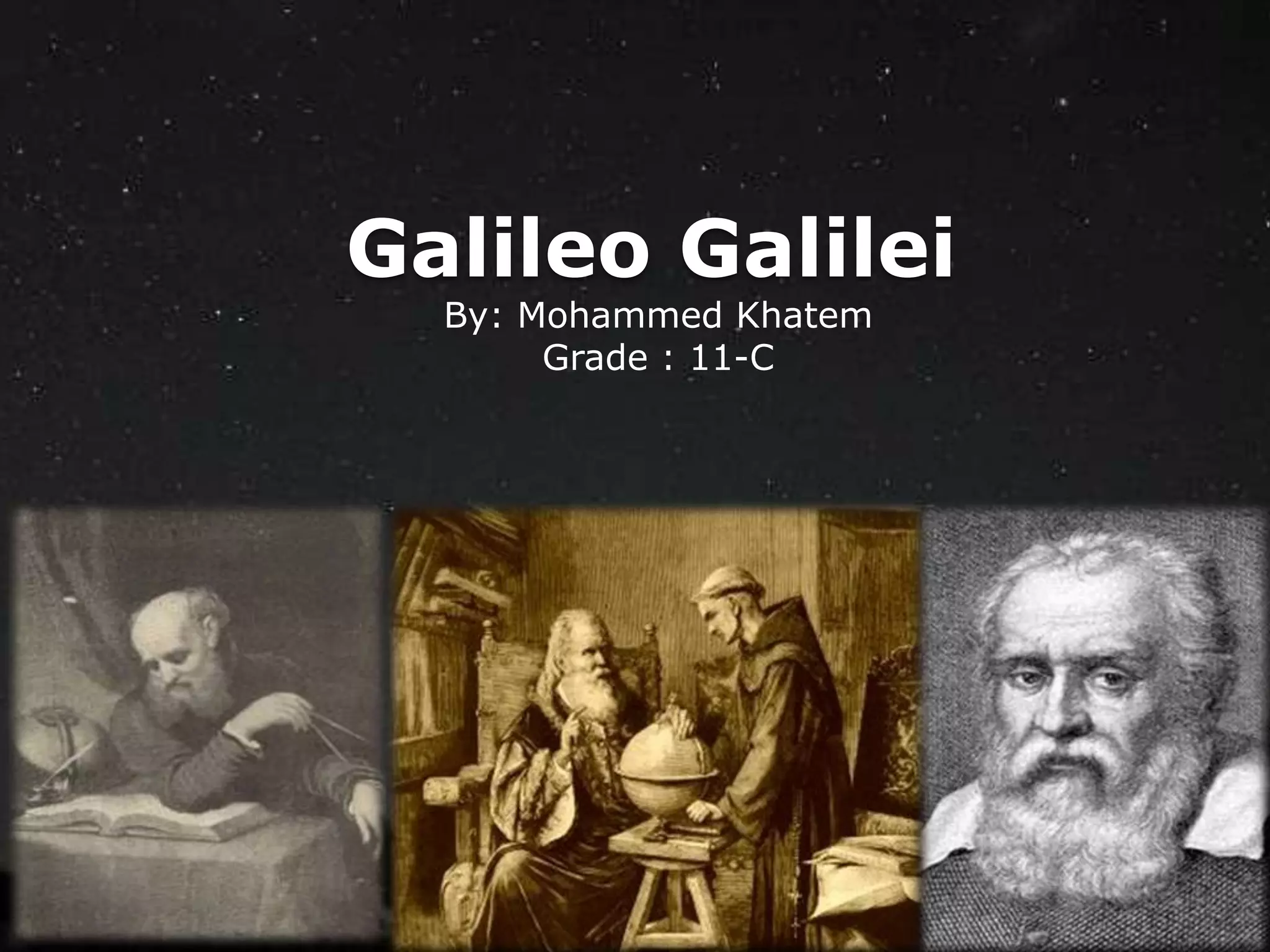
Galileo Galilei
By: Mohammed Khatem
Grade : 11-C
GENERAL OVERVIEW
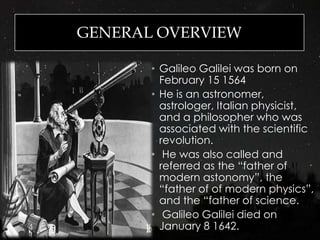
• Galileo Galilei was born on
February 15 1564
• He is an astronomer,
astrologer, Italian physicist,
and a philosopher who was
associated with the scientific
revolution.
• He was also called and
referred as the “father of
modern astonomy”, the
“father of of modern physics”,
and the “father of science.
• Galileo Galilei died on
January 8 1642.
EARLY CHILDHOOD
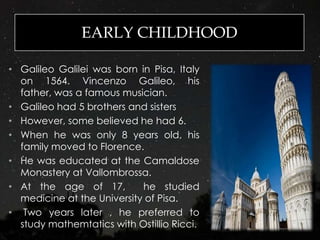
• Galileo Galilei was born in Pisa, Italy
on 1564. Vincenzo Galileo, his
father, was a famous musician.
• Galileo had 5 brothers and sisters
• However, some believed he had 6.
• When he was only 8 years old, his
family moved to Florence.
• He was educated at the Camaldose
Monastery at Vallombrossa.
• At the age of 17, he studied
medicine at the University of Pisa.
• Two years later , he preferred to
study mathemtatics with Ostillio Ricci.
LATER ON
Galileo grew up to be a great
astronomer and was given the chair
of mathematics. In 1610, he formed
his own telescope that was
capable to magnify 20x more than
regular telescopes. In fact, he
discovered 4 moons of Jupiter with
this magnificent telescope. Galileo
published several books throughout
his career. One of his most famous
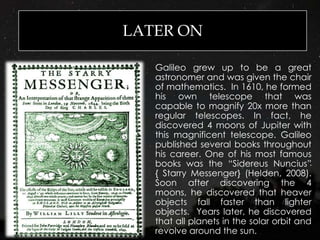
books was the “Sidereus Nuncius”
{ Starry Messenger} (Helden, 2008).
Soon after discovering the 4
moons, he discovered that heaver
objects fall faster than lighter
objects. Years later, he discovered
that all planets in the solar orbit and
revolve around the sun.
CHURCH CONTROVERSY
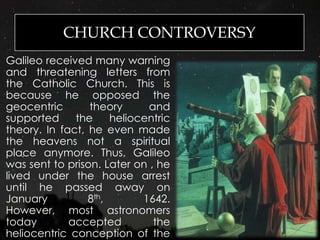
Galileo received many warning
and threatening letters from
the Catholic Church. This is
because he opposed the
geocentric theory and
supported the heliocentric
theory. In fact, he even made
the heavens not a spiritual
place anymore. Thus, Galileo
was sent to prison. Later on , he
lived under the house arrest
until he passed away on
January 8th, 1642.
However, most astronomers
today accepted the
heliocentric conception of the
THE TELESCOPE
Although Galileo was not the
first to invent the telescope, he
was the first to use it scientifically
to perceive and observe
heavenly objects and record his
findings and discoveries..
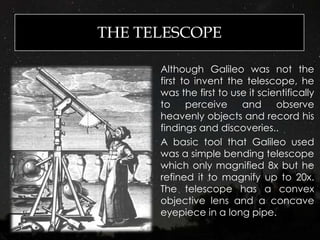
A basic tool that Galileo used
was a simple bending telescope
which only magnified 8x but he
refined it to magnify up to 20x.
The telescope has a convex
objective lens and a concave
eyepiece in a long pipe.
THE PENDULUM
When Galileo was studying at
the University of Pisa, he
began working and studying
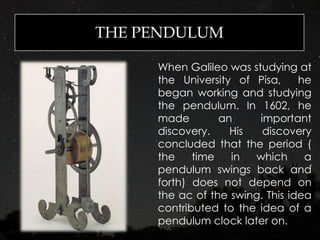
the pendulum. In 1602, he
made an important
discovery. His discovery
concluded that the period (
the time in which a
pendulum swings back and
forth) does not depend on
the ac of the swing. This idea
contributed to the idea of a
pendulum clock later on.
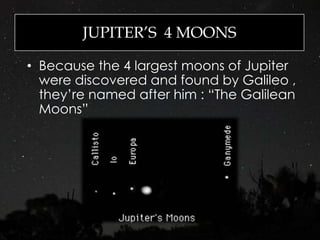
JUPITER’S 4 MOONS
• Because the 4 largest moons of Jupiter
were discovered and found by Galileo ,
they’re named after him : “The Galilean
Moons”
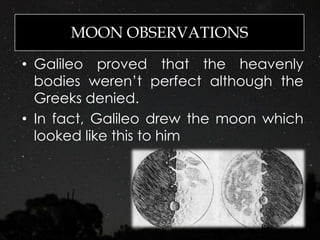
MOON OBSERVATIONS
• Galileo proved that the heavenly
bodies weren’t perfect although the
Greeks denied.
• In fact, Galileo drew the moon which
looked like this to him
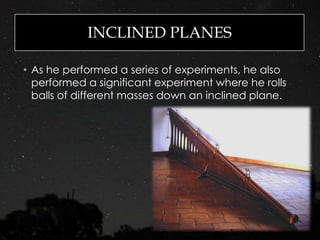
INCLINED PLANES
• As he performed a series of experiments, he also
performed a significant experiment where he rolls
balls of different masses down an inclined plane.
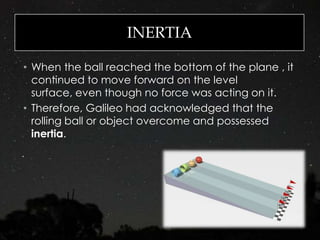
INERTIA
• When the ball reached the bottom of the plane , it
continued to move forward on the level
surface, even though no force was acting on it.
• Therefore, Galileo had acknowledged that the
rolling ball or object overcome and possessed
inertia.
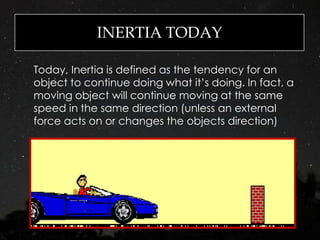
INERTIA TODAY
Today, Inertia is defined as the tendency for an
object to continue doing what it’s doing. In fact, a
moving object will continue moving at the same
speed in the same direction (unless an external
force acts on or changes the objects direction)
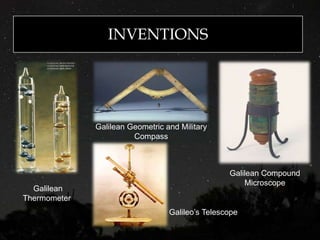
INVENTIONS
Galilean
Thermometer
Galilean Geometric and Military
Compass
Galilean Compound
Microscope
Galileo’s Telescope
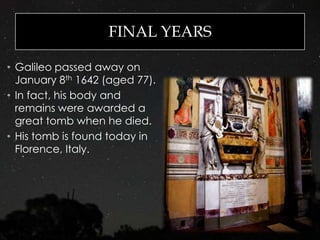
FINAL YEARS
• Galileo passed away on
January 8th 1642 (aged 77).
• In fact, his body and
remains were awarded a
great tomb when he died.
• His tomb is found today in
Florence, Italy.
BIBLIOGRAPHY
• Books:
Mario Biagioli. Galileo, Courtier: The Practice of Science in the Culture of
Absolutism. University of Chicago Press. 1994. 416pp.
Stillman Drake. Galileo at Work: His Scientific Biography. Dover. 2003. 560pp.
Van Helden, Al. The Galileo Project. 1995. 27 Nov. 2005.
• Websites:
"PE HTML PUBLIC "-//W3C//DTD HTML 4.01 Transitional//EN"
"http://www.w3.org/TR/html4/loose.dtd"Galileo Galilei: Experiments."
Lycos. 22 Feb. 2009 <http://www.lycos.com/info/galileo-galilei--
experiments.html>.

Galileo galilei

  • 1.
    Galileo Galilei By: MohammedKhatem Grade : 11-C
  • 2.
    GENERAL OVERVIEW • GalileoGalilei was born on February 15 1564 • He is an astronomer, astrologer, Italian physicist, and a philosopher who was associated with the scientific revolution. • He was also called and referred as the “father of modern astonomy”, the “father of of modern physics”, and the “father of science. • Galileo Galilei died on January 8 1642.
  • 3.
    EARLY CHILDHOOD • GalileoGalilei was born in Pisa, Italy on 1564. Vincenzo Galileo, his father, was a famous musician. • Galileo had 5 brothers and sisters • However, some believed he had 6. • When he was only 8 years old, his family moved to Florence. • He was educated at the Camaldose Monastery at Vallombrossa. • At the age of 17, he studied medicine at the University of Pisa. • Two years later , he preferred to study mathemtatics with Ostillio Ricci.
  • 4.
    LATER ON Galileo grewup to be a great astronomer and was given the chair of mathematics. In 1610, he formed his own telescope that was capable to magnify 20x more than regular telescopes. In fact, he discovered 4 moons of Jupiter with this magnificent telescope. Galileo published several books throughout his career. One of his most famous books was the “Sidereus Nuncius” { Starry Messenger} (Helden, 2008). Soon after discovering the 4 moons, he discovered that heaver objects fall faster than lighter objects. Years later, he discovered that all planets in the solar orbit and revolve around the sun.
  • 5.
    CHURCH CONTROVERSY Galileo receivedmany warning and threatening letters from the Catholic Church. This is because he opposed the geocentric theory and supported the heliocentric theory. In fact, he even made the heavens not a spiritual place anymore. Thus, Galileo was sent to prison. Later on , he lived under the house arrest until he passed away on January 8th, 1642. However, most astronomers today accepted the heliocentric conception of the
  • 6.
    THE TELESCOPE Although Galileowas not the first to invent the telescope, he was the first to use it scientifically to perceive and observe heavenly objects and record his findings and discoveries.. A basic tool that Galileo used was a simple bending telescope which only magnified 8x but he refined it to magnify up to 20x. The telescope has a convex objective lens and a concave eyepiece in a long pipe.
  • 7.
    THE PENDULUM When Galileowas studying at the University of Pisa, he began working and studying the pendulum. In 1602, he made an important discovery. His discovery concluded that the period ( the time in which a pendulum swings back and forth) does not depend on the ac of the swing. This idea contributed to the idea of a pendulum clock later on.
  • 8.
    JUPITER’S 4 MOONS •Because the 4 largest moons of Jupiter were discovered and found by Galileo , they’re named after him : “The Galilean Moons”
  • 9.
    MOON OBSERVATIONS • Galileoproved that the heavenly bodies weren’t perfect although the Greeks denied. • In fact, Galileo drew the moon which looked like this to him
  • 10.
    INCLINED PLANES • Ashe performed a series of experiments, he also performed a significant experiment where he rolls balls of different masses down an inclined plane.
  • 11.
    INERTIA • When theball reached the bottom of the plane , it continued to move forward on the level surface, even though no force was acting on it. • Therefore, Galileo had acknowledged that the rolling ball or object overcome and possessed inertia.
  • 12.
    INERTIA TODAY Today, Inertiais defined as the tendency for an object to continue doing what it’s doing. In fact, a moving object will continue moving at the same speed in the same direction (unless an external force acts on or changes the objects direction)
  • 13.
    INVENTIONS Galilean Thermometer Galilean Geometric andMilitary Compass Galilean Compound Microscope Galileo’s Telescope
  • 14.
    FINAL YEARS • Galileopassed away on January 8th 1642 (aged 77). • In fact, his body and remains were awarded a great tomb when he died. • His tomb is found today in Florence, Italy.
  • 15.
    BIBLIOGRAPHY • Books: Mario Biagioli.Galileo, Courtier: The Practice of Science in the Culture of Absolutism. University of Chicago Press. 1994. 416pp. Stillman Drake. Galileo at Work: His Scientific Biography. Dover. 2003. 560pp. Van Helden, Al. The Galileo Project. 1995. 27 Nov. 2005. • Websites: "PE HTML PUBLIC "-//W3C//DTD HTML 4.01 Transitional//EN" "http://www.w3.org/TR/html4/loose.dtd"Galileo Galilei: Experiments." Lycos. 22 Feb. 2009 <http://www.lycos.com/info/galileo-galilei-- experiments.html>.