Society of Petroleum Engineers
Distinguished Lecturer Program
www.spe.org/dl
Mack Shippen
The Science and Economics of
Multiphase Flow
Outline
– Introduction
– The Science of Multiphase Flow
– The Economics of Multiphase Flow
– Concluding Remarks
3 3
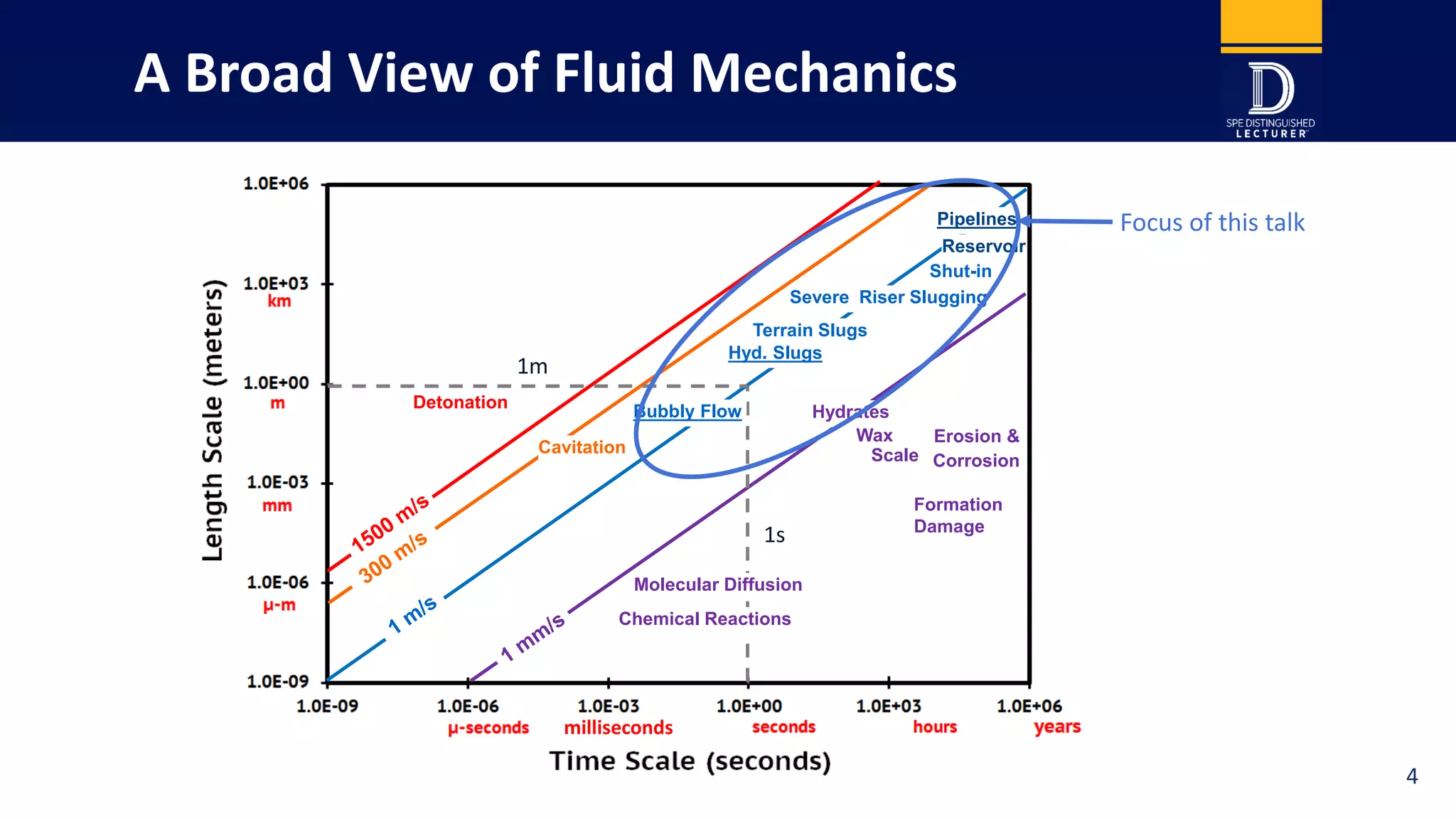
A Broad View of Fluid Mechanics
milliseconds
1m
1s
Detonation
Reservoir
Pipelines
Terrain Slugs
Molecular Diffusion
Chemical Reactions
Cavitation
Severe Riser Slugging
Hyd. Slugs
Bubbly Flow
Formation
Damage
Wax
Corrosion
Hydrates
Scale
Erosion &
Shut-in
4
Focus of this talk
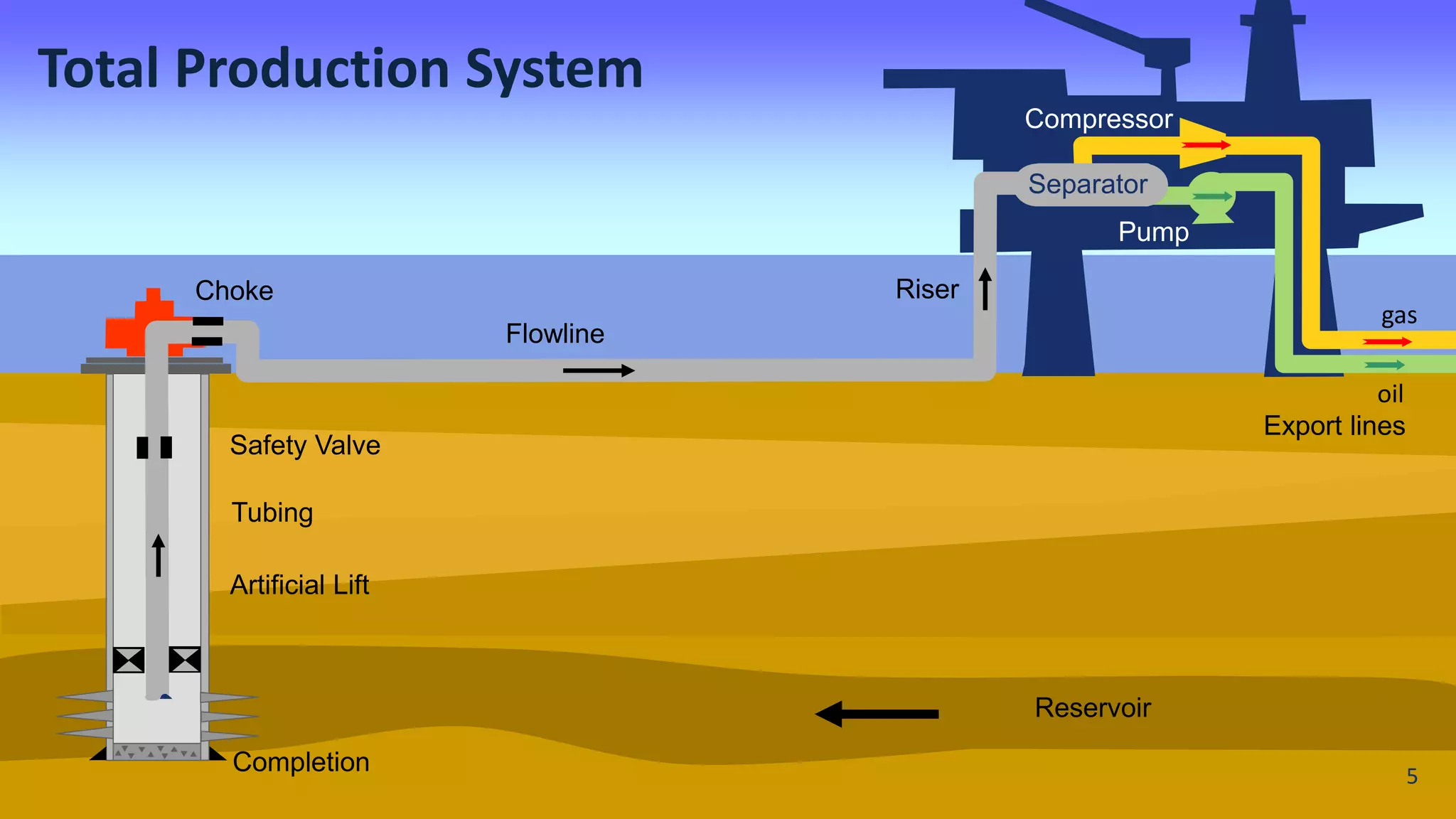
Total Production System
Completion
Choke
Safety Valve
Tubing
Flowline
Pump
Compressor
Separator
Export lines
Riser
Reservoir
gas
oil
Artificial Lift
5
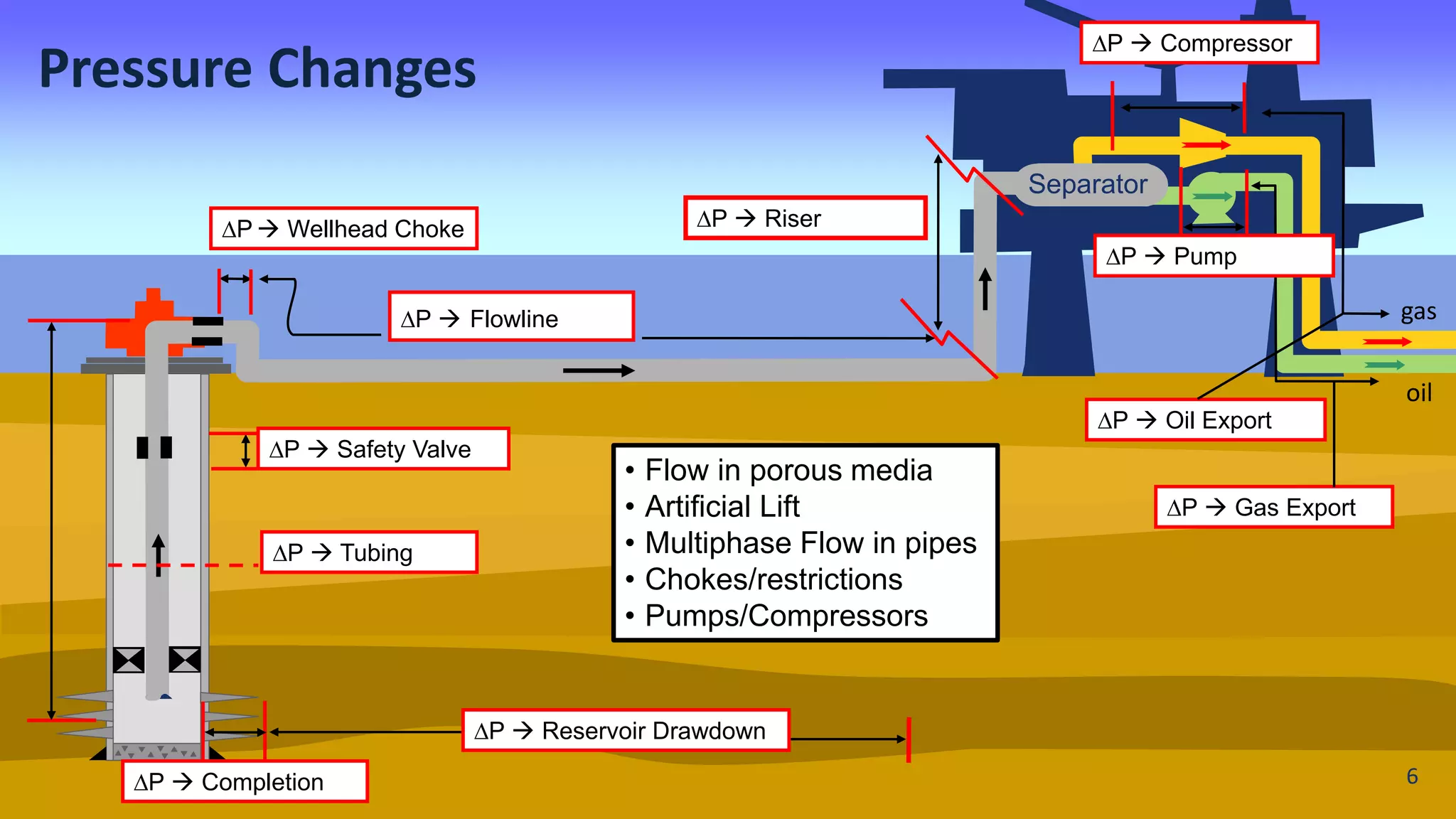
Pressure Changes
Separator
gas
oil
DP  Safety Valve
DP  Reservoir Drawdown
DP  Completion
DP  Wellhead Choke
DP  Flowline
DP  Compressor
DP  Oil Export
DP  Gas Export
DP  Tubing
DP  Riser
DP  Pump
• Flow in porous media
• Artificial Lift
• Multiphase Flow in pipes
• Chokes/restrictions
• Pumps/Compressors
6
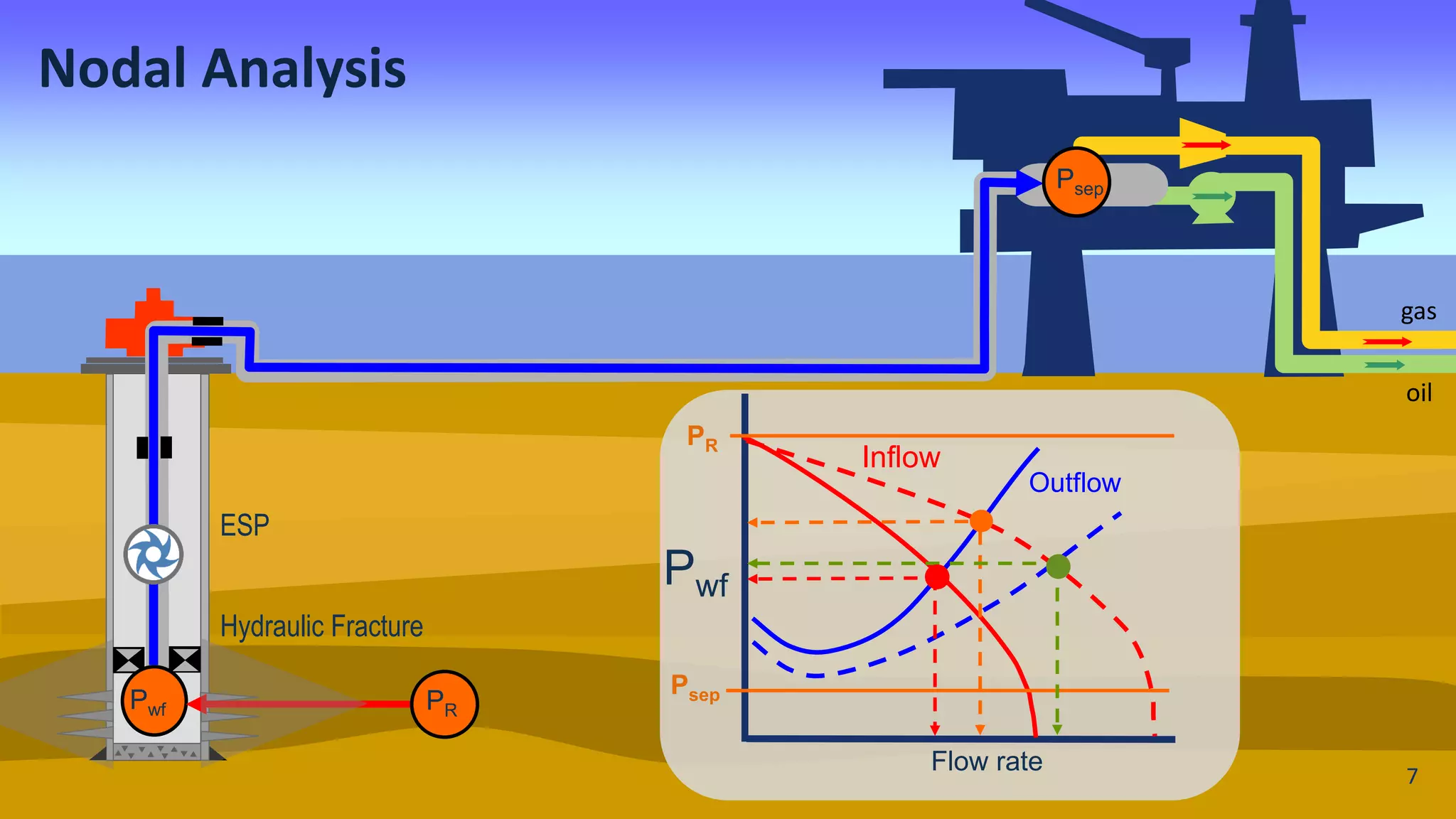
Nodal Analysis
gas
oil
Pwf
Pwf
Flow rate
Outflow
Inflow
PR
PR
Psep
Psep
Hydraulic Fracture
ESP
7
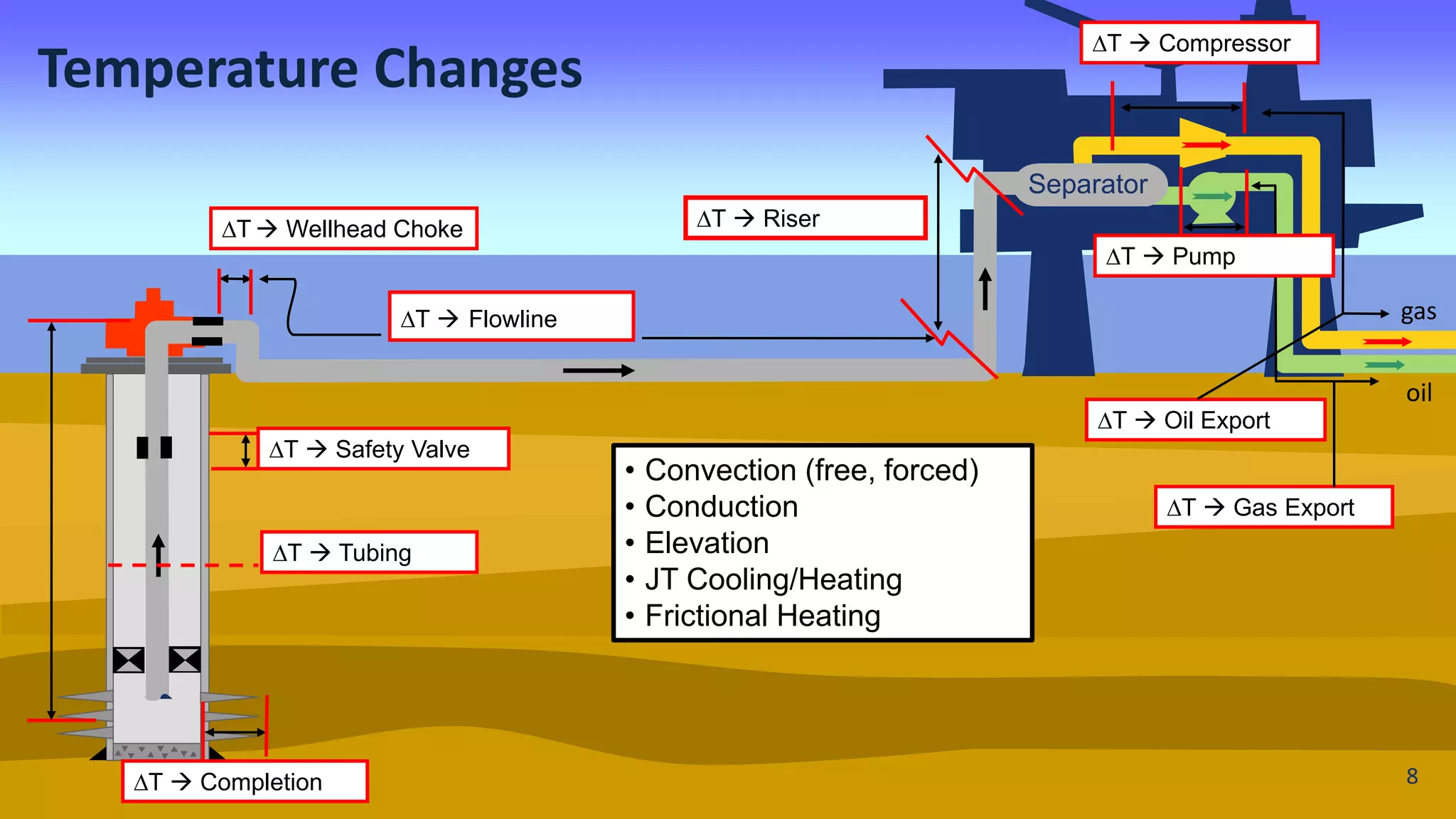
Temperature Changes
Separator
gas
oil
DT  Safety Valve
DT  Completion
DT  Wellhead Choke
DT  Flowline
DT  Compressor
DT  Oil Export
DT  Gas Export
DT  Tubing
DT  Riser
DT  Pump
• Convection (free, forced)
• Conduction
• Elevation
• JT Cooling/Heating
• Frictional Heating
8
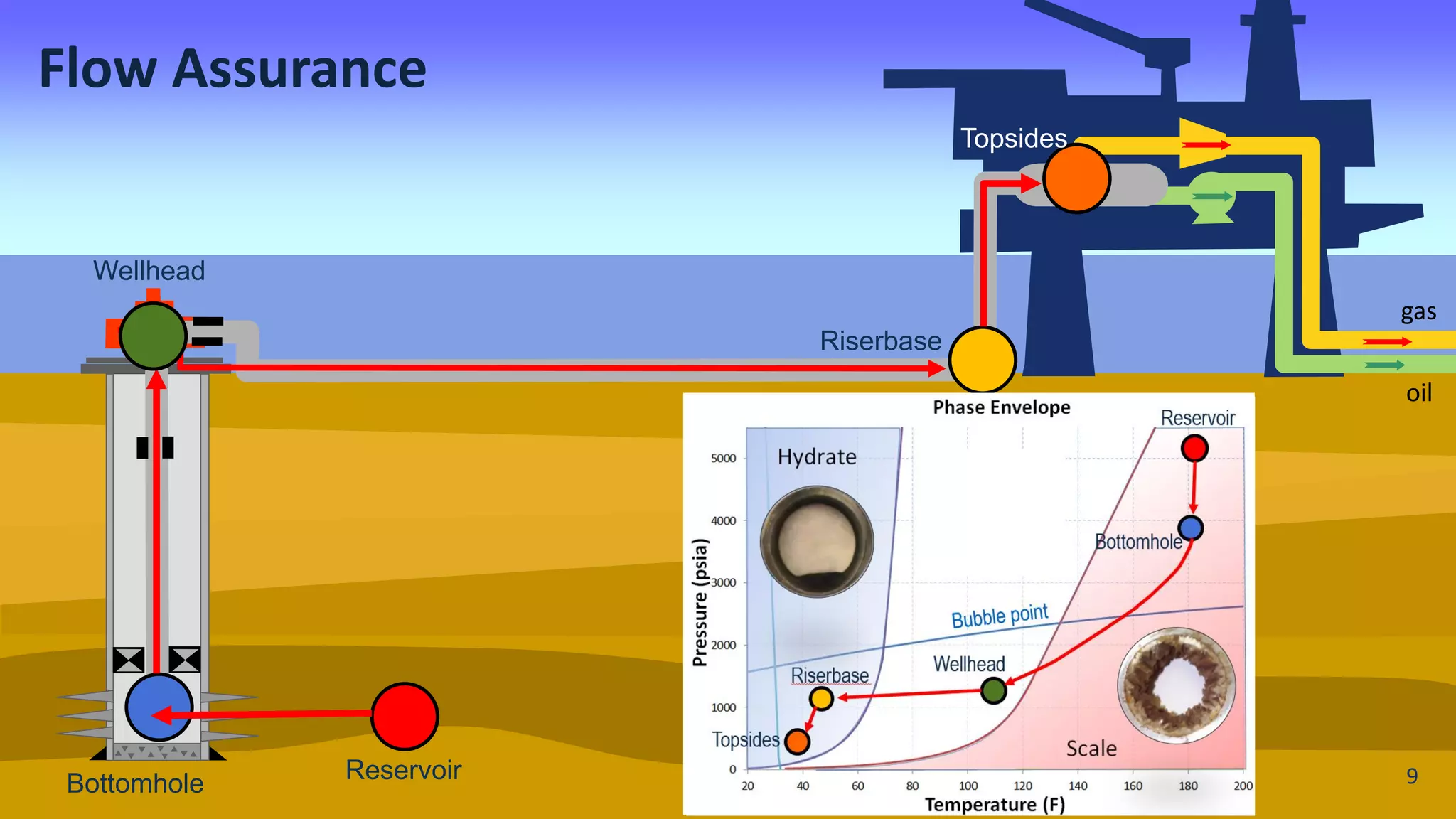
Flow Assurance
gas
oil
ReservoirBottomhole
Topsides
Riserbase
Reservoir
Bottomhole
Wellhead
Riserbase
Topsides
Wellhead
8
9
Outline
– Introduction
– The Science of Multiphase Flow
– The Economics of Multiphase Flow
– Concluding Remarks
3 10
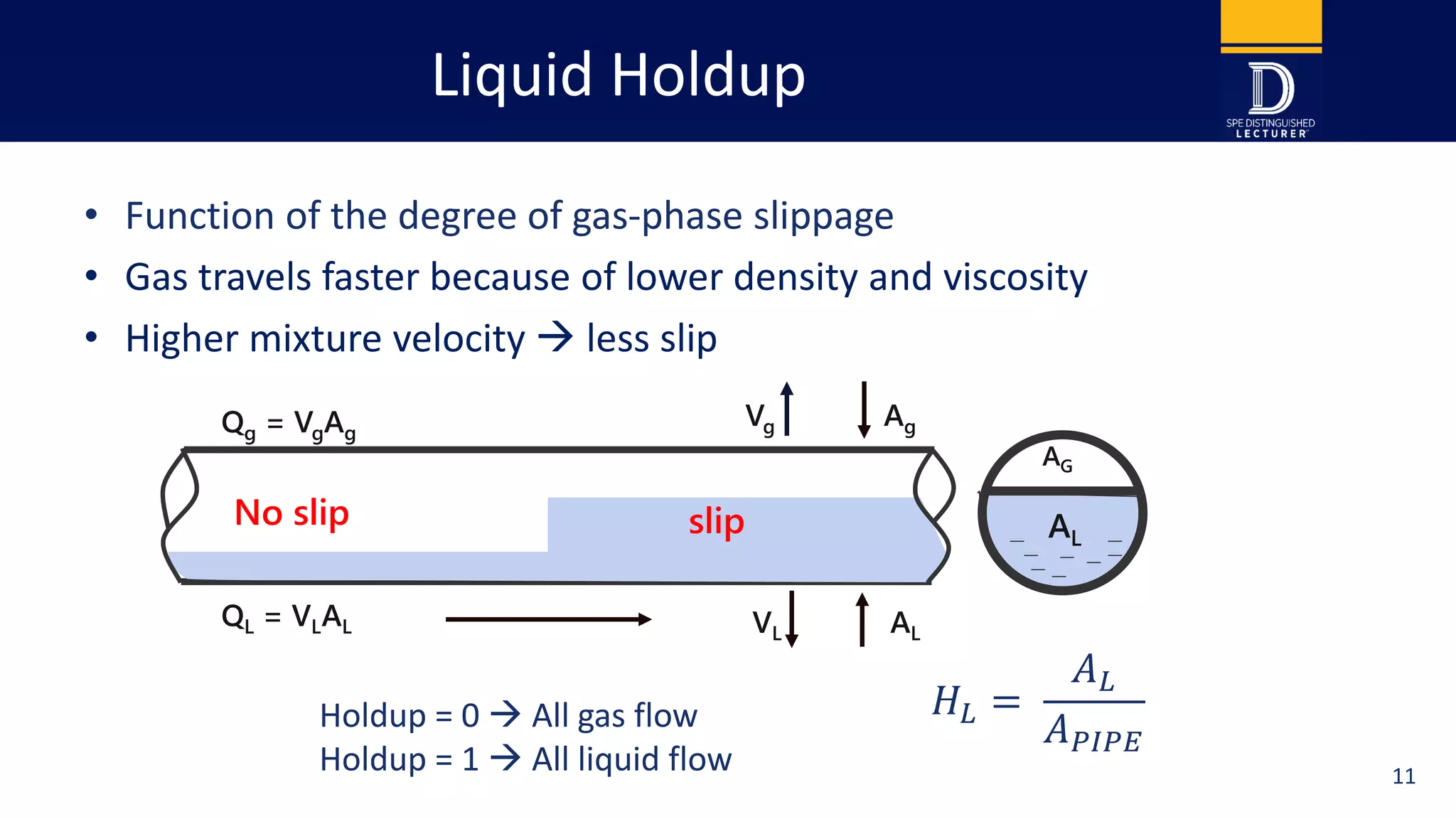
Liquid Holdup
• Function of the degree of gas-phase slippage
• Gas travels faster because of lower density and viscosity
• Higher mixture velocity  less slip
3
Qg = VgAg
QL = VLAL
Vg Ag
VL AL
AL
AG
No slip slip
Holdup = 0  All gas flow
Holdup = 1  All liquid flow
𝐻𝐿 =
𝐴 𝐿
𝐴 𝑃𝐼𝑃𝐸
11
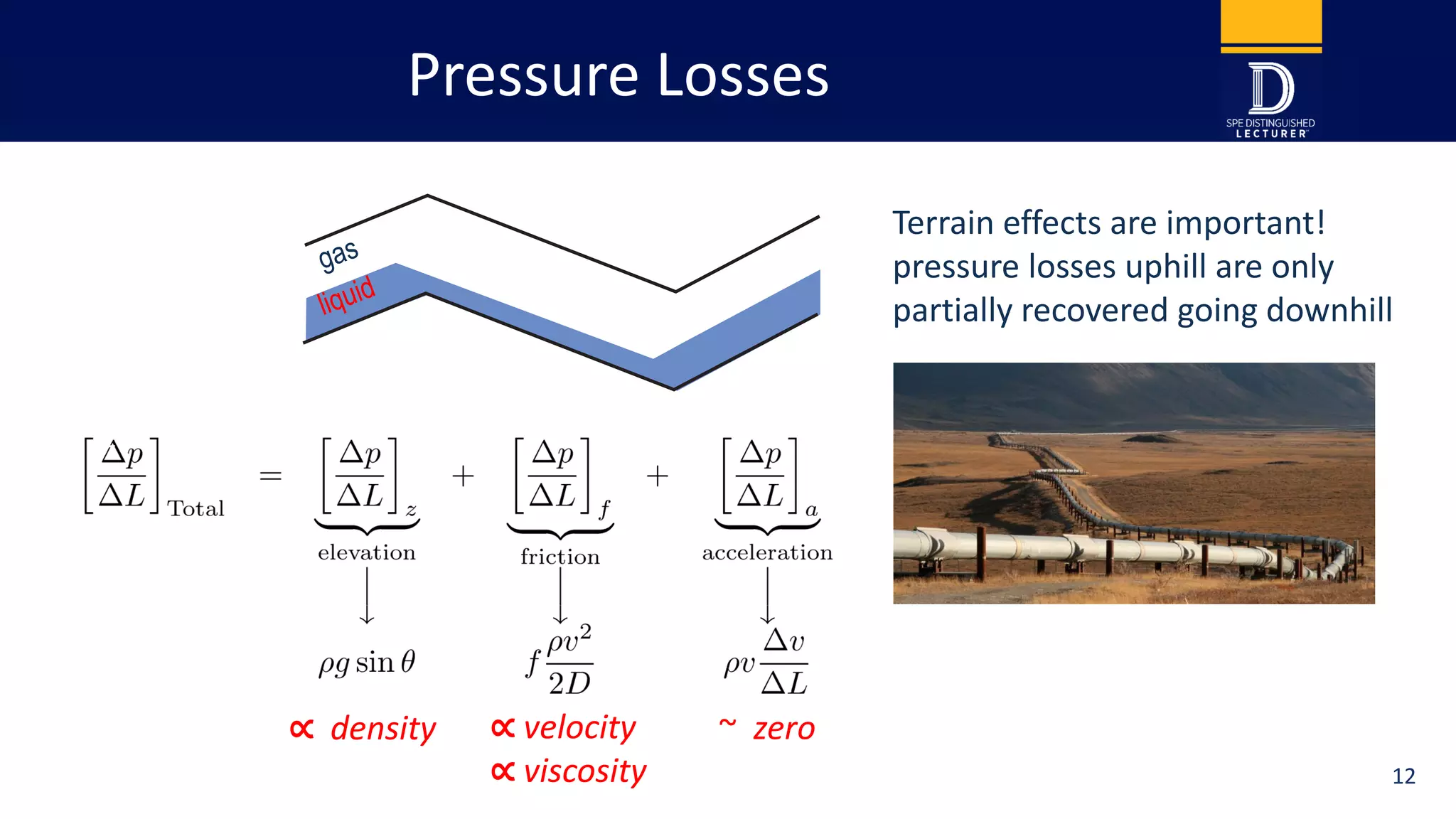
Pressure Losses
Terrain effects are important!
pressure losses uphill are only
partially recovered going downhill
12
∝ velocity
∝ viscosity
~ zero∝ density
12
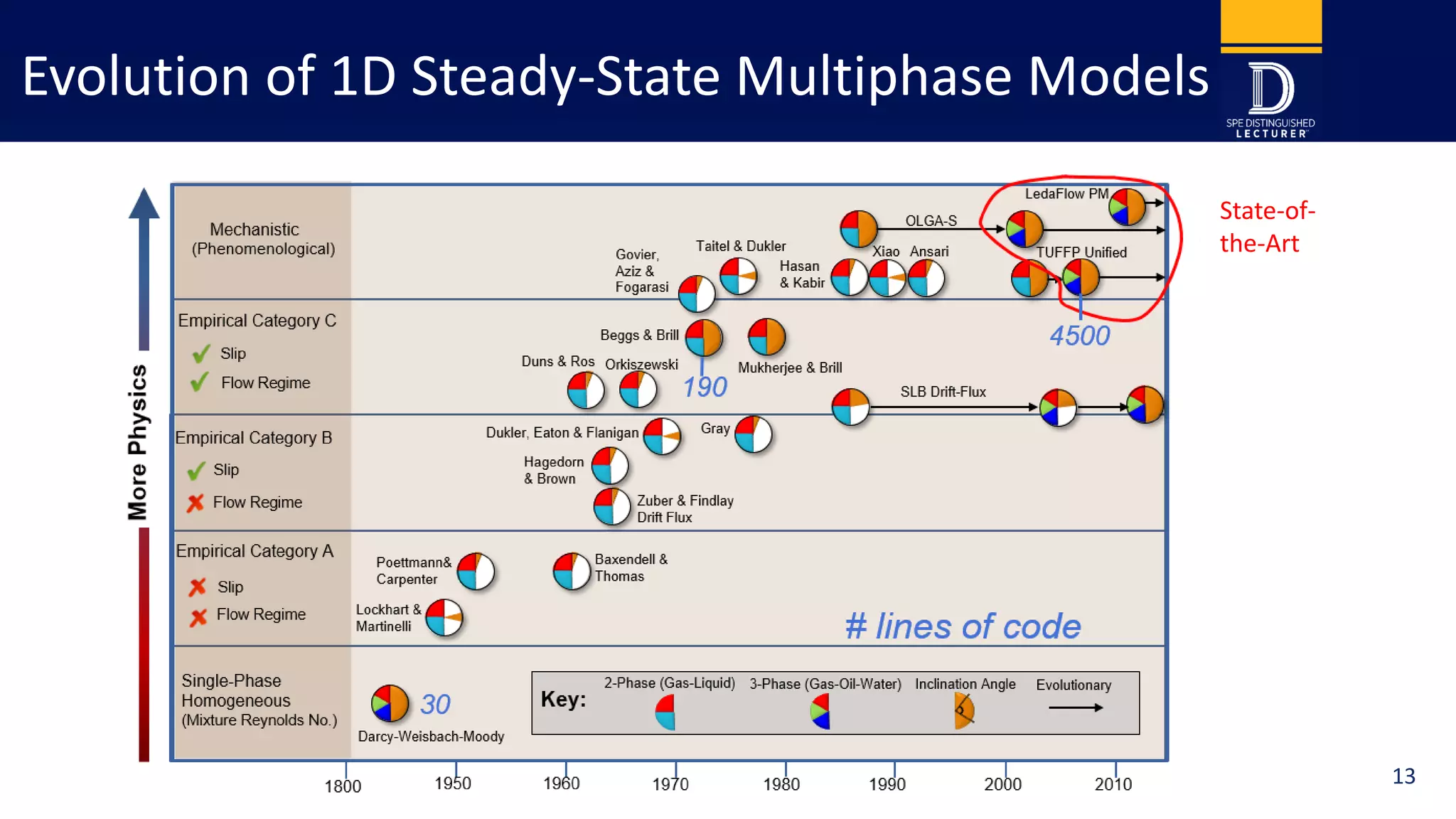
Evolution of 1D Steady-State Multiphase Models
MorePhysics
2000 2010199019801970196019501800
Single-Phase
Homogeneous
(Mixture Reynolds No.)
Darcy-Weisbach-Moody
Flow Regime
Slip
Zuber & Findlay
Drift Flux
Hagedorn
& Brown
Dukler, Eaton & Flanigan Gray
Empirical Category B
2-Phase (Gas-Liquid) 3-Phase (Gas-Oil-Water) Inclination Angle Evolutionary
Key:
Flow Regime
Slip
Lockhart &
Martinelli
Poettmann&
Carpenter
Empirical Category A Baxendell &
Thomas
Empirical Category C
Flow Regime
Slip
Mukherjee & BrillDuns & Ros
Beggs & Brill
SLB Drift-Flux
Orkiszewski
Mechanistic
(Phenomenological) AnsariGovier,
Aziz &
Fogarasi
Taitel & Dukler Xiao TUFFP Unified
Hasan
& Kabir
OLGA-S
LedaFlow PM
4500
30
190
# lines of code
13
State of th
State-of-
the-Art
3-Phase Mechanistic Flow Models
3
BHR 2007-A2
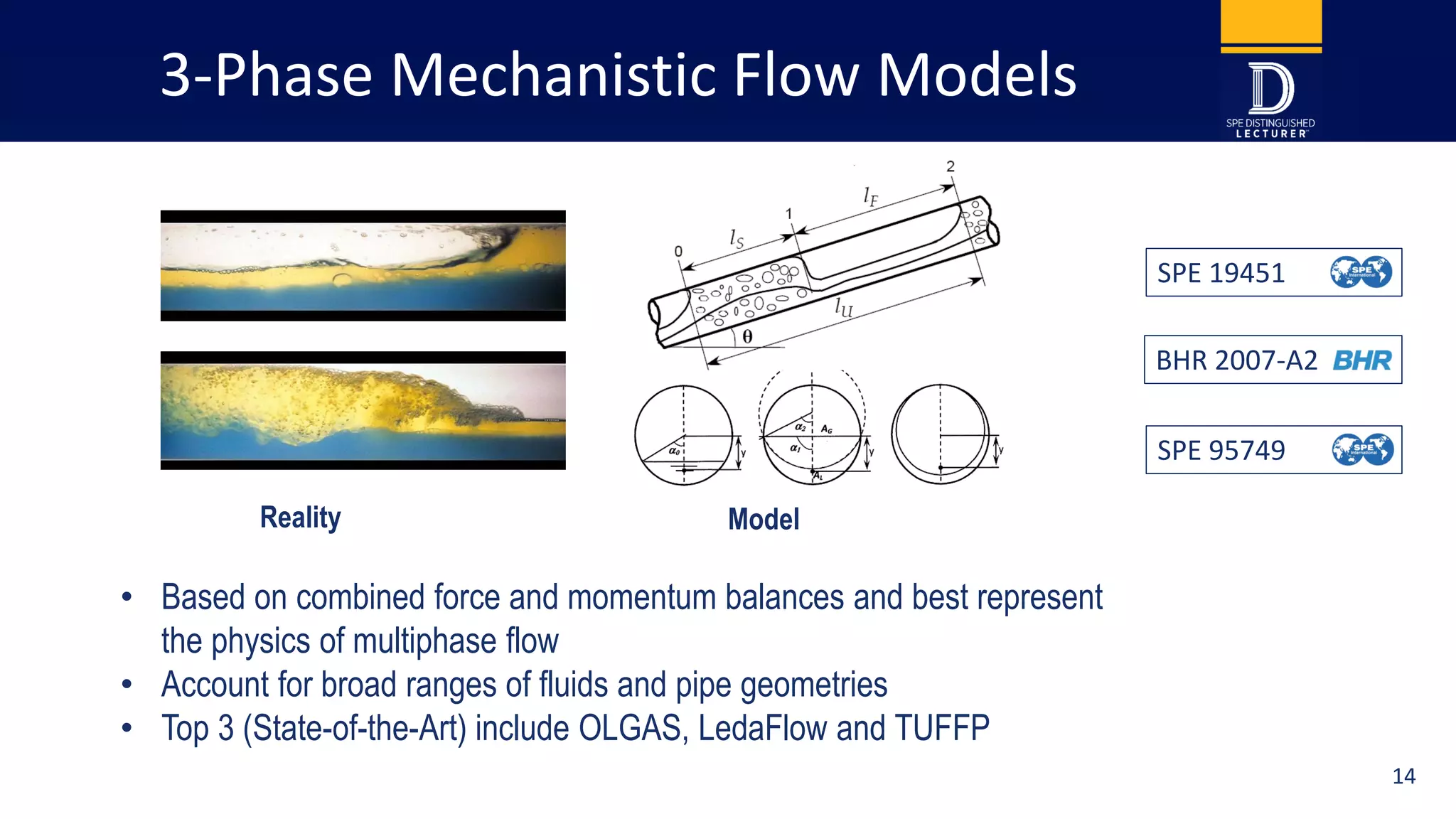
• Based on combined force and momentum balances and best represent
the physics of multiphase flow
• Account for broad ranges of fluids and pipe geometries
• Top 3 (State-of-the-Art) include OLGAS, LedaFlow and TUFFP
Reality Model
SPE 19451
SPE 95749
14
Oil-Water Flow
6-inch pipe
1500 BOPD
1500 BWPD
1.5 cp oil
2º up
2º down
0º
15
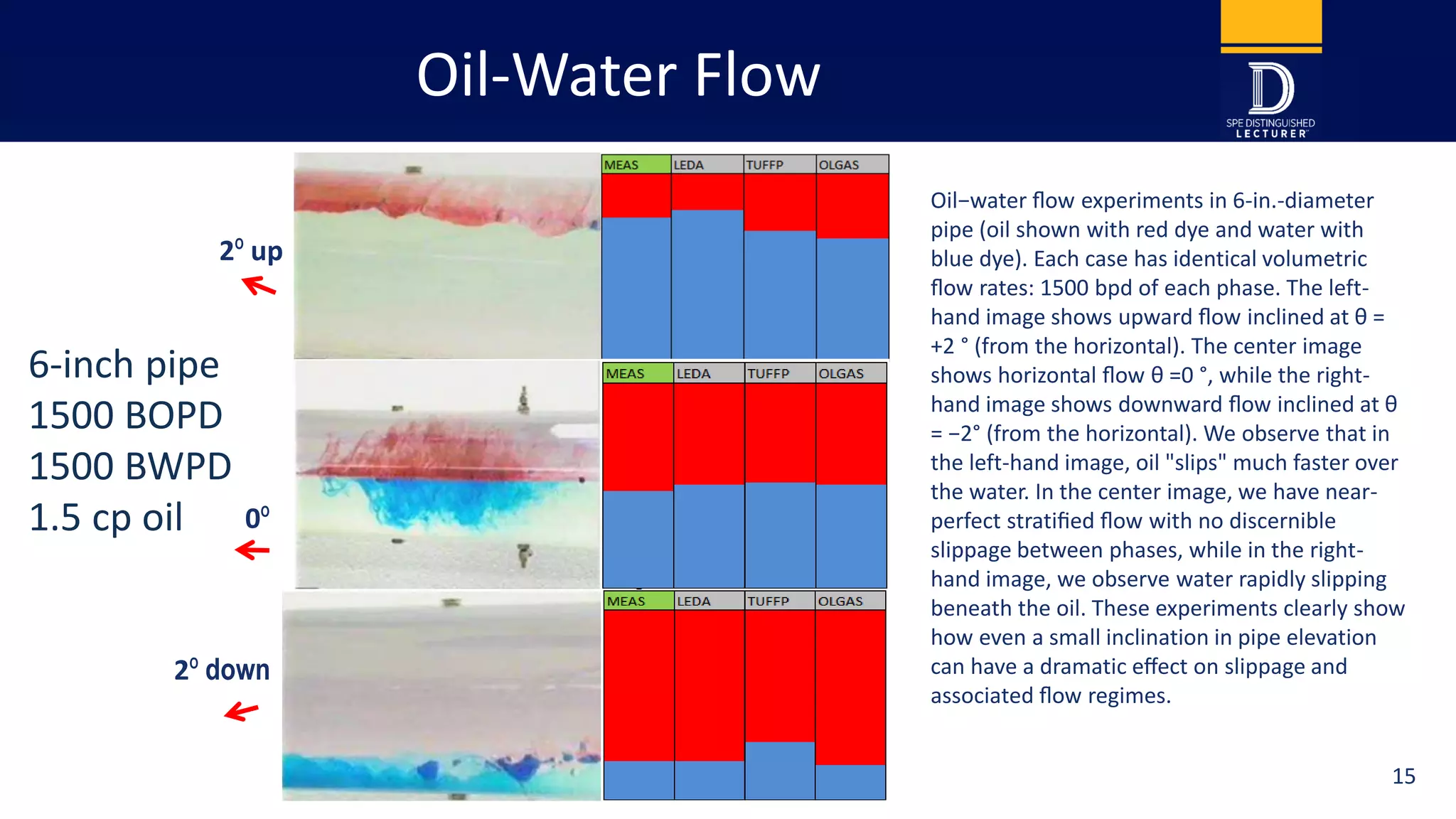
Oil−water flow experiments in 6-in.-diameter
pipe (oil shown with red dye and water with
blue dye). Each case has identical volumetric
flow rates: 1500 bpd of each phase. The left-
hand image shows upward flow inclined at θ =
+2 ° (from the horizontal). The center image
shows horizontal flow θ =0 °, while the right-
hand image shows downward flow inclined at θ
= −2° (from the horizontal). We observe that in
the left-hand image, oil "slips" much faster over
the water. In the center image, we have near-
perfect stratified flow with no discernible
slippage between phases, while in the right-
hand image, we observe water rapidly slipping
beneath the oil. These experiments clearly show
how even a small inclination in pipe elevation
can have a dramatic effect on slippage and
associated flow regimes.
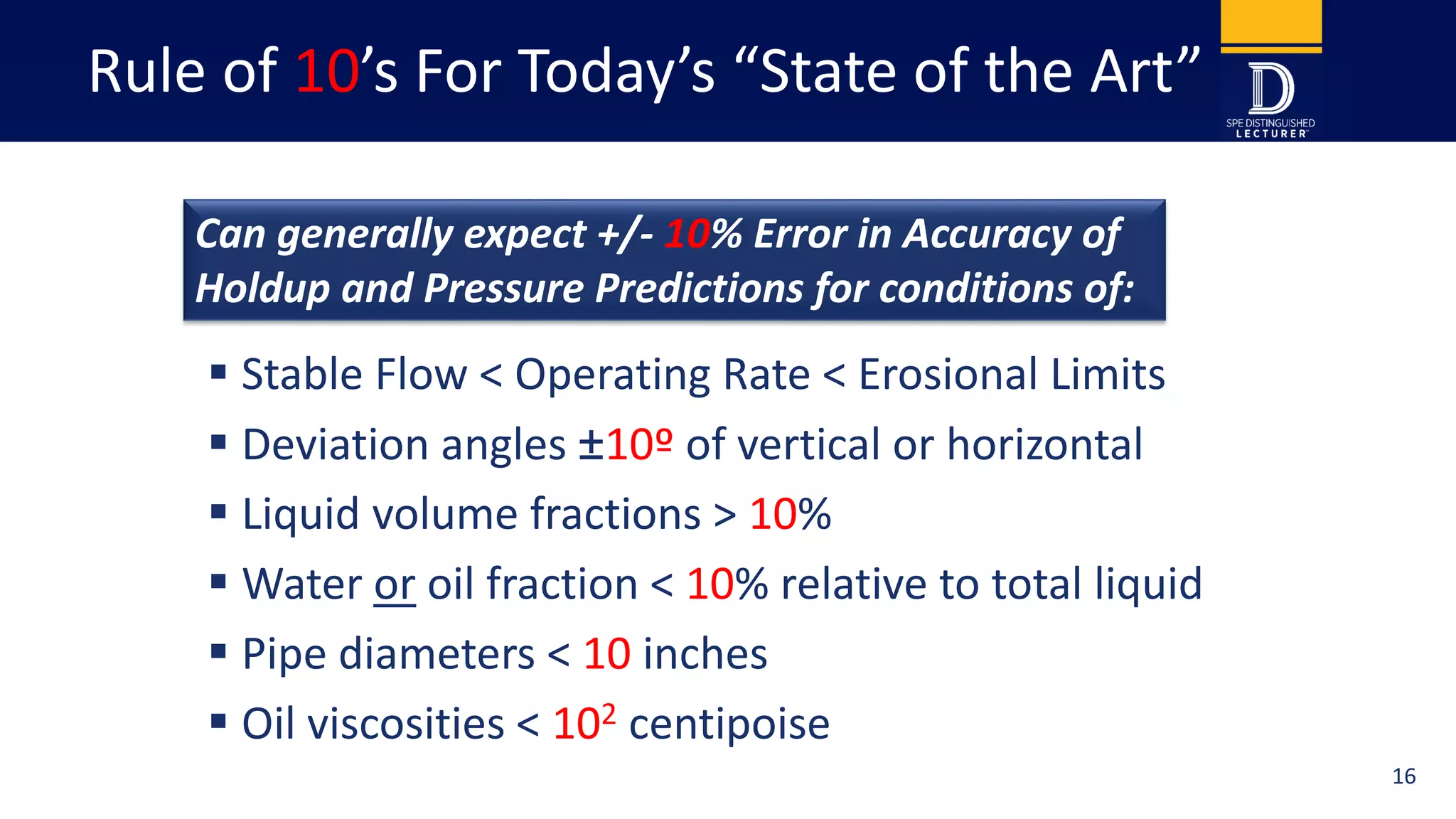
Rule of 10’s For Today’s “State of the Art”
 Stable Flow < Operating Rate < Erosional Limits
 Deviation angles ±10º of vertical or horizontal
 Liquid volume fractions > 10%
 Water or oil fraction < 10% relative to total liquid
 Pipe diameters < 10 inches
 Oil viscosities < 102 centipoise
3
Can generally expect +/- 10% Error in Accuracy of
Holdup and Pressure Predictions for conditions of:
16
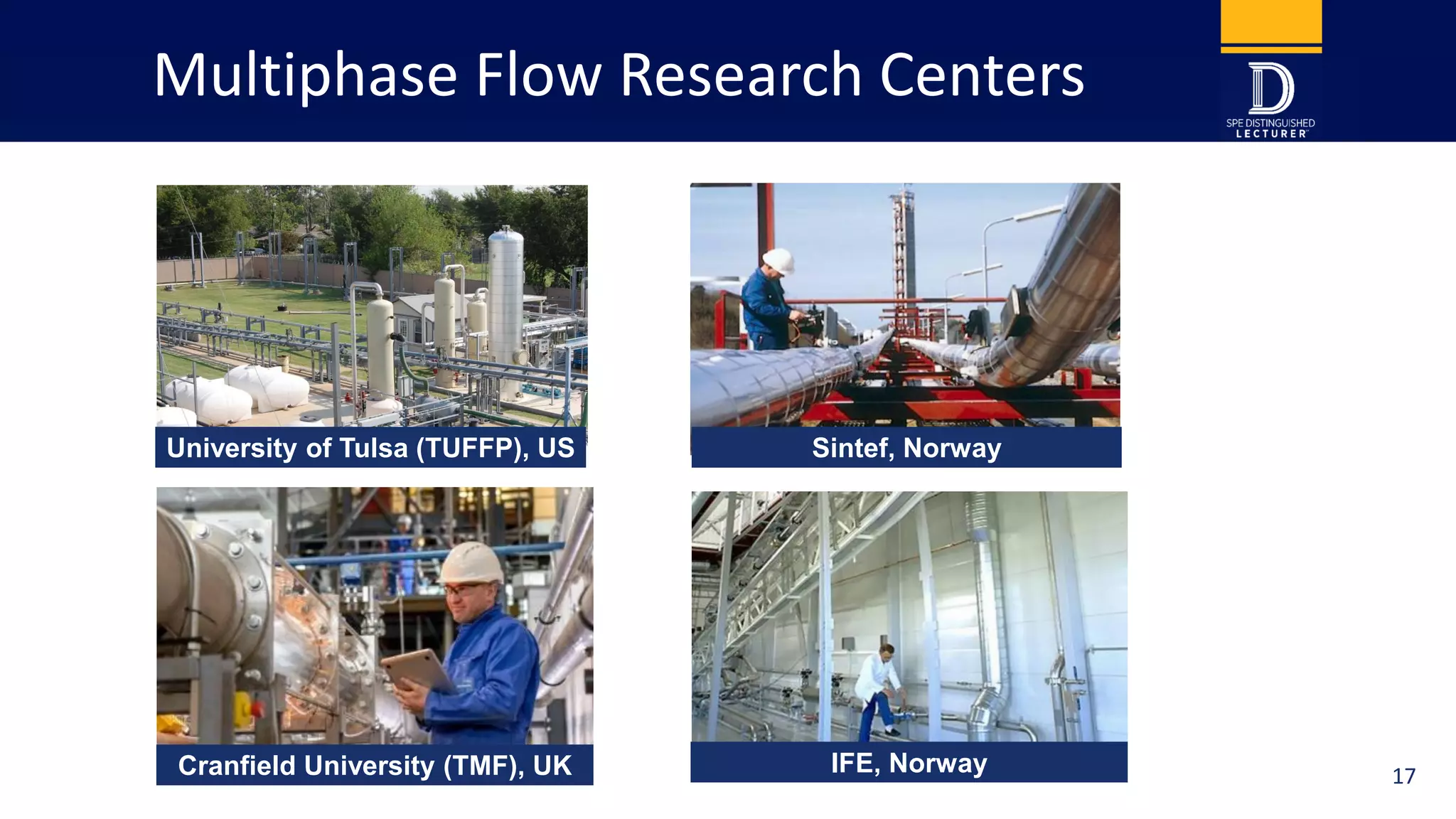
Multiphase Flow Research Centers
IFE, Norway
Sintef, Norway
Cranfield University (TMF), UK
University of Tulsa (TUFFP), US
17
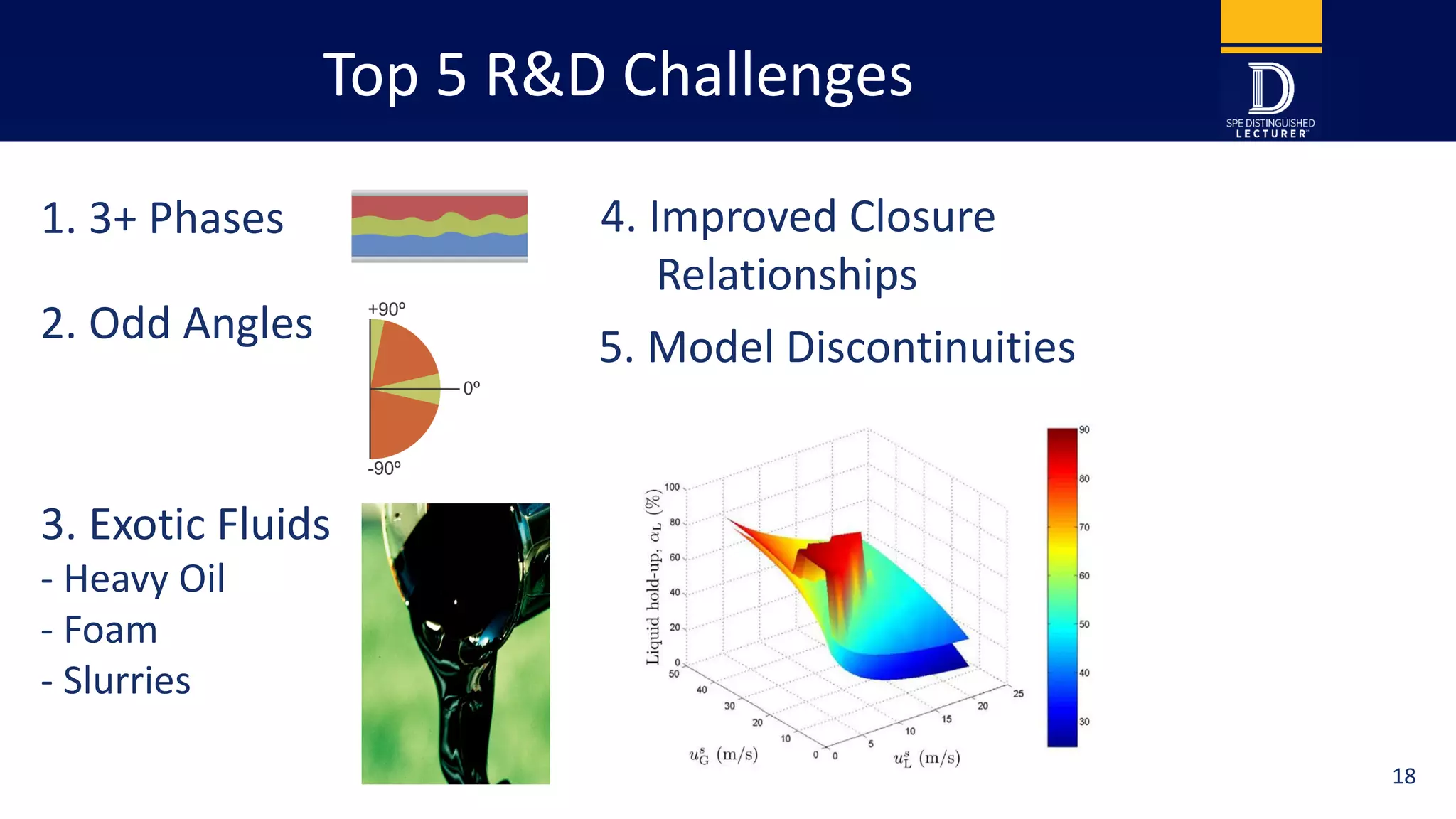
Top 5 R&D Challenges
3. Exotic Fluids
- Heavy Oil
- Foam
- Slurries
5. Model Discontinuities
4. Improved Closure
vv Relationships
2. Odd Angles
1. 3+ Phases
18
Outline
– Introduction
– The Science of Multiphase Flow
– The Economics of Multiphase Flow
– Concluding Remarks
3 19
Economics
“Economics is the study of the use of scarce
resources which have alternative uses”
- Lionel Robbins
20
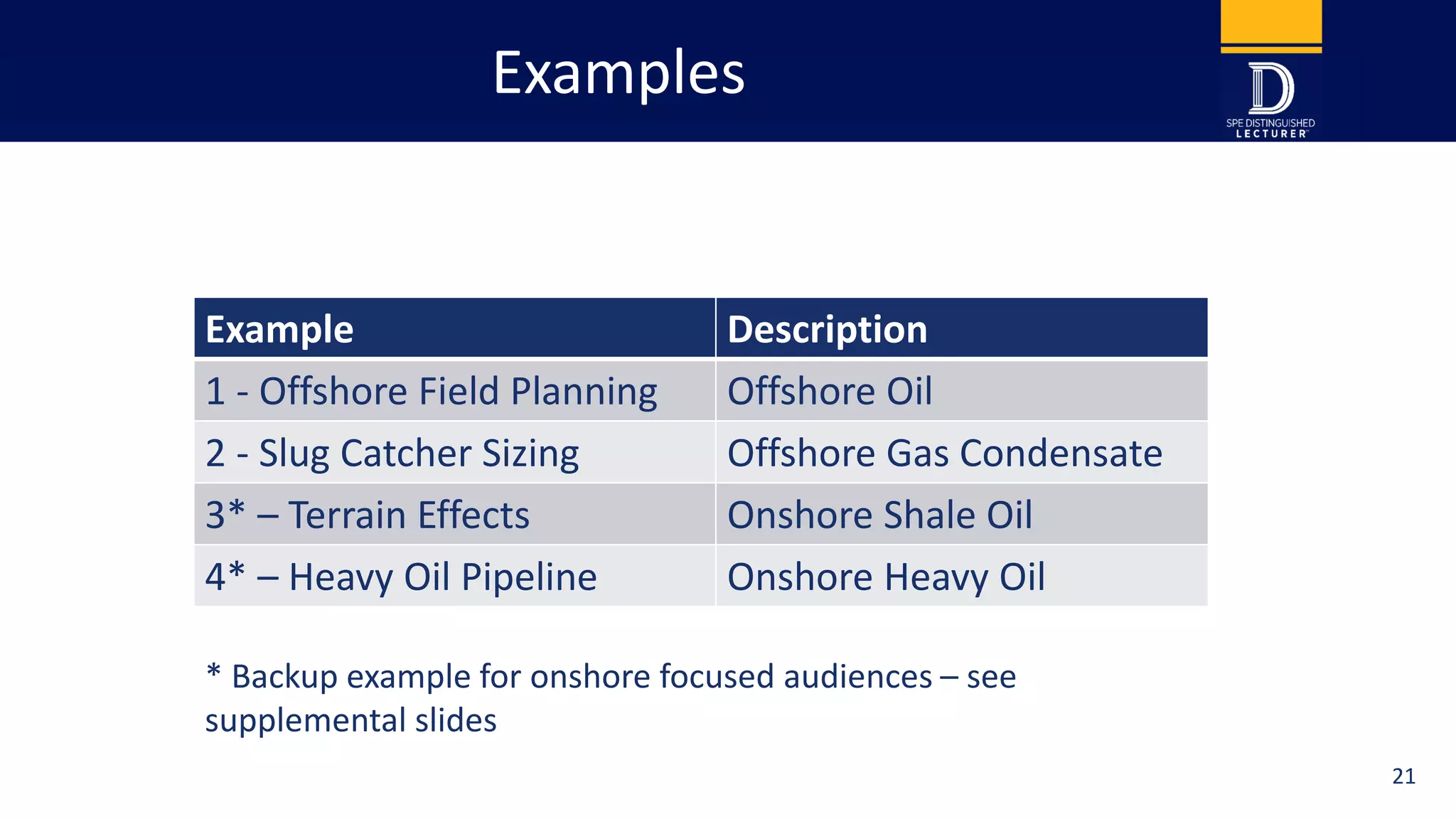
Examples
Example Description
1 - Offshore Field Planning Offshore Oil
2 - Slug Catcher Sizing Offshore Gas Condensate
3* – Terrain Effects Onshore Shale Oil
4* – Heavy Oil Pipeline Onshore Heavy Oil
* Backup example for onshore focused audiences – see
supplemental slides
21
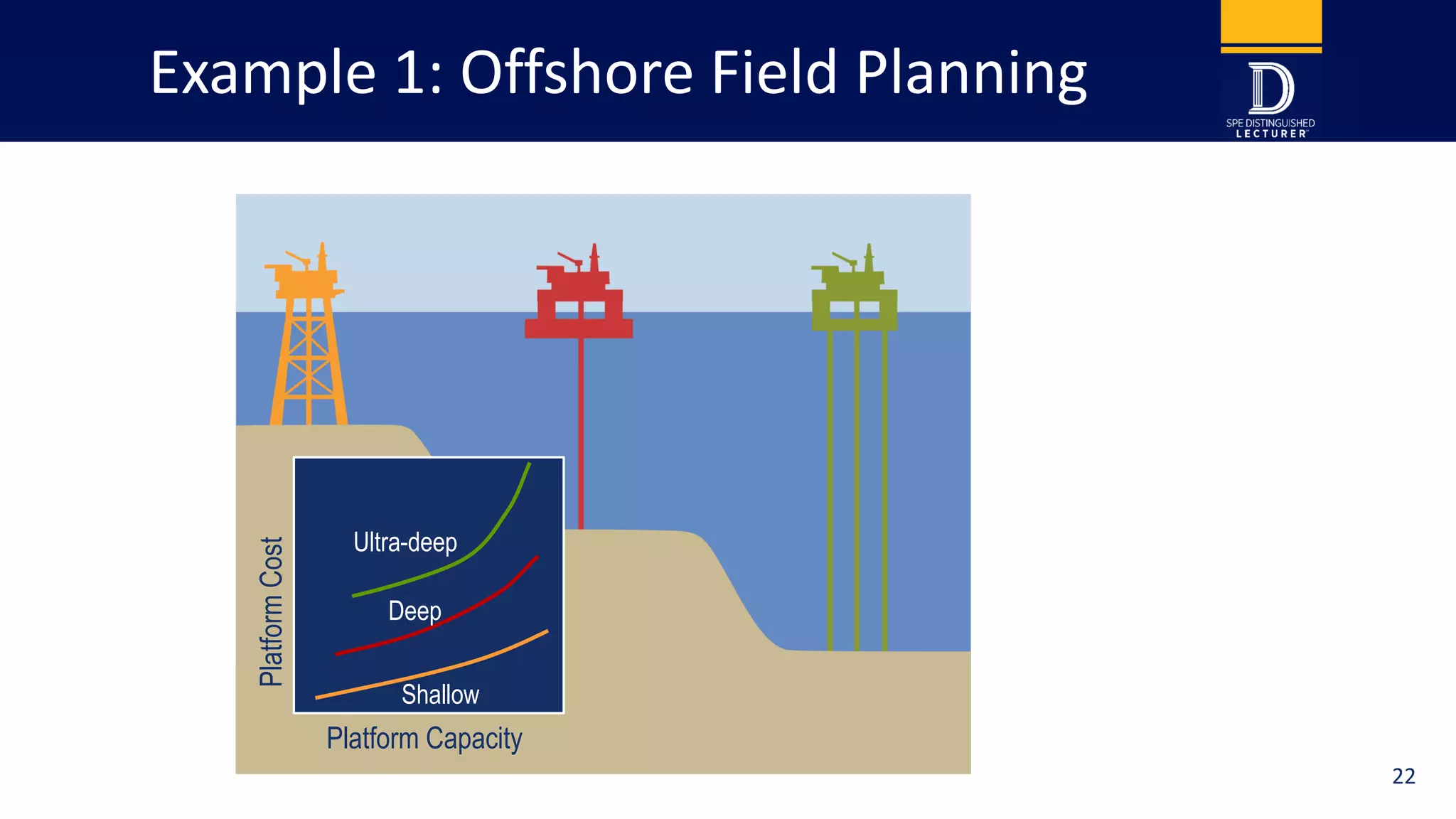
Example 1: Offshore Field Planning
PlatformCost
Platform Capacity
Ultra-deep
Deep
Shallow
22
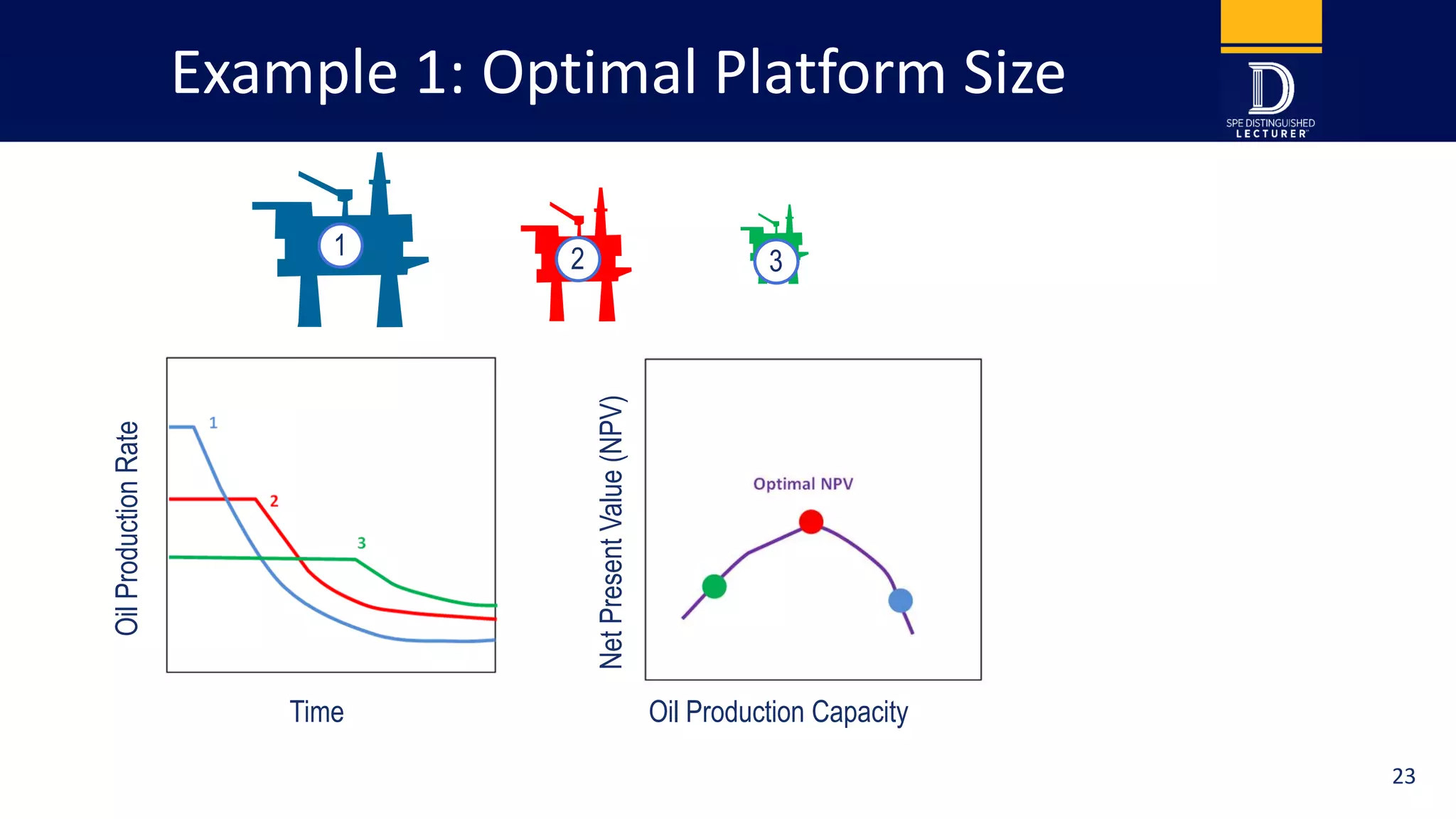
Example 1: Optimal Platform Size
1
32
Time
OilProductionRate
Oil Production Capacity
NetPresentValue(NPV)
23
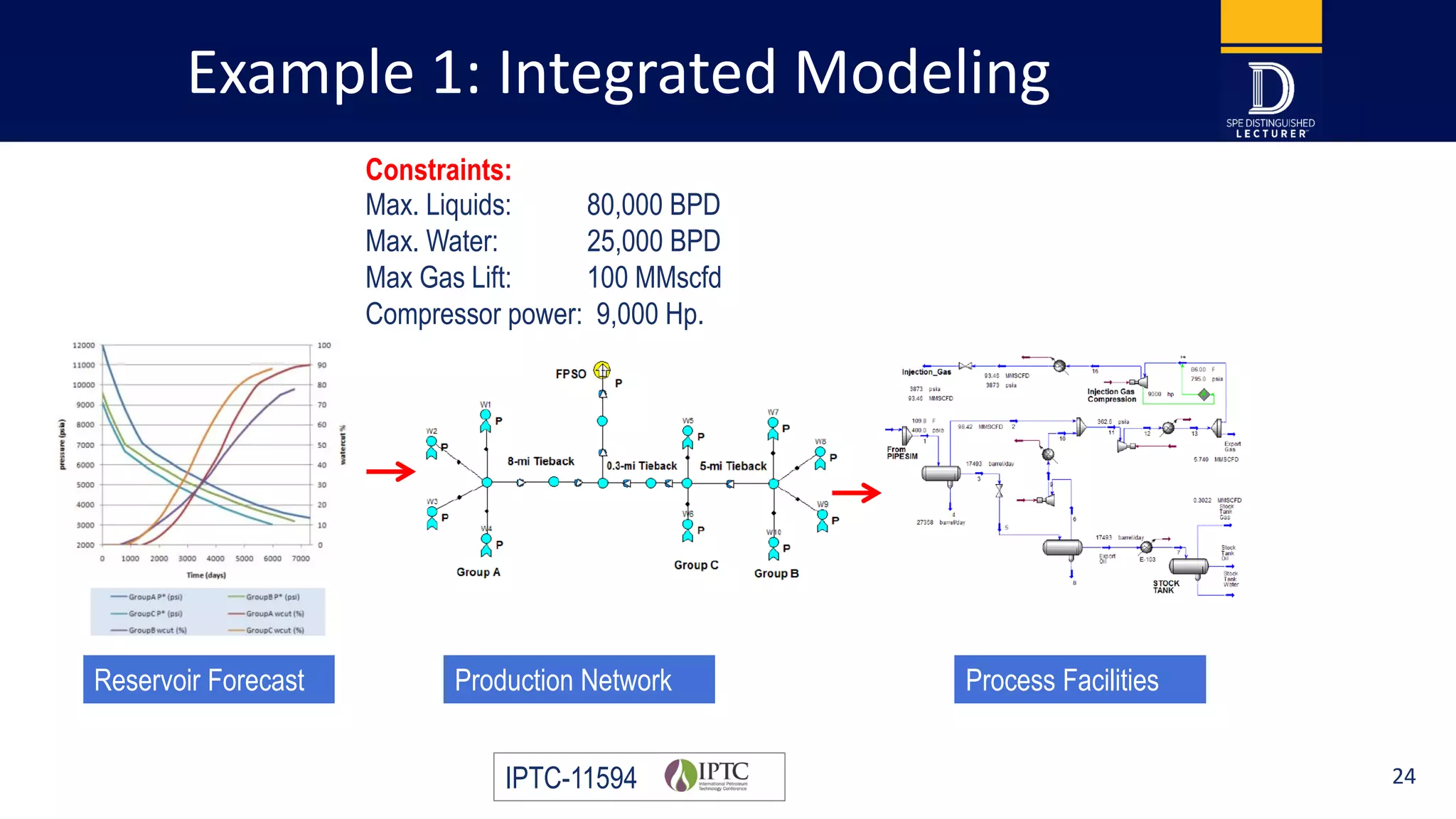
Example 1: Integrated Modeling
Constraints:
Reservoir Forecast Production Network Process Facilities
Max. Liquids: 80,000 BPD
Max. Water: 25,000 BPD
Max Gas Lift: 100 MMscfd
Compressor power: 9,000 Hp.
Production Network
IPTC-11594 24 24
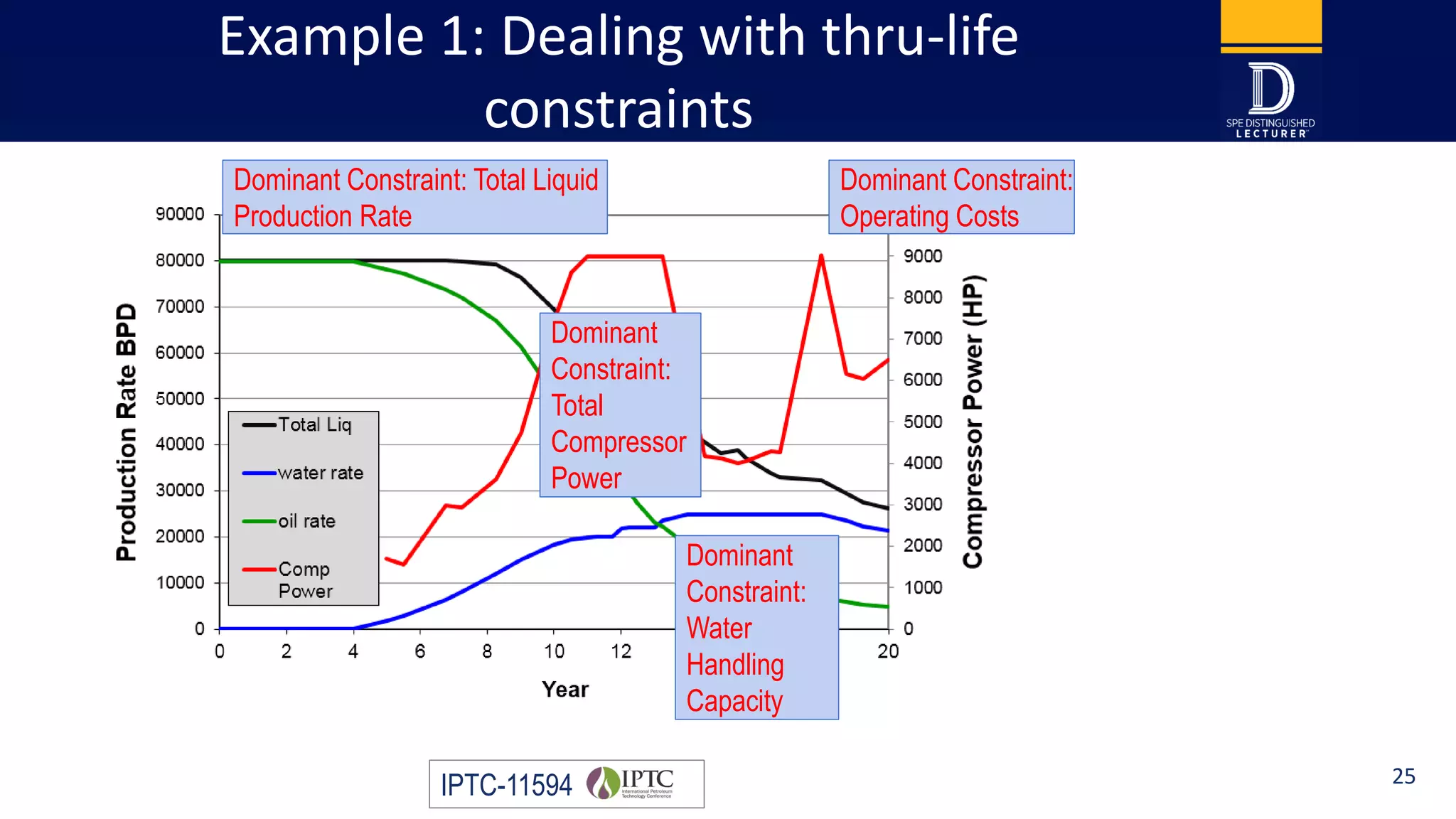
Example 1: Dealing with thru-life
constraints
IPTC-11594
Dominant Constraint: Total Liquid
Production Rate
Dominant
Constraint:
Total
Compressor
Power
Dominant
Constraint:
Water
Handling
Capacity
Dominant Constraint:
Operating Costs
25
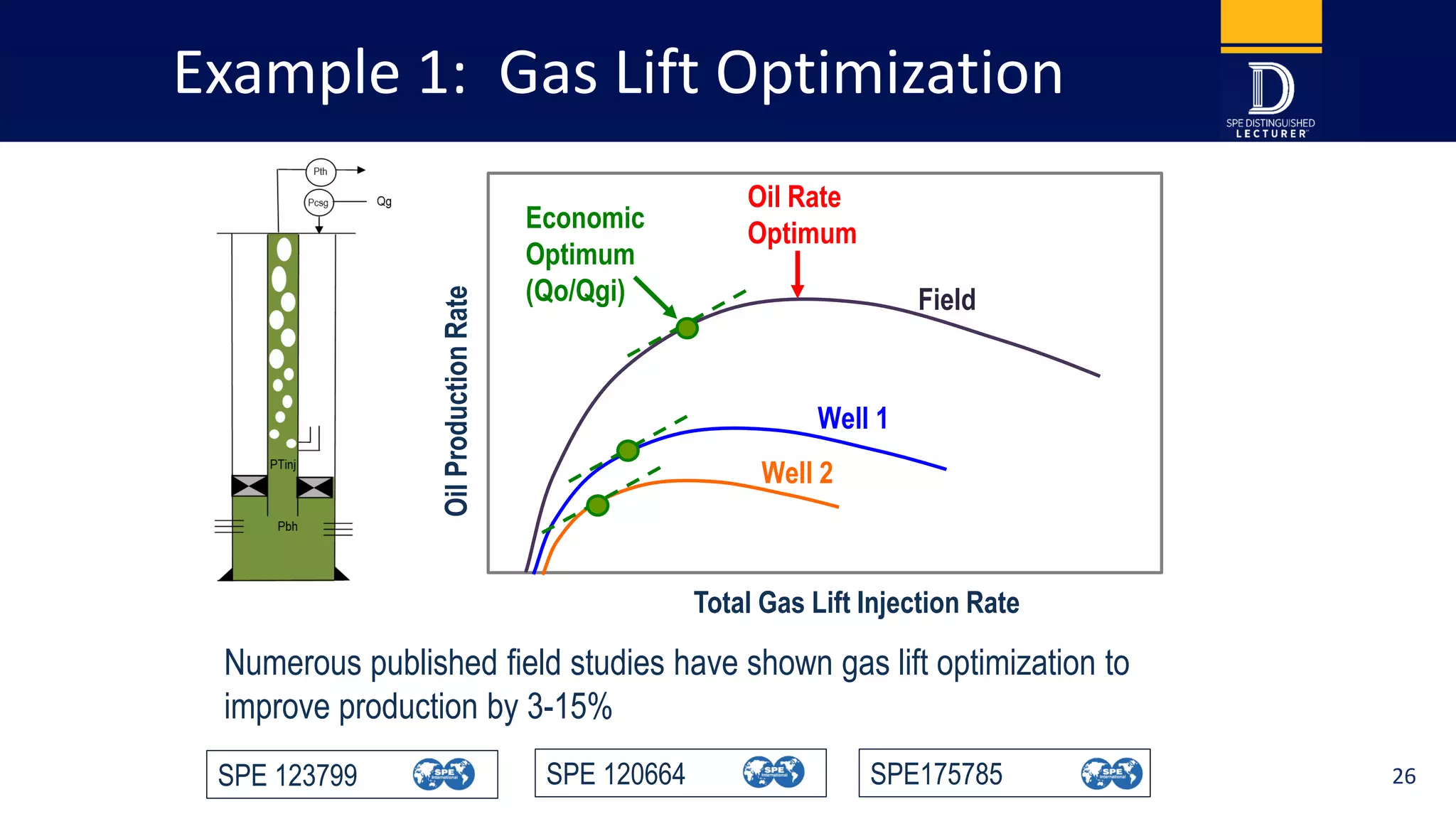
Example 1: Gas Lift Optimization
OilProductionRate
Total Gas Lift Injection Rate
Oil Rate
Optimum
Field
Well 1
Well 2
Economic
Optimum
(Qo/Qgi)
Numerous published field studies have shown gas lift optimization to
improve production by 3-15%
SPE175785SPE 120664SPE 123799 26
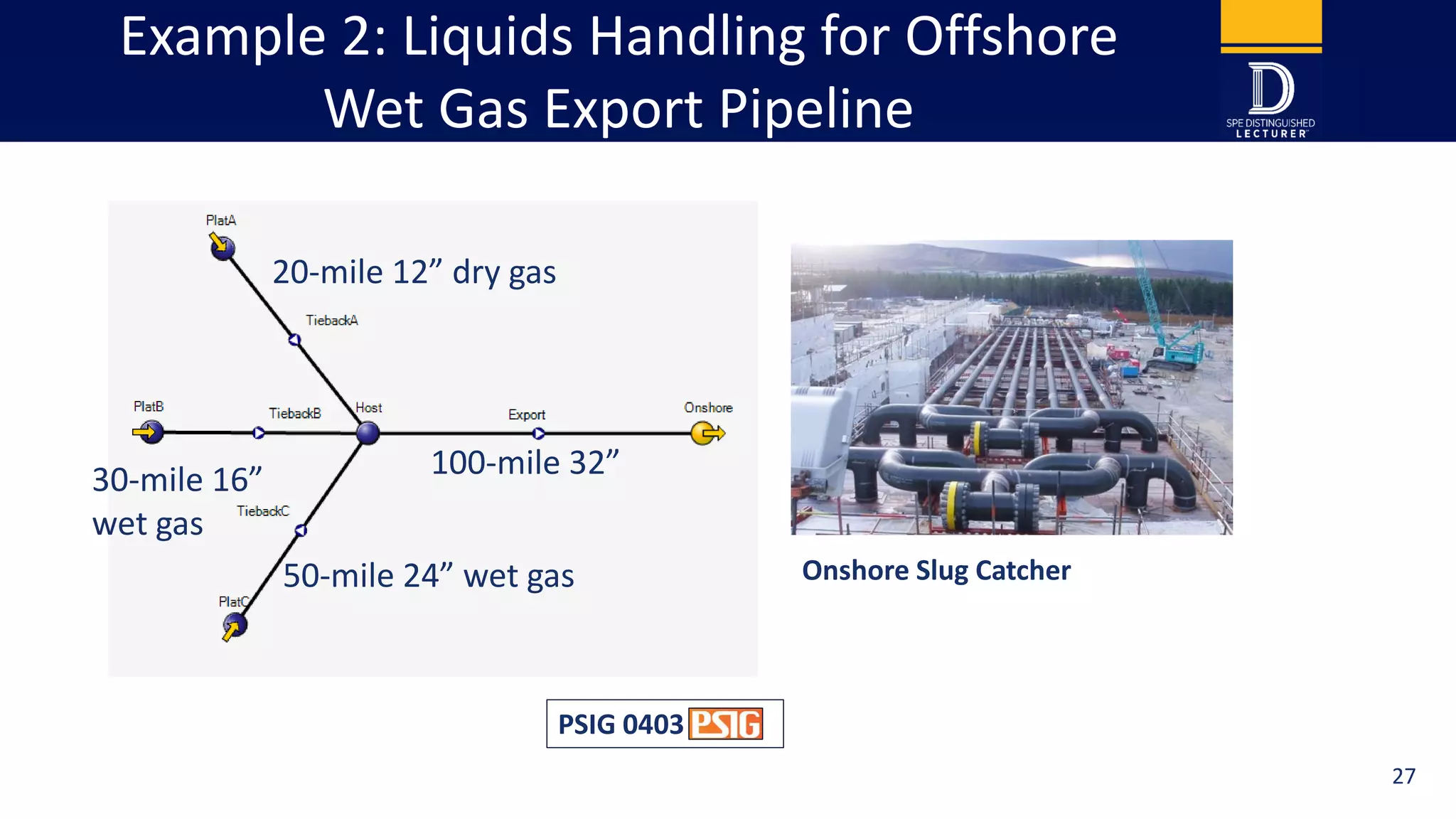
Example 2: Liquids Handling for Offshore
Wet Gas Export Pipeline
100-mile 32”
50-mile 24” wet gas
20-mile 12” dry gas
Onshore Slug Catcher
PSIG 0403
30-mile 16”
wet gas
27
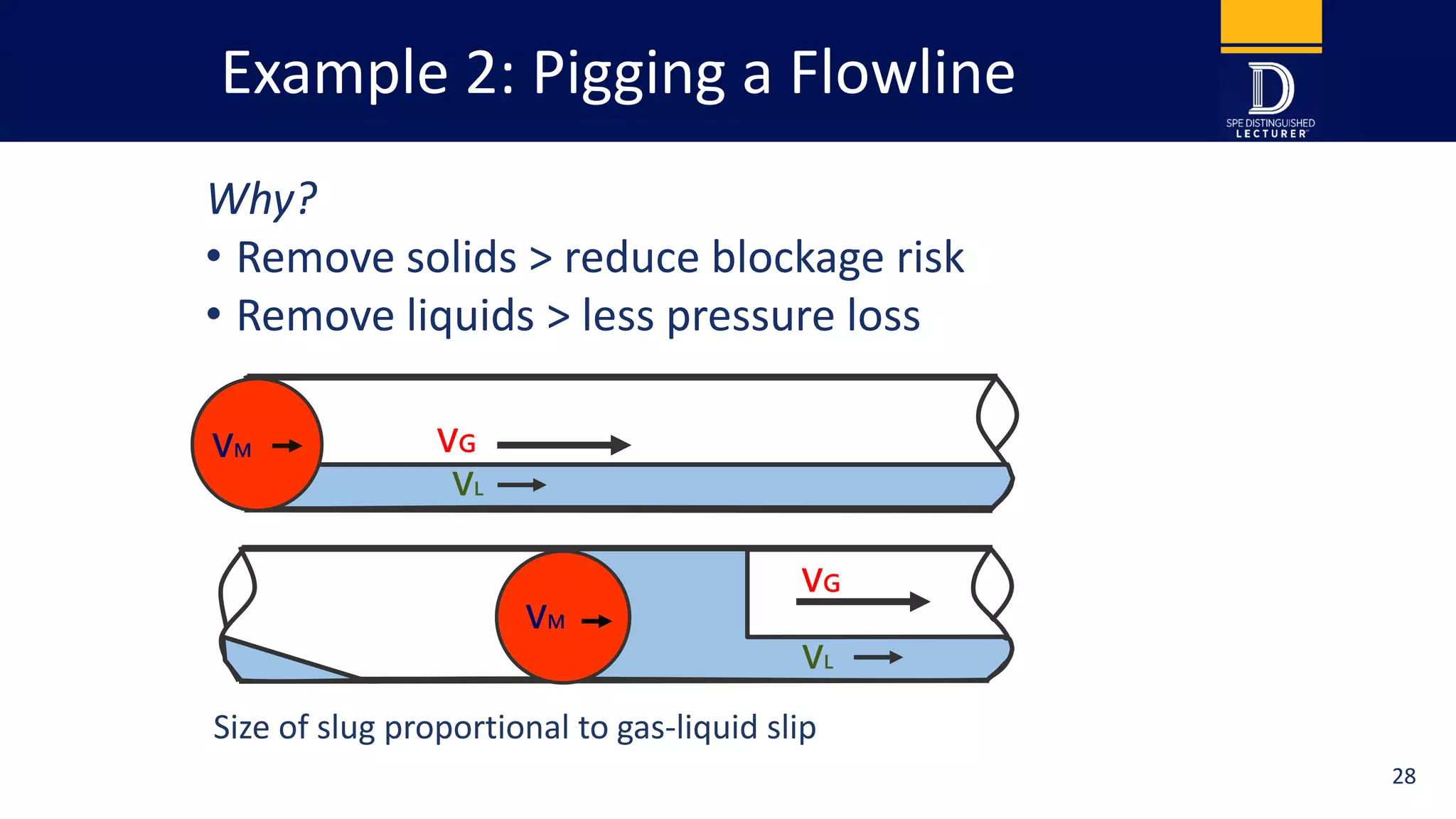
Example 2: Pigging a Flowline
Why?
• Remove solids > reduce blockage risk
• Remove liquids > less pressure loss
VL
VG
VM
VL
VGVM
Size of slug proportional to gas-liquid slip
28
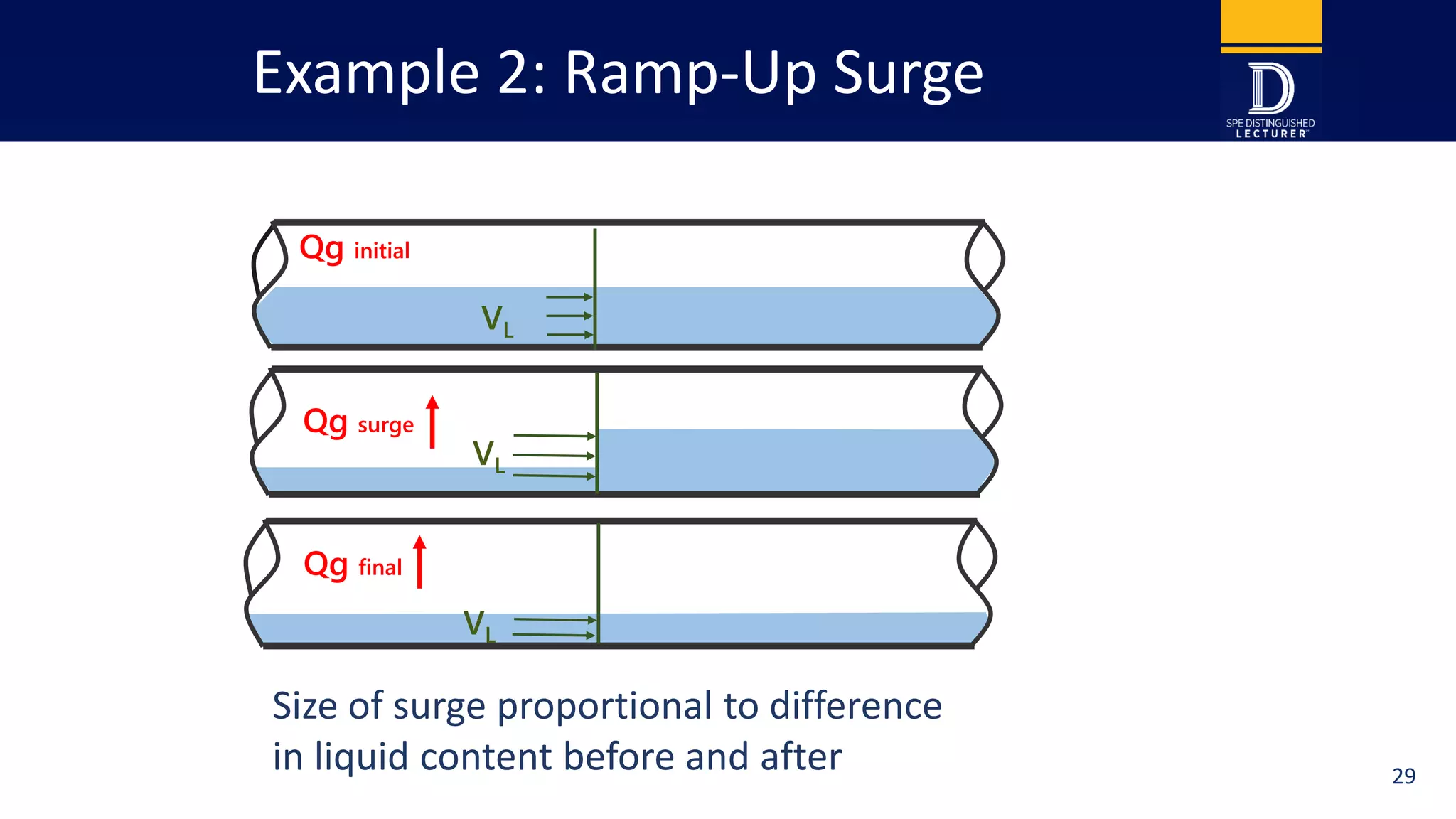
Example 2: Ramp-Up Surge
Qg initial
Qg final
Qg surge
VL
VL
VL
Size of surge proportional to difference
in liquid content before and after 29
Example 2: Slug Catcher Sizing
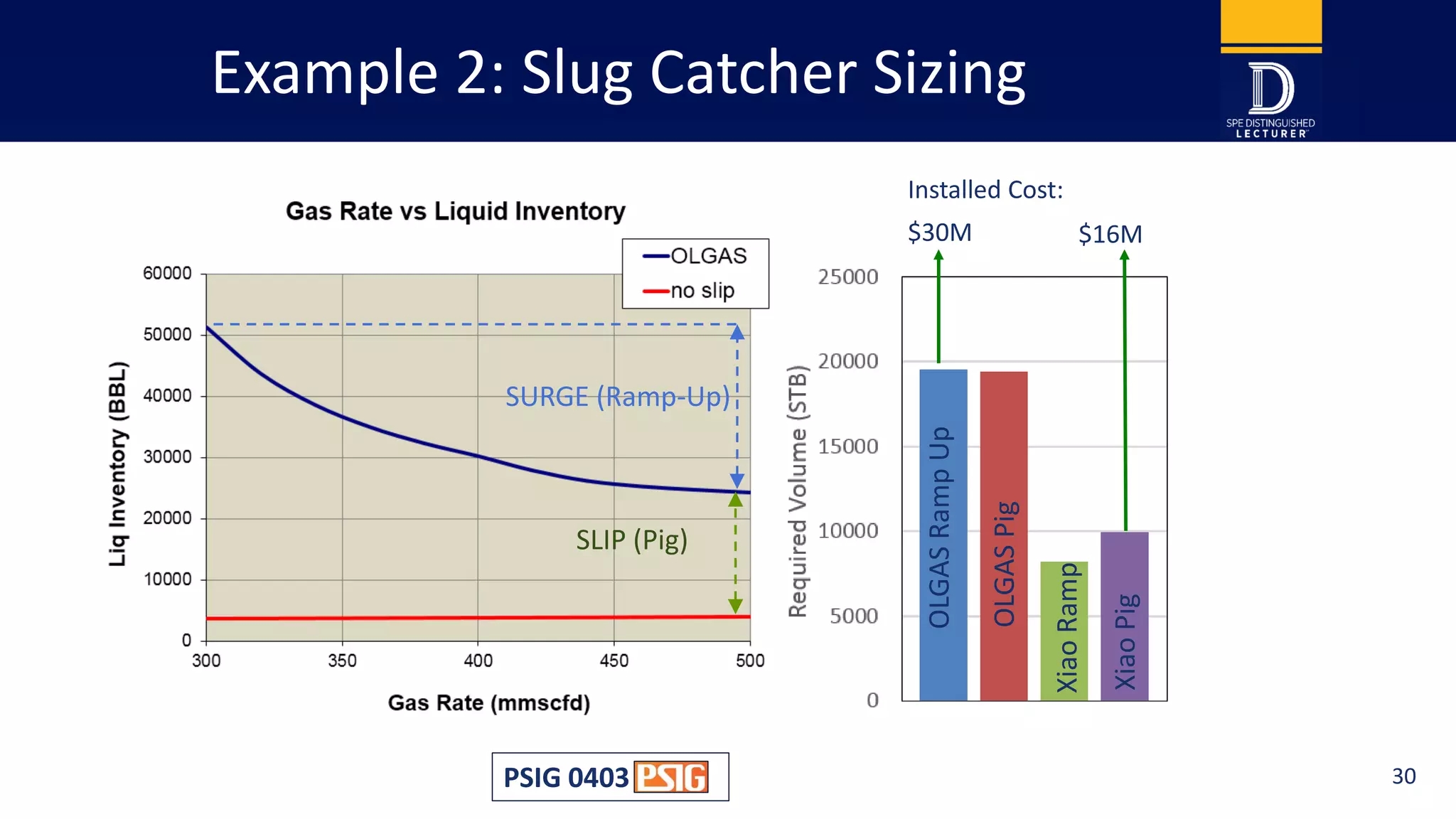
SLIP (Pig)
SURGE (Ramp-Up)
PSIG 0403
OLGASRampUp
OLGASPig
XiaoRamp
XiaoPig
$30M $16M
Installed Cost:
30
Example 2: Slug Catcher Sizing
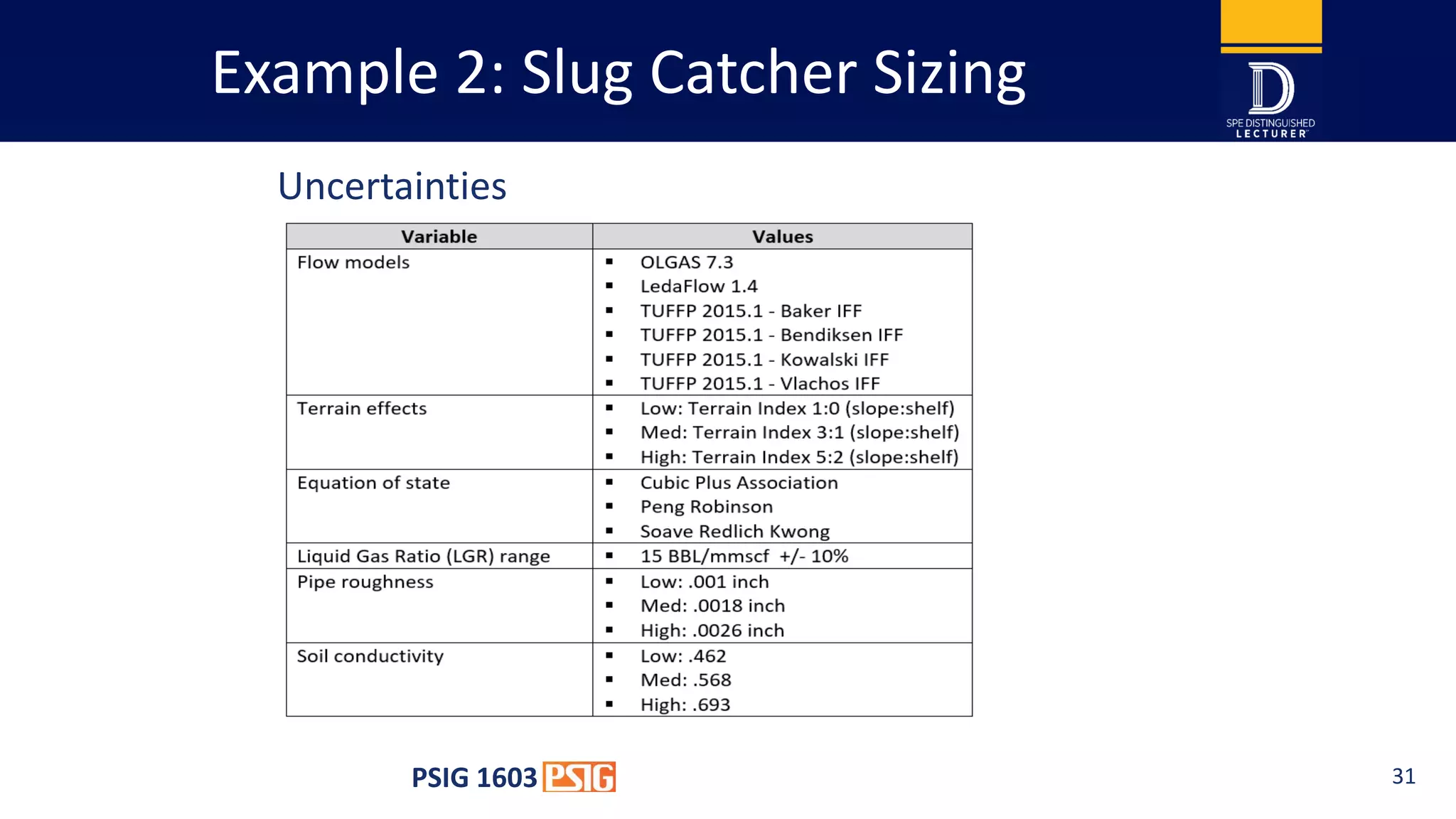
Uncertainties
PSIG 1603 31
Example 2: Slug Catcher Sizing
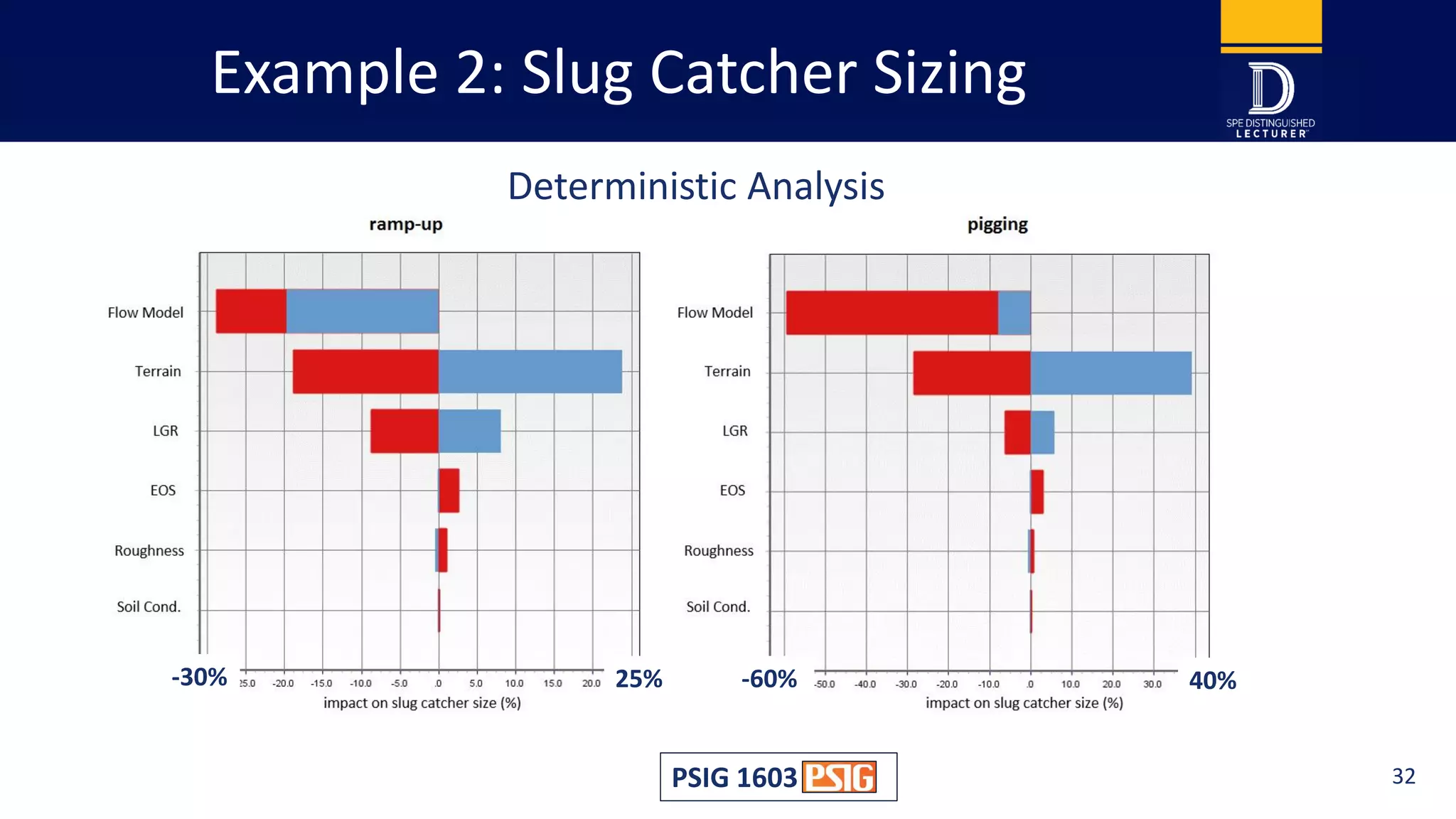
Deterministic Analysis
-30% 25% -60% 40%
PSIG 1603 32
Example 2: Slug Catcher Sizing
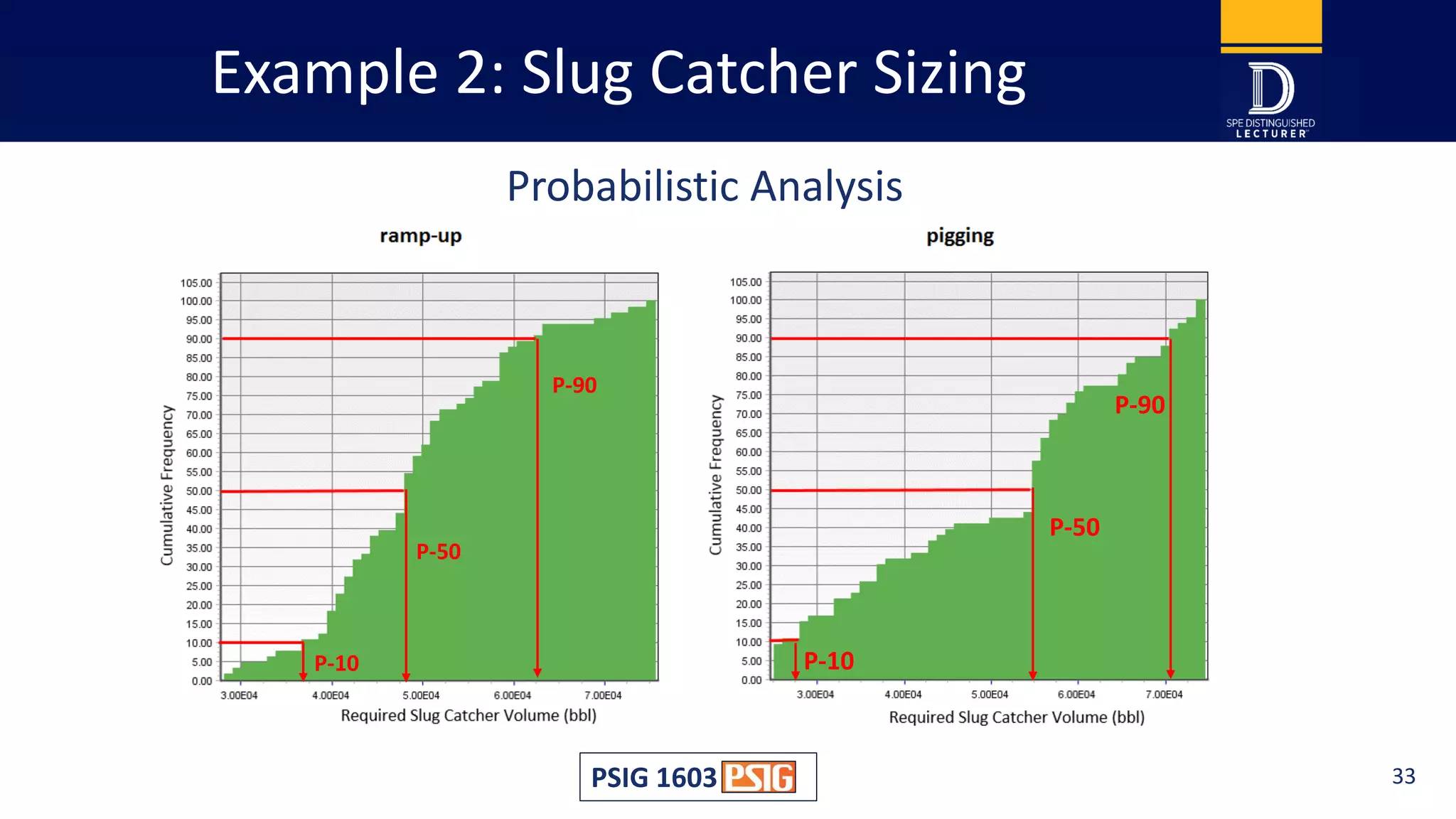
Probabilistic Analysis
P-10
P-50
P-90
P-50
P-90
P-10
PSIG 1603 33
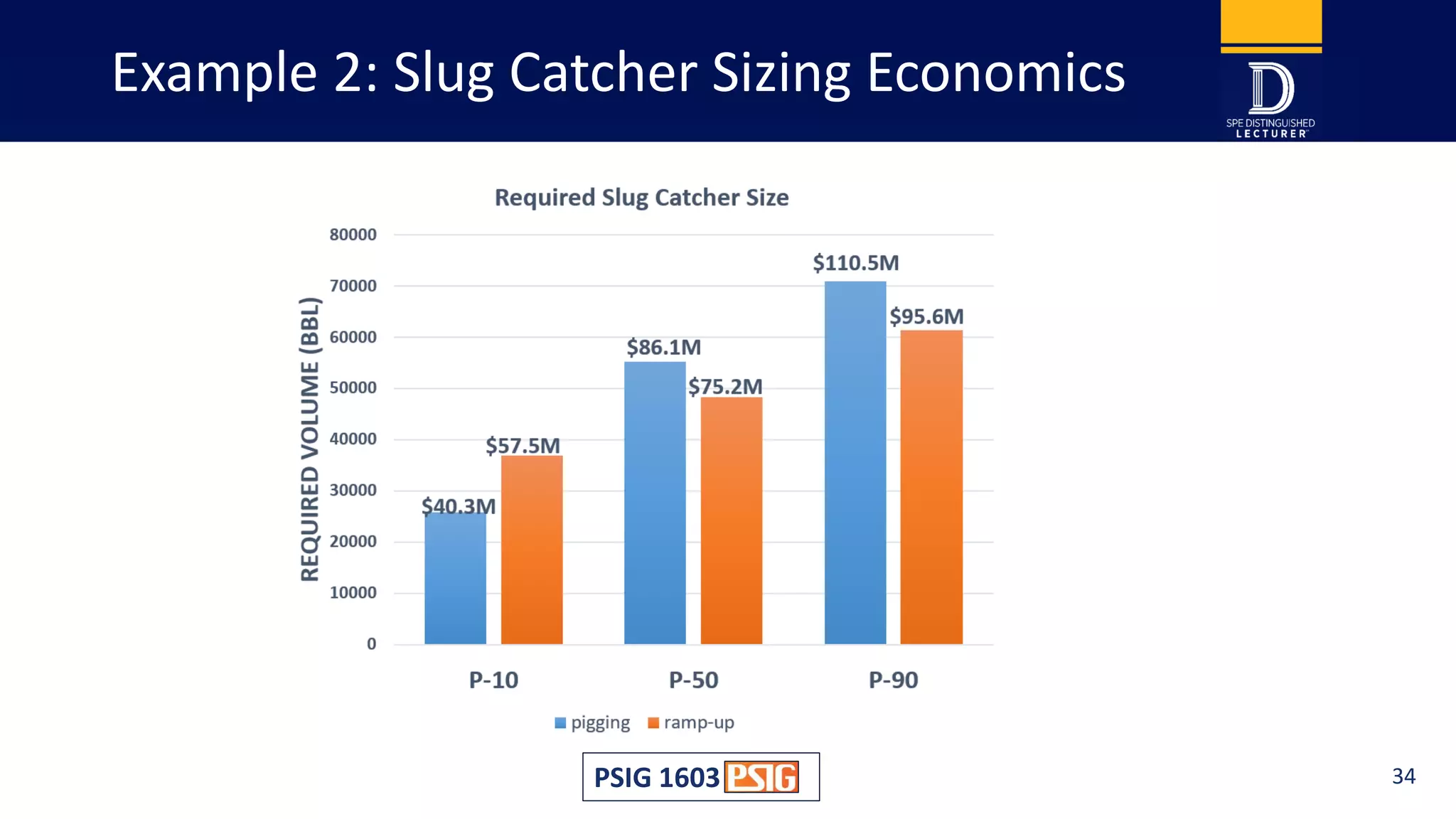
Example 2: Slug Catcher Sizing Economics
PSIG 1603 34
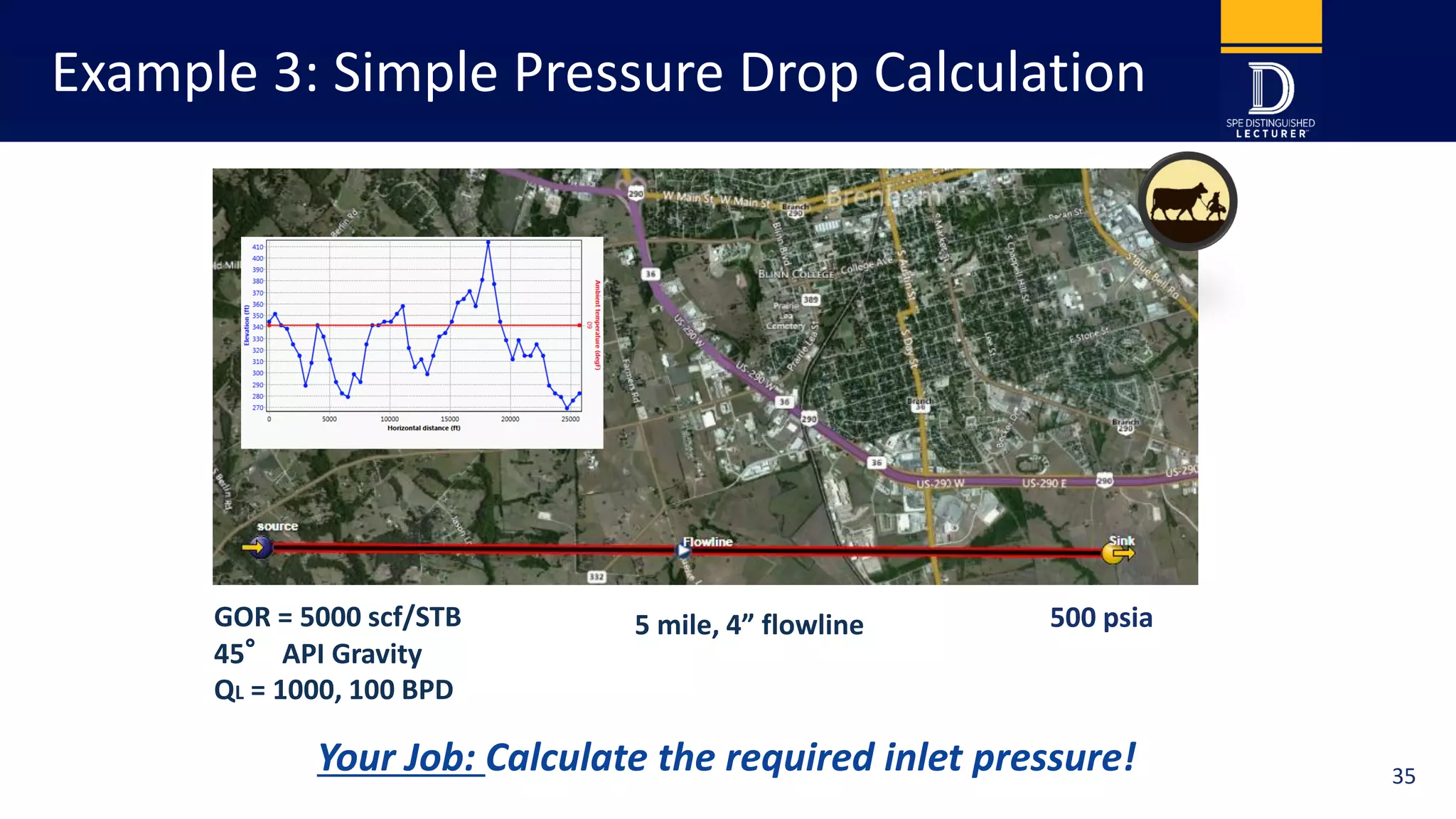
Example 3: Simple Pressure Drop Calculation
5 mile, 4” flowlineGOR = 5000 scf/STB
45° API Gravity
QL = 1000, 100 BPD
Your Job: Calculate the required inlet pressure!
500 psia
35
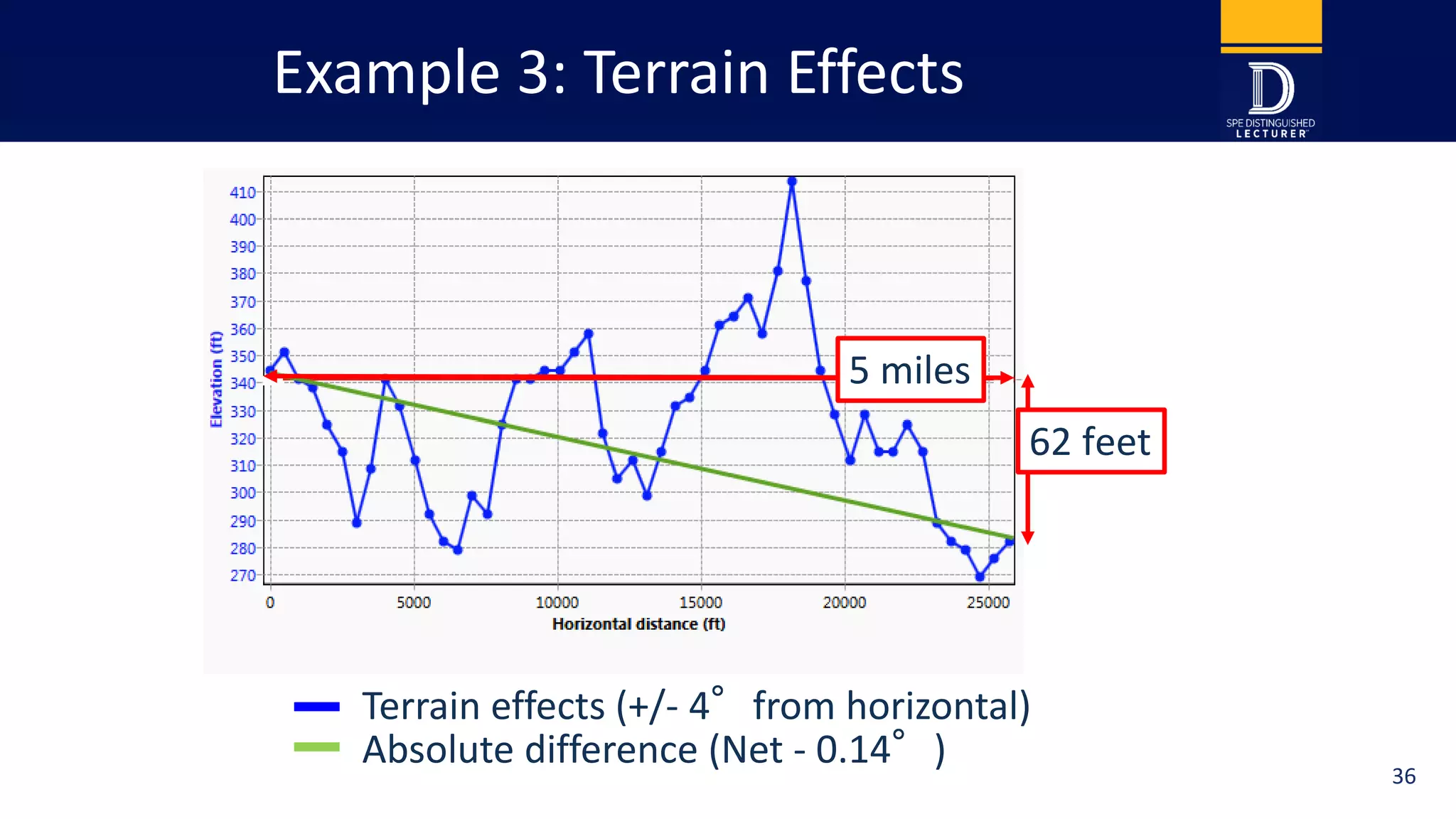
Example 3: Terrain Effects
62 feet
5 miles
Absolute difference (Net - 0.14°)
Terrain effects (+/- 4°from horizontal)
36
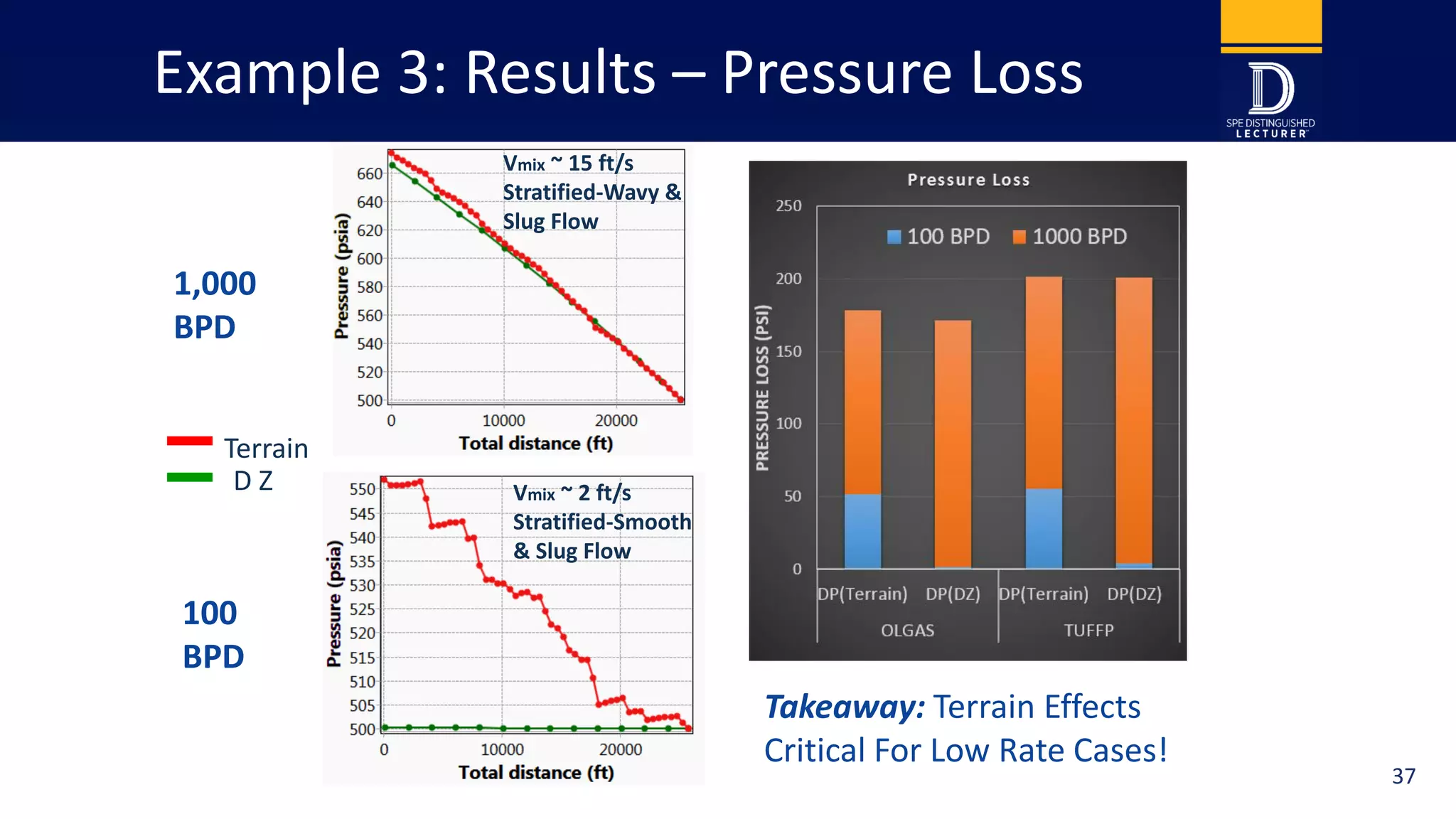
Example 3: Results – Pressure Loss
1,000
BPD
100
BPD
Vmix ~ 2 ft/s
Stratified-Smooth
& Slug Flow
D Z
Terrain
Takeaway: Terrain Effects
Critical For Low Rate Cases!
Vmix ~ 15 ft/s
Stratified-Wavy &
Slug Flow
37
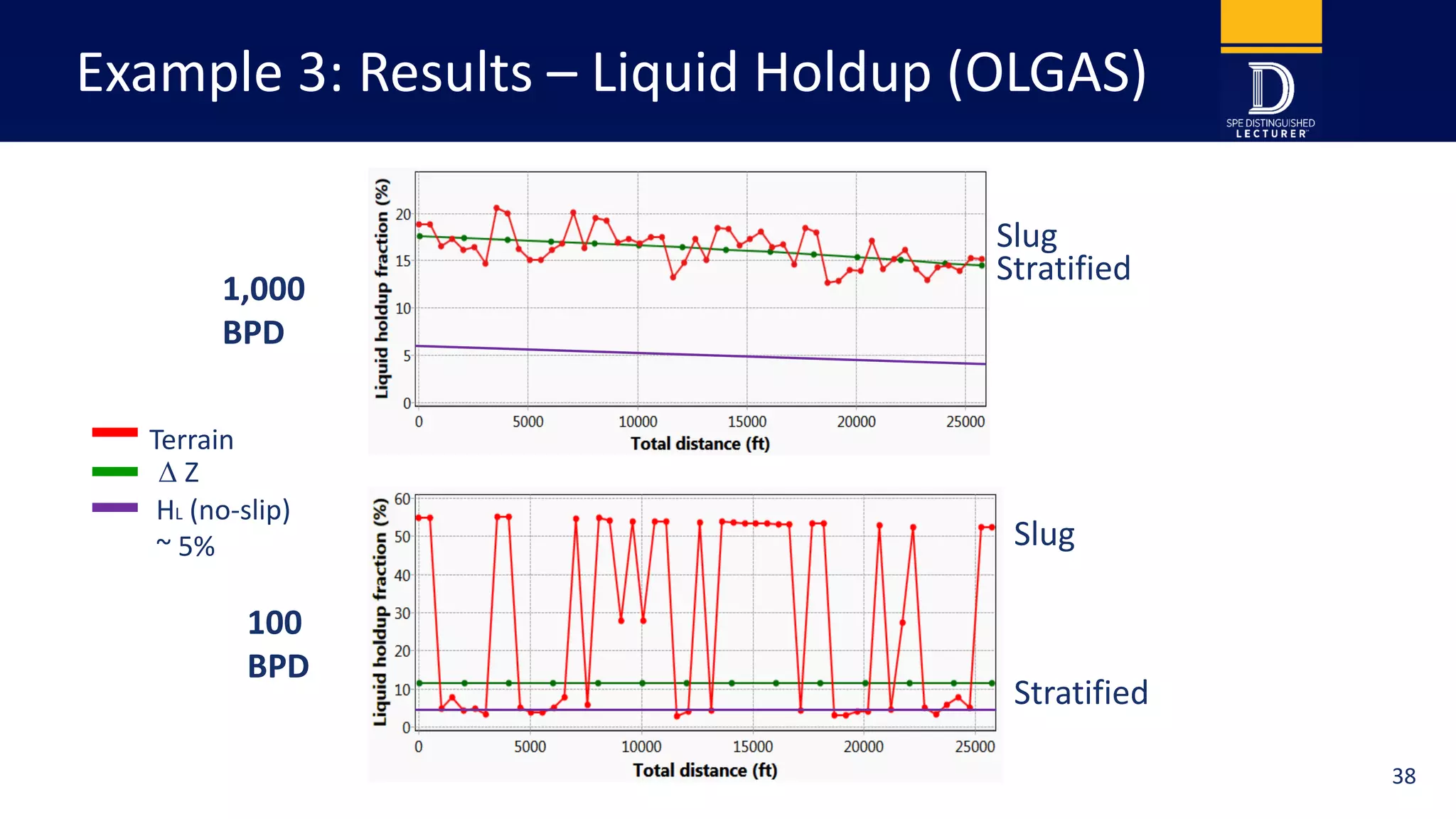
Example 3: Results – Liquid Holdup (OLGAS)
1,000
BPD
100
BPD
D Z
Terrain
HL (no-slip)
~ 5%
Slug
Stratified
Slug
Stratified
38
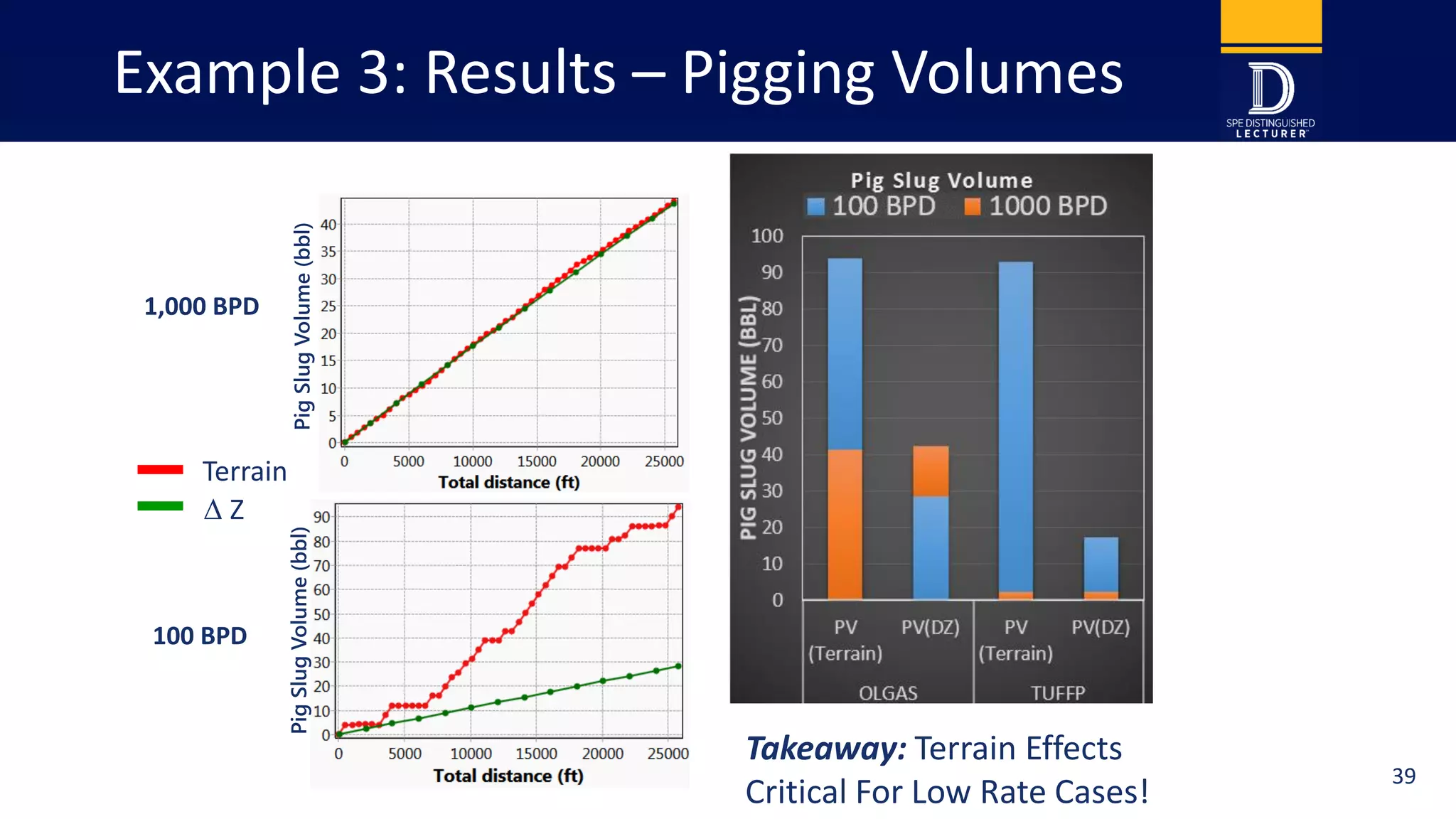
Example 3: Results – Pigging Volumes
1,000 BPD
100 BPD
D Z
Terrain
Takeaway: Terrain Effects
Critical For Low Rate Cases!
PigSlugVolume(bbl)
0
10
20
30
40
50
60
70
80
90
100
PV
(Terrain)
PV(DZ) PV
(Terrain)
PV(DZ)
OLGAS TUFFP
PIGSLUGVOLUME(BBL)
Pig Slug Volume
PigSlugVolume(bbl)
39
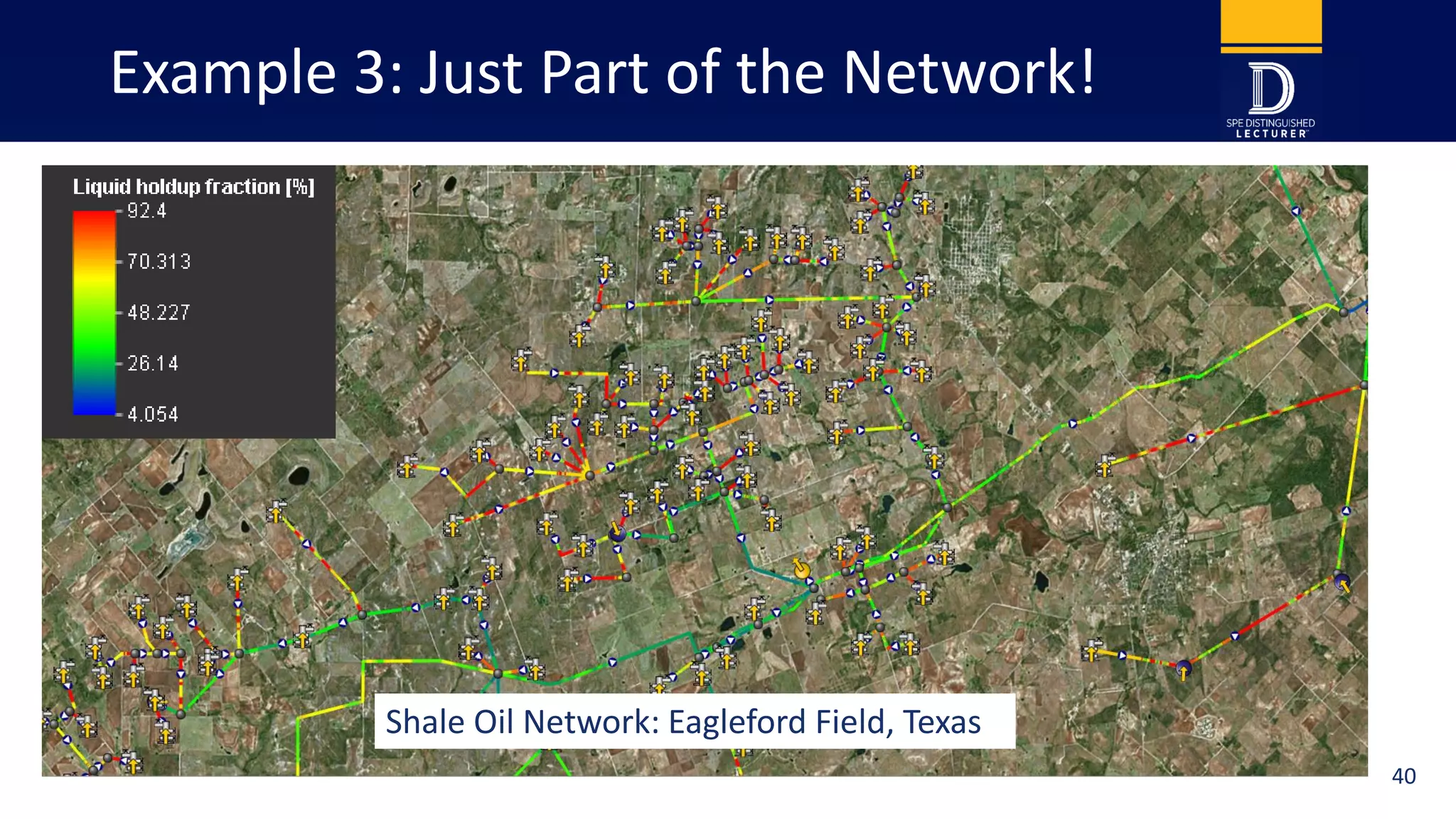
Example 3: Just Part of the Network!
Shale Oil Network: Eagleford Field, Texas
40
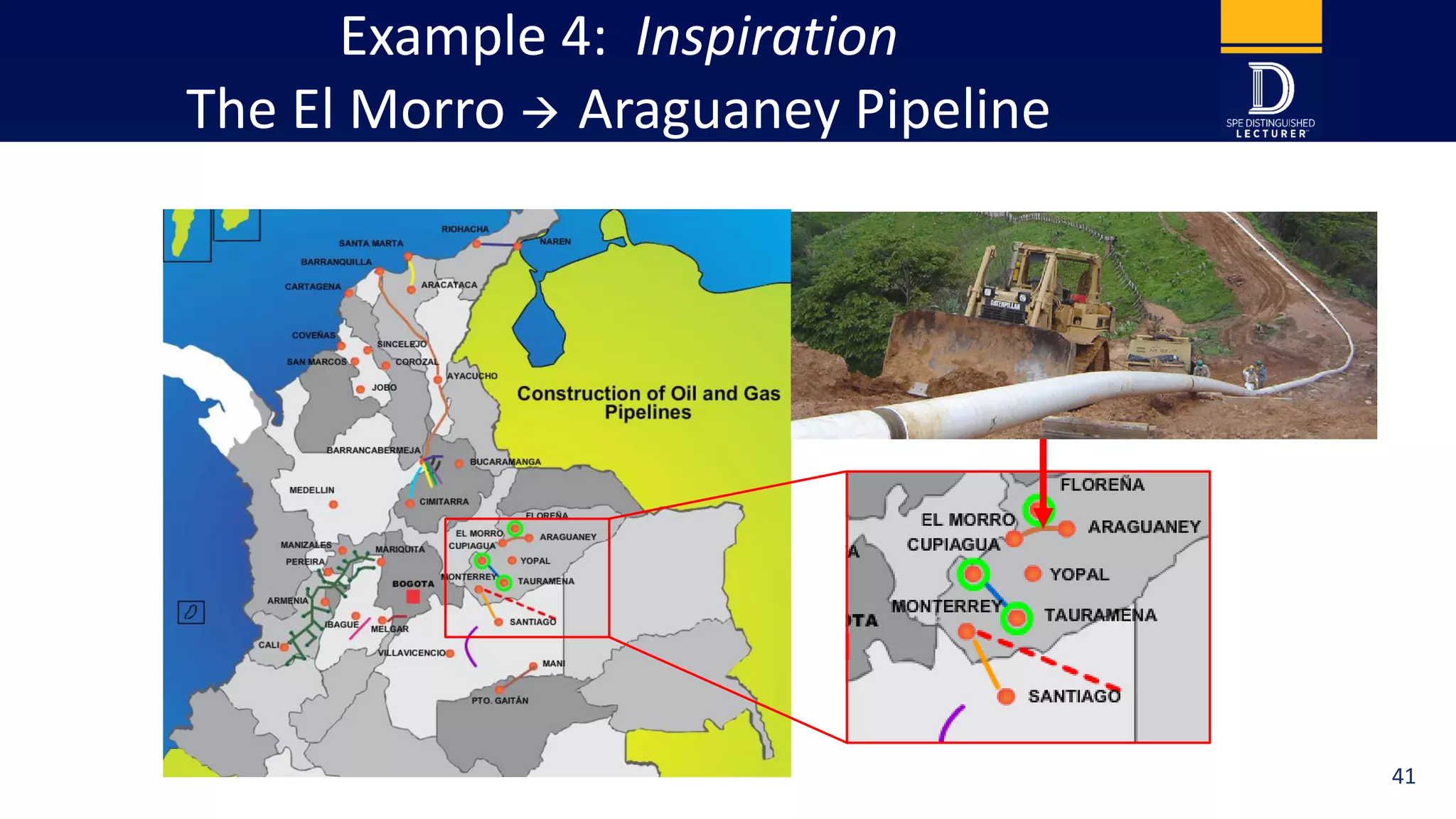
Example 4: Inspiration
The El Morro  Araguaney Pipeline
41
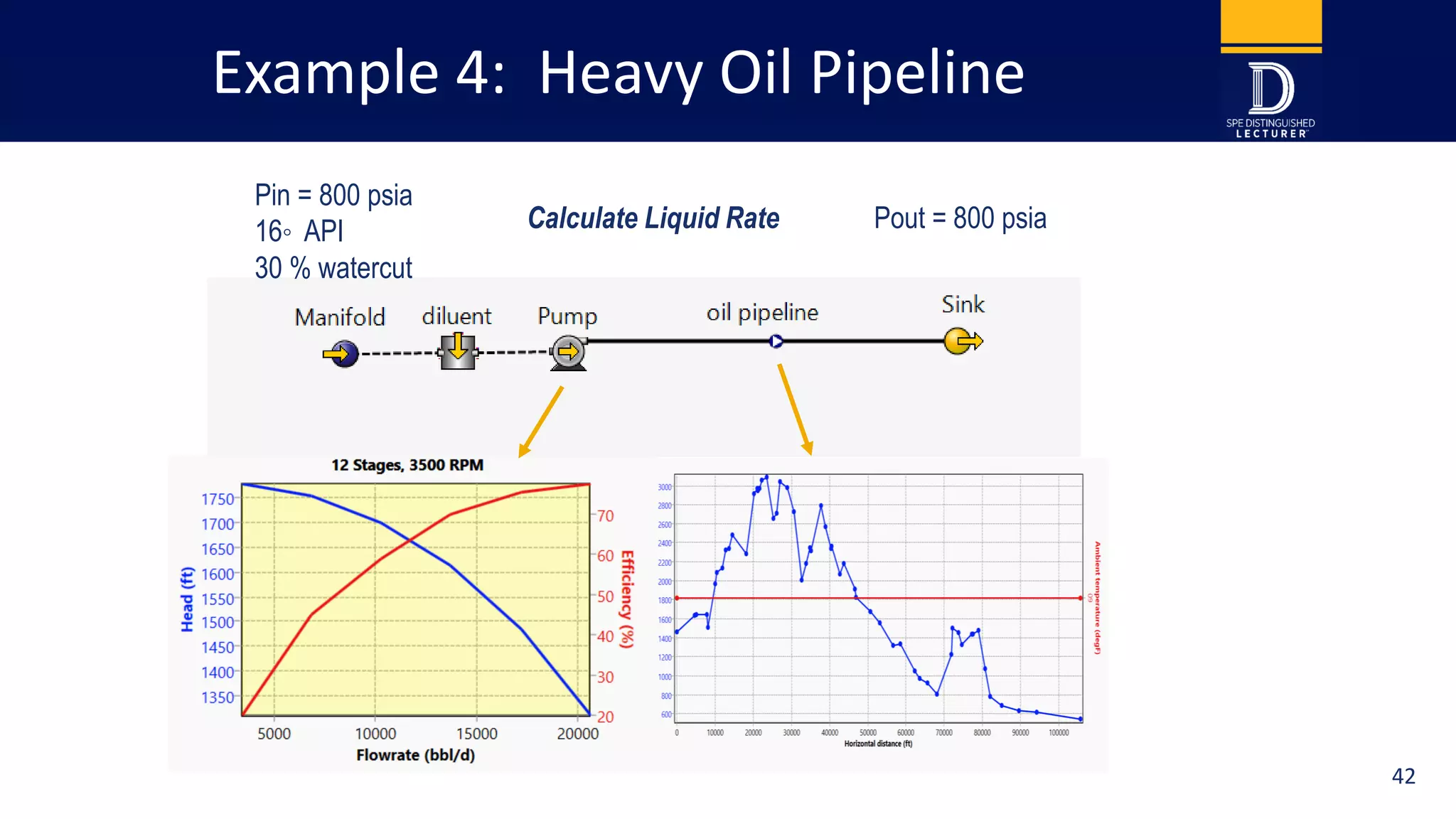
Example 4: Heavy Oil Pipeline
Pin = 800 psia
16◦ API
30 % watercut
Pout = 800 psiaCalculate Liquid Rate
42
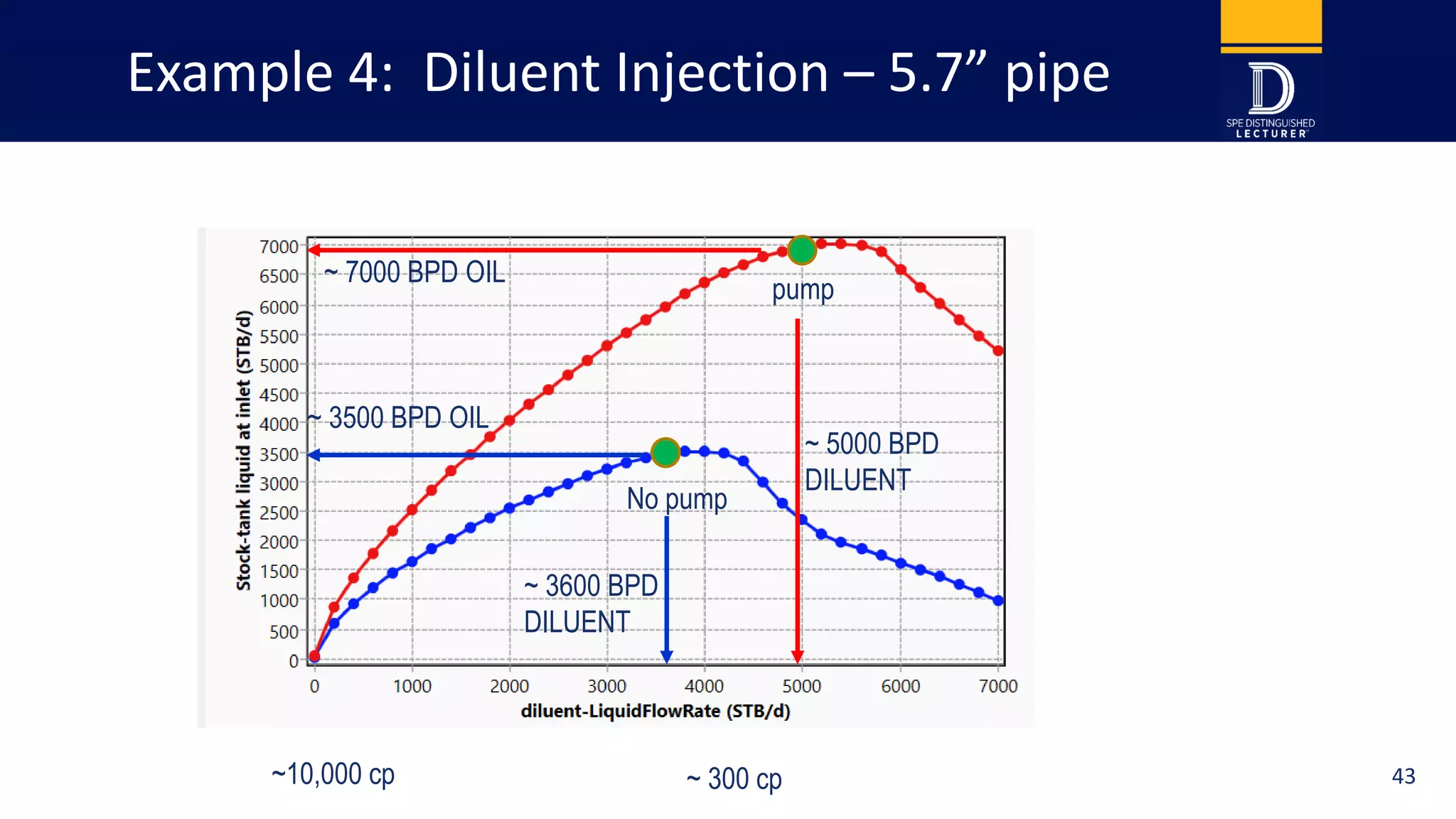
Example 4: Diluent Injection – 5.7” pipe
pump
No pump
~ 7000 BPD OIL
~ 5000 BPD
DILUENT
~ 3500 BPD OIL
~ 3600 BPD
DILUENT
~10,000 cp ~ 300 cp 43
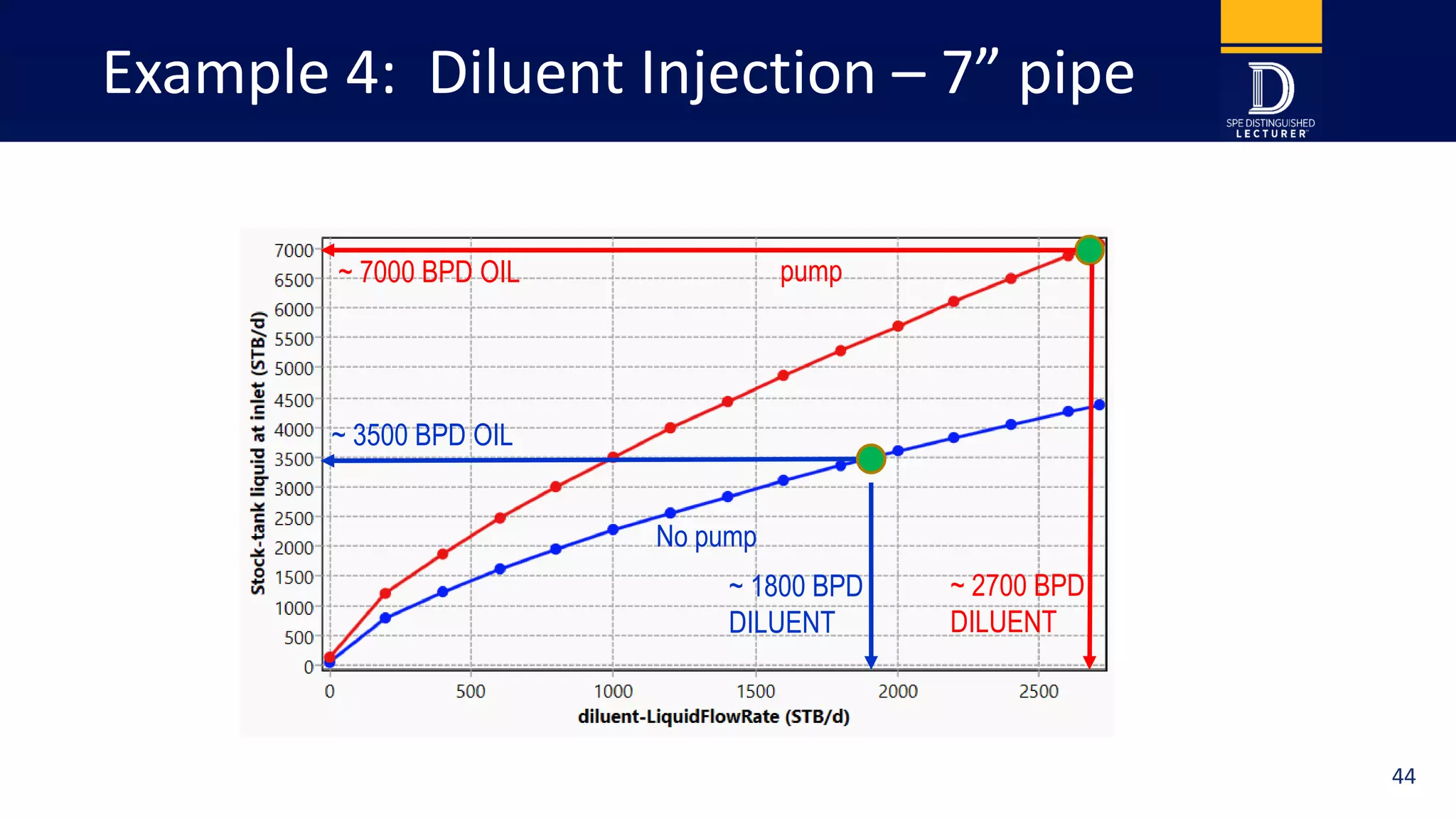
Example 4: Diluent Injection – 7” pipe
pump
No pump
~ 7000 BPD OIL
~ 3500 BPD OIL
~ 2700 BPD
DILUENT
~ 1800 BPD
DILUENT
44
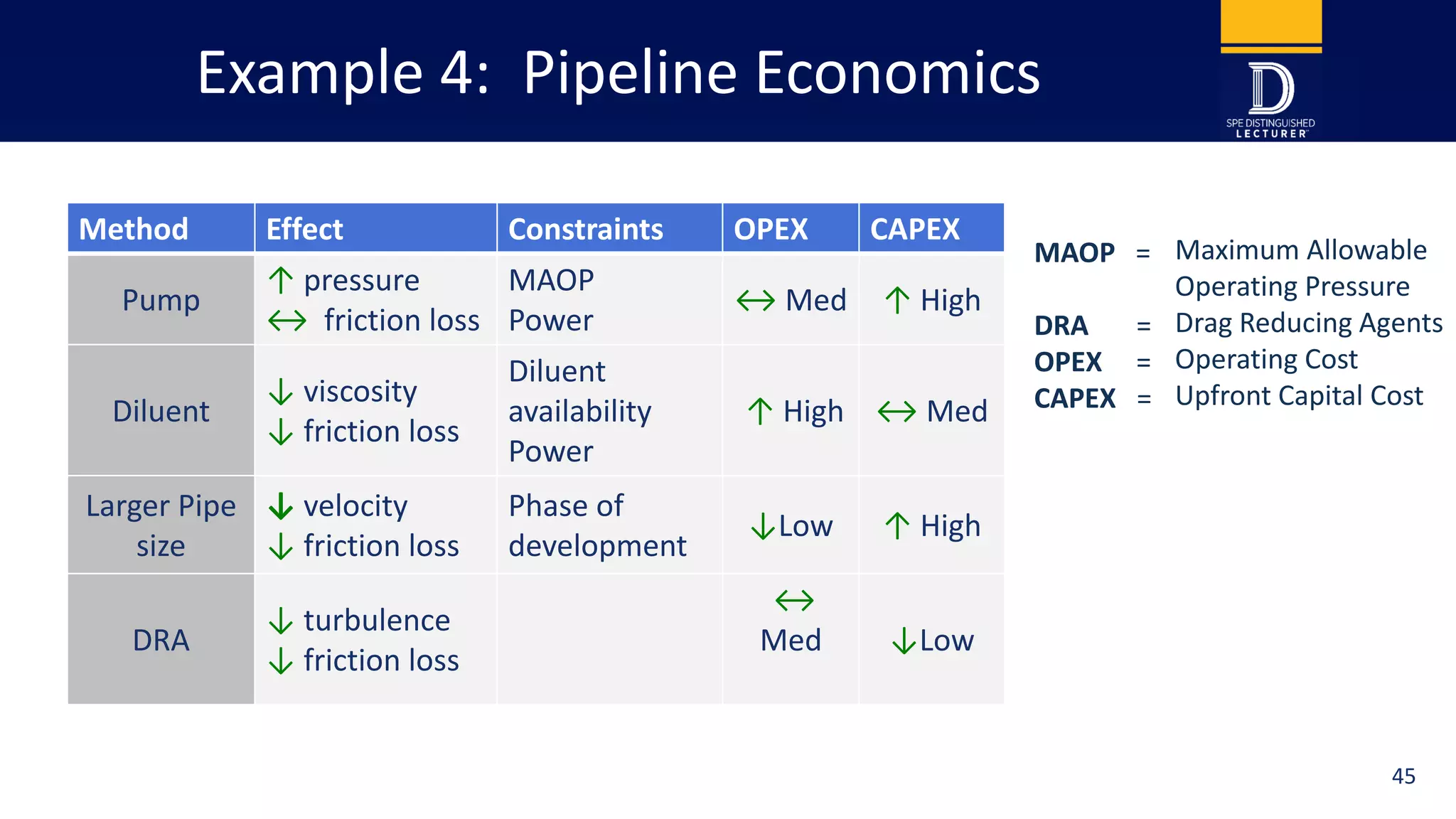
Example 4: Pipeline Economics
Method Effect Constraints OPEX CAPEX
Pump
↑ pressure
↔ friction loss
MAOP
Power
↔ Med ↑ High
Diluent
↓ viscosity
↓ friction loss
Diluent
availability
Power
↑ High ↔ Med
Larger Pipe
size
↓ velocity
↓ friction loss
Phase of
development
↓Low ↑ High
DRA
↓ turbulence
↓ friction loss
↔
Med ↓Low
Maximum Allowable
Operating Pressure
Drag Reducing Agents
Operating Cost
Upfront Capital Cost
MAOP =
DRA =
OPEX =
CAPEX =
45
Outline
– Introduction
– The Science of Multiphase Flow
– The Economics of Multiphase Flow
– Concluding Remarks
3 46
Concluding Remarks
• Good technology in multiphase flow modeling has
emerged from years of research and development
• Challenges still remain  flow assurance is not a certainty
• Economics justify the Science!
• Ultimate goal is to maximize production while minimizing
flow assurance risks and operational costs
47
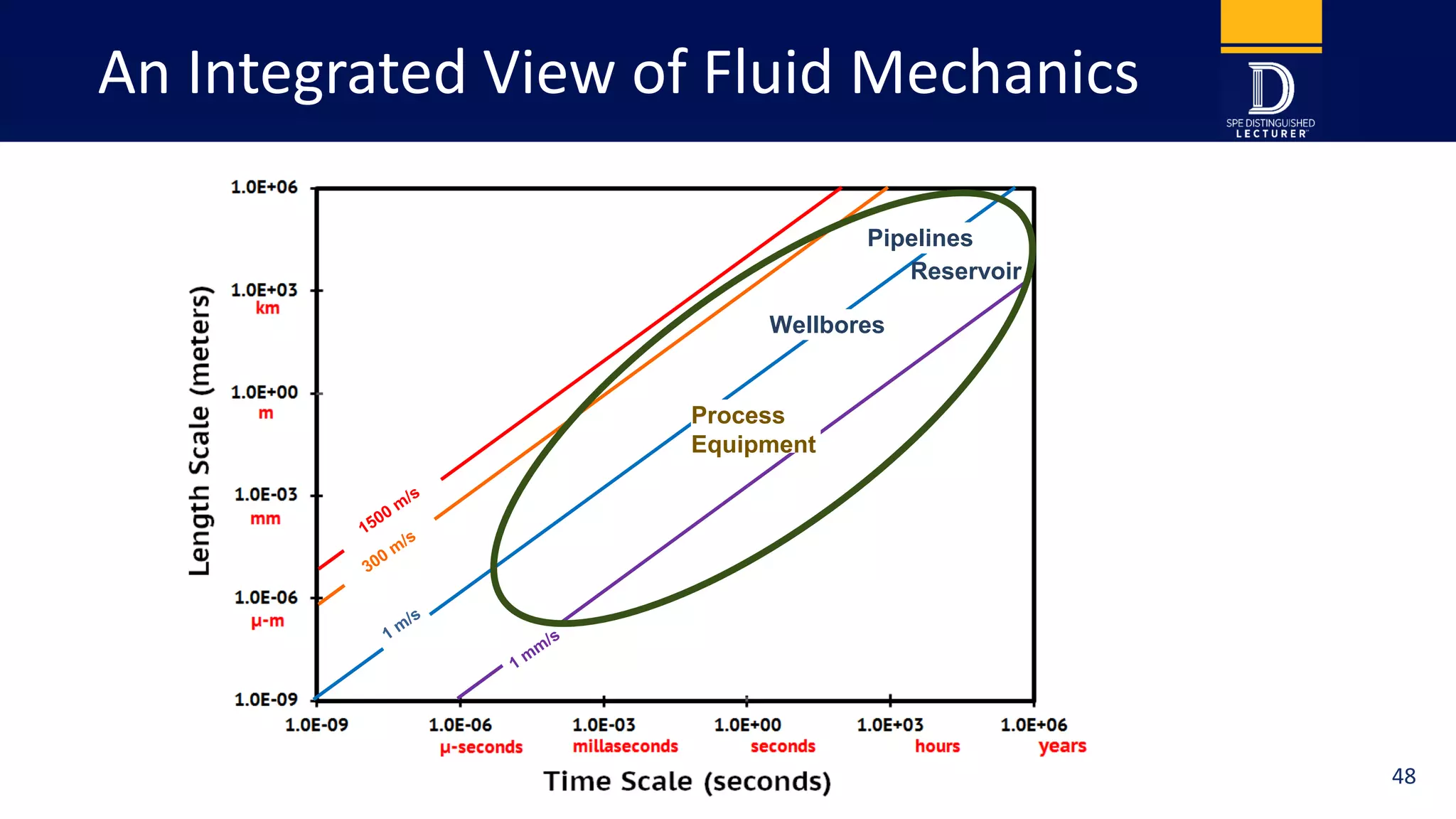
An Integrated View of Fluid Mechanics
Pipelines
Wellbores
Reservoir
Process
Equipment
48
Society of Petroleum Engineers
Distinguished Lecturer Program
www.spe.org/dl
Your Feedback is Important
Enter your section in the DL Evaluation Contest by
completing the evaluation form for this presentation
Visit SPE.org/dl
Supplemental Slides
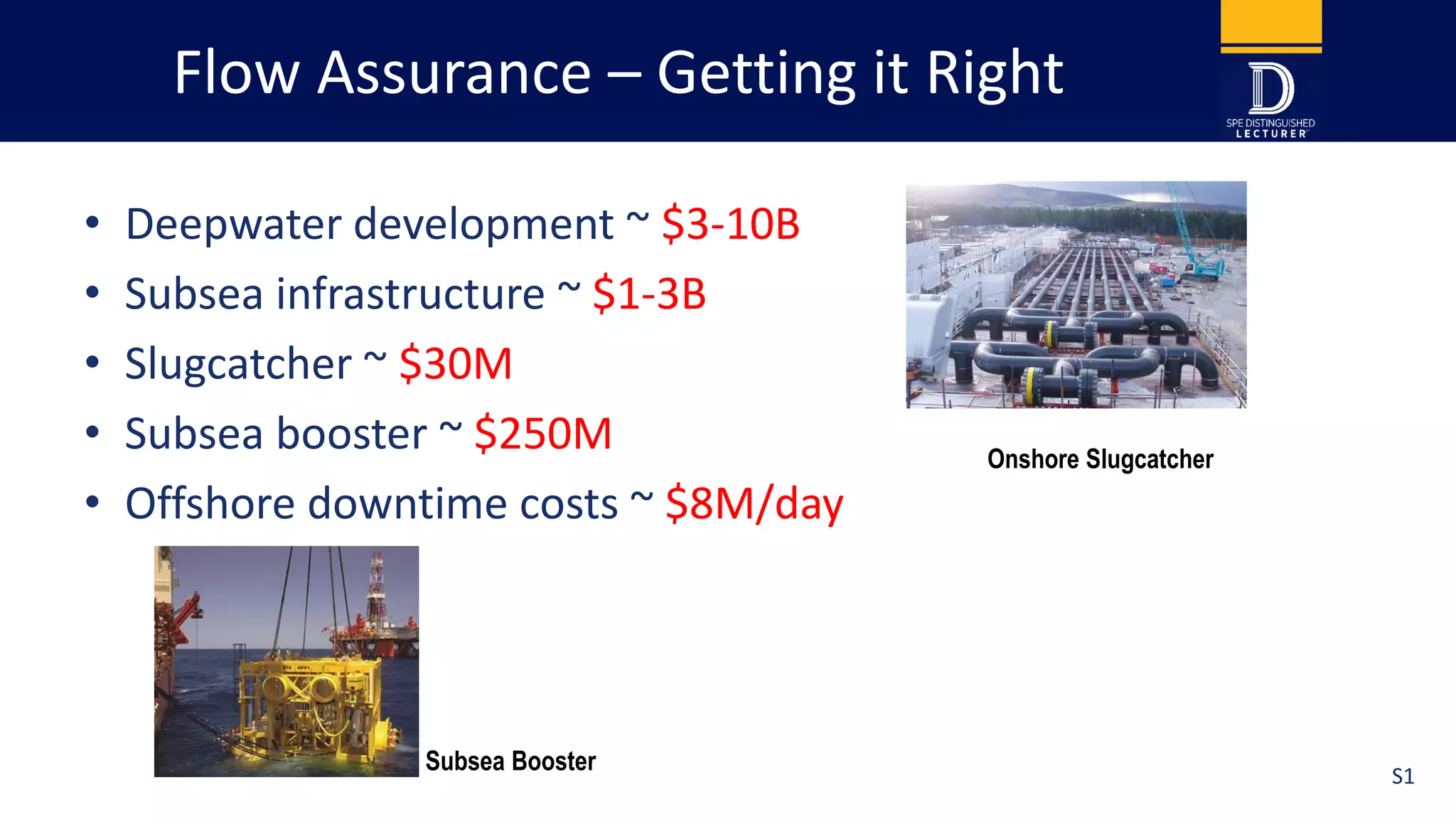
Flow Assurance – Getting it Right
• Deepwater development ~ $3-10B
• Subsea infrastructure ~ $1-3B
• Slugcatcher ~ $30M
• Subsea booster ~ $250M
• Offshore downtime costs ~ $8M/day
Onshore Slugcatcher
Subsea Booster S1
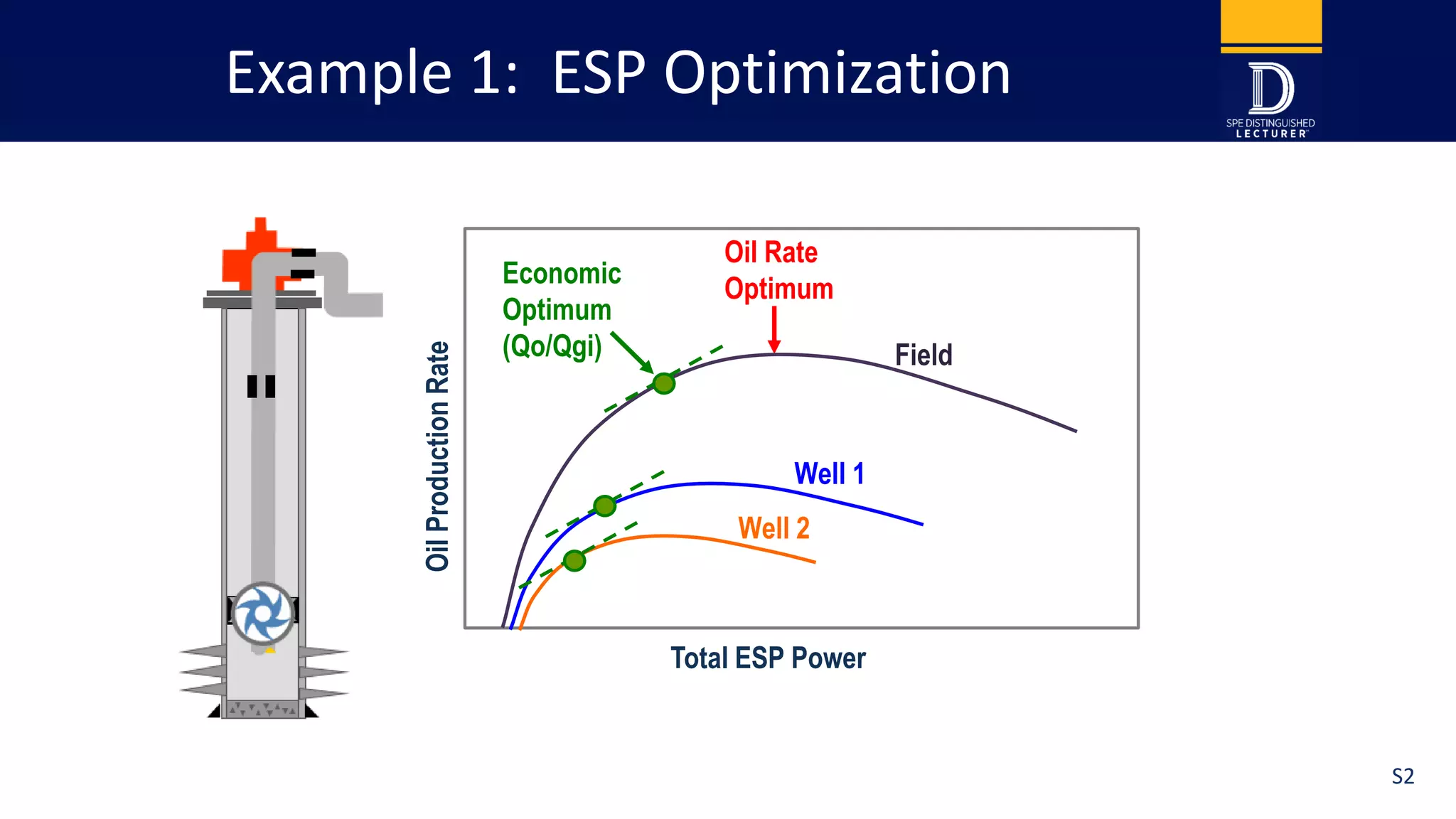
Example 1: ESP Optimization
OilProductionRate
Total ESP Power
Oil Rate
Optimum
Field
Well 1
Well 2
Economic
Optimum
(Qo/Qgi)
S2
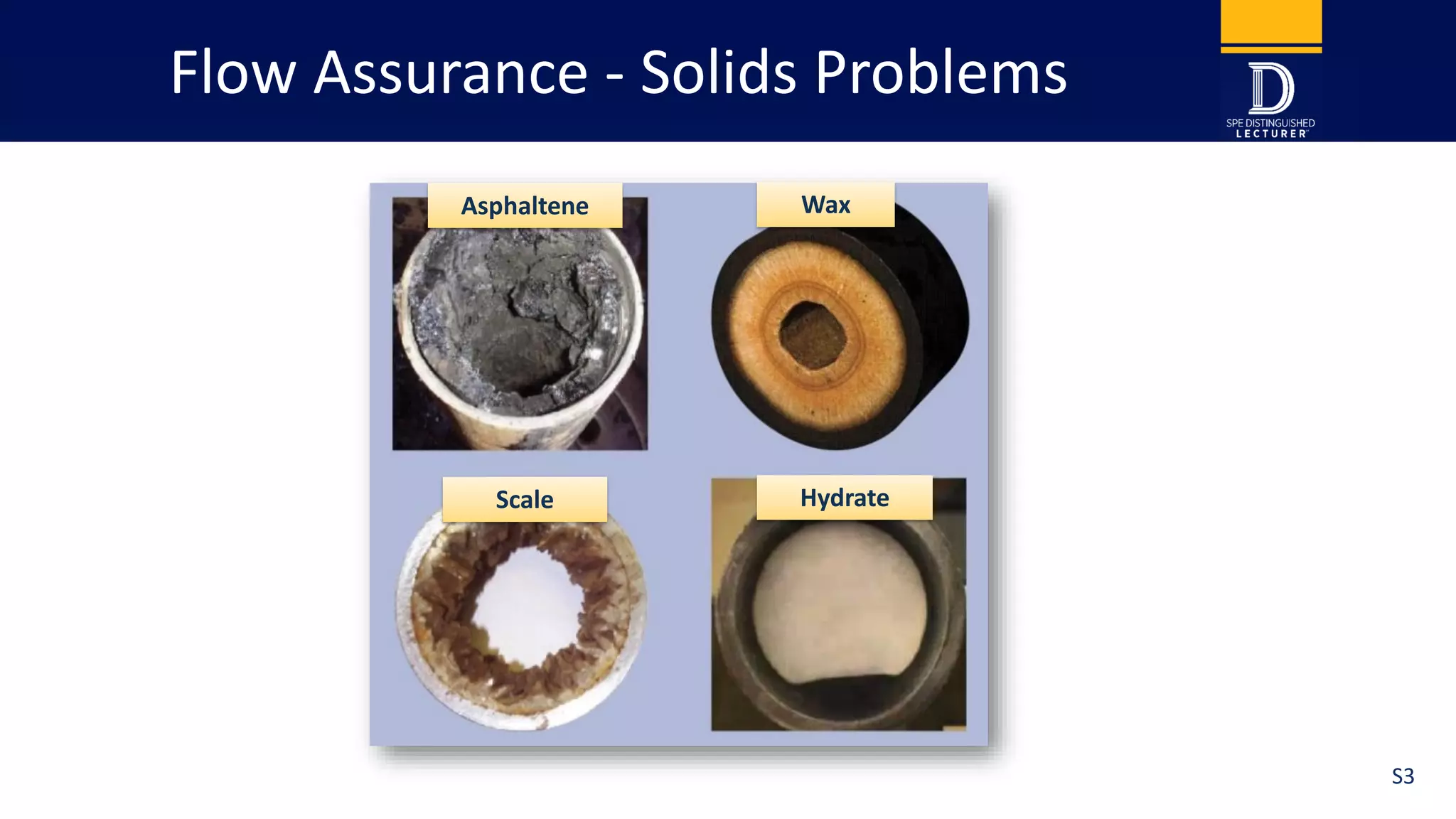
Flow Assurance - Solids Problems
Asphaltene Wax
Scale Hydrate
S3
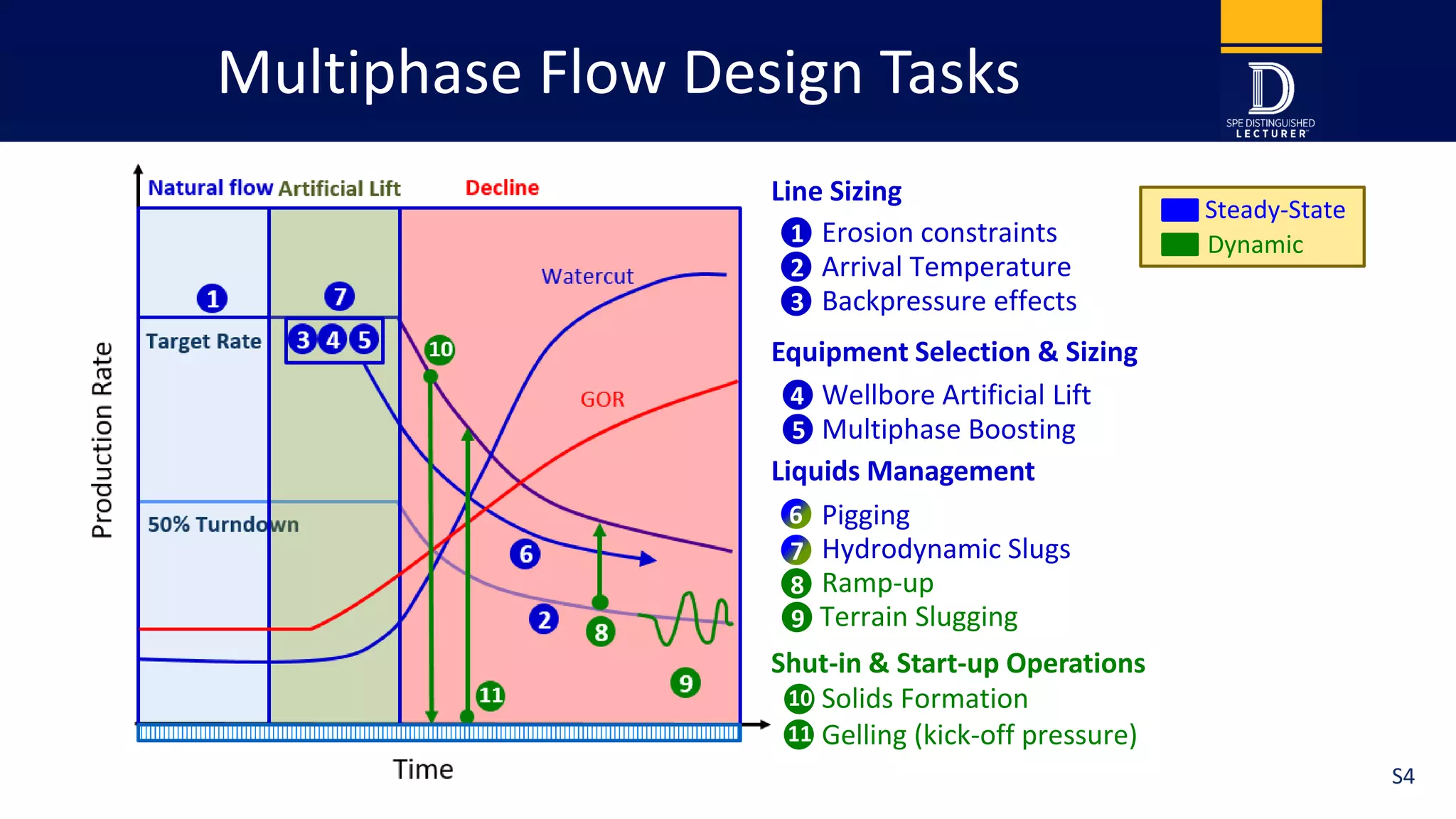
Multiphase Flow Design Tasks
Time
ProductionRate
Target Rate
50% Turndown
Natural flow Artificial Lift Decline Line Sizing
2
2
Arrival Temperature
Equipment Selection & Sizing
Erosion constraints
1
1
3 Backpressure effects
3
4 Wellbore Artificial Lift
5
4 5
Multiphase Boosting
Liquids Management
7
7
Hydrodynamic Slugs
6 Pigging
6
Watercut
GOR
Shut-in & Start-up Operations
8 Ramp-up
8
10 Solids Formation
10
11 Gelling (kick-off pressure)
11
Steady-State
Dynamic
Terrain Slugging9
9
S4
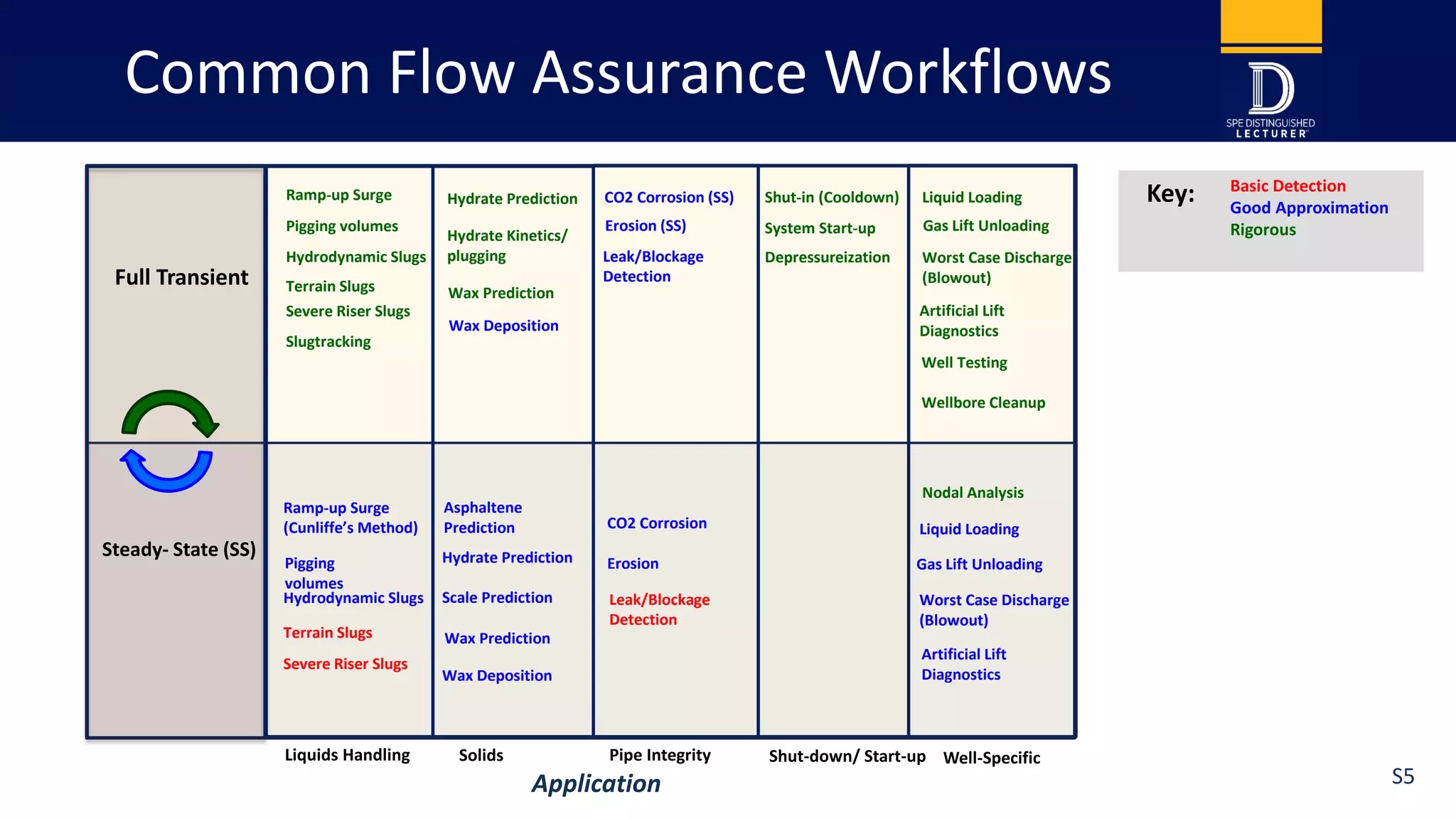
Common Flow Assurance Workflows
Basic Detection
Good Approximation
Rigorous
Key:
Full Transient
Steady- State (SS)
Liquids Handling
Ramp-up Surge
(Cunliffe’s Method)
Ramp-up Surge
Pigging
volumes
Hydrodynamic Slugs
Terrain Slugs
Severe Riser Slugs
Pigging volumes
Hydrodynamic Slugs
Terrain Slugs
Severe Riser Slugs
Slugtracking
Pipe Integrity
CO2 Corrosion
CO2 Corrosion (SS)
Erosion
Erosion (SS)
Leak/Blockage
Detection
Leak/Blockage
Detection
Solids
Wax Prediction
Scale Prediction
Wax Deposition
Hydrate Prediction
Hydrate Prediction
Wax Prediction
Hydrate Kinetics/
plugging
Wax Deposition
Asphaltene
Prediction
Well-Specific
Liquid Loading
Liquid Loading
Nodal Analysis
Gas Lift Unloading
Artificial Lift
Diagnostics
Gas Lift Unloading
Well Testing
Wellbore Cleanup
Worst Case Discharge
(Blowout)
Worst Case Discharge
(Blowout)
Artificial Lift
Diagnostics
Application
Shut-down/ Start-up
Shut-in (Cooldown)
System Start-up
Depressureization
S5

The Science and Economics of Multiphase Flow

  • 1.
    Society of PetroleumEngineers Distinguished Lecturer Program www.spe.org/dl Mack Shippen The Science and Economics of Multiphase Flow
  • 2.
    Outline – Introduction – TheScience of Multiphase Flow – The Economics of Multiphase Flow – Concluding Remarks 3 3
  • 3.
    A Broad Viewof Fluid Mechanics milliseconds 1m 1s Detonation Reservoir Pipelines Terrain Slugs Molecular Diffusion Chemical Reactions Cavitation Severe Riser Slugging Hyd. Slugs Bubbly Flow Formation Damage Wax Corrosion Hydrates Scale Erosion & Shut-in 4 Focus of this talk
  • 4.
    Total Production System Completion Choke SafetyValve Tubing Flowline Pump Compressor Separator Export lines Riser Reservoir gas oil Artificial Lift 5
  • 5.
    Pressure Changes Separator gas oil DP Safety Valve DP  Reservoir Drawdown DP  Completion DP  Wellhead Choke DP  Flowline DP  Compressor DP  Oil Export DP  Gas Export DP  Tubing DP  Riser DP  Pump • Flow in porous media • Artificial Lift • Multiphase Flow in pipes • Chokes/restrictions • Pumps/Compressors 6
  • 6.
  • 7.
    Temperature Changes Separator gas oil DT Safety Valve DT  Completion DT  Wellhead Choke DT  Flowline DT  Compressor DT  Oil Export DT  Gas Export DT  Tubing DT  Riser DT  Pump • Convection (free, forced) • Conduction • Elevation • JT Cooling/Heating • Frictional Heating 8
  • 8.
  • 9.
    Outline – Introduction – TheScience of Multiphase Flow – The Economics of Multiphase Flow – Concluding Remarks 3 10
  • 10.
    Liquid Holdup • Functionof the degree of gas-phase slippage • Gas travels faster because of lower density and viscosity • Higher mixture velocity  less slip 3 Qg = VgAg QL = VLAL Vg Ag VL AL AL AG No slip slip Holdup = 0  All gas flow Holdup = 1  All liquid flow 𝐻𝐿 = 𝐴 𝐿 𝐴 𝑃𝐼𝑃𝐸 11
  • 11.
    Pressure Losses Terrain effectsare important! pressure losses uphill are only partially recovered going downhill 12 ∝ velocity ∝ viscosity ~ zero∝ density 12
  • 12.
    Evolution of 1DSteady-State Multiphase Models MorePhysics 2000 2010199019801970196019501800 Single-Phase Homogeneous (Mixture Reynolds No.) Darcy-Weisbach-Moody Flow Regime Slip Zuber & Findlay Drift Flux Hagedorn & Brown Dukler, Eaton & Flanigan Gray Empirical Category B 2-Phase (Gas-Liquid) 3-Phase (Gas-Oil-Water) Inclination Angle Evolutionary Key: Flow Regime Slip Lockhart & Martinelli Poettmann& Carpenter Empirical Category A Baxendell & Thomas Empirical Category C Flow Regime Slip Mukherjee & BrillDuns & Ros Beggs & Brill SLB Drift-Flux Orkiszewski Mechanistic (Phenomenological) AnsariGovier, Aziz & Fogarasi Taitel & Dukler Xiao TUFFP Unified Hasan & Kabir OLGA-S LedaFlow PM 4500 30 190 # lines of code 13 State of th State-of- the-Art
  • 13.
    3-Phase Mechanistic FlowModels 3 BHR 2007-A2 • Based on combined force and momentum balances and best represent the physics of multiphase flow • Account for broad ranges of fluids and pipe geometries • Top 3 (State-of-the-Art) include OLGAS, LedaFlow and TUFFP Reality Model SPE 19451 SPE 95749 14
  • 14.
    Oil-Water Flow 6-inch pipe 1500BOPD 1500 BWPD 1.5 cp oil 2º up 2º down 0º 15 Oil−water flow experiments in 6-in.-diameter pipe (oil shown with red dye and water with blue dye). Each case has identical volumetric flow rates: 1500 bpd of each phase. The left- hand image shows upward flow inclined at θ = +2 ° (from the horizontal). The center image shows horizontal flow θ =0 °, while the right- hand image shows downward flow inclined at θ = −2° (from the horizontal). We observe that in the left-hand image, oil "slips" much faster over the water. In the center image, we have near- perfect stratified flow with no discernible slippage between phases, while in the right- hand image, we observe water rapidly slipping beneath the oil. These experiments clearly show how even a small inclination in pipe elevation can have a dramatic effect on slippage and associated flow regimes.
  • 15.
    Rule of 10’sFor Today’s “State of the Art”  Stable Flow < Operating Rate < Erosional Limits  Deviation angles ±10º of vertical or horizontal  Liquid volume fractions > 10%  Water or oil fraction < 10% relative to total liquid  Pipe diameters < 10 inches  Oil viscosities < 102 centipoise 3 Can generally expect +/- 10% Error in Accuracy of Holdup and Pressure Predictions for conditions of: 16
  • 16.
    Multiphase Flow ResearchCenters IFE, Norway Sintef, Norway Cranfield University (TMF), UK University of Tulsa (TUFFP), US 17
  • 17.
    Top 5 R&DChallenges 3. Exotic Fluids - Heavy Oil - Foam - Slurries 5. Model Discontinuities 4. Improved Closure vv Relationships 2. Odd Angles 1. 3+ Phases 18
  • 18.
    Outline – Introduction – TheScience of Multiphase Flow – The Economics of Multiphase Flow – Concluding Remarks 3 19
  • 19.
    Economics “Economics is thestudy of the use of scarce resources which have alternative uses” - Lionel Robbins 20
  • 20.
    Examples Example Description 1 -Offshore Field Planning Offshore Oil 2 - Slug Catcher Sizing Offshore Gas Condensate 3* – Terrain Effects Onshore Shale Oil 4* – Heavy Oil Pipeline Onshore Heavy Oil * Backup example for onshore focused audiences – see supplemental slides 21
  • 21.
    Example 1: OffshoreField Planning PlatformCost Platform Capacity Ultra-deep Deep Shallow 22
  • 22.
    Example 1: OptimalPlatform Size 1 32 Time OilProductionRate Oil Production Capacity NetPresentValue(NPV) 23
  • 23.
    Example 1: IntegratedModeling Constraints: Reservoir Forecast Production Network Process Facilities Max. Liquids: 80,000 BPD Max. Water: 25,000 BPD Max Gas Lift: 100 MMscfd Compressor power: 9,000 Hp. Production Network IPTC-11594 24 24
  • 24.
    Example 1: Dealingwith thru-life constraints IPTC-11594 Dominant Constraint: Total Liquid Production Rate Dominant Constraint: Total Compressor Power Dominant Constraint: Water Handling Capacity Dominant Constraint: Operating Costs 25
  • 25.
    Example 1: GasLift Optimization OilProductionRate Total Gas Lift Injection Rate Oil Rate Optimum Field Well 1 Well 2 Economic Optimum (Qo/Qgi) Numerous published field studies have shown gas lift optimization to improve production by 3-15% SPE175785SPE 120664SPE 123799 26
  • 26.
    Example 2: LiquidsHandling for Offshore Wet Gas Export Pipeline 100-mile 32” 50-mile 24” wet gas 20-mile 12” dry gas Onshore Slug Catcher PSIG 0403 30-mile 16” wet gas 27
  • 27.
    Example 2: Pigginga Flowline Why? • Remove solids > reduce blockage risk • Remove liquids > less pressure loss VL VG VM VL VGVM Size of slug proportional to gas-liquid slip 28
  • 28.
    Example 2: Ramp-UpSurge Qg initial Qg final Qg surge VL VL VL Size of surge proportional to difference in liquid content before and after 29
  • 29.
    Example 2: SlugCatcher Sizing SLIP (Pig) SURGE (Ramp-Up) PSIG 0403 OLGASRampUp OLGASPig XiaoRamp XiaoPig $30M $16M Installed Cost: 30
  • 30.
    Example 2: SlugCatcher Sizing Uncertainties PSIG 1603 31
  • 31.
    Example 2: SlugCatcher Sizing Deterministic Analysis -30% 25% -60% 40% PSIG 1603 32
  • 32.
    Example 2: SlugCatcher Sizing Probabilistic Analysis P-10 P-50 P-90 P-50 P-90 P-10 PSIG 1603 33
  • 33.
    Example 2: SlugCatcher Sizing Economics PSIG 1603 34
  • 34.
    Example 3: SimplePressure Drop Calculation 5 mile, 4” flowlineGOR = 5000 scf/STB 45° API Gravity QL = 1000, 100 BPD Your Job: Calculate the required inlet pressure! 500 psia 35
  • 35.
    Example 3: TerrainEffects 62 feet 5 miles Absolute difference (Net - 0.14°) Terrain effects (+/- 4°from horizontal) 36
  • 36.
    Example 3: Results– Pressure Loss 1,000 BPD 100 BPD Vmix ~ 2 ft/s Stratified-Smooth & Slug Flow D Z Terrain Takeaway: Terrain Effects Critical For Low Rate Cases! Vmix ~ 15 ft/s Stratified-Wavy & Slug Flow 37
  • 37.
    Example 3: Results– Liquid Holdup (OLGAS) 1,000 BPD 100 BPD D Z Terrain HL (no-slip) ~ 5% Slug Stratified Slug Stratified 38
  • 38.
    Example 3: Results– Pigging Volumes 1,000 BPD 100 BPD D Z Terrain Takeaway: Terrain Effects Critical For Low Rate Cases! PigSlugVolume(bbl) 0 10 20 30 40 50 60 70 80 90 100 PV (Terrain) PV(DZ) PV (Terrain) PV(DZ) OLGAS TUFFP PIGSLUGVOLUME(BBL) Pig Slug Volume PigSlugVolume(bbl) 39
  • 39.
    Example 3: JustPart of the Network! Shale Oil Network: Eagleford Field, Texas 40
  • 40.
    Example 4: Inspiration TheEl Morro  Araguaney Pipeline 41
  • 41.
    Example 4: HeavyOil Pipeline Pin = 800 psia 16◦ API 30 % watercut Pout = 800 psiaCalculate Liquid Rate 42
  • 42.
    Example 4: DiluentInjection – 5.7” pipe pump No pump ~ 7000 BPD OIL ~ 5000 BPD DILUENT ~ 3500 BPD OIL ~ 3600 BPD DILUENT ~10,000 cp ~ 300 cp 43
  • 43.
    Example 4: DiluentInjection – 7” pipe pump No pump ~ 7000 BPD OIL ~ 3500 BPD OIL ~ 2700 BPD DILUENT ~ 1800 BPD DILUENT 44
  • 44.
    Example 4: PipelineEconomics Method Effect Constraints OPEX CAPEX Pump ↑ pressure ↔ friction loss MAOP Power ↔ Med ↑ High Diluent ↓ viscosity ↓ friction loss Diluent availability Power ↑ High ↔ Med Larger Pipe size ↓ velocity ↓ friction loss Phase of development ↓Low ↑ High DRA ↓ turbulence ↓ friction loss ↔ Med ↓Low Maximum Allowable Operating Pressure Drag Reducing Agents Operating Cost Upfront Capital Cost MAOP = DRA = OPEX = CAPEX = 45
  • 45.
    Outline – Introduction – TheScience of Multiphase Flow – The Economics of Multiphase Flow – Concluding Remarks 3 46
  • 46.
    Concluding Remarks • Goodtechnology in multiphase flow modeling has emerged from years of research and development • Challenges still remain  flow assurance is not a certainty • Economics justify the Science! • Ultimate goal is to maximize production while minimizing flow assurance risks and operational costs 47
  • 47.
    An Integrated Viewof Fluid Mechanics Pipelines Wellbores Reservoir Process Equipment 48
  • 48.
    Society of PetroleumEngineers Distinguished Lecturer Program www.spe.org/dl Your Feedback is Important Enter your section in the DL Evaluation Contest by completing the evaluation form for this presentation Visit SPE.org/dl
  • 49.
  • 50.
    Flow Assurance –Getting it Right • Deepwater development ~ $3-10B • Subsea infrastructure ~ $1-3B • Slugcatcher ~ $30M • Subsea booster ~ $250M • Offshore downtime costs ~ $8M/day Onshore Slugcatcher Subsea Booster S1
  • 51.
    Example 1: ESPOptimization OilProductionRate Total ESP Power Oil Rate Optimum Field Well 1 Well 2 Economic Optimum (Qo/Qgi) S2
  • 52.
    Flow Assurance -Solids Problems Asphaltene Wax Scale Hydrate S3
  • 53.
    Multiphase Flow DesignTasks Time ProductionRate Target Rate 50% Turndown Natural flow Artificial Lift Decline Line Sizing 2 2 Arrival Temperature Equipment Selection & Sizing Erosion constraints 1 1 3 Backpressure effects 3 4 Wellbore Artificial Lift 5 4 5 Multiphase Boosting Liquids Management 7 7 Hydrodynamic Slugs 6 Pigging 6 Watercut GOR Shut-in & Start-up Operations 8 Ramp-up 8 10 Solids Formation 10 11 Gelling (kick-off pressure) 11 Steady-State Dynamic Terrain Slugging9 9 S4
  • 54.
    Common Flow AssuranceWorkflows Basic Detection Good Approximation Rigorous Key: Full Transient Steady- State (SS) Liquids Handling Ramp-up Surge (Cunliffe’s Method) Ramp-up Surge Pigging volumes Hydrodynamic Slugs Terrain Slugs Severe Riser Slugs Pigging volumes Hydrodynamic Slugs Terrain Slugs Severe Riser Slugs Slugtracking Pipe Integrity CO2 Corrosion CO2 Corrosion (SS) Erosion Erosion (SS) Leak/Blockage Detection Leak/Blockage Detection Solids Wax Prediction Scale Prediction Wax Deposition Hydrate Prediction Hydrate Prediction Wax Prediction Hydrate Kinetics/ plugging Wax Deposition Asphaltene Prediction Well-Specific Liquid Loading Liquid Loading Nodal Analysis Gas Lift Unloading Artificial Lift Diagnostics Gas Lift Unloading Well Testing Wellbore Cleanup Worst Case Discharge (Blowout) Worst Case Discharge (Blowout) Artificial Lift Diagnostics Application Shut-down/ Start-up Shut-in (Cooldown) System Start-up Depressureization S5