Primary funding is provided by
The SPE Foundation through member donations
and a contribution from Offshore Europe
The Society is grateful to those companies that allow their
professionals to serve as lecturers
Additional support provided by AIME
Society of Petroleum Engineers
Distinguished Lecturer Program
www.spe.org/dl
Society of Petroleum Engineers
Distinguished Lecturer Program
www.spe.org/dl
George Stosur
Consultant, Formerly U.S. Department of Energy
Global Warming Wars and Fossil Energy
Current and Future Realities
Outline
• World supply/demand for Fossil Fuels
• Linkage to global climate change
• Greenhouse gases and effects
• Science and politics; ongoing battles
• Very difficult challenges; technical and political
• Opportunities for the petroleum industry
Shouting match between the political
and environmental left and right
• The left
(believers)
• The right
(sceptics)
• Recent
developments
Demands curbs on smokestack
and tailpipe heat trapping gases
See global warming between
an irritant and a hoax
A “warming” trend between
the two camps; move to pragmatism
4
IPCC -- led by U.N.
• Financed by IPCC Trust
Fund (governments)
• Emphasis on modeling
NIPCC -- led by sceptics
• Financed by corporate
and private interests
• Emphasis on measurements
5
Neither does their own research.
Both claim assessment based on published
literature and peer-reviewed sources.
Is there more than one legitimate perspective?
6
Intergovernmental Panel on
Climate Change (IPCC)
(UN sanction and support)
Non-governmental Int. Panel on
Climate Change (NIPCC)
(No govt. sanction or support)
Human activity has minor impactClimate change due to human activity
Greenhouse Gases
• Act like glass in a
greenhouse
• Control infrared solar
energy entering/leaving
atmosphere
• Without these gases --
avg. Tair would be
-18ºC, not +15ºC
• Water vapor
• Carbon dioxide
• Methane, hydr.
• Ozone
• Nitrous oxides
• Some synthetics
11
# 1 Concern:
Rapid CO2 increase
• Well documented
increase of CO2
• Correlates with T
8Source: NOAA
Atmospheric CO2 at Mauna Loa, Hawaii
• Precisely
measured
and well
established
rise of CO2
9
Courtesy: NOAA
Step Back in Geologic Time
With complex systems,
the key to predicting the future lies
in understanding the past
10
Good correlation of Global T, CO2 CH4 over 400,000 years
11
Source: Petit et al. 1999; Nature, 399-429; IPCC
N. America’s Topography – 20,000 years ago
• America’s last
glaciation (ice
thickness in m)
• Greater coastlines
because sea level
was 400 ft lower
Courtesy: John Willy and Sons, 1999
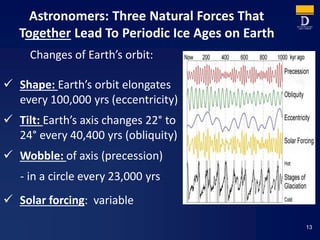
Astronomers: Three Natural Forces That
Together Lead To Periodic Ice Ages on Earth
Changes of Earth’s orbit:
✓ Shape: Earth’s orbit elongates
every 100,000 yrs (eccentricity)
✓ Tilt: Earth’s axis changes 22° to
24° every 40,400 yrs (obliquity)
✓ Wobble: of axis (precession)
- in a circle every 23,000 yrs
✓ Solar forcing: variable
13
Solar Cycles
• Well established solar cycles – 11 years
• Longer and unknown solar cycles?
• Solar Magnetic Waves
– Mini Ice Age predicted 2021 to 2054?
14
Little “Ice Age”
Source: Wikipedia
a.k.a. Little Ice Age
12
Frozen River Thames, Maunder Minimum,1693
Source: The Museum of London 15
IPCC’s conclusions (U.N. -2014)
• Human influence on climate system is clear
• Surface T projected to rise over the 21st century
under all emission scenarios (modeling)
• Oceans to warm, acidify, sea level to rise
• Rain/drought events to become more intense
• Impact on fauna and flora
• Climate change beyond 2100 – irreversible
16
The Inconvenient Scientists (“Sceptics”)
• Feel being intimidated into silence
• Claim that their grants disappear, their work
derided, labeled as industry stooges
• Most are retired; need no grants
• Claim that alarm, not genuine scientific interest
appears essential to maintaining funding
17
Reaction of the Petroleum Industry
• Changing attitude; a reflection of political reality
• Industry has long opposed
emission constraints; now
cooperate on structuring rules
• Now discuss who and how
to pay for CO2 sequestration
• Recent trend: push to simplify
rules (deconstruction)
18
19
Reaction of SPE members
(From discussion on )
“SPE Connect” posts on climate change (informal % count:)
Neutral* – 46% Believers – 25% Sceptics –29%
20
*No detectable leaning, e.g. focus of CO2 disposal, etc.
• The SPE Climate Change Task Force recommended
that SPE should not develop a public position statement
on climate science and climate change because
"SPE does not have technical expertise or mandate for
assessing climate science or guiding policy“
• “Climate science and policy are outside of SPE’s
core competencies; SPE is recommended to draw
on information from other competent sources”
U.S. policy converging on carbon tax
• Concept: put price on CO2; consumers will
find thousands of ways to cut emissions
• Avoids myriad of gov. regulations; shrinks gov. size
• Peg tax at $40/ton of CO2; equiv. to ~36c/gal
• Tax money would go to citizens, not gov. revenue
• “Carbon dividend” to a family of four ~$2,000/yr
• Expect fights from industry, esp. coal
21
Two Top U.S. Economists Win Nobel for
Work on Growth and Climate
• “There are billions of people, millions of firms,
thousands of govs., hundreds of nations.
For them to take action, they
must have incentives”
• “We can raise prices of goods
and services that are carbon intensive and
lower the ones that are less carbon intensive.”
22
WSJ; Oct 10, 2018
Hot off the press
• “Senators to unveil carbon tax bill to generate
$2.5 trillion in 10 years
• It would rebate 70 % of the money to families
and use the rest for energy infrastructure
23Reuters, July 24, 2019
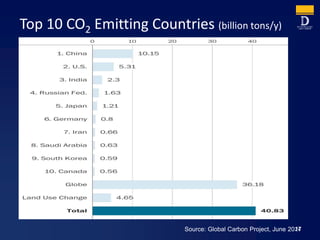
Top 10 CO2 Emitting Countries (billion tons/y)
24Source: Global Carbon Project, June 2017
25
Carbon Capture and Storage
• CCS challenges not only technical, but economic,
legislative, winning public acceptance
• EOR -- first step to a CCS business, but limited
by scale, geography. Short term solution. <1%*
• Deep saline formation below 1000m
likely main type of storage in short/mid term
• Other options: not many and not attractive
26
*Sunil Kokal, JPT, July 2017
Good News for Petroleum
Engineers/Geologists
• Long term CO2 storage -- political reality
• We are leading source of expertise for
subsurface injection of any fluids
• Massive projects required; many opportunities,
new businesses; specialized services
• Most of these will fall on our shoulders
27
Example: EOR/CO2 Sequestration
• CO2/coal gas. plant in ND, captured, compressed,
pipelined, injected to depleted oil field in
Weyburn, Canada
• CO2 flooding and
long-term storage
• CO2 misc. dominate
U.S. EOR; 139 active
28Courtesy: IEA/GHG Report on CSC, 3/2017
Shortcomings of the Paris agreement
• Based largely on political imperatives
• Pledges were voluntary, submitted in advance
• All were accepted without scrutiny
• Pledges did not have to mention emissions levels
• There were no penalties for falling short
29
Wall Street Journal, June 2017
“Those who rely solely on forecasting in their thinking about
the future, can find the consequences very expensive”
30
Source: C3 Headlines
Source: Shell International, Ltd (modified)
2019 SPE President Offers a Vision of
Oil and Gas Sustainability
31
• Outlined the focus of
his year-long tenure
• Future image of our
industry; promotion of
energy sustainability
JPT: Sept 27, 2018
Oil and Gas Climate Initiative (OGCI)
• Voluntary, CEO-led initiative, established
in 2014 by ten major oil/gas companies
• Aim: lower carbon footprints of energy industry via
engagements, policies, investments and deployment
32
Public pressure matters (1)
• “Norway’s $1 trillion pension fund wants out
of oil stocks” (CNN, 4/16/18)
• “ExxonMobil to decrease CH4 emissions by 15%,
flaring by 25% by 2020. Already spent >$9 billion
since 2000, (O&GJ, 5/23/18)
• New target for CO2 emission standards in the EU
causing panic among car makers -- potential fines
up to €33 billion ($37 billion), (WSJ, 6/21/ 19)
• “Shell to link carbon emissions to executive pay,
capitulating to investor pressure” (WSJ; 12/4/18)
33
Public pressure matters (2)
• California mandated completely carbon-free
electricity by 2045 (WSJ, 9/17/18)
• Saudi Aramco to invest up to $5 billion in the
renewable energy sector (JPT; 7/18)
• Majors to reduce oil exploration, begin to
diversify into renewable energy (WSJ, 7/14/18)
• “Investor pressure could change what it means
to be an oil and gas company” (JPT; 7/20/18)
34
The world is losing war against climate change*
Why??? Three major reasons:
• Soaring energy demand, esp. developing countries
• Economic and political inertia. Powerful lobbies,
huge investments made by banks; can cripple the
banking system if investments fail
• Not just power generation: steel, cement, farming,
transport; generate >1/2 of global CO2 emissions;
technically harder to clean than power generation
35
*Credit: The Economist, August 4, 2018
Why so hard to change? Economics!
• Macron imposed taxes on
fuel to fight climate change;
faced riots; had to backed off
• The Extinction Rebellion,
in London: “Tell the Truth”
• Voters in liberal Washington
state have twice rejected higher tax on fuel
• Fuel almost free in Venezuela; Gov. afraid
of raising prices/taxes; fear of inciting riots
36
Quotable
Solar panels are
great, but we
should be hearing
about trucks,
cement, and
cow farts, too.
37
— Bill Gates on tech innovation to battle greenhouse gas emissions
Measuring greenhouse gas emissions
BBC News, U.K. Edition
• Farmers in New Zealand disgusted at gov.
plans to impose animal "flatulence tax“
• Sending parcels of cow manure
to members of parliament
• Angered postal workers: smelly
packages to pose health risk
• Also testing sheep for CH4 production
38
Source: NZ newspaper, 2009
Methane, the hot gas…
Two major sources of methane:
• Natural sources (30%): wetlands, termites,
oceanic processes, other minor sources
• Anthropogenic sources (70%): fermentation
in ruminant animals, rice cultivation, biomass
burning, landfills, coal mining, sewage treatment
• 21% more potent than CO2; role of methane hydrates
My parting statement
• CO2 sequestration will
become an integral
part of all operations
utilizing fossil energy
• In fact, that process has already begun
40
Green Transportation
41
Conclusions, Future Trends
• Near term: favor cheap NG, reduce CO2 emissions, LNG
• Mid term: environmentally acceptable ways to
utilize heavy oil, “clean coal,” renewables
• Long term: permanent solution to CO2 sequestration;
it’s not an option -- it’s a must
✓ Renewables significant, but will not replace HC
✓ Pressure to address global warming is growing
✓ The global climate wars to continue
42
Society of Petroleum Engineers
Distinguished Lecturer Program
www.spe.org/dl
43
Your Feedback is Important
Enter your section in the DL Evaluation Contest by
completing the evaluation form for this presentation
Visit SPE.org/dl
#SPEDL
So, take advantage of SPE’s multiple learning opportunities
43
44
RESERVE
45
Current and future realities
• SPE’s president called oil/gas industry at large to
help meet the twin challenges of growing future
energy demand and global climate change more
aggressively – (2019 mtg of US Energy Association)
• “Considers SPE ideal with members in
154 countries – 65% under 35
• “We are ready to accept the responsibility
as well as claim the credit”
46
Source: April 25, 2019
Coal in trouble – gas is king
• Coal mines continue
filing for bankruptcy
• Gas production surges
• Trend to continue
• Lower CO2 emissions
• Renewable energy (wind, solar, hydro) to
outpace coal by 2020 for first time ever in U.S.
47
Source: EIA, Short-Term
Energy Outlook, April 2019
“‘Sin stocks’ Seek Atonement”
(Wall Street Journal, 7/9/19)
• “Shell, VW, among those spending billions
on ‘responsible’ products”
• “Across the spectrum of industries, companies
act to improve their image/business prospects
by shifting to less-harmful products”
• Ex.: VW, a pariah of investors (emissions scandal);
focused on battery powered vehicles and hybrids
• Energy producers join hunt for ‘cleaner barrels’
Financial Times, 7/8/19)
48
U.S. Government Funding
of Climate Change
• Total U.S. expenditures on climate change
from FY 1993 to 2014: $166 billion (2012 $$)
• By comparison, Congressional Budget Office
estimated the entire Apollo program, from
1962 to 1973 (17 missions; 7 with men to
moon and back) -- cost $170 billion (2005 $$)
49
Source: Kenneth Haapala; “U.S. Government Funding of
Climate Change” Capital Research Center, Washington, D.C.
DOE laboratories, ExxonMobil launch
lower-emissions research
• Two US DOE National Labs and ExxonMobil Corp. plan to
invest up to $100 million over 10 years to advance lower
emissions energy technologies that could be brought to
a commercial scale. One of the largest agreements
between DOE’s National Labs and the private sector
• Exxon’s VP for R&D: “Finding solutions to address
climate change is going to take everyone—governments,
companies, and academia—working together,”
50O&GJ, 5/8/2019
51
“Mars Melt Hints at Solar,
Not Human Cause for Warming”
• From NASA’s Mars Global
Surveyor and Odyssey
missions
• CO2 "ice caps" near
Mars‘s south pole
diminishing for three
summers in a row
52
National Geographic, Feb 27, 2007
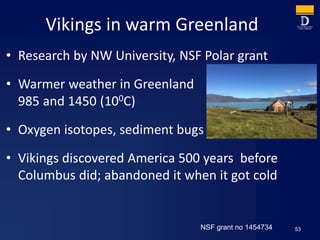
Vikings in warm Greenland
• Research by NW University, NSF Polar grant
• Warmer weather in Greenland
985 and 1450 (100C)
• Oxygen isotopes, sediment bugs
• Vikings discovered America 500 years before
Columbus did; abandoned it when it got cold
53NSF grant no 1454734
54

George Stosur

  • 1.
    Primary funding isprovided by The SPE Foundation through member donations and a contribution from Offshore Europe The Society is grateful to those companies that allow their professionals to serve as lecturers Additional support provided by AIME Society of Petroleum Engineers Distinguished Lecturer Program www.spe.org/dl
  • 2.
    Society of PetroleumEngineers Distinguished Lecturer Program www.spe.org/dl George Stosur Consultant, Formerly U.S. Department of Energy Global Warming Wars and Fossil Energy Current and Future Realities
  • 3.
    Outline • World supply/demandfor Fossil Fuels • Linkage to global climate change • Greenhouse gases and effects • Science and politics; ongoing battles • Very difficult challenges; technical and political • Opportunities for the petroleum industry
  • 4.
    Shouting match betweenthe political and environmental left and right • The left (believers) • The right (sceptics) • Recent developments Demands curbs on smokestack and tailpipe heat trapping gases See global warming between an irritant and a hoax A “warming” trend between the two camps; move to pragmatism 4
  • 5.
    IPCC -- ledby U.N. • Financed by IPCC Trust Fund (governments) • Emphasis on modeling NIPCC -- led by sceptics • Financed by corporate and private interests • Emphasis on measurements 5 Neither does their own research. Both claim assessment based on published literature and peer-reviewed sources.
  • 6.
    Is there morethan one legitimate perspective? 6 Intergovernmental Panel on Climate Change (IPCC) (UN sanction and support) Non-governmental Int. Panel on Climate Change (NIPCC) (No govt. sanction or support) Human activity has minor impactClimate change due to human activity
  • 7.
    Greenhouse Gases • Actlike glass in a greenhouse • Control infrared solar energy entering/leaving atmosphere • Without these gases -- avg. Tair would be -18ºC, not +15ºC • Water vapor • Carbon dioxide • Methane, hydr. • Ozone • Nitrous oxides • Some synthetics 11
  • 8.
    # 1 Concern: RapidCO2 increase • Well documented increase of CO2 • Correlates with T 8Source: NOAA
  • 9.
    Atmospheric CO2 atMauna Loa, Hawaii • Precisely measured and well established rise of CO2 9 Courtesy: NOAA
  • 10.
    Step Back inGeologic Time With complex systems, the key to predicting the future lies in understanding the past 10
  • 11.
    Good correlation ofGlobal T, CO2 CH4 over 400,000 years 11 Source: Petit et al. 1999; Nature, 399-429; IPCC
  • 12.
    N. America’s Topography– 20,000 years ago • America’s last glaciation (ice thickness in m) • Greater coastlines because sea level was 400 ft lower Courtesy: John Willy and Sons, 1999
  • 13.
    Astronomers: Three NaturalForces That Together Lead To Periodic Ice Ages on Earth Changes of Earth’s orbit: ✓ Shape: Earth’s orbit elongates every 100,000 yrs (eccentricity) ✓ Tilt: Earth’s axis changes 22° to 24° every 40,400 yrs (obliquity) ✓ Wobble: of axis (precession) - in a circle every 23,000 yrs ✓ Solar forcing: variable 13
  • 14.
    Solar Cycles • Wellestablished solar cycles – 11 years • Longer and unknown solar cycles? • Solar Magnetic Waves – Mini Ice Age predicted 2021 to 2054? 14 Little “Ice Age” Source: Wikipedia a.k.a. Little Ice Age 12
  • 15.
    Frozen River Thames,Maunder Minimum,1693 Source: The Museum of London 15
  • 16.
    IPCC’s conclusions (U.N.-2014) • Human influence on climate system is clear • Surface T projected to rise over the 21st century under all emission scenarios (modeling) • Oceans to warm, acidify, sea level to rise • Rain/drought events to become more intense • Impact on fauna and flora • Climate change beyond 2100 – irreversible 16
  • 17.
    The Inconvenient Scientists(“Sceptics”) • Feel being intimidated into silence • Claim that their grants disappear, their work derided, labeled as industry stooges • Most are retired; need no grants • Claim that alarm, not genuine scientific interest appears essential to maintaining funding 17
  • 18.
    Reaction of thePetroleum Industry • Changing attitude; a reflection of political reality • Industry has long opposed emission constraints; now cooperate on structuring rules • Now discuss who and how to pay for CO2 sequestration • Recent trend: push to simplify rules (deconstruction) 18
  • 19.
  • 20.
    Reaction of SPEmembers (From discussion on ) “SPE Connect” posts on climate change (informal % count:) Neutral* – 46% Believers – 25% Sceptics –29% 20 *No detectable leaning, e.g. focus of CO2 disposal, etc. • The SPE Climate Change Task Force recommended that SPE should not develop a public position statement on climate science and climate change because "SPE does not have technical expertise or mandate for assessing climate science or guiding policy“ • “Climate science and policy are outside of SPE’s core competencies; SPE is recommended to draw on information from other competent sources”
  • 21.
    U.S. policy convergingon carbon tax • Concept: put price on CO2; consumers will find thousands of ways to cut emissions • Avoids myriad of gov. regulations; shrinks gov. size • Peg tax at $40/ton of CO2; equiv. to ~36c/gal • Tax money would go to citizens, not gov. revenue • “Carbon dividend” to a family of four ~$2,000/yr • Expect fights from industry, esp. coal 21
  • 22.
    Two Top U.S.Economists Win Nobel for Work on Growth and Climate • “There are billions of people, millions of firms, thousands of govs., hundreds of nations. For them to take action, they must have incentives” • “We can raise prices of goods and services that are carbon intensive and lower the ones that are less carbon intensive.” 22 WSJ; Oct 10, 2018
  • 23.
    Hot off thepress • “Senators to unveil carbon tax bill to generate $2.5 trillion in 10 years • It would rebate 70 % of the money to families and use the rest for energy infrastructure 23Reuters, July 24, 2019
  • 24.
    Top 10 CO2Emitting Countries (billion tons/y) 24Source: Global Carbon Project, June 2017
  • 25.
  • 26.
    Carbon Capture andStorage • CCS challenges not only technical, but economic, legislative, winning public acceptance • EOR -- first step to a CCS business, but limited by scale, geography. Short term solution. <1%* • Deep saline formation below 1000m likely main type of storage in short/mid term • Other options: not many and not attractive 26 *Sunil Kokal, JPT, July 2017
  • 27.
    Good News forPetroleum Engineers/Geologists • Long term CO2 storage -- political reality • We are leading source of expertise for subsurface injection of any fluids • Massive projects required; many opportunities, new businesses; specialized services • Most of these will fall on our shoulders 27
  • 28.
    Example: EOR/CO2 Sequestration •CO2/coal gas. plant in ND, captured, compressed, pipelined, injected to depleted oil field in Weyburn, Canada • CO2 flooding and long-term storage • CO2 misc. dominate U.S. EOR; 139 active 28Courtesy: IEA/GHG Report on CSC, 3/2017
  • 29.
    Shortcomings of theParis agreement • Based largely on political imperatives • Pledges were voluntary, submitted in advance • All were accepted without scrutiny • Pledges did not have to mention emissions levels • There were no penalties for falling short 29 Wall Street Journal, June 2017
  • 30.
    “Those who relysolely on forecasting in their thinking about the future, can find the consequences very expensive” 30 Source: C3 Headlines Source: Shell International, Ltd (modified)
  • 31.
    2019 SPE PresidentOffers a Vision of Oil and Gas Sustainability 31 • Outlined the focus of his year-long tenure • Future image of our industry; promotion of energy sustainability JPT: Sept 27, 2018
  • 32.
    Oil and GasClimate Initiative (OGCI) • Voluntary, CEO-led initiative, established in 2014 by ten major oil/gas companies • Aim: lower carbon footprints of energy industry via engagements, policies, investments and deployment 32
  • 33.
    Public pressure matters(1) • “Norway’s $1 trillion pension fund wants out of oil stocks” (CNN, 4/16/18) • “ExxonMobil to decrease CH4 emissions by 15%, flaring by 25% by 2020. Already spent >$9 billion since 2000, (O&GJ, 5/23/18) • New target for CO2 emission standards in the EU causing panic among car makers -- potential fines up to €33 billion ($37 billion), (WSJ, 6/21/ 19) • “Shell to link carbon emissions to executive pay, capitulating to investor pressure” (WSJ; 12/4/18) 33
  • 34.
    Public pressure matters(2) • California mandated completely carbon-free electricity by 2045 (WSJ, 9/17/18) • Saudi Aramco to invest up to $5 billion in the renewable energy sector (JPT; 7/18) • Majors to reduce oil exploration, begin to diversify into renewable energy (WSJ, 7/14/18) • “Investor pressure could change what it means to be an oil and gas company” (JPT; 7/20/18) 34
  • 35.
    The world islosing war against climate change* Why??? Three major reasons: • Soaring energy demand, esp. developing countries • Economic and political inertia. Powerful lobbies, huge investments made by banks; can cripple the banking system if investments fail • Not just power generation: steel, cement, farming, transport; generate >1/2 of global CO2 emissions; technically harder to clean than power generation 35 *Credit: The Economist, August 4, 2018
  • 36.
    Why so hardto change? Economics! • Macron imposed taxes on fuel to fight climate change; faced riots; had to backed off • The Extinction Rebellion, in London: “Tell the Truth” • Voters in liberal Washington state have twice rejected higher tax on fuel • Fuel almost free in Venezuela; Gov. afraid of raising prices/taxes; fear of inciting riots 36
  • 37.
    Quotable Solar panels are great,but we should be hearing about trucks, cement, and cow farts, too. 37 — Bill Gates on tech innovation to battle greenhouse gas emissions
  • 38.
    Measuring greenhouse gasemissions BBC News, U.K. Edition • Farmers in New Zealand disgusted at gov. plans to impose animal "flatulence tax“ • Sending parcels of cow manure to members of parliament • Angered postal workers: smelly packages to pose health risk • Also testing sheep for CH4 production 38 Source: NZ newspaper, 2009
  • 39.
    Methane, the hotgas… Two major sources of methane: • Natural sources (30%): wetlands, termites, oceanic processes, other minor sources • Anthropogenic sources (70%): fermentation in ruminant animals, rice cultivation, biomass burning, landfills, coal mining, sewage treatment • 21% more potent than CO2; role of methane hydrates
  • 40.
    My parting statement •CO2 sequestration will become an integral part of all operations utilizing fossil energy • In fact, that process has already begun 40
  • 41.
  • 42.
    Conclusions, Future Trends •Near term: favor cheap NG, reduce CO2 emissions, LNG • Mid term: environmentally acceptable ways to utilize heavy oil, “clean coal,” renewables • Long term: permanent solution to CO2 sequestration; it’s not an option -- it’s a must ✓ Renewables significant, but will not replace HC ✓ Pressure to address global warming is growing ✓ The global climate wars to continue 42
  • 43.
    Society of PetroleumEngineers Distinguished Lecturer Program www.spe.org/dl 43 Your Feedback is Important Enter your section in the DL Evaluation Contest by completing the evaluation form for this presentation Visit SPE.org/dl #SPEDL So, take advantage of SPE’s multiple learning opportunities 43
  • 44.
  • 45.
  • 46.
    Current and futurerealities • SPE’s president called oil/gas industry at large to help meet the twin challenges of growing future energy demand and global climate change more aggressively – (2019 mtg of US Energy Association) • “Considers SPE ideal with members in 154 countries – 65% under 35 • “We are ready to accept the responsibility as well as claim the credit” 46 Source: April 25, 2019
  • 47.
    Coal in trouble– gas is king • Coal mines continue filing for bankruptcy • Gas production surges • Trend to continue • Lower CO2 emissions • Renewable energy (wind, solar, hydro) to outpace coal by 2020 for first time ever in U.S. 47 Source: EIA, Short-Term Energy Outlook, April 2019
  • 48.
    “‘Sin stocks’ SeekAtonement” (Wall Street Journal, 7/9/19) • “Shell, VW, among those spending billions on ‘responsible’ products” • “Across the spectrum of industries, companies act to improve their image/business prospects by shifting to less-harmful products” • Ex.: VW, a pariah of investors (emissions scandal); focused on battery powered vehicles and hybrids • Energy producers join hunt for ‘cleaner barrels’ Financial Times, 7/8/19) 48
  • 49.
    U.S. Government Funding ofClimate Change • Total U.S. expenditures on climate change from FY 1993 to 2014: $166 billion (2012 $$) • By comparison, Congressional Budget Office estimated the entire Apollo program, from 1962 to 1973 (17 missions; 7 with men to moon and back) -- cost $170 billion (2005 $$) 49 Source: Kenneth Haapala; “U.S. Government Funding of Climate Change” Capital Research Center, Washington, D.C.
  • 50.
    DOE laboratories, ExxonMobillaunch lower-emissions research • Two US DOE National Labs and ExxonMobil Corp. plan to invest up to $100 million over 10 years to advance lower emissions energy technologies that could be brought to a commercial scale. One of the largest agreements between DOE’s National Labs and the private sector • Exxon’s VP for R&D: “Finding solutions to address climate change is going to take everyone—governments, companies, and academia—working together,” 50O&GJ, 5/8/2019
  • 51.
  • 52.
    “Mars Melt Hintsat Solar, Not Human Cause for Warming” • From NASA’s Mars Global Surveyor and Odyssey missions • CO2 "ice caps" near Mars‘s south pole diminishing for three summers in a row 52 National Geographic, Feb 27, 2007
  • 53.
    Vikings in warmGreenland • Research by NW University, NSF Polar grant • Warmer weather in Greenland 985 and 1450 (100C) • Oxygen isotopes, sediment bugs • Vikings discovered America 500 years before Columbus did; abandoned it when it got cold 53NSF grant no 1454734
  • 54.