Society of Petroleum Engineers
Distinguished Lecturer Program
www.spe.org/dl
Silviu Livescu
Baker Hughes, a GE Company
Coiled Tubing Telemetry –
State of the Technology
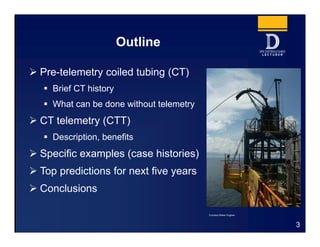
Outline
 Pre-telemetry coiled tubing (CT)
 Brief CT history
 What can be done without telemetry
 CT telemetry (CTT)
 Description, benefits
 Specific examples (case histories)
 Top predictions for next five years
 Conclusions
3
Courtesy Baker Hughes
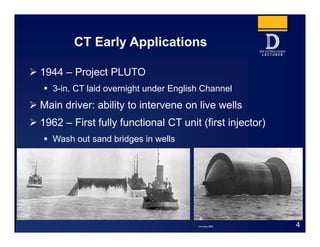
 1944 – Project PLUTO
 3-in. CT laid overnight under English Channel
 Main driver: ability to intervene on live wells
 1962 – First fully functional CT unit (first injector)
 Wash out sand bridges in wells
CT Early Applications
4Courtesy BBC
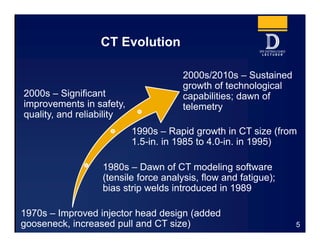
CT Evolution
5
1970s – Improved injector head design (added
gooseneck, increased pull and CT size)
1980s – Dawn of CT modeling software
(tensile force analysis, flow and fatigue);
bias strip welds introduced in 1989
2000s – Significant
improvements in safety,
quality, and reliability
2000s/2010s – Sustained
growth of technological
capabilities; dawn of
telemetry
1990s – Rapid growth in CT size (from
1.5-in. in 1985 to 4.0-in. in 1995)
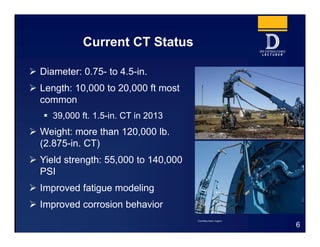
Current CT Status
 Diameter: 0.75- to 4.5-in.
 Length: 10,000 to 20,000 ft most
common
 39,000 ft. 1.5-in. CT in 2013
 Weight: more than 120,000 lb.
(2.875-in. CT)
 Yield strength: 55,000 to 140,000
PSI
 Improved fatigue modeling
 Improved corrosion behavior
6
Courtesy Baker Hughes
CT Advantages and Disadvantages
7
 Advantages
 Live well intervention
 Continuously circulating fluids
 Ability to perform continuous well-control operations
 Disadvantages
 Limited pumping rates and push/pull ability
 Service life limitations (fatigue, corrosion, wear)
 Logistical challenges
 No rotation
Pre-Telemetry CT Operations
8
 Most common pumping applications
 Cleanouts
 Gas lifting
 Stimulation – mostly multi-stage hydraulic fracturing
 Most common mechanical applications
 Milling and drilling
 Setting plugs
 Running large tools – perforating guns, logging tools
Telemetry with CT
9
 Telemetry = tele [remote] + metron [measure]
 Consider the drivers
 Evolution of wells and reservoirs
 Maturing reservoirs
 Unconventional reservoirs
 Deep water
 More intelligent completions
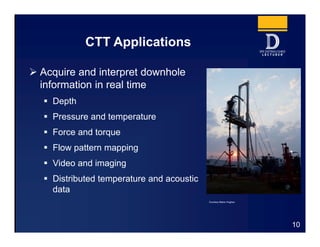
CTT Applications
10
 Acquire and interpret downhole
information in real time
 Depth
 Pressure and temperature
 Force and torque
 Flow pattern mapping
 Video and imaging
 Distributed temperature and acoustic
data
Courtesy Baker Hughes
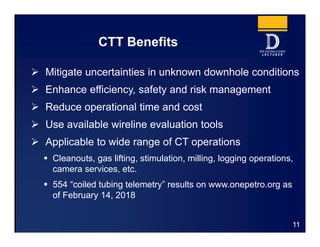
CTT Benefits
 Mitigate uncertainties in unknown downhole conditions
 Enhance efficiency, safety and risk management
 Reduce operational time and cost
 Use available wireline evaluation tools
 Applicable to wide range of CT operations
 Cleanouts, gas lifting, stimulation, milling, logging operations,
camera services, etc.
 554 “coiled tubing telemetry” results on www.onepetro.org as
of February 14, 2018
11
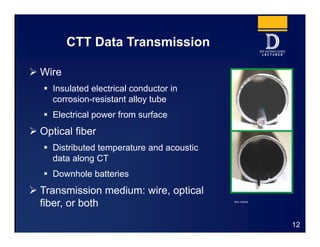
CTT Data Transmission
 Wire
 Insulated electrical conductor in
corrosion-resistant alloy tube
 Electrical power from surface
 Optical fiber
 Distributed temperature and acoustic
data along CT
 Downhole batteries
 Transmission medium: wire, optical
fiber, or both
12
SPE-183026
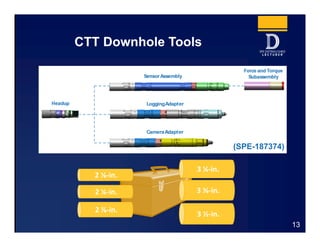
CTT Downhole Tools
13
3 ¼‐in. 3 ¼‐in. 
3 ⅜‐in.3 ⅜‐in.
3 ½‐in.3 ½‐in.
2 ⅛‐in.2 ⅛‐in.
2 ¼‐in. 2 ¼‐in. 
2 ⅞‐in.2 ⅞‐in.
(SPE-187374)
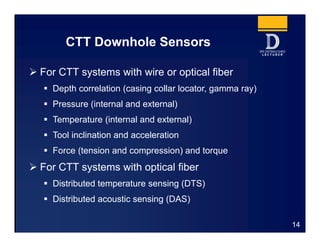
CTT Downhole Sensors
 For CTT systems with wire or optical fiber
 Depth correlation (casing collar locator, gamma ray)
 Pressure (internal and external)
 Temperature (internal and external)
 Tool inclination and acceleration
 Force (tension and compression) and torque
 For CTT systems with optical fiber
 Distributed temperature sensing (DTS)
 Distributed acoustic sensing (DAS)
14
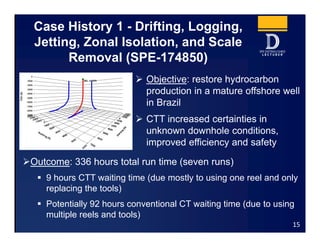
Case History 1 - Drifting, Logging,
Jetting, Zonal Isolation, and Scale
Removal (SPE-174850)
 Objective: restore hydrocarbon
production in a mature offshore well
in Brazil
 CTT increased certainties in
unknown downhole conditions,
improved efficiency and safety
15
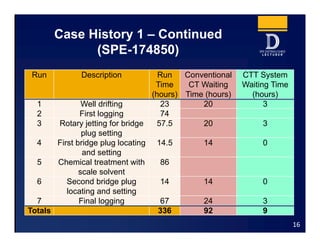
Outcome: 336 hours total run time (seven runs)
 9 hours CTT waiting time (due mostly to using one reel and only
replacing the tools)
 Potentially 92 hours conventional CT waiting time (due to using
multiple reels and tools)
Case History 1 – Continued
(SPE-174850)
16
Run Description Run
Time
(hours)
Conventional
CT Waiting
Time (hours)
CTT System
Waiting Time
(hours)
1 Well drifting 23 20 3
2 First logging 74
3 Rotary jetting for bridge
plug setting
57.5 20 3
4 First bridge plug locating
and setting
14.5 14 0
5 Chemical treatment with
scale solvent
86
6 Second bridge plug
locating and setting
14 14 0
7 Final logging 67 24 3
Totals 336 92 9
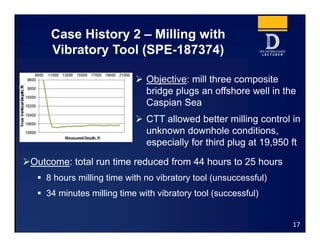
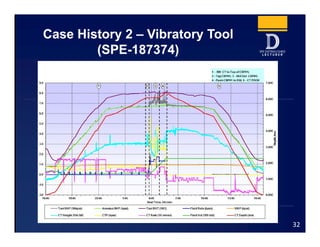
Case History 2 – Milling with
Vibratory Tool (SPE-187374)
 Objective: mill three composite
bridge plugs an offshore well in the
Caspian Sea
 CTT allowed better milling control in
unknown downhole conditions,
especially for third plug at 19,950 ft
17
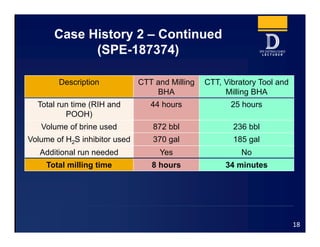
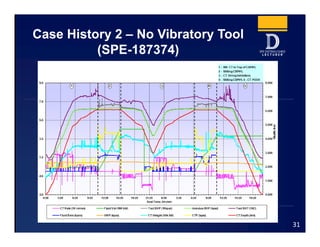
Outcome: total run time reduced from 44 hours to 25 hours
 8 hours milling time with no vibratory tool (unsuccessful)
 34 minutes milling time with vibratory tool (successful)
Case History 2 – Continued
(SPE-187374)
18
Description CTT and Milling
BHA
CTT, Vibratory Tool and
Milling BHA
Total run time (RIH and
POOH)
44 hours 25 hours
Volume of brine used 872 bbl 236 bbl
Volume of H2S inhibitor used 370 gal 185 gal
Additional run needed Yes No
Total milling time 8 hours 34 minutes
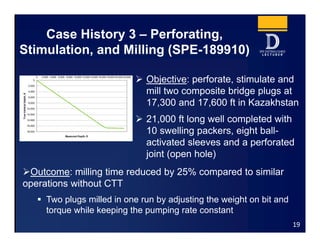
Case History 3 – Perforating,
Stimulation, and Milling (SPE-189910)
 Objective: perforate, stimulate and
mill two composite bridge plugs at
17,300 and 17,600 ft in Kazakhstan
 21,000 ft long well completed with
10 swelling packers, eight ball-
activated sleeves and a perforated
joint (open hole)
19
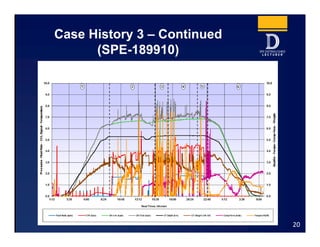
Outcome: milling time reduced by 25% compared to similar
operations without CTT
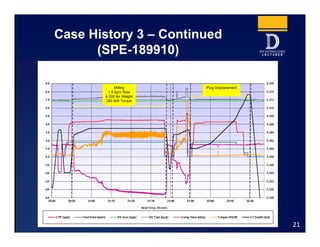
 Two plugs milled in one run by adjusting the weight on bit and
torque while keeping the pumping rate constant
0
2,000
4,000
6,000
8,000
10,000
12,000
14,000
16,000
18,000
0 2,000 4,000 6,000 8,000 10,000 12,000 14,000 16,000 18,000 20,000 22,000
TrueVerticalDepth,ft
Measured Depth, ft
Case History 3 – Continued
(SPE-189910)
20
Case History 3 – Continued
(SPE-189910)
21
Milling
1.8 bpm Rate
4,300 lbs Weight
280 lb/ft Torque
Plug Displacement
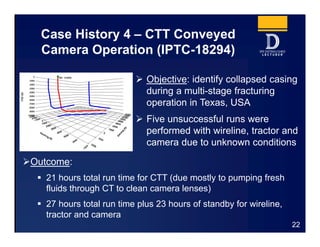
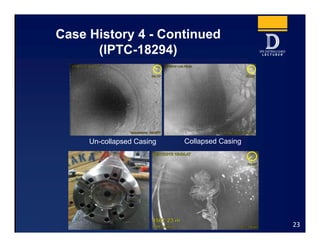
Case History 4 – CTT Conveyed
Camera Operation (IPTC-18294)
22
 Objective: identify collapsed casing
during a multi-stage fracturing
operation in Texas, USA
 Five unsuccessful runs were
performed with wireline, tractor and
camera due to unknown conditions
Outcome:
 21 hours total run time for CTT (due mostly to pumping fresh
fluids through CT to clean camera lenses)
 27 hours total run time plus 23 hours of standby for wireline,
tractor and camera
Case History 4 - Continued
(IPTC-18294)
23
Un-collapsed Casing Collapsed Casing
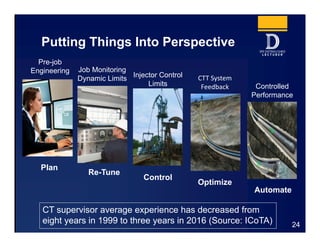
Putting Things Into Perspective
CT supervisor average experience has decreased from
eight years in 1999 to three years in 2016 (Source: ICoTA)
Plan
Re-Tune
Control
Optimize
Automate
Pre-job
Engineering Job Monitoring
Dynamic Limits Injector Control
Limits
CTT System 
Feedback Controlled
Performance
24
Next Five Years Top Predictions
 Further real-time data monitoring enhancements for
better decision making and lower costs
 Pumping applications – e.g., friction reducing (lubricants,
vibratory tools, tractors), acid tunneling, cleanouts, etc.
 Mechanical applications – e.g., milling/drilling
 Electrical applications
 Significant development for optimization and
automation of CT operations
 Less prone to people-related safety incidents
25
Conclusions
 CTT systems improve well intervention operations
 Increase certainties in unknown downhole conditions
 Enhance efficiency, safety and risk management
 Reduce operational time and cost
 Acquire and interpret downhole information in real time
 Depth
 Pressure
 Temperature
 Tool force and torque
 Distributed temperature and acoustic data
26
Conclusions (Continued)
 Applicable to many CT operations
 Cleanouts, gas lifting, stimulation, milling, logging
operations, camera services, etc.
 Telemetry will be commonly used for CT operations
27
With telemetry, CT operations will become
 Less people intensive
 More hardware and software intensive
 Less prone to people-related safety incidents
Society of Petroleum Engineers
Distinguished Lecturer Program
www.spe.org/dl 28
Your Feedback is Important
Enter your section in the DL Evaluation Contest by
completing the evaluation form for this presentation
Visit SPE.org/dl
Backup
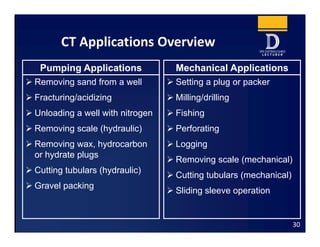
CT Applications Overview
 Removing sand from a well
 Fracturing/acidizing
 Unloading a well with nitrogen
 Removing scale (hydraulic)
 Removing wax, hydrocarbon
or hydrate plugs
 Cutting tubulars (hydraulic)
 Gravel packing
 Setting a plug or packer
 Milling/drilling
 Fishing
 Perforating
 Logging
 Removing scale (mechanical)
 Cutting tubulars (mechanical)
 Sliding sleeve operation
Pumping Applications Mechanical Applications
30
Case History 2 – No Vibratory Tool
(SPE-187374)
31
Case History 2 – Vibratory Tool
(SPE-187374)
32

Silviu Livescu

  • 2.
    Society of PetroleumEngineers Distinguished Lecturer Program www.spe.org/dl Silviu Livescu Baker Hughes, a GE Company Coiled Tubing Telemetry – State of the Technology
  • 3.
    Outline  Pre-telemetry coiledtubing (CT)  Brief CT history  What can be done without telemetry  CT telemetry (CTT)  Description, benefits  Specific examples (case histories)  Top predictions for next five years  Conclusions 3 Courtesy Baker Hughes
  • 4.
     1944 –Project PLUTO  3-in. CT laid overnight under English Channel  Main driver: ability to intervene on live wells  1962 – First fully functional CT unit (first injector)  Wash out sand bridges in wells CT Early Applications 4Courtesy BBC
  • 5.
    CT Evolution 5 1970s –Improved injector head design (added gooseneck, increased pull and CT size) 1980s – Dawn of CT modeling software (tensile force analysis, flow and fatigue); bias strip welds introduced in 1989 2000s – Significant improvements in safety, quality, and reliability 2000s/2010s – Sustained growth of technological capabilities; dawn of telemetry 1990s – Rapid growth in CT size (from 1.5-in. in 1985 to 4.0-in. in 1995)
  • 6.
    Current CT Status Diameter: 0.75- to 4.5-in.  Length: 10,000 to 20,000 ft most common  39,000 ft. 1.5-in. CT in 2013  Weight: more than 120,000 lb. (2.875-in. CT)  Yield strength: 55,000 to 140,000 PSI  Improved fatigue modeling  Improved corrosion behavior 6 Courtesy Baker Hughes
  • 7.
    CT Advantages andDisadvantages 7  Advantages  Live well intervention  Continuously circulating fluids  Ability to perform continuous well-control operations  Disadvantages  Limited pumping rates and push/pull ability  Service life limitations (fatigue, corrosion, wear)  Logistical challenges  No rotation
  • 8.
    Pre-Telemetry CT Operations 8 Most common pumping applications  Cleanouts  Gas lifting  Stimulation – mostly multi-stage hydraulic fracturing  Most common mechanical applications  Milling and drilling  Setting plugs  Running large tools – perforating guns, logging tools
  • 9.
    Telemetry with CT 9 Telemetry = tele [remote] + metron [measure]  Consider the drivers  Evolution of wells and reservoirs  Maturing reservoirs  Unconventional reservoirs  Deep water  More intelligent completions
  • 10.
    CTT Applications 10  Acquireand interpret downhole information in real time  Depth  Pressure and temperature  Force and torque  Flow pattern mapping  Video and imaging  Distributed temperature and acoustic data Courtesy Baker Hughes
  • 11.
    CTT Benefits  Mitigateuncertainties in unknown downhole conditions  Enhance efficiency, safety and risk management  Reduce operational time and cost  Use available wireline evaluation tools  Applicable to wide range of CT operations  Cleanouts, gas lifting, stimulation, milling, logging operations, camera services, etc.  554 “coiled tubing telemetry” results on www.onepetro.org as of February 14, 2018 11
  • 12.
    CTT Data Transmission Wire  Insulated electrical conductor in corrosion-resistant alloy tube  Electrical power from surface  Optical fiber  Distributed temperature and acoustic data along CT  Downhole batteries  Transmission medium: wire, optical fiber, or both 12 SPE-183026
  • 13.
  • 14.
    CTT Downhole Sensors For CTT systems with wire or optical fiber  Depth correlation (casing collar locator, gamma ray)  Pressure (internal and external)  Temperature (internal and external)  Tool inclination and acceleration  Force (tension and compression) and torque  For CTT systems with optical fiber  Distributed temperature sensing (DTS)  Distributed acoustic sensing (DAS) 14
  • 15.
    Case History 1- Drifting, Logging, Jetting, Zonal Isolation, and Scale Removal (SPE-174850)  Objective: restore hydrocarbon production in a mature offshore well in Brazil  CTT increased certainties in unknown downhole conditions, improved efficiency and safety 15 Outcome: 336 hours total run time (seven runs)  9 hours CTT waiting time (due mostly to using one reel and only replacing the tools)  Potentially 92 hours conventional CT waiting time (due to using multiple reels and tools)
  • 16.
    Case History 1– Continued (SPE-174850) 16 Run Description Run Time (hours) Conventional CT Waiting Time (hours) CTT System Waiting Time (hours) 1 Well drifting 23 20 3 2 First logging 74 3 Rotary jetting for bridge plug setting 57.5 20 3 4 First bridge plug locating and setting 14.5 14 0 5 Chemical treatment with scale solvent 86 6 Second bridge plug locating and setting 14 14 0 7 Final logging 67 24 3 Totals 336 92 9
  • 17.
    Case History 2– Milling with Vibratory Tool (SPE-187374)  Objective: mill three composite bridge plugs an offshore well in the Caspian Sea  CTT allowed better milling control in unknown downhole conditions, especially for third plug at 19,950 ft 17 Outcome: total run time reduced from 44 hours to 25 hours  8 hours milling time with no vibratory tool (unsuccessful)  34 minutes milling time with vibratory tool (successful)
  • 18.
    Case History 2– Continued (SPE-187374) 18 Description CTT and Milling BHA CTT, Vibratory Tool and Milling BHA Total run time (RIH and POOH) 44 hours 25 hours Volume of brine used 872 bbl 236 bbl Volume of H2S inhibitor used 370 gal 185 gal Additional run needed Yes No Total milling time 8 hours 34 minutes
  • 19.
    Case History 3– Perforating, Stimulation, and Milling (SPE-189910)  Objective: perforate, stimulate and mill two composite bridge plugs at 17,300 and 17,600 ft in Kazakhstan  21,000 ft long well completed with 10 swelling packers, eight ball- activated sleeves and a perforated joint (open hole) 19 Outcome: milling time reduced by 25% compared to similar operations without CTT  Two plugs milled in one run by adjusting the weight on bit and torque while keeping the pumping rate constant 0 2,000 4,000 6,000 8,000 10,000 12,000 14,000 16,000 18,000 0 2,000 4,000 6,000 8,000 10,000 12,000 14,000 16,000 18,000 20,000 22,000 TrueVerticalDepth,ft Measured Depth, ft
  • 20.
    Case History 3– Continued (SPE-189910) 20
  • 21.
    Case History 3– Continued (SPE-189910) 21 Milling 1.8 bpm Rate 4,300 lbs Weight 280 lb/ft Torque Plug Displacement
  • 22.
    Case History 4– CTT Conveyed Camera Operation (IPTC-18294) 22  Objective: identify collapsed casing during a multi-stage fracturing operation in Texas, USA  Five unsuccessful runs were performed with wireline, tractor and camera due to unknown conditions Outcome:  21 hours total run time for CTT (due mostly to pumping fresh fluids through CT to clean camera lenses)  27 hours total run time plus 23 hours of standby for wireline, tractor and camera
  • 23.
    Case History 4- Continued (IPTC-18294) 23 Un-collapsed Casing Collapsed Casing
  • 24.
    Putting Things IntoPerspective CT supervisor average experience has decreased from eight years in 1999 to three years in 2016 (Source: ICoTA) Plan Re-Tune Control Optimize Automate Pre-job Engineering Job Monitoring Dynamic Limits Injector Control Limits CTT System  Feedback Controlled Performance 24
  • 25.
    Next Five YearsTop Predictions  Further real-time data monitoring enhancements for better decision making and lower costs  Pumping applications – e.g., friction reducing (lubricants, vibratory tools, tractors), acid tunneling, cleanouts, etc.  Mechanical applications – e.g., milling/drilling  Electrical applications  Significant development for optimization and automation of CT operations  Less prone to people-related safety incidents 25
  • 26.
    Conclusions  CTT systemsimprove well intervention operations  Increase certainties in unknown downhole conditions  Enhance efficiency, safety and risk management  Reduce operational time and cost  Acquire and interpret downhole information in real time  Depth  Pressure  Temperature  Tool force and torque  Distributed temperature and acoustic data 26
  • 27.
    Conclusions (Continued)  Applicableto many CT operations  Cleanouts, gas lifting, stimulation, milling, logging operations, camera services, etc.  Telemetry will be commonly used for CT operations 27 With telemetry, CT operations will become  Less people intensive  More hardware and software intensive  Less prone to people-related safety incidents
  • 28.
    Society of PetroleumEngineers Distinguished Lecturer Program www.spe.org/dl 28 Your Feedback is Important Enter your section in the DL Evaluation Contest by completing the evaluation form for this presentation Visit SPE.org/dl
  • 29.
  • 30.
    CT Applications Overview  Removing sandfrom a well  Fracturing/acidizing  Unloading a well with nitrogen  Removing scale (hydraulic)  Removing wax, hydrocarbon or hydrate plugs  Cutting tubulars (hydraulic)  Gravel packing  Setting a plug or packer  Milling/drilling  Fishing  Perforating  Logging  Removing scale (mechanical)  Cutting tubulars (mechanical)  Sliding sleeve operation Pumping Applications Mechanical Applications 30
  • 31.
    Case History 2– No Vibratory Tool (SPE-187374) 31
  • 32.
    Case History 2– Vibratory Tool (SPE-187374) 32