Primary funding is provided by
The SPE Foundation through member donations
and a contribution from Offshore Europe
The Society is grateful to those companies that allow their
professionals to serve as lecturers
Additional support provided by AIME
Society of Petroleum Engineers
Distinguished Lecturer Program
www.spe.org/dl
Society of Petroleum Engineers
Distinguished Lecturer Program
www.spe.org/dl
Dr. Hank Rawlins
Technical Director
Enhanced Production Through
Surface Facilities Sand Management
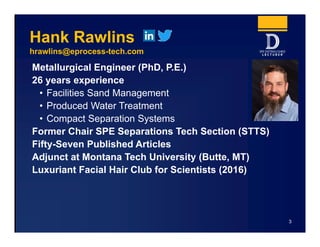
Hank Rawlins
hrawlins@eprocess-tech.com
Metallurgical Engineer (PhD, P.E.)
26 years experience
• Facilities Sand Management
• Produced Water Treatment
• Compact Separation Systems
Former Chair SPE Separations Tech Section (STTS)
Fifty-Seven Published Articles
Adjunct at Montana Tech University (Butte, MT)
Luxuriant Facial Hair Club for Scientists (2016)
3
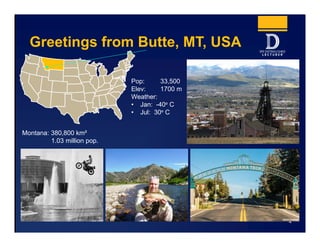
Greetings from Butte, MT, USA
4
Pop: 33,500
Elev: 1700 m
Weather:
• Jan: -40º C
• Jul: 30º C
Montana: 380,800 km²
1.03 million pop.
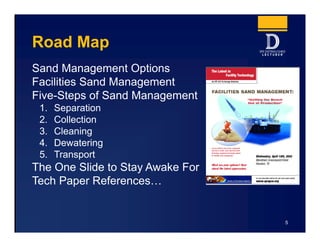
Road Map
Sand Management Options
Facilities Sand Management
Five-Steps of Sand Management
1. Separation
2. Collection
3. Cleaning
4. Dewatering
5. Transport
The One Slide to Stay Awake For
Tech Paper References…
5
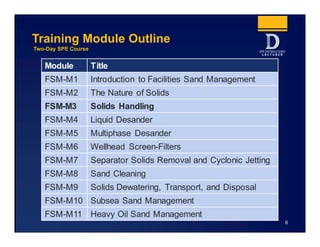
Training Module Outline
Two-Day SPE Course
6
Module Title
FSM-M1 Introduction to Facilities Sand Management
FSM-M2 The Nature of Solids
FSM-M3 Solids Handling
FSM-M4 Liquid Desander
FSM-M5 Multiphase Desander
FSM-M6 Wellhead Screen-Filters
FSM-M7 Separator Solids Removal and Cyclonic Jetting
FSM-M8 Sand Cleaning
FSM-M9 Solids Dewatering, Transport, and Disposal
FSM-M10 Subsea Sand Management
FSM-M11 Heavy Oil Sand Management
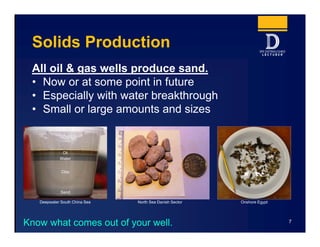
Solids Production
All oil & gas wells produce sand.
• Now or at some point in future
• Especially with water breakthrough
• Small or large amounts and sizes
7
Sand
Clay
Water
Oil
Deepwater South China Sea North Sea Danish Sector Onshore Egypt
Know what comes out of your well.
What are Produced Solids?
Inorganic, Insoluble Particulate Material
• Not asphaltene, paraffin, wax, hydrate, or resin (organic)
• Not precipitates (soluble) or scale (non-particulate)
• Natural solids: from reservoir material
• Artificial solids: corrosion debris, proppant, junk, etc.
Primarily “sand” by classification
• ISO/Wentworth “sand” from 63-2000 microns
• Practical separation limit is 10 microns
Solid particles separable in facilities equipment
8
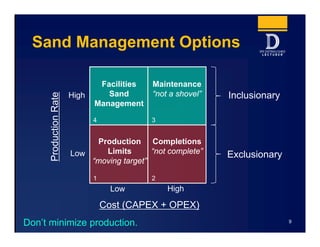
Sand Management Options
9
ProductionRate
Cost (CAPEX + OPEX)
Low High
Low
High Inclusionary
Exclusionary
Production
Limits
“moving target”
Completions
“not complete”
Maintenance
“not a shovel”
Facilities
Sand
Management
Don’t minimize production.
4 3
21
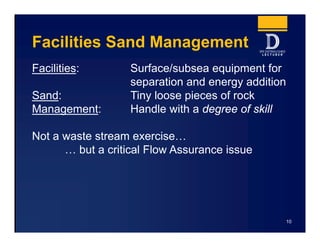
Facilities Sand Management
Facilities: Surface/subsea equipment for
separation and energy addition
Sand: Tiny loose pieces of rock
Management: Handle with a degree of skill
Not a waste stream exercise…
… but a critical Flow Assurance issue
10
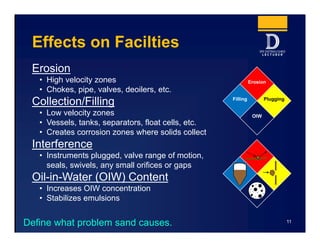
Effects on Facilties
Erosion
• High velocity zones
• Chokes, pipe, valves, deoilers, etc.
Collection/Filling
• Low velocity zones
• Vessels, tanks, separators, float cells, etc.
• Creates corrosion zones where solids collect
Interference
• Instruments plugged, valve range of motion,
seals, swivels, any small orifices or gaps
Oil-in-Water (OIW) Content
• Increases OIW concentration
• Stabilizes emulsions
11
Define what problem sand causes.
Erosion
Filling Plugging
OIW
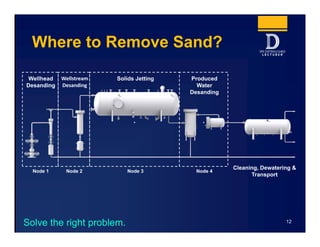
Where to Remove Sand?
12
Solve the right problem.
Wellhead
Desanding
Solids Jetting Produced
Water
Desanding
Cleaning, Dewatering &
Transport
Wellstream
Desanding
. .
Node 1 Node 2 Node 3 Node 4
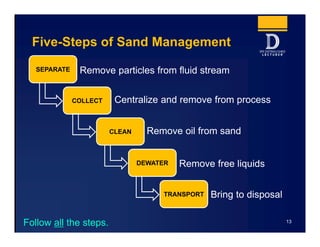
Five-Steps of Sand Management
13
Follow all the steps.
Remove particles from fluid stream
Centralize and remove from process
Remove oil from sand
Remove free liquids
Bring to disposal
SEPARATE
COLLECT
CLEAN
DEWATER
TRANSPORT
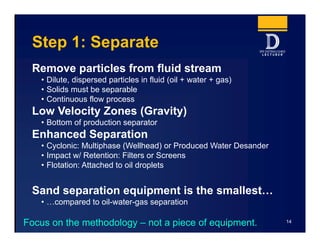
Step 1: Separate
Remove particles from fluid stream
• Dilute, dispersed particles in fluid (oil + water + gas)
• Solids must be separable
• Continuous flow process
Low Velocity Zones (Gravity)
• Bottom of production separator
Enhanced Separation
• Cyclonic: Multiphase (Wellhead) or Produced Water Desander
• Impact w/ Retention: Filters or Screens
• Flotation: Attached to oil droplets
Sand separation equipment is the smallest…
• …compared to oil-water-gas separation
14
Focus on the methodology – not a piece of equipment.
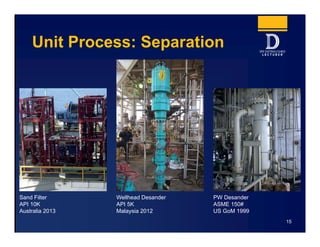
Unit Process: Separation
15
Sand Filter
API 10K
Australia 2013
Wellhead Desander
API 5K
Malaysia 2012
PW Desander
ASME 150#
US GoM 1999
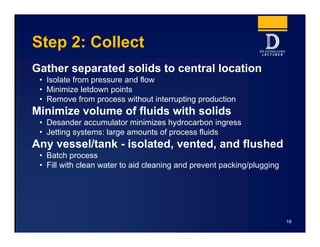
Step 2: Collect
Gather separated solids to central location
• Isolate from pressure and flow
• Minimize letdown points
• Remove from process without interrupting production
Minimize volume of fluids with solids
• Desander accumulator minimizes hydrocarbon ingress
• Jetting systems: large amounts of process fluids
Any vessel/tank - isolated, vented, and flushed
• Batch process
• Fill with clean water to aid cleaning and prevent packing/plugging
16
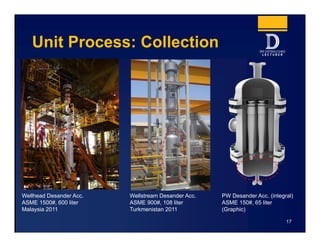
Unit Process: Collection
17
Wellhead Desander Acc.
ASME 1500#, 600 liter
Malaysia 2011
Wellstream Desander Acc.
ASME 900#, 108 liter
Turkmenistan 2011
PW Desander Acc. (integral)
ASME 150#, 65 liter
(Graphic)
Step 3: Clean
Remove adsorbed oil from surface of particle
• Not H2S, pyrophoric material, heavy metals, or NORM
Clean to meet offshore discharge
• <1 weight% oil-on-dry solids (OSPAR spec)
• Offshore cleaning systems use batch cyclone-recirculation loop
• Specialized systems use chemicals, heat, and/or biological agents
Integrate cleaning action in all areas
• Separation, collection, and transport
• May eliminate need for specific cleaning station
Cleaned sand is easer to dewater and transport
18
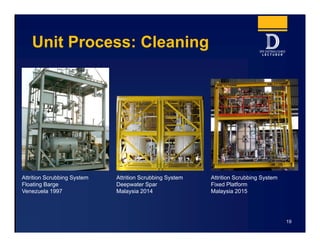
Unit Process: Cleaning
19
Attrition Scrubbing System
Floating Barge
Venezuela 1997
Attrition Scrubbing System
Deepwater Spar
Malaysia 2014
Attrition Scrubbing System
Fixed Platform
Malaysia 2015
Step 4: Dewater
Removing free liquids associated with sand
• Minimizes disposal volume
• Up to 90% reduction in volume
Open (non-hazardous) dewatering
• Liquids to open drain, sand/vapors open to atmosphere
• Hanging dewatering bag
Closed (hazardous) dewatering
• Liquids captured to closed drain, vapors captured to vent system,
and solids not exposed to atmosphere or personnel
• Screen-lined bin
Dewatering bag/bin also transport device
• Combined step with transport
20
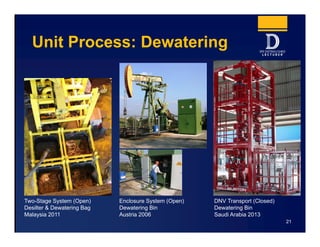
Unit Process: Dewatering
Two-Stage System (Open)
Desilter & Dewatering Bag
Malaysia 2011
Enclosure System (Open)
Dewatering Bin
Austria 2006
DNV Transport (Closed)
Dewatering Bin
Saudi Arabia 2013
21
Step 5: Transport
Disposal site determines route & method
Overboard discharge:
• Transported by pipe as a slurry to caisson
Landfill disposal:
• Transported in dewatering bag or bin to landfill
Slurry injection:
• Transported by pipe as a slurry to injection pump
Unique methods:
• Add sand to road surface mix
• Add sand to existing drill cuttings disposal
• Grind smaller size prior to injection disposal
• Bioremediation
22
Know where to put the sand.
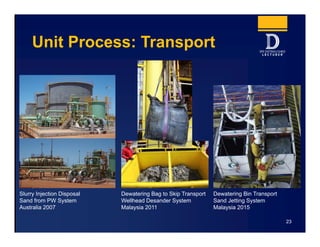
Unit Process: Transport
23
Slurry Injection Disposal
Sand from PW System
Australia 2007
Dewatering Bag to Skip Transport
Wellhead Desander System
Malaysia 2011
Dewatering Bin Transport
Sand Jetting System
Malaysia 2015
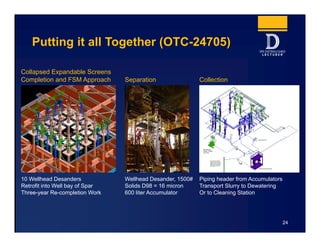
Putting it all Together (OTC-24705)
24
Wellhead Desander, 1500#
Solids D98 = 16 micron
600 liter Accumulator
10 Wellhead Desanders
Retrofit into Well bay of Spar
Three-year Re-completion Work
Piping header from Accumulators
Transport Slurry to Dewatering
Or to Cleaning Station
Collapsed Expandable Screens
Completion and FSM Approach Separation Collection
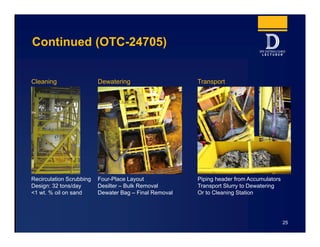
Continued (OTC-24705)
25
Four-Place Layout
Desilter – Bulk Removal
Dewater Bag – Final Removal
Recirculation Scrubbing
Design: 32 tons/day
<1 wt. % oil on sand
Piping header from Accumulators
Transport Slurry to Dewatering
Or to Cleaning Station
Cleaning Dewatering Transport
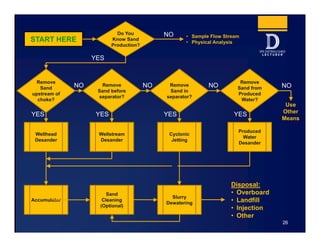
26
Do You
Know Sand
Production?
START HERE
NO • Sample Flow Stream
• Physical Analysis
Remove
Sand
upstream of
choke?
YES
Remove
Sand before
separator?
Remove
Sand in
separator?
Remove
Sand from
Produced
Water?
Wellhead
Desander
Wellstream
Desander
Cyclonic
Jetting
Produced
Water
Desander
NO NO NO NO
Use
Other
Means
YES YES YES YES
Accumulator
Slurry
Dewatering
Disposal:
• Overboard
• Landfill
• Injection
• Other
Sand
Cleaning
(Optional)
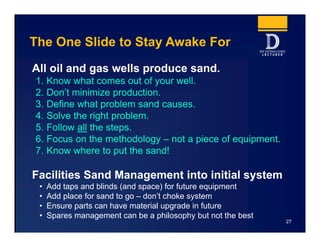
The One Slide to Stay Awake For
All oil and gas wells produce sand.
1. Know what comes out of your well.
2. Don’t minimize production.
3. Define what problem sand causes.
4. Solve the right problem.
5. Follow all the steps.
6. Focus on the methodology – not a piece of equipment.
7. Know where to put the sand!
Facilities Sand Management into initial system
• Add taps and blinds (and space) for future equipment
• Add place for sand to go – don’t choke system
• Ensure parts can have material upgrade in future
• Spares management can be a philosophy but not the best
27
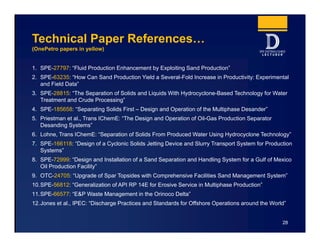
Technical Paper References…
(OnePetro papers in yellow)
1. SPE-27797: “Fluid Production Enhancement by Exploiting Sand Production”
2. SPE-63235: “How Can Sand Production Yield a Several-Fold Increase in Productivity: Experimental
and Field Data”
3. SPE-28815: “The Separation of Solids and Liquids With Hydrocyclone-Based Technology for Water
Treatment and Crude Processing”
4. SPE-185658: “Separating Solids First – Design and Operation of the Multiphase Desander”
5. Priestman et al., Trans IChemE: “The Design and Operation of Oil-Gas Production Separator
Desanding Systems”
6. Lohne, Trans IChemE: “Separation of Solids From Produced Water Using Hydrocyclone Technology”
7. SPE-166118: “Design of a Cyclonic Solids Jetting Device and Slurry Transport System for Production
Systems”
8. SPE-72999: “Design and Installation of a Sand Separation and Handling System for a Gulf of Mexico
Oil Production Facility”
9. OTC-24705: “Upgrade of Spar Topsides with Comprehensive Facilities Sand Management System”
10.SPE-56812: “Generalization of API RP 14E for Erosive Service in Multiphase Production”
11.SPE-66577: “E&P Waste Management in the Orinoco Delta”
12.Jones et al., IPEC: “Discharge Practices and Standards for Offshore Operations around the World”
28
Where to get more info?
Connect on LinkedIn
• FSM article each week on Tuesday (85 so far)
• Material taken directly from FSM training course
Get articles from OnePetro (www.onepetro.org)
Take Facilities Sand Management two-day training course
Future: SPE DL Webinar on FSM
29
Society of Petroleum Engineers
Distinguished Lecturer Program
www.spe.org/dl 30
Your Feedback is Important
Enter your section in the DL Evaluation Contest by
completing the evaluation form for this presentation
Visit SPE.org/dl
#SPEDL

Hank Rawlins

  • 1.
    Primary funding isprovided by The SPE Foundation through member donations and a contribution from Offshore Europe The Society is grateful to those companies that allow their professionals to serve as lecturers Additional support provided by AIME Society of Petroleum Engineers Distinguished Lecturer Program www.spe.org/dl
  • 2.
    Society of PetroleumEngineers Distinguished Lecturer Program www.spe.org/dl Dr. Hank Rawlins Technical Director Enhanced Production Through Surface Facilities Sand Management
  • 3.
    Hank Rawlins hrawlins@eprocess-tech.com Metallurgical Engineer(PhD, P.E.) 26 years experience • Facilities Sand Management • Produced Water Treatment • Compact Separation Systems Former Chair SPE Separations Tech Section (STTS) Fifty-Seven Published Articles Adjunct at Montana Tech University (Butte, MT) Luxuriant Facial Hair Club for Scientists (2016) 3
  • 4.
    Greetings from Butte,MT, USA 4 Pop: 33,500 Elev: 1700 m Weather: • Jan: -40º C • Jul: 30º C Montana: 380,800 km² 1.03 million pop.
  • 5.
    Road Map Sand ManagementOptions Facilities Sand Management Five-Steps of Sand Management 1. Separation 2. Collection 3. Cleaning 4. Dewatering 5. Transport The One Slide to Stay Awake For Tech Paper References… 5
  • 6.
    Training Module Outline Two-DaySPE Course 6 Module Title FSM-M1 Introduction to Facilities Sand Management FSM-M2 The Nature of Solids FSM-M3 Solids Handling FSM-M4 Liquid Desander FSM-M5 Multiphase Desander FSM-M6 Wellhead Screen-Filters FSM-M7 Separator Solids Removal and Cyclonic Jetting FSM-M8 Sand Cleaning FSM-M9 Solids Dewatering, Transport, and Disposal FSM-M10 Subsea Sand Management FSM-M11 Heavy Oil Sand Management
  • 7.
    Solids Production All oil& gas wells produce sand. • Now or at some point in future • Especially with water breakthrough • Small or large amounts and sizes 7 Sand Clay Water Oil Deepwater South China Sea North Sea Danish Sector Onshore Egypt Know what comes out of your well.
  • 8.
    What are ProducedSolids? Inorganic, Insoluble Particulate Material • Not asphaltene, paraffin, wax, hydrate, or resin (organic) • Not precipitates (soluble) or scale (non-particulate) • Natural solids: from reservoir material • Artificial solids: corrosion debris, proppant, junk, etc. Primarily “sand” by classification • ISO/Wentworth “sand” from 63-2000 microns • Practical separation limit is 10 microns Solid particles separable in facilities equipment 8
  • 9.
    Sand Management Options 9 ProductionRate Cost(CAPEX + OPEX) Low High Low High Inclusionary Exclusionary Production Limits “moving target” Completions “not complete” Maintenance “not a shovel” Facilities Sand Management Don’t minimize production. 4 3 21
  • 10.
    Facilities Sand Management Facilities:Surface/subsea equipment for separation and energy addition Sand: Tiny loose pieces of rock Management: Handle with a degree of skill Not a waste stream exercise… … but a critical Flow Assurance issue 10
  • 11.
    Effects on Facilties Erosion •High velocity zones • Chokes, pipe, valves, deoilers, etc. Collection/Filling • Low velocity zones • Vessels, tanks, separators, float cells, etc. • Creates corrosion zones where solids collect Interference • Instruments plugged, valve range of motion, seals, swivels, any small orifices or gaps Oil-in-Water (OIW) Content • Increases OIW concentration • Stabilizes emulsions 11 Define what problem sand causes. Erosion Filling Plugging OIW
  • 12.
    Where to RemoveSand? 12 Solve the right problem. Wellhead Desanding Solids Jetting Produced Water Desanding Cleaning, Dewatering & Transport Wellstream Desanding . . Node 1 Node 2 Node 3 Node 4
  • 13.
    Five-Steps of SandManagement 13 Follow all the steps. Remove particles from fluid stream Centralize and remove from process Remove oil from sand Remove free liquids Bring to disposal SEPARATE COLLECT CLEAN DEWATER TRANSPORT
  • 14.
    Step 1: Separate Removeparticles from fluid stream • Dilute, dispersed particles in fluid (oil + water + gas) • Solids must be separable • Continuous flow process Low Velocity Zones (Gravity) • Bottom of production separator Enhanced Separation • Cyclonic: Multiphase (Wellhead) or Produced Water Desander • Impact w/ Retention: Filters or Screens • Flotation: Attached to oil droplets Sand separation equipment is the smallest… • …compared to oil-water-gas separation 14 Focus on the methodology – not a piece of equipment.
  • 15.
    Unit Process: Separation 15 SandFilter API 10K Australia 2013 Wellhead Desander API 5K Malaysia 2012 PW Desander ASME 150# US GoM 1999
  • 16.
    Step 2: Collect Gatherseparated solids to central location • Isolate from pressure and flow • Minimize letdown points • Remove from process without interrupting production Minimize volume of fluids with solids • Desander accumulator minimizes hydrocarbon ingress • Jetting systems: large amounts of process fluids Any vessel/tank - isolated, vented, and flushed • Batch process • Fill with clean water to aid cleaning and prevent packing/plugging 16
  • 17.
    Unit Process: Collection 17 WellheadDesander Acc. ASME 1500#, 600 liter Malaysia 2011 Wellstream Desander Acc. ASME 900#, 108 liter Turkmenistan 2011 PW Desander Acc. (integral) ASME 150#, 65 liter (Graphic)
  • 18.
    Step 3: Clean Removeadsorbed oil from surface of particle • Not H2S, pyrophoric material, heavy metals, or NORM Clean to meet offshore discharge • <1 weight% oil-on-dry solids (OSPAR spec) • Offshore cleaning systems use batch cyclone-recirculation loop • Specialized systems use chemicals, heat, and/or biological agents Integrate cleaning action in all areas • Separation, collection, and transport • May eliminate need for specific cleaning station Cleaned sand is easer to dewater and transport 18
  • 19.
    Unit Process: Cleaning 19 AttritionScrubbing System Floating Barge Venezuela 1997 Attrition Scrubbing System Deepwater Spar Malaysia 2014 Attrition Scrubbing System Fixed Platform Malaysia 2015
  • 20.
    Step 4: Dewater Removingfree liquids associated with sand • Minimizes disposal volume • Up to 90% reduction in volume Open (non-hazardous) dewatering • Liquids to open drain, sand/vapors open to atmosphere • Hanging dewatering bag Closed (hazardous) dewatering • Liquids captured to closed drain, vapors captured to vent system, and solids not exposed to atmosphere or personnel • Screen-lined bin Dewatering bag/bin also transport device • Combined step with transport 20
  • 21.
    Unit Process: Dewatering Two-StageSystem (Open) Desilter & Dewatering Bag Malaysia 2011 Enclosure System (Open) Dewatering Bin Austria 2006 DNV Transport (Closed) Dewatering Bin Saudi Arabia 2013 21
  • 22.
    Step 5: Transport Disposalsite determines route & method Overboard discharge: • Transported by pipe as a slurry to caisson Landfill disposal: • Transported in dewatering bag or bin to landfill Slurry injection: • Transported by pipe as a slurry to injection pump Unique methods: • Add sand to road surface mix • Add sand to existing drill cuttings disposal • Grind smaller size prior to injection disposal • Bioremediation 22 Know where to put the sand.
  • 23.
    Unit Process: Transport 23 SlurryInjection Disposal Sand from PW System Australia 2007 Dewatering Bag to Skip Transport Wellhead Desander System Malaysia 2011 Dewatering Bin Transport Sand Jetting System Malaysia 2015
  • 24.
    Putting it allTogether (OTC-24705) 24 Wellhead Desander, 1500# Solids D98 = 16 micron 600 liter Accumulator 10 Wellhead Desanders Retrofit into Well bay of Spar Three-year Re-completion Work Piping header from Accumulators Transport Slurry to Dewatering Or to Cleaning Station Collapsed Expandable Screens Completion and FSM Approach Separation Collection
  • 25.
    Continued (OTC-24705) 25 Four-Place Layout Desilter– Bulk Removal Dewater Bag – Final Removal Recirculation Scrubbing Design: 32 tons/day <1 wt. % oil on sand Piping header from Accumulators Transport Slurry to Dewatering Or to Cleaning Station Cleaning Dewatering Transport
  • 26.
    26 Do You Know Sand Production? STARTHERE NO • Sample Flow Stream • Physical Analysis Remove Sand upstream of choke? YES Remove Sand before separator? Remove Sand in separator? Remove Sand from Produced Water? Wellhead Desander Wellstream Desander Cyclonic Jetting Produced Water Desander NO NO NO NO Use Other Means YES YES YES YES Accumulator Slurry Dewatering Disposal: • Overboard • Landfill • Injection • Other Sand Cleaning (Optional)
  • 27.
    The One Slideto Stay Awake For All oil and gas wells produce sand. 1. Know what comes out of your well. 2. Don’t minimize production. 3. Define what problem sand causes. 4. Solve the right problem. 5. Follow all the steps. 6. Focus on the methodology – not a piece of equipment. 7. Know where to put the sand! Facilities Sand Management into initial system • Add taps and blinds (and space) for future equipment • Add place for sand to go – don’t choke system • Ensure parts can have material upgrade in future • Spares management can be a philosophy but not the best 27
  • 28.
    Technical Paper References… (OnePetropapers in yellow) 1. SPE-27797: “Fluid Production Enhancement by Exploiting Sand Production” 2. SPE-63235: “How Can Sand Production Yield a Several-Fold Increase in Productivity: Experimental and Field Data” 3. SPE-28815: “The Separation of Solids and Liquids With Hydrocyclone-Based Technology for Water Treatment and Crude Processing” 4. SPE-185658: “Separating Solids First – Design and Operation of the Multiphase Desander” 5. Priestman et al., Trans IChemE: “The Design and Operation of Oil-Gas Production Separator Desanding Systems” 6. Lohne, Trans IChemE: “Separation of Solids From Produced Water Using Hydrocyclone Technology” 7. SPE-166118: “Design of a Cyclonic Solids Jetting Device and Slurry Transport System for Production Systems” 8. SPE-72999: “Design and Installation of a Sand Separation and Handling System for a Gulf of Mexico Oil Production Facility” 9. OTC-24705: “Upgrade of Spar Topsides with Comprehensive Facilities Sand Management System” 10.SPE-56812: “Generalization of API RP 14E for Erosive Service in Multiphase Production” 11.SPE-66577: “E&P Waste Management in the Orinoco Delta” 12.Jones et al., IPEC: “Discharge Practices and Standards for Offshore Operations around the World” 28
  • 29.
    Where to getmore info? Connect on LinkedIn • FSM article each week on Tuesday (85 so far) • Material taken directly from FSM training course Get articles from OnePetro (www.onepetro.org) Take Facilities Sand Management two-day training course Future: SPE DL Webinar on FSM 29
  • 30.
    Society of PetroleumEngineers Distinguished Lecturer Program www.spe.org/dl 30 Your Feedback is Important Enter your section in the DL Evaluation Contest by completing the evaluation form for this presentation Visit SPE.org/dl #SPEDL