Contents
❑ Introduction.
❑ Steam Injection.
❑ Cyclic Steam Stimulation (CSS).
❑ Insitu Combustion (ISC).
❑ Steam AssistedGravity Drainage (SAGD).
• Thermal methods have been tested since 1950’s, and
they are the most advanced among EOR methods, as
far as field experience and technology are concerned.
They are best suited for heavy oils (10-20° API) and
tar sands (≤10° API).
• Thermal methods supply heat to the reservoir, and
vaporize some of the oil.
Introduction
There are four main types of thermal EOR
namely:
1. Steam Injection.
2. Cyclic Steam Stimulation (CSS).
3. Insitu Combustion (ISC).
4. Steam Assisted Gravity Drainage (SAGD).
• To understand each method of thermal EOR,
Advantages, disadvantages, Injection process
of Thermal into the formations and suitable
conditions to be applied have to be
considered.
• To do thermal injection in EOR, new wells have
to be drilled for injection except in CSS.
Steam Injection
Mechanism
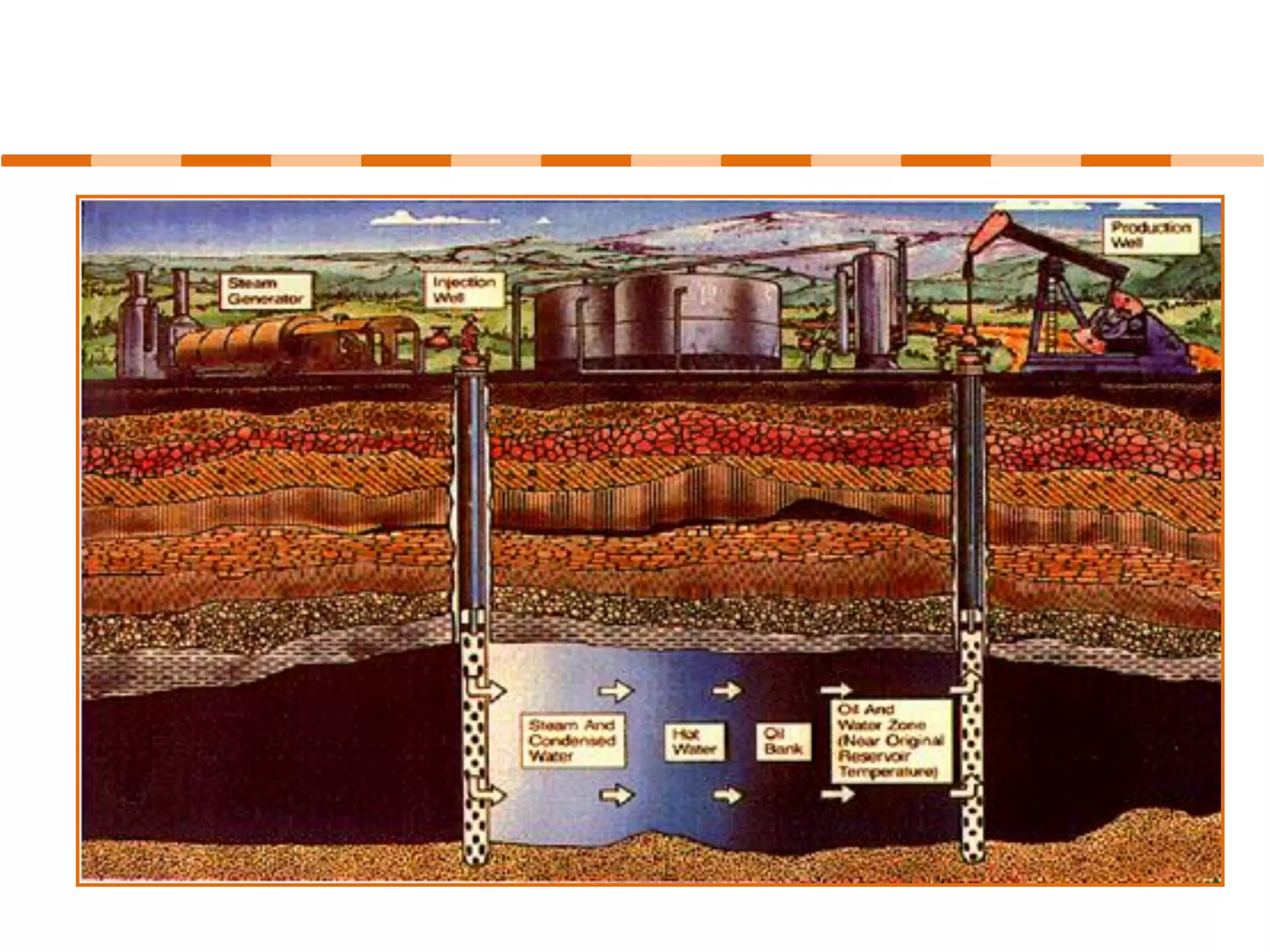
• Steam flooding is a pattern drive, similar to water
flooding, steam is injected continuously with a certain
quality (80% steam and 20% water) to the reservoir
having shallow depth which is preferred.
• It forms a steam zone which advances slowly in the
reservoir heating the oil and reducing its viscosity.
• Once steam is injected into the oil reservoir with good
quality.
• Steam reacts with oil and reduces its viscosity, by
creating an oil bank and in addition to continuous steam
injected oil is pushed towards the producer.
• Wettability is changed from oil to water wet due to the
reduction of oil viscosity.
Advantages
• Reduces Sor (remaining oil in the reservoir).
• Reduces oil viscosity resulting in mobility ratio
reduction and wettability change.
• Good performance due to continuous steam injection.
• High RF.
• SOR (Steam Oil Ratio is controlled).
Disadvantages
• Steam override to the adjacent formation due to thin
reservoir net pay and high steam mobility.
• Less effectiveness at deep reservoir due to reduction of
steam quality.
• Cannot be applied at deeper reservoir depth.
• Heat losses occurred in case of strong or excessive
water drive.
Conditions to be Applied
• Low API (<22 Degree API).
• Viscous oil (more than 100 cp).
• Thick net pay (more than 10 m) to avoid heat losses to
the adjacent formations.
• Perforation has to be away from OWC to avoid steam
condensation.
• Reasonable current reservoir pressure.
• High reservoir permeability to support steam traveling
inside the reservoir.
CSS
Mechanism
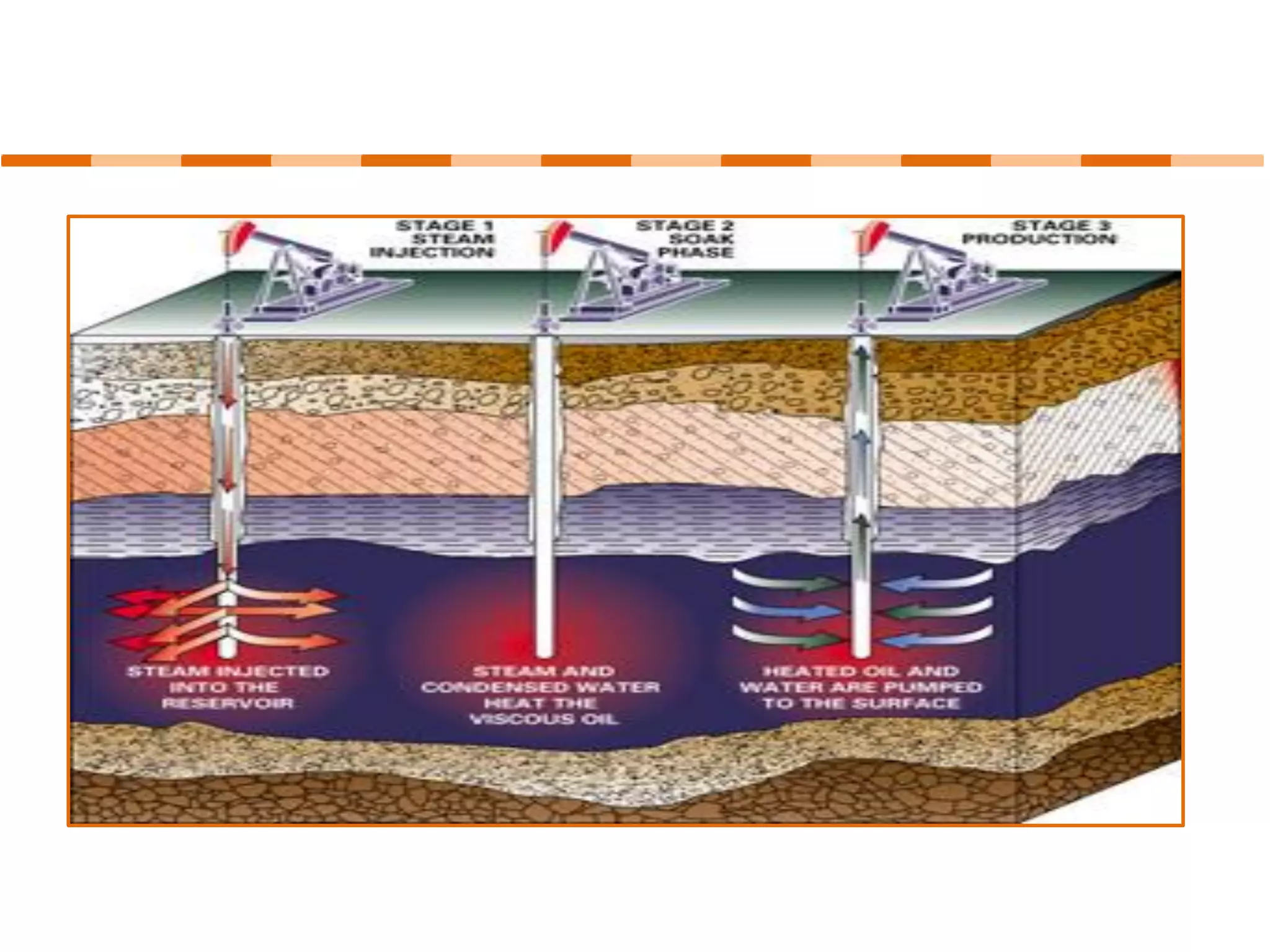
• Cyclic steam stimulation is a “single well” process and
called Huff and Puff.
• It is the only EOR method that is applied in the
producer itself.
• It is called Cyclic Steam Injection (CSI).
• It consists of three stages:
• Injection period.
• Soaking period.
• Production period.
Mechanism
• The process started with steam injection in the
producer itself with high steam quality, usually 80%, for
a period of 14 - 21 days
• The well is shut-in, then followed by soaking period of 3
- 5 days to allow the heat to be distributed in the
formation, still the well is shut-in.
• Then followed by production period.
• Cycles are repeated when the oil rate becomes
uneconomic.
Advantages
• Prepare the field for future steam flooding by heating a
part of the reservoir.
• Reduced oil viscosity and there for change the
wettability around the well bore from oil to water wet
in addition to mobility ratio reduction.
• Reduces Sor (remaining oil in the reservoir).
• Quick increment in oil rate once the production phase is
started.
Disadvantages
• Difficult to be applied in case of low current reservoir
pressure.
• Steam injection is not continuous.
• Affected by strong water aquifer drive.
Conditions to be Applied
• Large filed area and steam is selected to be
implemented in the future, CSS is used to heat a part
of the reservoir.
• Low API (less than 22.1 Degree API).
• Viscous oil (more than 100 cp).
• Good net pay (10 m at least to avoid heat losses).
• Enough reservoir pressure to hold the injection
pressure.
ISC
Mechanism
• In-situ combustion or fire flooding involves starting a
fire in the reservoir and injecting air to sustain the
burning of some of the crude oil.
• The injection mechanism is usually done under high
pressure and temperature.
• Air or any gas contains oxygen is injected in the
reservoir to start the ignition.
• Then followed by continuous injection of air to sustain
the burning process in addition to push the combustion
front towards the producer.
• The heat produced reduces the viscosity of the
reservoir fluid thereby increasing the mobility of the
oil.
• The mobility must be high enough so that
hydrocarbons can be displaced from the combustion
area to the cold area of the reservoir.
• Thus for this process, high permeability and high
porosity are most attractive.
ISC Types
There are three types of in-situ combustion processes
as described below:
1. Dry in-situ combustion. (ignition and burning flow
from Injector to producer).
2. Wet in-situ combustion. (ignition and burning flow
from Injector to producer).
3. Reverse in-situ combustion. (ignition from producer
and burning flow from Injector to producer).
Dry ISC:
• It is the normal in-situ combustion process, both
injection of air and burning front are created at the
injector and it is not followed by injection of water and
the process is kept dry, in this process the propagation
of the burning front and the combustion front are from
the injector to the producer.
Wet ISC:
• In this process water in injected in the reservoir after
the air is being injected into the reservoir, the reason of
water injection is to cool the reservoir to protect the
well from damage due to the very high temperature
which is crated of the burning process.
Reverse ISC:
• in reverse in-situ combustion injection of air is in the
injector and the ignition is created in the producer, it is
called reverse due to the direction of the combustion
front is in the opposite direction of the injection, then
by the continuous air injection burning front is
travelled in the reservoir towards the producer.
Advantages
• Mobility ratio reduction and mobility control.
• Oil viscosity reduction.
• Wettability change from oil to water wet.
• It is cheaper process.
• Incremental in the RF %.
Disadvantages
• Reservoir damage where any other EOR methods
cannot be applied after that.
• A part of OIIP is burned during ignition and burning in
the reservoir as well as providing fuel to the process.
• Complex process.
• Unfavorable gas-oil mobility during the injection and
burning front processes.
• Carbon dioxide is formed during the process which it
affects the surface facilities if it is being produced.
Conditions to be Applied
• Heavy oil (low API is needed).
• Oil viscous can be low or high.
• No strong aquifer from the bottom.
• It can be applied in deeper reservoir up to 6000 ft.
• Good porosity and permeability.
• High remaining oil left in the reservoir.
SAGD
Mechanism
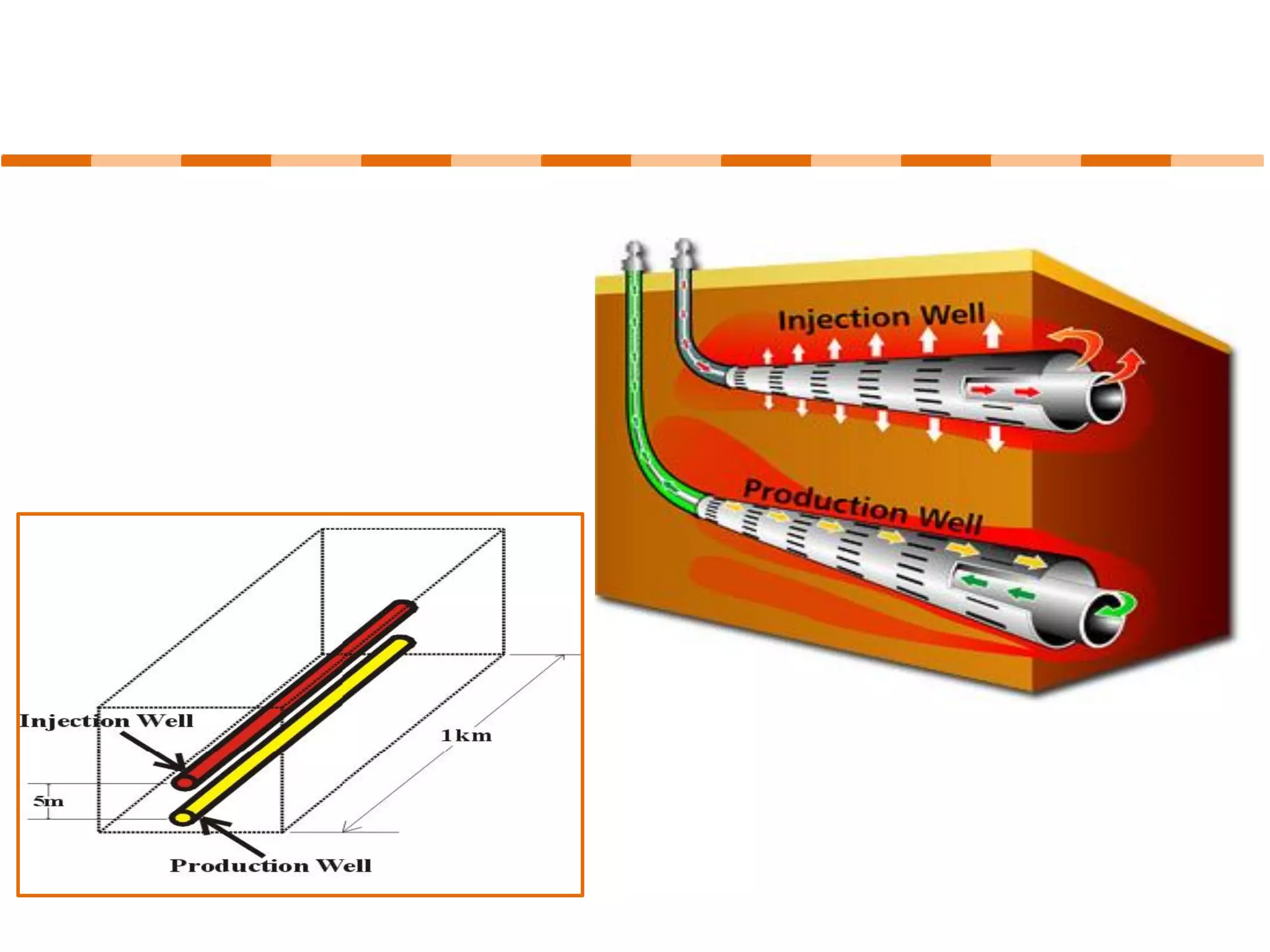
• SAGD means steam assisted gravity drainage the
process implemented by drilling two horizontal wells
parallel to each other, one for the injection (upper) of
steam creates a steam chamber from which oil can
drain towards the producer (lower)
• The oil which is normally immobile is heated, allowing
gravity drainage towards the lower producer at the
bottom.
• There are two factors are controlling the mechanism,
steam effect in addition to gravity effect which it helps
the steam to flow from the injector towards the
producer.
• The most typical application is as follows: Two wells are
drilled, both extended in a horizontal direction with the
producer being parallel to and vertically below the
injector.
• Steam is injected into the injector (upper well), heated
oil drains by gravity towards the producer.
• The producer is completed such the oil which is heated
through conduction and can flow as a separate phase
from the injected steam.
Advantages
• High reduction in oil viscosity from 1000s cp to less than
10 cp and there for mobility ratio reduction in addition
to flow control.
• Applicable for extra heavy oils and bitumen.
• High recovery factor, it depends on the horizontal wells.
• Wettability change from oil to water wet.
Disadvantages
• Swelling of clay leads to low efficient.
• Presence of aquifer results in condensation.
• Cost of horizontal wells.
• Environmental problems due to high water production.
Conditions to be Applied
• Very heavy oil, it is good for oil API less than 13 and it
can be applied for bitumen reservoirs.
• Viscous oil with a viscosity more than 100 cp and it can
be applied up to 5000 cp.
• Thick reservoir, to be able to drill two horizontal wells
(more than 15 m)
• Sand continuity for the horizontal sections.
• Good reservoir porosity and permeability.
• Weak or moderate aquifer strength.
• Shallow reservoirs are suitable (to avoid heat losses and
lowering steam quality).
EOR thermal Steam Injection.pdf

EOR thermal Steam Injection.pdf

  • 1.
    Contents ❑ Introduction. ❑ SteamInjection. ❑ Cyclic Steam Stimulation (CSS). ❑ Insitu Combustion (ISC). ❑ Steam AssistedGravity Drainage (SAGD).
  • 2.
    • Thermal methodshave been tested since 1950’s, and they are the most advanced among EOR methods, as far as field experience and technology are concerned. They are best suited for heavy oils (10-20° API) and tar sands (≤10° API). • Thermal methods supply heat to the reservoir, and vaporize some of the oil. Introduction
  • 3.
    There are fourmain types of thermal EOR namely: 1. Steam Injection. 2. Cyclic Steam Stimulation (CSS). 3. Insitu Combustion (ISC). 4. Steam Assisted Gravity Drainage (SAGD).
  • 4.
    • To understandeach method of thermal EOR, Advantages, disadvantages, Injection process of Thermal into the formations and suitable conditions to be applied have to be considered. • To do thermal injection in EOR, new wells have to be drilled for injection except in CSS.
  • 5.
  • 6.
    Mechanism • Steam floodingis a pattern drive, similar to water flooding, steam is injected continuously with a certain quality (80% steam and 20% water) to the reservoir having shallow depth which is preferred. • It forms a steam zone which advances slowly in the reservoir heating the oil and reducing its viscosity.
  • 8.
    • Once steamis injected into the oil reservoir with good quality. • Steam reacts with oil and reduces its viscosity, by creating an oil bank and in addition to continuous steam injected oil is pushed towards the producer. • Wettability is changed from oil to water wet due to the reduction of oil viscosity.
  • 9.
    Advantages • Reduces Sor(remaining oil in the reservoir). • Reduces oil viscosity resulting in mobility ratio reduction and wettability change. • Good performance due to continuous steam injection. • High RF. • SOR (Steam Oil Ratio is controlled).
  • 10.
    Disadvantages • Steam overrideto the adjacent formation due to thin reservoir net pay and high steam mobility. • Less effectiveness at deep reservoir due to reduction of steam quality. • Cannot be applied at deeper reservoir depth. • Heat losses occurred in case of strong or excessive water drive.
  • 11.
    Conditions to beApplied • Low API (<22 Degree API). • Viscous oil (more than 100 cp). • Thick net pay (more than 10 m) to avoid heat losses to the adjacent formations. • Perforation has to be away from OWC to avoid steam condensation. • Reasonable current reservoir pressure. • High reservoir permeability to support steam traveling inside the reservoir.
  • 12.
  • 13.
    Mechanism • Cyclic steamstimulation is a “single well” process and called Huff and Puff. • It is the only EOR method that is applied in the producer itself. • It is called Cyclic Steam Injection (CSI). • It consists of three stages: • Injection period. • Soaking period. • Production period.
  • 14.
    Mechanism • The processstarted with steam injection in the producer itself with high steam quality, usually 80%, for a period of 14 - 21 days • The well is shut-in, then followed by soaking period of 3 - 5 days to allow the heat to be distributed in the formation, still the well is shut-in. • Then followed by production period. • Cycles are repeated when the oil rate becomes uneconomic.
  • 18.
    Advantages • Prepare thefield for future steam flooding by heating a part of the reservoir. • Reduced oil viscosity and there for change the wettability around the well bore from oil to water wet in addition to mobility ratio reduction. • Reduces Sor (remaining oil in the reservoir). • Quick increment in oil rate once the production phase is started.
  • 19.
    Disadvantages • Difficult tobe applied in case of low current reservoir pressure. • Steam injection is not continuous. • Affected by strong water aquifer drive.
  • 20.
    Conditions to beApplied • Large filed area and steam is selected to be implemented in the future, CSS is used to heat a part of the reservoir. • Low API (less than 22.1 Degree API). • Viscous oil (more than 100 cp). • Good net pay (10 m at least to avoid heat losses). • Enough reservoir pressure to hold the injection pressure.
  • 21.
  • 22.
    Mechanism • In-situ combustionor fire flooding involves starting a fire in the reservoir and injecting air to sustain the burning of some of the crude oil. • The injection mechanism is usually done under high pressure and temperature. • Air or any gas contains oxygen is injected in the reservoir to start the ignition. • Then followed by continuous injection of air to sustain the burning process in addition to push the combustion front towards the producer.
  • 25.
    • The heatproduced reduces the viscosity of the reservoir fluid thereby increasing the mobility of the oil. • The mobility must be high enough so that hydrocarbons can be displaced from the combustion area to the cold area of the reservoir. • Thus for this process, high permeability and high porosity are most attractive.
  • 26.
    ISC Types There arethree types of in-situ combustion processes as described below: 1. Dry in-situ combustion. (ignition and burning flow from Injector to producer). 2. Wet in-situ combustion. (ignition and burning flow from Injector to producer). 3. Reverse in-situ combustion. (ignition from producer and burning flow from Injector to producer).
  • 27.
    Dry ISC: • Itis the normal in-situ combustion process, both injection of air and burning front are created at the injector and it is not followed by injection of water and the process is kept dry, in this process the propagation of the burning front and the combustion front are from the injector to the producer.
  • 28.
    Wet ISC: • Inthis process water in injected in the reservoir after the air is being injected into the reservoir, the reason of water injection is to cool the reservoir to protect the well from damage due to the very high temperature which is crated of the burning process.
  • 29.
    Reverse ISC: • inreverse in-situ combustion injection of air is in the injector and the ignition is created in the producer, it is called reverse due to the direction of the combustion front is in the opposite direction of the injection, then by the continuous air injection burning front is travelled in the reservoir towards the producer.
  • 30.
    Advantages • Mobility ratioreduction and mobility control. • Oil viscosity reduction. • Wettability change from oil to water wet. • It is cheaper process. • Incremental in the RF %.
  • 31.
    Disadvantages • Reservoir damagewhere any other EOR methods cannot be applied after that. • A part of OIIP is burned during ignition and burning in the reservoir as well as providing fuel to the process. • Complex process. • Unfavorable gas-oil mobility during the injection and burning front processes. • Carbon dioxide is formed during the process which it affects the surface facilities if it is being produced.
  • 32.
    Conditions to beApplied • Heavy oil (low API is needed). • Oil viscous can be low or high. • No strong aquifer from the bottom. • It can be applied in deeper reservoir up to 6000 ft. • Good porosity and permeability. • High remaining oil left in the reservoir.
  • 33.
  • 34.
    Mechanism • SAGD meanssteam assisted gravity drainage the process implemented by drilling two horizontal wells parallel to each other, one for the injection (upper) of steam creates a steam chamber from which oil can drain towards the producer (lower) • The oil which is normally immobile is heated, allowing gravity drainage towards the lower producer at the bottom.
  • 37.
    • There aretwo factors are controlling the mechanism, steam effect in addition to gravity effect which it helps the steam to flow from the injector towards the producer. • The most typical application is as follows: Two wells are drilled, both extended in a horizontal direction with the producer being parallel to and vertically below the injector.
  • 38.
    • Steam isinjected into the injector (upper well), heated oil drains by gravity towards the producer. • The producer is completed such the oil which is heated through conduction and can flow as a separate phase from the injected steam.
  • 39.
    Advantages • High reductionin oil viscosity from 1000s cp to less than 10 cp and there for mobility ratio reduction in addition to flow control. • Applicable for extra heavy oils and bitumen. • High recovery factor, it depends on the horizontal wells. • Wettability change from oil to water wet.
  • 40.
    Disadvantages • Swelling ofclay leads to low efficient. • Presence of aquifer results in condensation. • Cost of horizontal wells. • Environmental problems due to high water production.
  • 41.
    Conditions to beApplied • Very heavy oil, it is good for oil API less than 13 and it can be applied for bitumen reservoirs. • Viscous oil with a viscosity more than 100 cp and it can be applied up to 5000 cp. • Thick reservoir, to be able to drill two horizontal wells (more than 15 m) • Sand continuity for the horizontal sections. • Good reservoir porosity and permeability. • Weak or moderate aquifer strength. • Shallow reservoirs are suitable (to avoid heat losses and lowering steam quality).