
Primary funding is provided by
The SPE Foundation through member donations
and a contribution from Offshore Europe
The Society is grateful to those companies that allow their
professionals to serve as lecturers
Additional support provided by AIME
Society of Petroleum Engineers
Distinguished Lecturer Program
www.spe.org/dl
Society of Petroleum Engineers
Distinguished Lecturer Program
www.spe.org/dl
John D. Hedengren, Ph.D.
Brigham Young University
Drilling Automation and Downhole Monitoring
with Physics-based Models
Outline
• Why and how to automate drilling?
• 3 elements of automation
• Automation case study
• Closed loop downhole automation
• Challenges and opportunities: Physics-based or machine learned models
• Create fit-for-purpose digital twins for automation
• Unlock a new way of thinking
• Predictive versus reactive automation
• Combine pressure and rate control
• Conclusions
http://graphics8.nytimes.com
3
Why Automate Drilling?
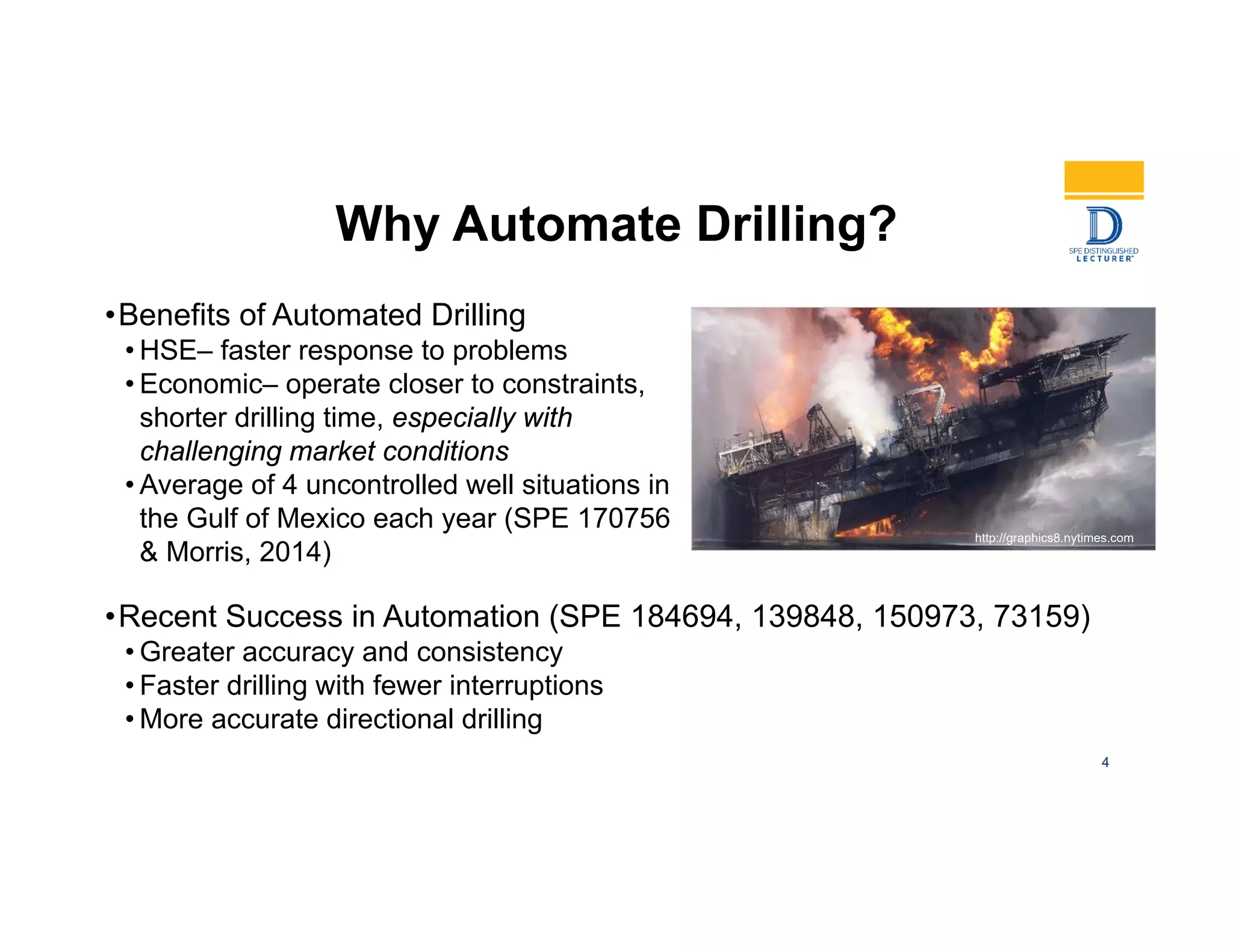
•Benefits of Automated Drilling
• HSE– faster response to problems
• Economic– operate closer to constraints,
shorter drilling time, especially with
challenging market conditions
• Average of 4 uncontrolled well situations in
the Gulf of Mexico each year (SPE 170756
& Morris, 2014)
http://graphics8.nytimes.com
4
•Recent Success in Automation (SPE 184694, 139848, 150973, 73159)
• Greater accuracy and consistency
• Faster drilling with fewer interruptions
• More accurate directional drilling
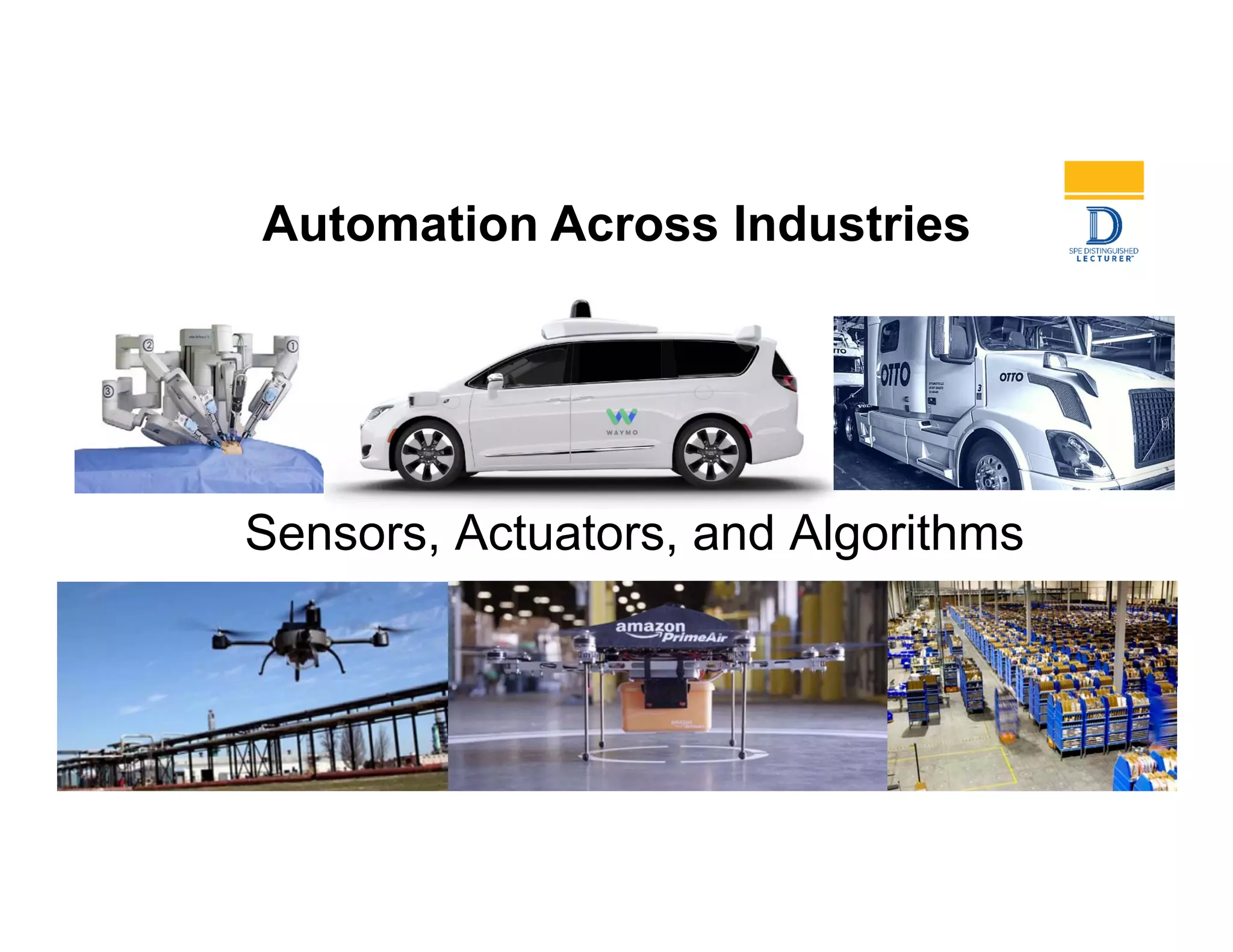
Automation OpportunitiesAutomation Across Industries
5
Sensors, Actuators, and Algorithms
Automation Opportunities
Source:PetroWiki
Levels of Automation
6
Level 1 Level 2 Level 3
Automation Opportunities
Source:PetroWiki
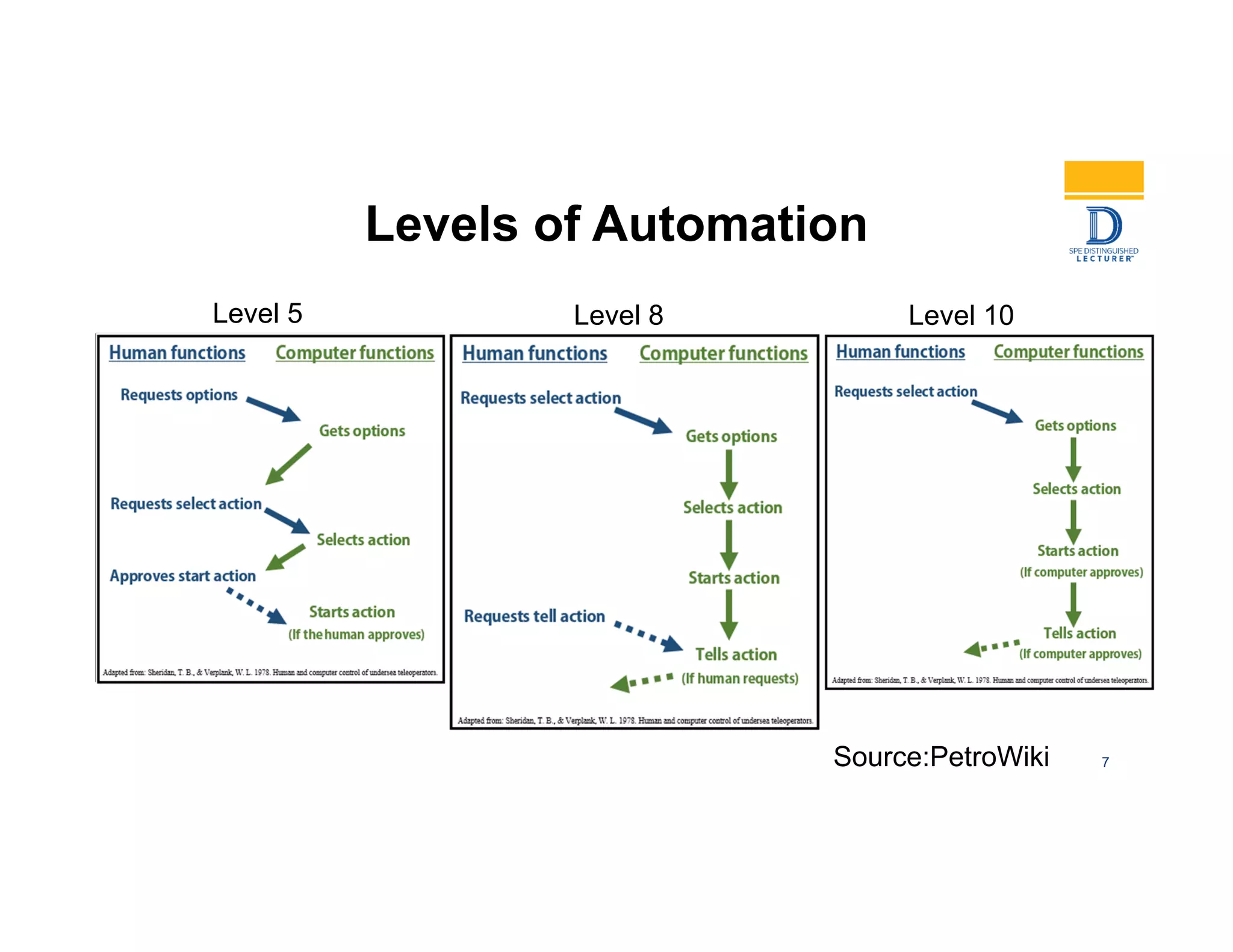
Levels of Automation
7
Level 5 Level 8 Level 10
Automation Opportunities
Source: Tesla
What Level of Automation?
7
How to Automate Drilling?
•Three elements for automation
• Sensor (measurement)
• Actuator (valve, motor, pump)
• Controller (computer)
•Considerations
• Open or proprietary
• Centralized or distributed
• Simple or complex
9
Sensor Actuator Controller
Reservoir
Weight on
Bit
Rotation
Speed
Drill
String
Annulus
Back Pressure
Pump
Main Mud Pump
Choke
Valve
Transmit Downhole Sensor Data
10
Sensor
25 GB/hour
150,000 points/sec
51,200 GB/hr
Source: Simafore, Fortune, RTInsights, Cisco
Hedengren, J. D., Eaton, A. N., Overview of Estimation Methods for Industrial Dynamic
Systems, Springer, 2017, DOI: 10.1007/s11081-015-9295-9.
Monitor Bottom Hole Pressure
11
Sensor
Depth
Pressure
Connections
BHP
Drilling Window
Adjust Choke Valve
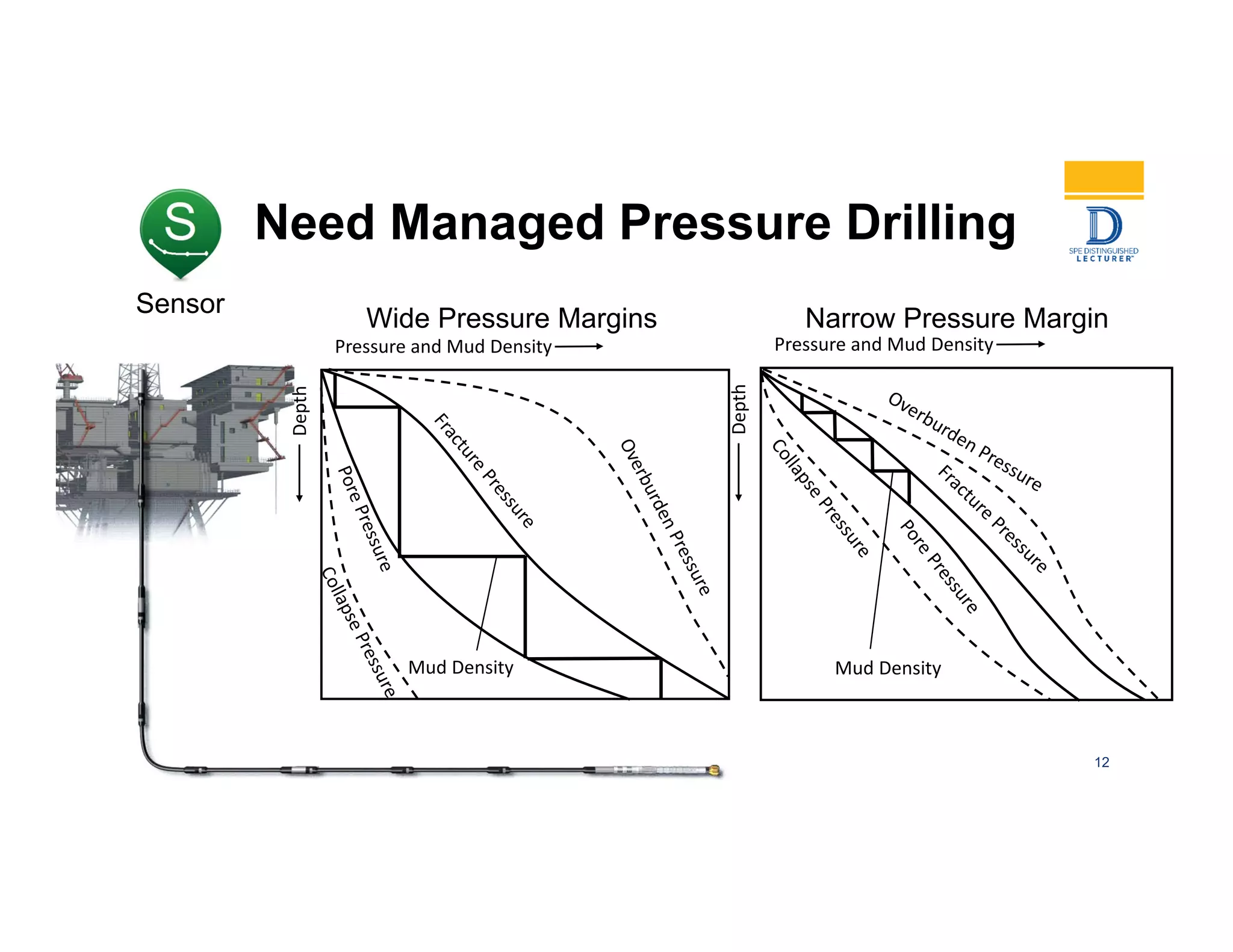
Need Managed Pressure Drilling
12
Sensor Depth
Pressure and Mud Density
Mud Density
Depth
Pressure and Mud Density
Mud Density
Wide Pressure Margins Narrow Pressure Margin
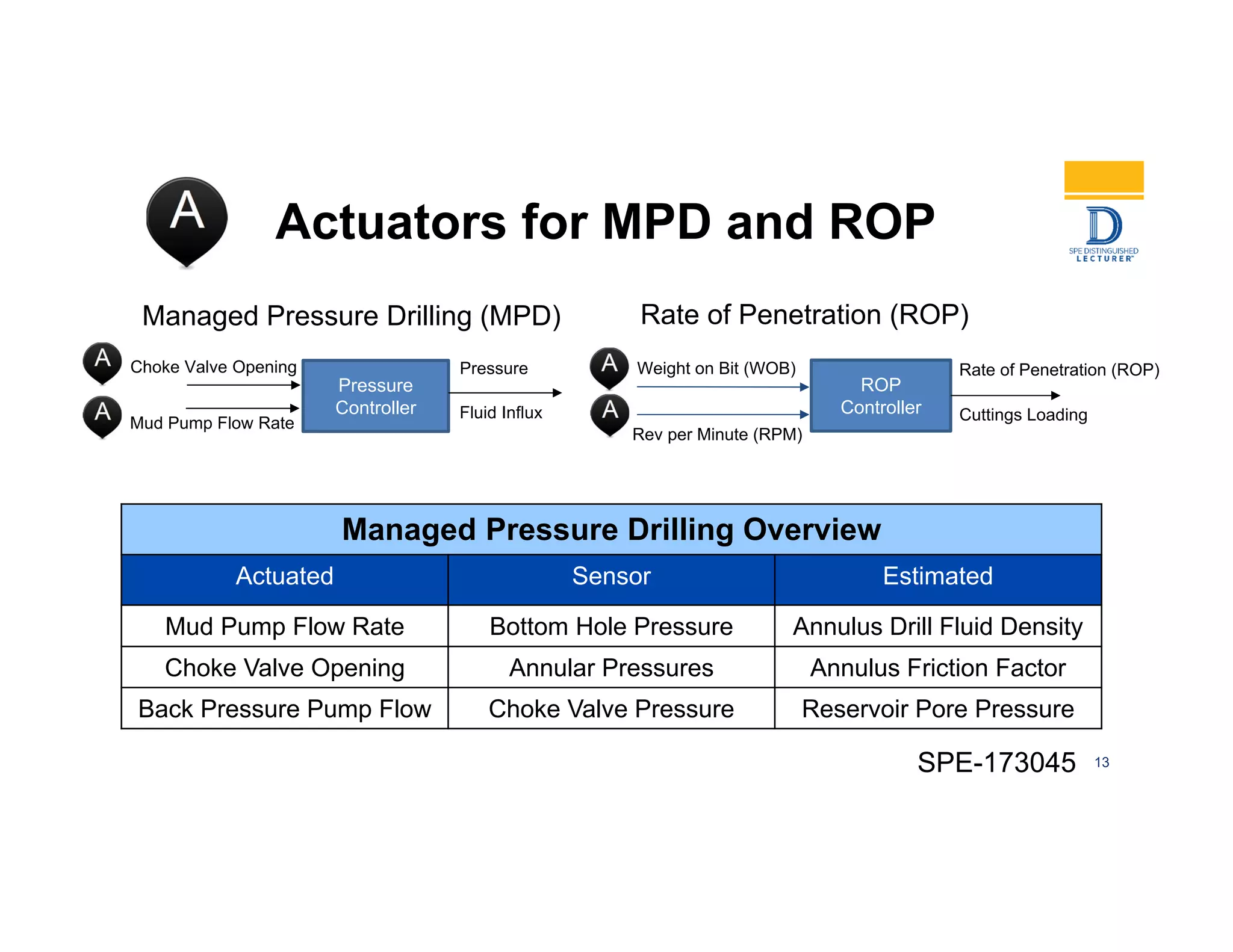
Managed Pressure Drilling Overview
Actuated Sensor Estimated
Mud Pump Flow Rate Bottom Hole Pressure Annulus Drill Fluid Density
Choke Valve Opening Annular Pressures Annulus Friction Factor
Back Pressure Pump Flow Choke Valve Pressure Reservoir Pore Pressure
Actuators for MPD and ROP
SPE-173045 13
Choke Valve Opening
Mud Pump Flow Rate
Pressure
Controller
Pressure Weight on Bit (WOB)
Rev per Minute (RPM)
ROP
Controller
Rate of Penetration (ROP)
Managed Pressure Drilling (MPD) Rate of Penetration (ROP)
Cuttings LoadingFluid Influx
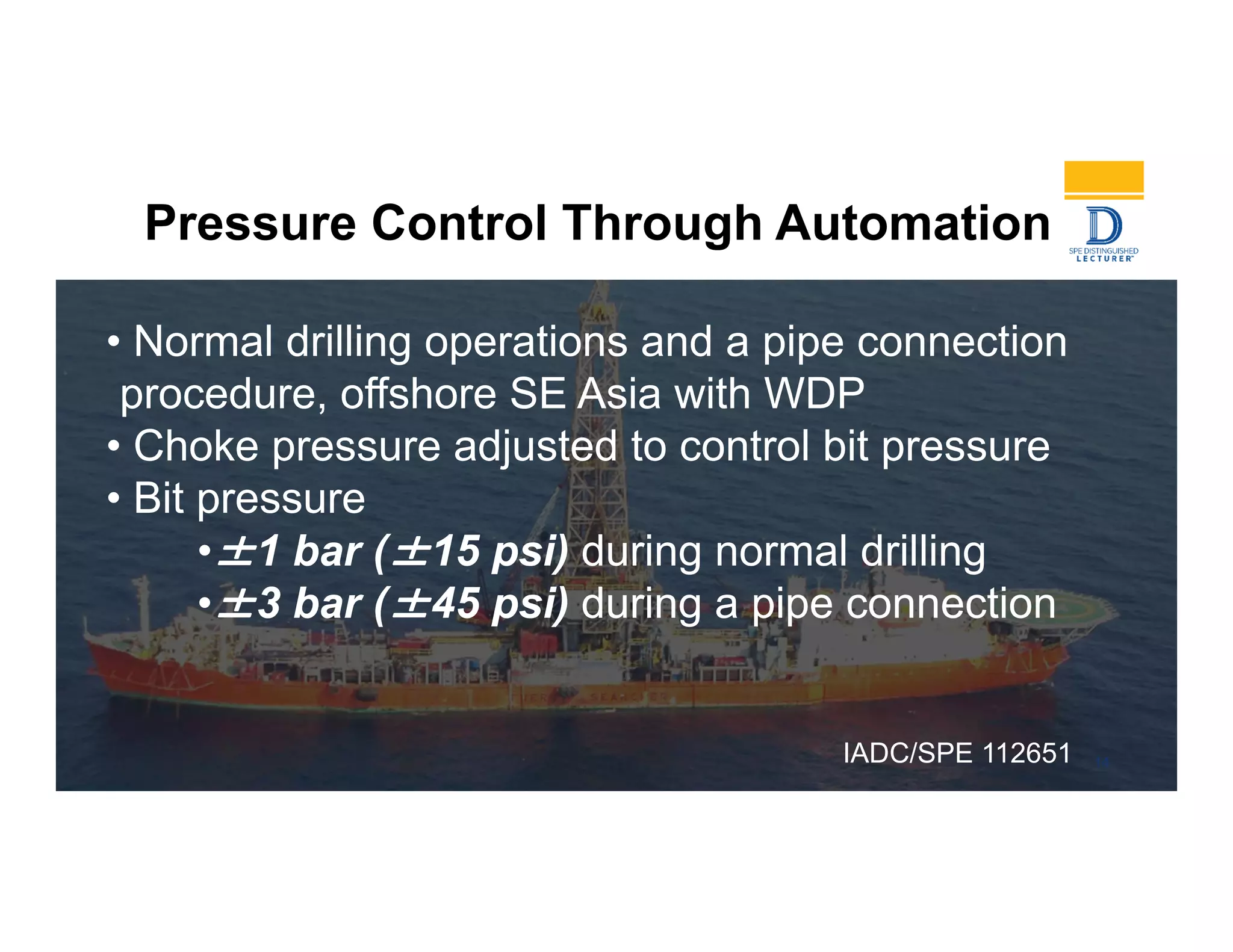
Pressure Control Through Automation
• Normal drilling operations and a pipe connection
procedure, offshore SE Asia with WDP
• Choke pressure adjusted to control bit pressure
• Bit pressure
•±1 bar (±15 psi) during normal drilling
•±3 bar (±45 psi) during a pipe connection
14IADC/SPE 112651
Controllers for Automation
15
•Sequence control for batch processes
•Feedback control for continuous systems
•Feedforward control anticipates disturbances
https://commons.wikimedia.org
FUTUREPAST
k
Actuator P+I+D+FF
P = proportional error
I = integral error
D = derivative error
FF = feedforward
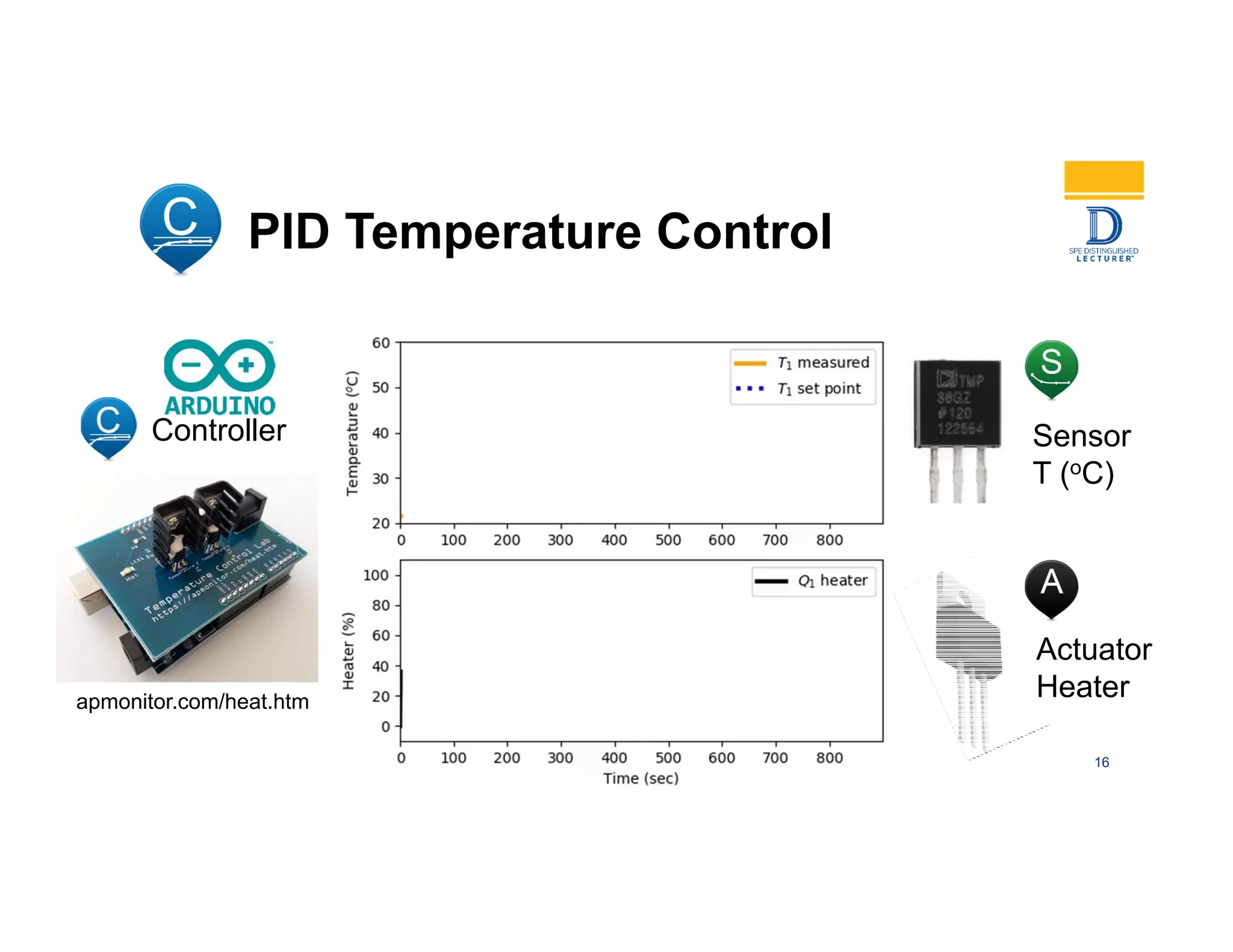
PID Temperature Control
16
Sensor
T (oC)
Actuator
Heater
Controller
apmonitor.com/heat.htm
FUTUREPAST
k
Conventional Feedback Control Model Predictive Control
Driving While Looking in Reverse
(Feedback)
Driving While Looking Forward
(Predictive or Feedforward)
17
Improve with Predictive Automation
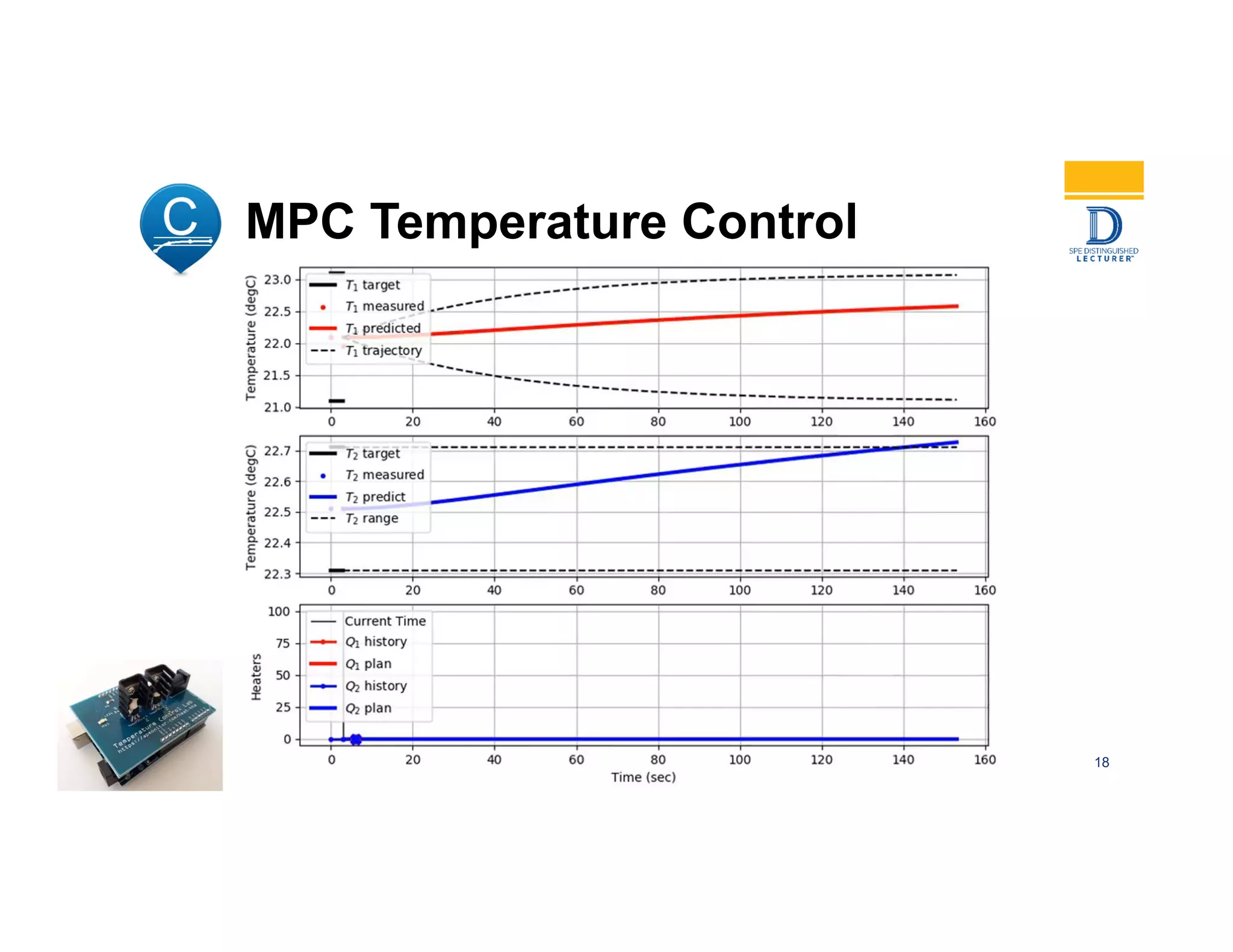
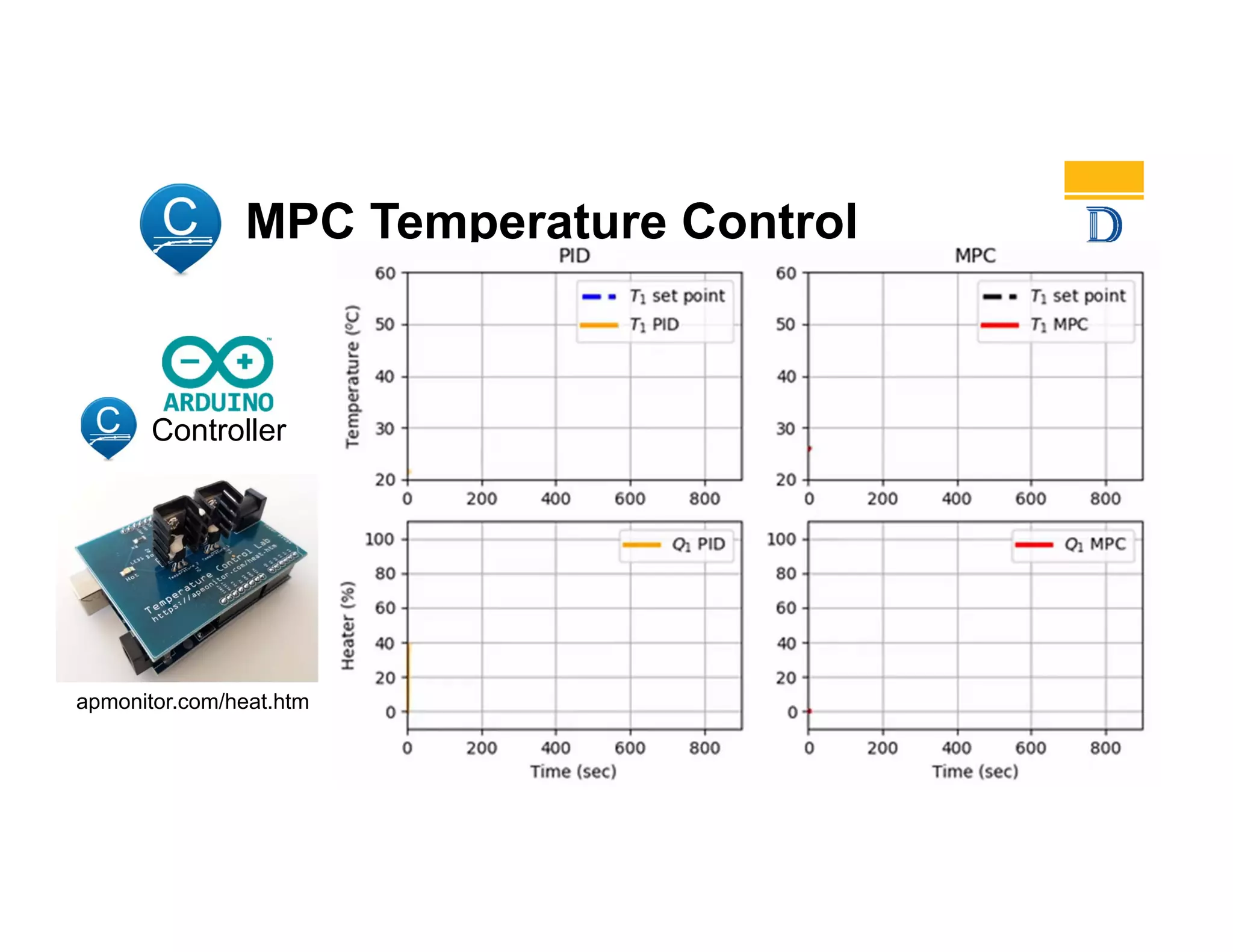
MPC Temperature Control
18
MPC Temperature Control
19
Controller
apmonitor.com/heat.htm
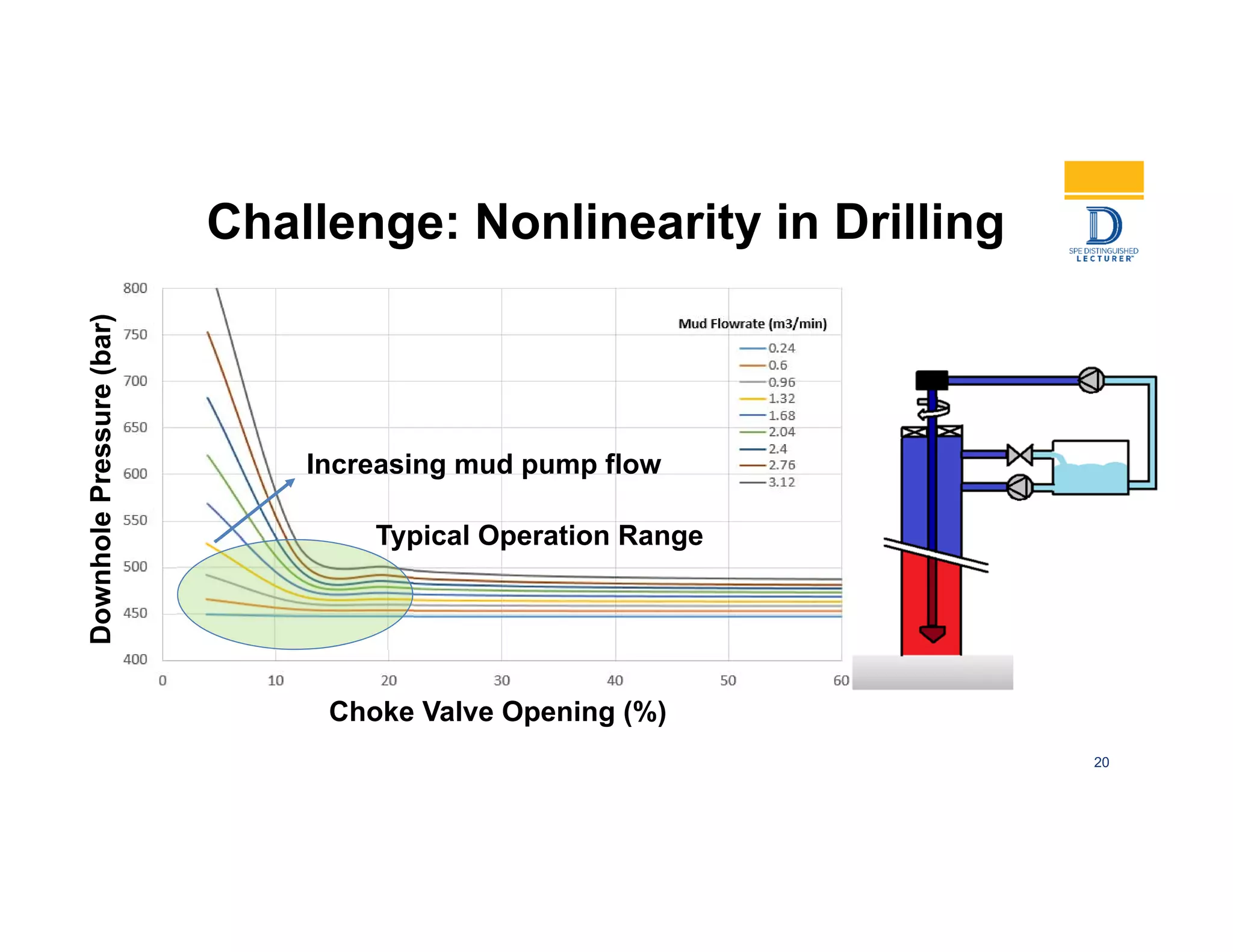
Challenge: Nonlinearity in Drilling
Increasing mud pump flow
Typical Operation Range
DownholePressure(bar)
Choke Valve Opening (%)
20
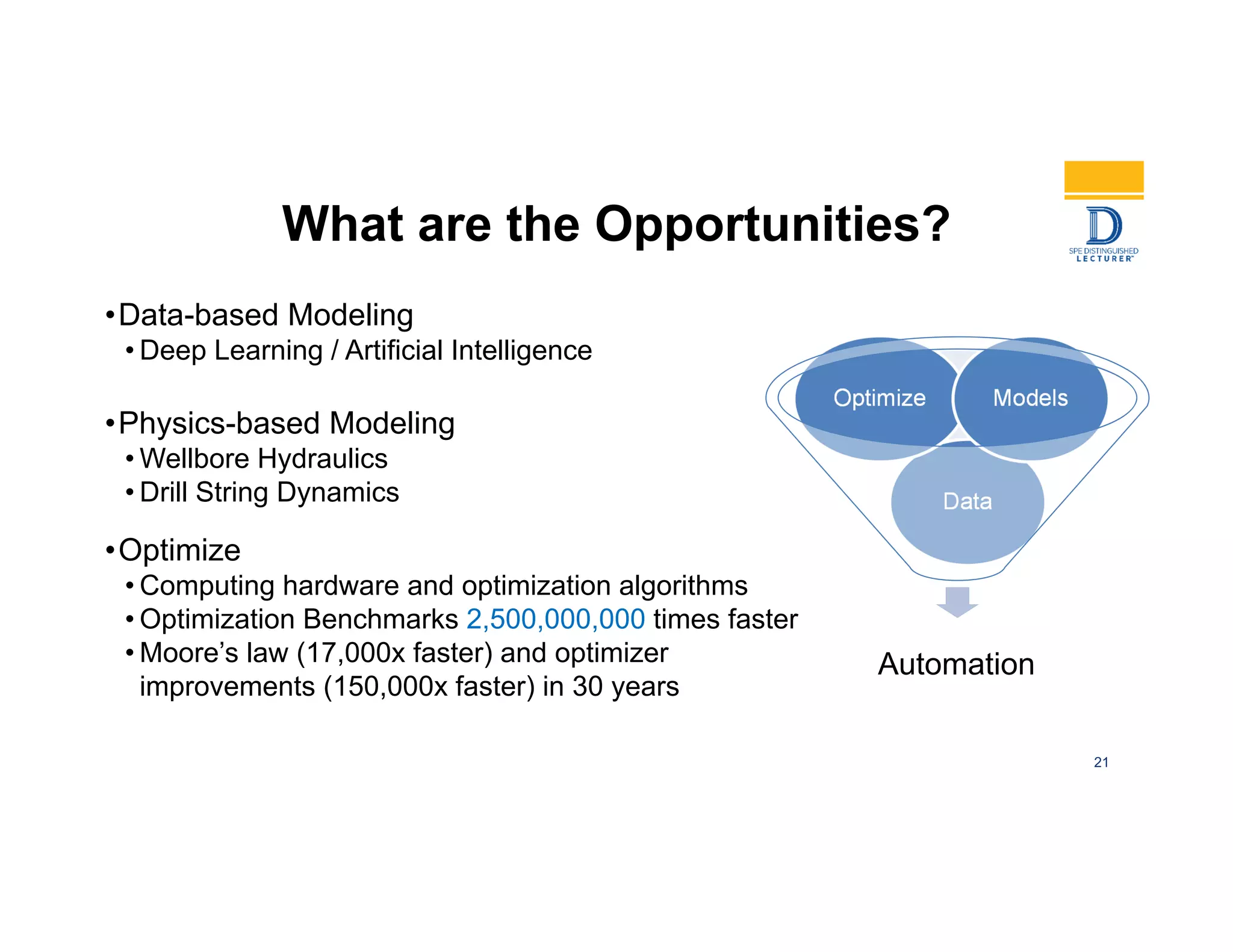
What are the Opportunities?
•Data-based Modeling
• Deep Learning / Artificial Intelligence
•Physics-based Modeling
• Wellbore Hydraulics
• Drill String Dynamics
•Optimize
• Computing hardware and optimization algorithms
• Optimization Benchmarks 2,500,000,000 times faster
• Moore’s law (17,000x faster) and optimizer
improvements (150,000x faster) in 30 years
Data
Optimize Models
Automation
21
22
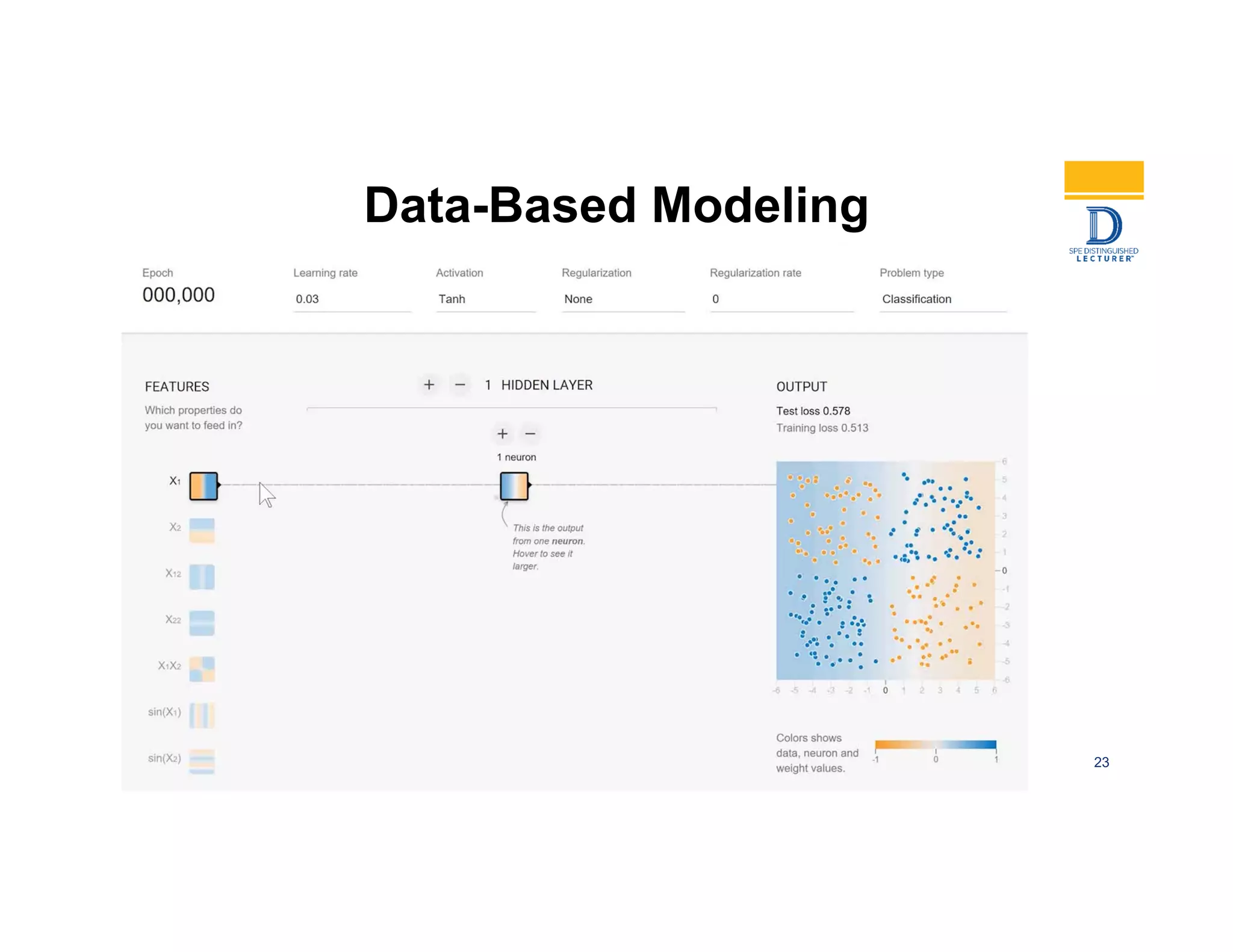
Data-Based Modeling
https://playground.tensorflow.org
23
Data-Based Modeling
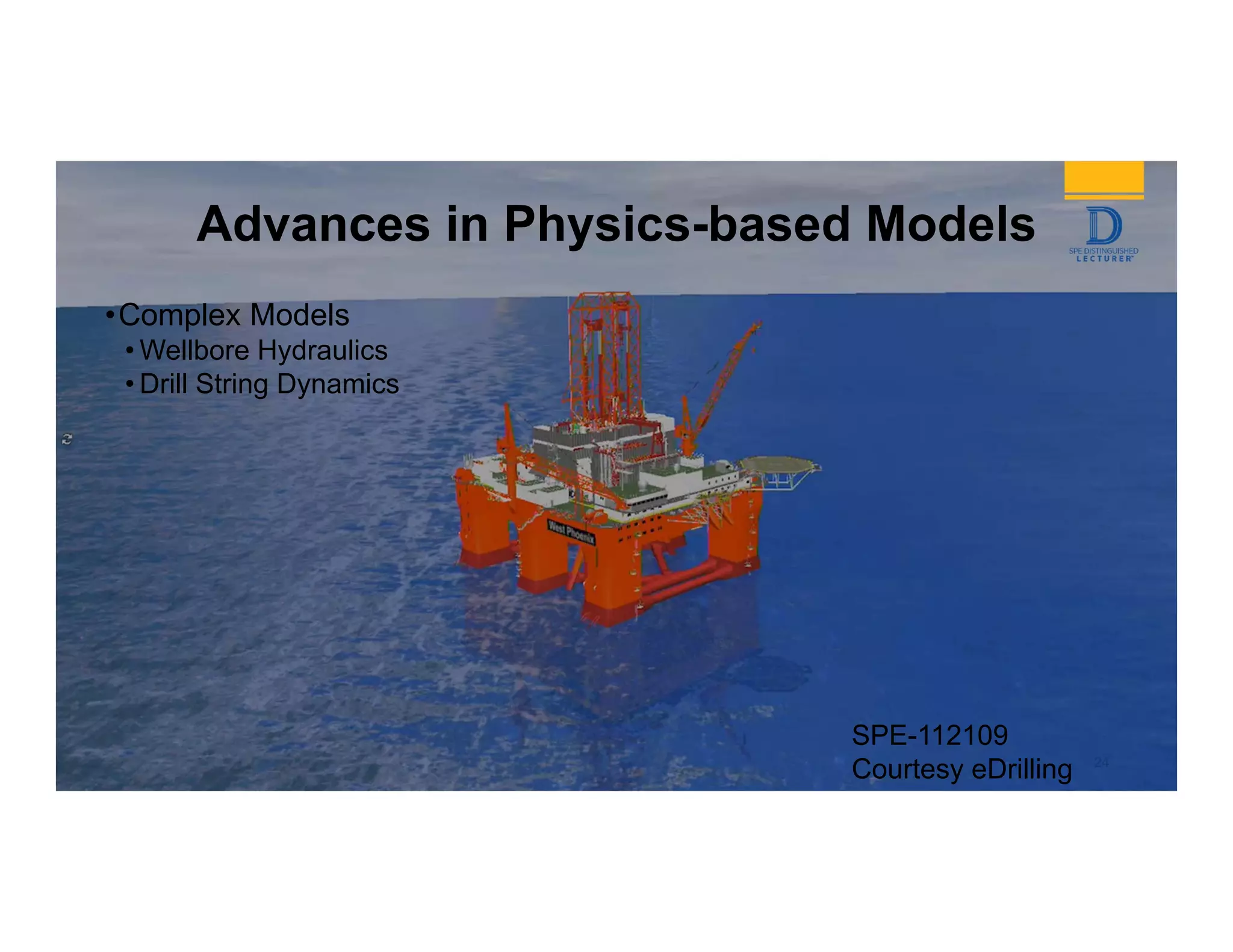
Advances in Physics-based Models
•Complex Models
• Wellbore Hydraulics
• Drill String Dynamics
SPE-112109
Courtesy eDrilling 24
Advances in Physics-based Models
•High Fidelity Modeling
• Wellbore Hydraulics
• Drill String Dynamics
SPE-173154
Courtesy MSC Software 25
26Drilling Simulator Celle
Hardware-Simulator
Need Fit-for-Purpose Models
Downhole pressure
Mud pump pressure
Choke valve pressure
27
P(bar)P(bar)P(bar)
Lower order, machine learned model
matches physics-based model
Time (sec)
Machine Learning with Automation
28
Controller
apmonitor.com/heat.htm
ConventionalControl
Mud Pump Constant
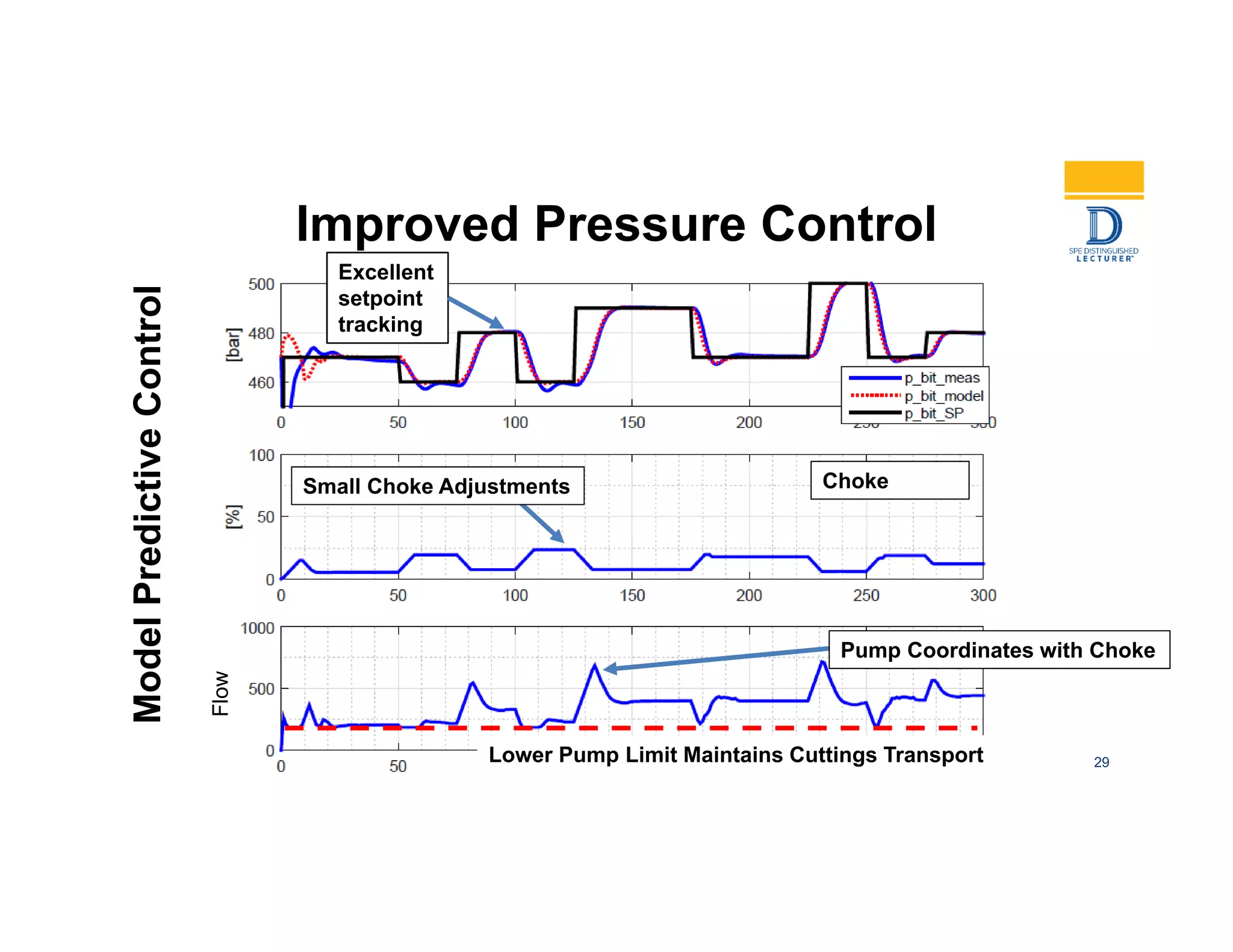
Improved Pressure Control
ModelPredictiveControl
Lower Pump Limit Maintains Cuttings Transport 29
Flow
Excellent
setpoint
tracking
Choke
Pump Coordinates with Choke
Small Choke Adjustments
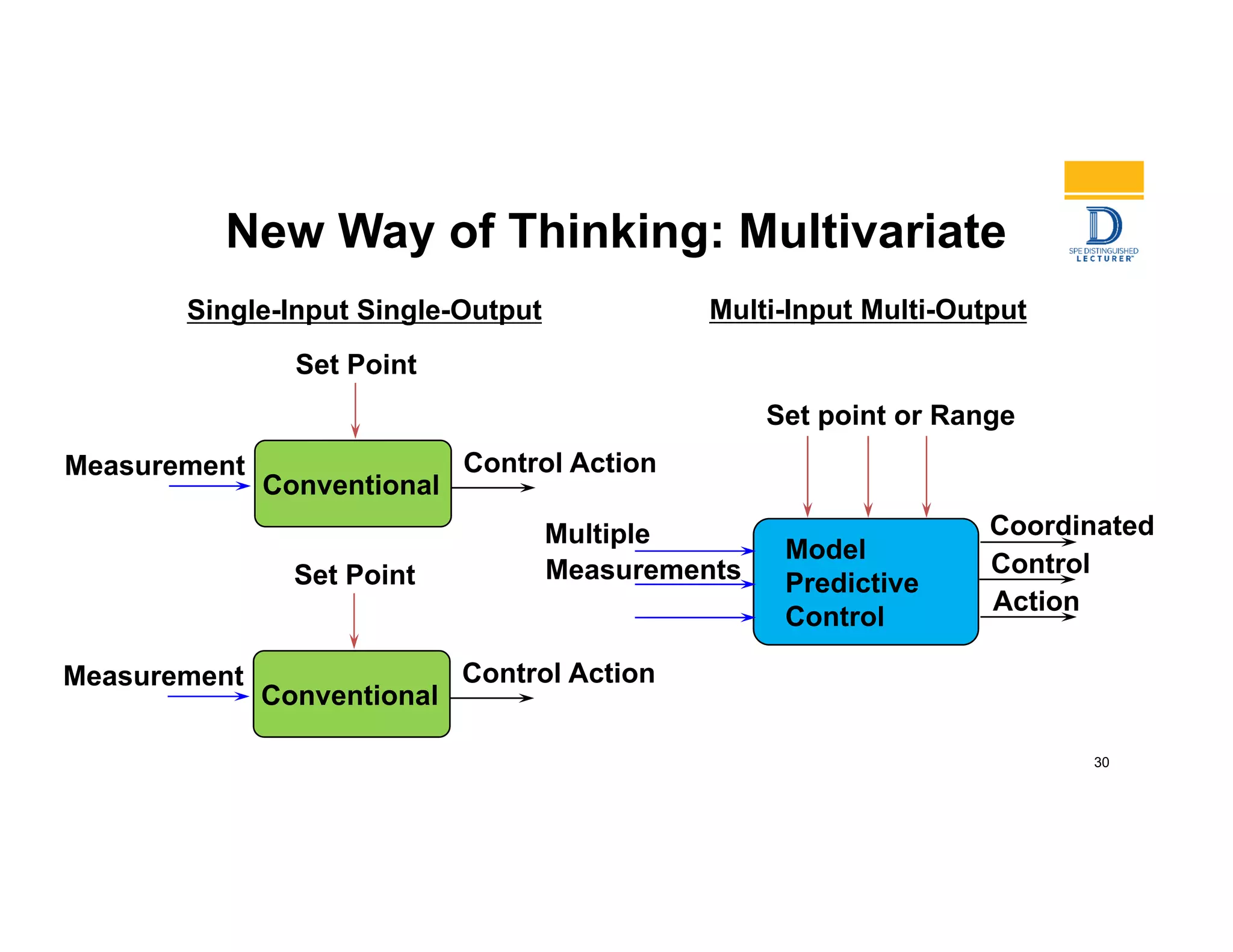
New Way of Thinking: Multivariate
Single-Input Single-Output Multi-Input Multi-Output
Conventional
Control Action
Set Point
Measurement
Model
Predictive
Control
Set point or Range
Conventional
Control Action
Set Point
Measurement
Measurements Control
Coordinated
Action
Multiple
30
Automated Kick Response
Improvement with
Combined Control
Automation
Improvement
New Way of Thinking:
Pressure Control and Rate Optimization
Choke Valve Opening
Mud Pump Flow Rate
Pressure
Controller
Pressure Weight on Bit (WOB)
Rev per Minute (RPM)
ROP
Controller
Rate of Penetration (ROP)
Rev per Minute (RPM)
Weight on Bit (WOB)
Choke Valve Opening
Downhole Pressure
Rate of Penetration
Combined
Controller
Pump Flow Rates
SPE-170275
ROP 20% higher
31
Challenges of Predictive Automation
•Requires digitization as a foundation
•Automation can become unreliable if the control model is not calibrated
or is not sufficiently accurate
•Advanced nonlinear, predictive controllers can fail to converge and result
in lost or poor control
•To address these challenges, reinforcement learning maintains model
accuracy and controller stability without interrupting the drilling process
32
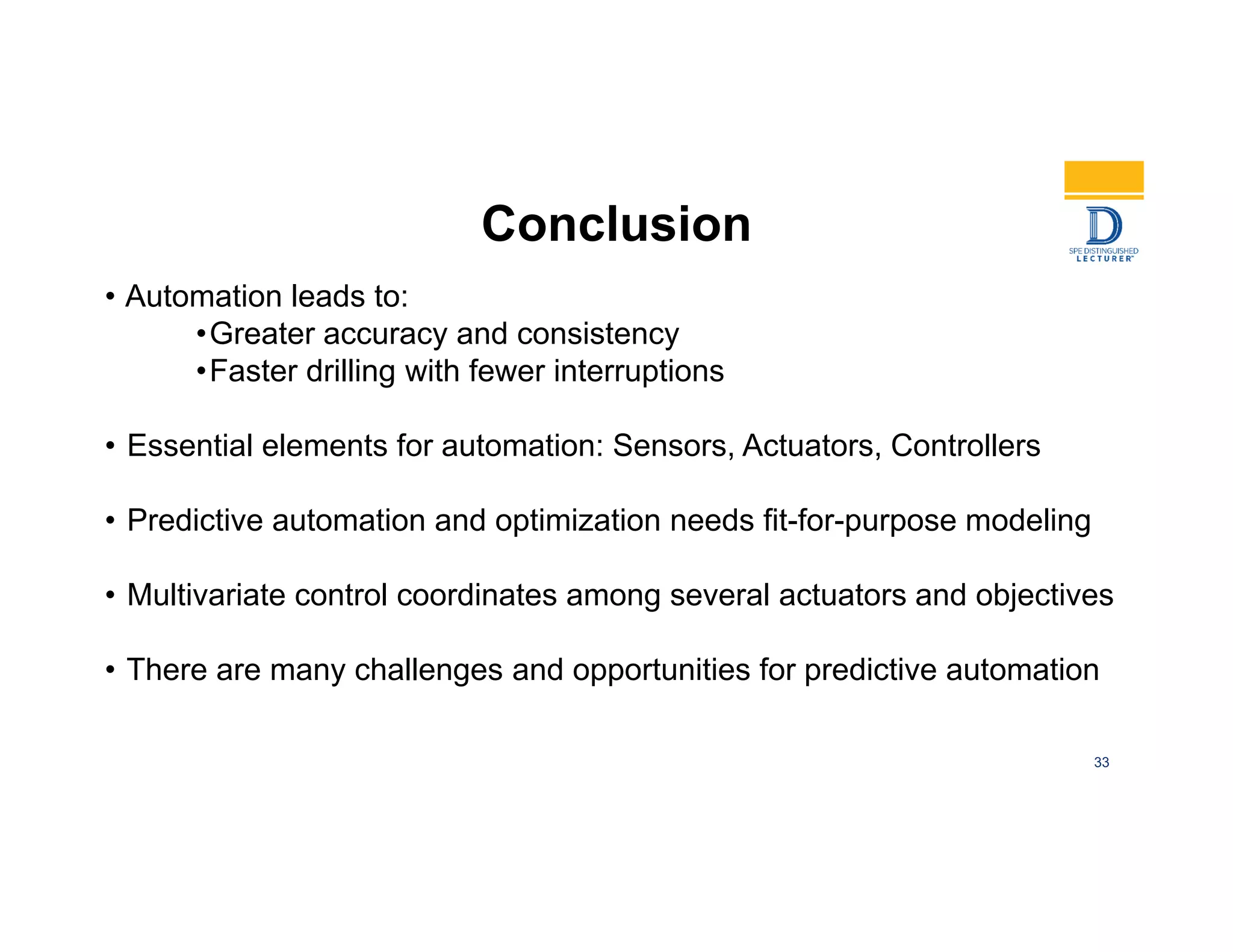
Conclusion
• Automation leads to:
•Greater accuracy and consistency
•Faster drilling with fewer interruptions
• Essential elements for automation: Sensors, Actuators, Controllers
• Predictive automation and optimization needs fit-for-purpose modeling
• Multivariate control coordinates among several actuators and objectives
• There are many challenges and opportunities for predictive automation
33
Resources and Collaborations
•Open Source Drilling Models + Cases + Data
• Pastusek, P., Payette, G., Shor, R., Cayeux, E., Aarsnes, U.J., Hedengren, J.D.,
Menand, S., Macpherson, J., Gandikota, R., Behounek, M., Harmer, R.,
Detournay, E., Illerhaus, R., Liu, Y., Creating Open Source Models, Test Cases,
and Data for Oilfield Drilling Challenges, SPE/IADC Drilling Conference, The
Hague, Netherlands, March 2019, SPE-194082-MS.
https://github.com/APMonitor/drilling
•Online Course
•Machine Learning and Dynamic Optimization
•January-April 2019: https://apmonitor.com/do
•Connect on LinkedIn: https://www.linkedin.com/in/hedengren
34
35
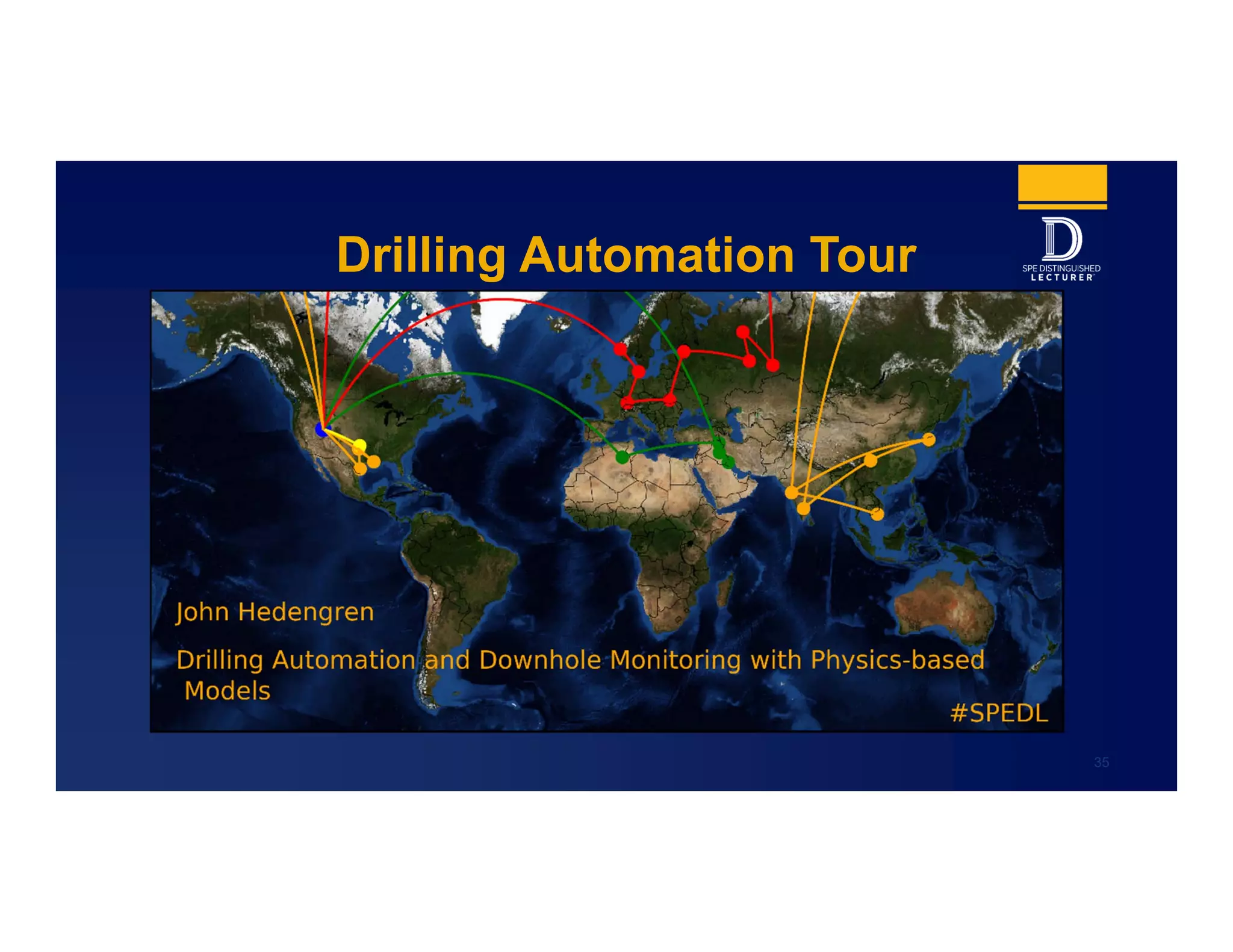
Drilling Automation Tour
Society of Petroleum Engineers
Distinguished Lecturer Program
www.spe.org/dl 36
Your Feedback is Important
Enter your section in the DL Evaluation Contest by
completing the evaluation form for this presentation
Visit SPE.org/dl
#SPEDL
36

John Hedengren

  • 1.
    Primary funding isprovided by The SPE Foundation through member donations and a contribution from Offshore Europe The Society is grateful to those companies that allow their professionals to serve as lecturers Additional support provided by AIME Society of Petroleum Engineers Distinguished Lecturer Program www.spe.org/dl
  • 2.
    Society of PetroleumEngineers Distinguished Lecturer Program www.spe.org/dl John D. Hedengren, Ph.D. Brigham Young University Drilling Automation and Downhole Monitoring with Physics-based Models
  • 3.
    Outline • Why andhow to automate drilling? • 3 elements of automation • Automation case study • Closed loop downhole automation • Challenges and opportunities: Physics-based or machine learned models • Create fit-for-purpose digital twins for automation • Unlock a new way of thinking • Predictive versus reactive automation • Combine pressure and rate control • Conclusions http://graphics8.nytimes.com 3
  • 4.
    Why Automate Drilling? •Benefitsof Automated Drilling • HSE– faster response to problems • Economic– operate closer to constraints, shorter drilling time, especially with challenging market conditions • Average of 4 uncontrolled well situations in the Gulf of Mexico each year (SPE 170756 & Morris, 2014) http://graphics8.nytimes.com 4 •Recent Success in Automation (SPE 184694, 139848, 150973, 73159) • Greater accuracy and consistency • Faster drilling with fewer interruptions • More accurate directional drilling
  • 5.
    Automation OpportunitiesAutomation AcrossIndustries 5 Sensors, Actuators, and Algorithms
  • 6.
    Automation Opportunities Source:PetroWiki Levels ofAutomation 6 Level 1 Level 2 Level 3
  • 7.
    Automation Opportunities Source:PetroWiki Levels ofAutomation 7 Level 5 Level 8 Level 10
  • 8.
  • 9.
    How to AutomateDrilling? •Three elements for automation • Sensor (measurement) • Actuator (valve, motor, pump) • Controller (computer) •Considerations • Open or proprietary • Centralized or distributed • Simple or complex 9 Sensor Actuator Controller Reservoir Weight on Bit Rotation Speed Drill String Annulus Back Pressure Pump Main Mud Pump Choke Valve
  • 10.
    Transmit Downhole SensorData 10 Sensor 25 GB/hour 150,000 points/sec 51,200 GB/hr Source: Simafore, Fortune, RTInsights, Cisco Hedengren, J. D., Eaton, A. N., Overview of Estimation Methods for Industrial Dynamic Systems, Springer, 2017, DOI: 10.1007/s11081-015-9295-9.
  • 11.
    Monitor Bottom HolePressure 11 Sensor Depth Pressure Connections BHP Drilling Window Adjust Choke Valve
  • 12.
    Need Managed PressureDrilling 12 Sensor Depth Pressure and Mud Density Mud Density Depth Pressure and Mud Density Mud Density Wide Pressure Margins Narrow Pressure Margin
  • 13.
    Managed Pressure DrillingOverview Actuated Sensor Estimated Mud Pump Flow Rate Bottom Hole Pressure Annulus Drill Fluid Density Choke Valve Opening Annular Pressures Annulus Friction Factor Back Pressure Pump Flow Choke Valve Pressure Reservoir Pore Pressure Actuators for MPD and ROP SPE-173045 13 Choke Valve Opening Mud Pump Flow Rate Pressure Controller Pressure Weight on Bit (WOB) Rev per Minute (RPM) ROP Controller Rate of Penetration (ROP) Managed Pressure Drilling (MPD) Rate of Penetration (ROP) Cuttings LoadingFluid Influx
  • 14.
    Pressure Control ThroughAutomation • Normal drilling operations and a pipe connection procedure, offshore SE Asia with WDP • Choke pressure adjusted to control bit pressure • Bit pressure •±1 bar (±15 psi) during normal drilling •±3 bar (±45 psi) during a pipe connection 14IADC/SPE 112651
  • 15.
    Controllers for Automation 15 •Sequencecontrol for batch processes •Feedback control for continuous systems •Feedforward control anticipates disturbances https://commons.wikimedia.org FUTUREPAST k Actuator P+I+D+FF P = proportional error I = integral error D = derivative error FF = feedforward
  • 16.
    PID Temperature Control 16 Sensor T(oC) Actuator Heater Controller apmonitor.com/heat.htm
  • 17.
    FUTUREPAST k Conventional Feedback ControlModel Predictive Control Driving While Looking in Reverse (Feedback) Driving While Looking Forward (Predictive or Feedforward) 17 Improve with Predictive Automation
  • 18.
  • 19.
  • 20.
    Challenge: Nonlinearity inDrilling Increasing mud pump flow Typical Operation Range DownholePressure(bar) Choke Valve Opening (%) 20
  • 21.
    What are theOpportunities? •Data-based Modeling • Deep Learning / Artificial Intelligence •Physics-based Modeling • Wellbore Hydraulics • Drill String Dynamics •Optimize • Computing hardware and optimization algorithms • Optimization Benchmarks 2,500,000,000 times faster • Moore’s law (17,000x faster) and optimizer improvements (150,000x faster) in 30 years Data Optimize Models Automation 21
  • 22.
  • 23.
  • 24.
    Advances in Physics-basedModels •Complex Models • Wellbore Hydraulics • Drill String Dynamics SPE-112109 Courtesy eDrilling 24
  • 25.
    Advances in Physics-basedModels •High Fidelity Modeling • Wellbore Hydraulics • Drill String Dynamics SPE-173154 Courtesy MSC Software 25
  • 26.
  • 27.
    Need Fit-for-Purpose Models Downholepressure Mud pump pressure Choke valve pressure 27 P(bar)P(bar)P(bar) Lower order, machine learned model matches physics-based model Time (sec)
  • 28.
    Machine Learning withAutomation 28 Controller apmonitor.com/heat.htm
  • 29.
    ConventionalControl Mud Pump Constant ImprovedPressure Control ModelPredictiveControl Lower Pump Limit Maintains Cuttings Transport 29 Flow Excellent setpoint tracking Choke Pump Coordinates with Choke Small Choke Adjustments
  • 30.
    New Way ofThinking: Multivariate Single-Input Single-Output Multi-Input Multi-Output Conventional Control Action Set Point Measurement Model Predictive Control Set point or Range Conventional Control Action Set Point Measurement Measurements Control Coordinated Action Multiple 30
  • 31.
    Automated Kick Response Improvementwith Combined Control Automation Improvement New Way of Thinking: Pressure Control and Rate Optimization Choke Valve Opening Mud Pump Flow Rate Pressure Controller Pressure Weight on Bit (WOB) Rev per Minute (RPM) ROP Controller Rate of Penetration (ROP) Rev per Minute (RPM) Weight on Bit (WOB) Choke Valve Opening Downhole Pressure Rate of Penetration Combined Controller Pump Flow Rates SPE-170275 ROP 20% higher 31
  • 32.
    Challenges of PredictiveAutomation •Requires digitization as a foundation •Automation can become unreliable if the control model is not calibrated or is not sufficiently accurate •Advanced nonlinear, predictive controllers can fail to converge and result in lost or poor control •To address these challenges, reinforcement learning maintains model accuracy and controller stability without interrupting the drilling process 32
  • 33.
    Conclusion • Automation leadsto: •Greater accuracy and consistency •Faster drilling with fewer interruptions • Essential elements for automation: Sensors, Actuators, Controllers • Predictive automation and optimization needs fit-for-purpose modeling • Multivariate control coordinates among several actuators and objectives • There are many challenges and opportunities for predictive automation 33
  • 34.
    Resources and Collaborations •OpenSource Drilling Models + Cases + Data • Pastusek, P., Payette, G., Shor, R., Cayeux, E., Aarsnes, U.J., Hedengren, J.D., Menand, S., Macpherson, J., Gandikota, R., Behounek, M., Harmer, R., Detournay, E., Illerhaus, R., Liu, Y., Creating Open Source Models, Test Cases, and Data for Oilfield Drilling Challenges, SPE/IADC Drilling Conference, The Hague, Netherlands, March 2019, SPE-194082-MS. https://github.com/APMonitor/drilling •Online Course •Machine Learning and Dynamic Optimization •January-April 2019: https://apmonitor.com/do •Connect on LinkedIn: https://www.linkedin.com/in/hedengren 34
  • 35.
  • 36.
    Society of PetroleumEngineers Distinguished Lecturer Program www.spe.org/dl 36 Your Feedback is Important Enter your section in the DL Evaluation Contest by completing the evaluation form for this presentation Visit SPE.org/dl #SPEDL 36