Primary funding is provided by
The SPE Foundation through member donations
and a contribution from Offshore Europe
The Society is grateful to those companies that allow their
professionals to serve as lecturers
Additional support provided by AIME
Society of Petroleum Engineers
Distinguished Lecturer Program
www.spe.org/dl
Society of Petroleum Engineers
Distinguished Lecturer Program
www.spe.org/dl
2
Roberto F. Aguilera
Curtin University
Australia
The Exceptional Price Performance of Oil –
Explanations and Prospects
3
Outline
• Oil price performance
– Explanations for extraordinary rise of past decades
• Recent market developments: why the price fell
– Shale oil supply, technology developments
• Long‐term outlook 
– Projections for production, costs and prices
4
Background issues and questions
• Price hovered ~ $50/barrel over past few years
– Low prices driven by forces of supply & demand
• Can shale (and conventional) oil remain economic 
at current market prices?
• Can the shale boom spread globally?
• Are lower prices the new normal?
5
Past oil price developments
• What explains oil’s 
extraordinary price rise 
since 1970? 
– Not financial 
speculation, nor rapid 
consumption
– Not OPEC production 
cuts, nor depletion 0
100
200
300
400
500
600
700
800
900
1970
1972
1974
1976
1978
1980
1982
1984
1986
1988
1990
1992
1994
1996
1998
2000
2002
2004
2006
2008
2010
2012
2014
2016
Oil
Metals+minerals
*UN's Manufactured Unit Value Index (MUV) in US$ used as deflator
Sources: UNCTAD, UNSTAT and IMF online
Real prices* of oil and metals+minerals.
Index, 1970‐72=100
759% rise, 
1970‐2014
38% rise, 
1970‐2014
6
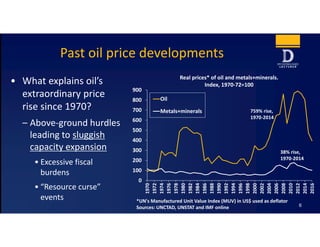
Past oil price developments
• What explains oil’s 
extraordinary price 
rise since 1970? 
– Above‐ground hurdles 
leading to sluggish 
capacity expansion
• Excessive fiscal 
burdens
• “Resource curse” 
events
0
100
200
300
400
500
600
700
800
900
1970
1972
1974
1976
1978
1980
1982
1984
1986
1988
1990
1992
1994
1996
1998
2000
2002
2004
2006
2008
2010
2012
2014
2016
Oil
Metals+minerals
*UN's Manufactured Unit Value Index (MUV) in US$ used as deflator
Sources: UNCTAD, UNSTAT and IMF online
Real prices* of oil and metals+minerals.
Index, 1970‐72=100
759% rise, 
1970‐2014
38% rise, 
1970‐2014
7
Recent price developments
• What explains the oil 
price fall of 2014?
– Disappointing global 
economic growth 
leading to moderate 
demand growth 
– Rapid rise of shale oil  0
20
40
60
80
100
120
0
2
4
6
8
10
12
1920 1930 1940 1950 1960 1970 1980 1990 2000 2010
$/barrel
Source: Energy Information Administration (EIA, annual). 
Million barrels/day
US crude oil production
Oil price
8
Shale reaction to price changes
• Cycle still being 
determined, but 
relatively quick 
compared to 
other oil sources
– Shale output 
responds in ~6 
months
20
30
40
50
60
70
80
90
100
110
3.0
3.5
4.0
4.5
5.0
5.5
6.0
6.5
7.0
7.5
Jan‐14
May‐14
Sep‐14
Jan‐15
May‐15
Sep‐15
Jan‐16
May‐16
Sep‐16
Jan‐17
May‐17
Sep‐17
Jan‐18
May‐18
Sep‐18
Jan‐19
May‐19
$/barrel
Million barrels/day
Source: EIA Statistics
Shale oil production vs oil price
9
Short‐term price prospects
• Upside
– Robust GDP growth
– Supply disruptions
• Downside
– Trade disputes
– Shale & other 
supply growth 42
47
52
57
62
67
72
77
82
87
$/barrel
Source: EIA Statistics
Brent oil price
10
Supply boom: just getting started?
• Forecasts repeatedly 
revised upwards
– Pessimistic 
projections  
common but 
surprising      
(reserves ↑, 
produc vity ↑,   
costs ↓) 88
90
92
94
96
98
100
102
104
2015 2020 2025 2030 2035 2040
Million barrels/day
Source: IEA World Energy Outlook (editions 2011 to 2018)
World crude oil production forecasts
2018
2017
2016
2015
2014
2013
2012
2011
11
Technological progress on display
• While rig count 
plunged on back of 
low prices, 
production dropped 
only moderately
• Production resilient 
to price drop, thanks 
to impressive 
productivity rise
Source: EIA Drilling Productivity Report (2018)
 ‐
 50
 100
 150
 200
 250
 ‐
 0.2
 0.4
 0.6
 0.8
 1.0
 1.2
 1.4
Jan‐07
Jul‐07
Jan‐08
Jul‐08
Jan‐09
Jul‐09
Jan‐10
Jul‐10
Jan‐11
Jul‐11
Jan‐12
Jul‐12
Jan‐13
Jul‐13
Jan‐14
Jul‐14
Jan‐15
Jul‐15
Jan‐16
Jul‐16
Jan‐17
Jul‐17
Jan‐18
Jul‐18
Jan‐19
Jul‐19
Rigs
Production (million barrels/day)
Bakken oil production and rig count
Production
Rig Count
12
Is technology progress exhausted?
• Drilling
– Operational efficiency (e.g. # days to drill)
– Increased pad and multi‐lateral drilling
– Reduced well spacing, longer laterals
• Hydraulic fracturing 
– Increased # of stages, optimal spacing
– Re‐fracturing
– Waterless fracturing
– Enhanced Oil Recovery (EOR)
Foster S-Curve for shale technology
Source: Aguilera et al (2014)
• Digitalization & automation
13
Will the revolution spread internationally?
• Shale boom has potential to spread
– Several countries well‐positioned (e.g. Canada, 
Argentina, Australia, China, Mexico, Russia) 
– Slower pace than US
• Result would be increased production and downward 
pressure on oil prices
14
Global shale resources widely distributed
• Shale oil resource                 
~ 420 billion barrels
• Some important regions 
excluded
• Of the total:
– United States, 19%
– Russia, 18%
– China, 8%
– Argentina, 6% 
– Libya, 6%
Shale oil technically 
recoverable resources
Source: EIA, Advanced Resources International  (2015) 
0
10
20
30
40
50
60
70
80
78
75
32
27 26
23
16 16 13 13
Billion barrels
15
Global shale resources widely distributed
• Shale gas resource                 
~ 7577 trillion cubic feet
• Some important regions 
excluded
• Of the total:
– China, 15%
– Argentina, 11%
– Algeria, 9%
– United States, 8% 
– Canada, 8%
Source: EIA, Advanced Resources International  (2015) 
0
200
400
600
800
1000
1200 1115
802
707
623
573 545
429 390
285 245
Trillion cubic feet
Shale gas technically 
recoverable resources
Key considerations for global shale 
development
1. Geology
2. Infrastructure
3. Ownership
4. Drilling rigs
5. Technical progress 
(e.g. to mitigate steep decline rates)
6. Risk capital
7. Regulation
8. Environmental impact
9. Public acceptance
16
17
Environmental impacts
• Most concerns relate to hydraulic fracturing:
– Intensive water use 
– Water contamination
– Methane leakage
– Induced seismicity
• There are indeed environmental risks from extraction 
methods, though often exaggerated by media
• Damage caused by infant industry, but hazards will be 
overcome as industry matures
18
Speculative exercise: rest of world 
shale oil impact in 2035 (mb/d)
• Assume rest of world exploits its share by 2035 as 
successfully as US did in 10 years
• Theoretically, yields 19.5 million barrels/day by 2035 
(similar to global oil production rise over past 20 years)
Global 2018 
oil output
Global rise, 
20 years 
(1998‐2018)
US share of 
shale oil 
resources, 
EIA
US shale 
production rise, 
10 years 
(2004‐2014)
Rest of World 
shale production 
rise,
(2035)
94.8 21.7 19% 3.9 19.5
Source: British Petroleum (annual), The Price of Oil (2015) 
19
Non‐US shale oil production costs, 2014 
and 2035, $/barrel
• Costs average $60/barrel in 
2035
• Thus, price cannot fall 
below that level for global 
shale expansion to succeed
• In optimistic case, costs 
average $40/barrel in 2035
COUNTRY/REGION
2014
2035
(at 1.5% ↓
per year)
2035
(at 3.0% ↓ 
per year)
Canada 45 33 24
Russia 65 47 34
Argentina 50 36 26
China 75 55 40
North Africa 100 73 53
Mexico 60 44 32
Australia 85 62 45
Colombia  95 69 50
Brazil 90 66 47
Cost estimates for 2014 based on IHS (2014). Costs in 2035,
estimated in The Price of Oil (2015), assume technological
progress (i.e. cost reductions) of 1.5% and 3.0% per annum.
20
Speculative exercise: conventional oil
revolution in 2035 (mb/d)
• Application of shale technologies to conventional oil 
theoretically yields additional 19.7 million barrels/day 
Global 2018 
oil output
Global rise, 
20 years 
(1998‐2018)
US share of 
oil reserves, 
BP
US conventional oil 
production rise, 
8 years 
(2008‐2016)
Rest of World 
conventional oil 
production rise,
(2035)
94.8 21.7 2.6% 0.5 19.7
Source: British Petroleum (annual), The Price of Oil (2015) 
21
Liquids supply cost curve, 2014
• Various liquids sources economically viable, which further 
suggests prices need not rise above current levels
Source: Aguilera (2014)
Quantity (billion barrels)
$/barrel
22
Price implications
• Successful global shale & conventional 
oil expansion puts significant 
downward pressure on price
• Sufficient amounts of oil 
available in 2035 at total 
costs not exceeding 
$40‐60/barrel
– Thus, $40‐60 price adequate 
to support any conceivable 
level of demand
• Ample supply additions at this level assure 
that price settles at $40‐60 in long term
SP1
P3
Price
QuantityQ3 Q1
D3
D1 D2
Q2
P2
Ample supply 
available 
at ~$40‐60
Thus, shifts in demand 
have little price impact
23
Oil demand prospects
• Wide range of views on future pace 
of demand growth
• Slowing consumption due to oil‐
saving technology and climate 
stabilization efforts could suppress 
price somewhat
• So far, no large‐scale substitute for 
oil in transport
• Low price gives oil competitive 
advantage vs alternatives
24
World primary energy mix (1850‐2035)
• Low prices will 
extend the use 
of oil & gas 
over a longer 
period of time
0
0.2
0.4
0.6
0.8
1
1850 1875 1900 1925 1950 1975 2000 2025
Fractionoftotalenergymarket
Year
Oil
Gas
Coal
Wood
Nuclear
Hydro
Other Ren.
Source: Based on Aguilera and Aguilera (2008, 2018)
2525
Natural gas price developments
• Regional prices 
diverged as shale gas 
supply & oil price rose
• Divergence has 
narrowed with lower 
oil price & expanding 
global gas trade
Source: IMF, Cedigaz
0
3
6
9
12
15
18
21
Jan‐09
Jul‐09
Jan‐10
Jul‐10
Jan‐11
Jul‐11
Jan‐12
Jul‐12
Jan‐13
Jul‐13
Jan‐14
Jul‐14
Jan‐15
Jul‐15
Jan‐16
Jul‐16
Jan‐17
Jul‐17
Jan‐18
Jul‐18
Jan‐19
Jul‐19
$/million Btu
US (Henry Hub spot) German border Japan LNG
UK (NBP spot) LNG Asia (FOB)
26
• Improved productivity and 
operational efficiencies 
• Better planning, cooperation, 
standardisation, simple 
construction, and floating LNG
In low price environment, LNG sellers 
bringing project costs down 
• On consumption side, floating infrastructure enables 
poorer countries to increase gas consumption
27
Conclusions
• Despite past experience, oil price turning point has been 
reached
• Oil prices unlikely to prevail above production costs of 
new supplies
• Innovation will allow for economic production in spite of 
low prices
• Oil and gas will play important role in satisfying long‐
term energy demand
28
References
• Aguilera RF (2014), “Production Costs of Global Conventional and Unconventional Petroleum”, Energy Policy, Vol 64, pp 134‐140.
• Aguilera RF and R Aguilera (2008), “Assessing the Past, Present, and Near Future of the Global Energy Market”, SPE Journal of
Petroleum Technology, May. Presented as SPE110215 at the 2007 SPE Annual Technical Conference and Exhibition held in Anaheim,
California, U.S.A., 11–14 November 2007.
• Aguilera RF and R Aguilera (2018), “Revisiting the long‐run energy mix with the global energy market model (GEM)”, Mineral 
Economics, Vol 31, pp 221‐227. 
• Aguilera RF and M Radetzki (2015), The Price of Oil, Cambridge University Press, Cambridge, UK.
• Aguilera RF, Ripple RD and R Aguilera (2014), “Link Between Endowments, Economics and Environment in Conventional and 
Unconventional Gas Reservoirs,” Fuel, Vol 126, pp 224‐238.
• BP (annual), BP Statistical Review of World Energy, British Petroleum, London.
• EIA (annual), Annual Energy Outlook, Energy Information Administration, Washington DC.
• EIA (2015), World Shale Resource Assessments, Energy Information Administration, Washington DC. 
• EIA (2017), Drilling Productivity Report, Energy Information Administration, Washington DC.
• IHS (2014c), “Going Global: Tight Oil Production. Leaping out of North America and onto the World Stage,” Webster J, IHS Energy.
• IMF (2017), Primary Commodity Prices, International Monetary Fund, Washington DC.
• UNCTAD, UNCTAD Stat, United Nations Conference on Trade and Development, Geneva.
• UNSTATS, National Accounts Main Aggregates Database, United Nations Statistics Division, New York.
29
Thank you
Questions?
Society of Petroleum Engineers
Distinguished Lecturer Program
www.spe.org/dl
30
Your Feedback is Important
Enter your section in the DL Evaluation Contest by
completing the evaluation form for this presentation
Visit SPE.org/dl
#SPEDL

Roberto Aguilera