Primary funding is provided by
The SPE Foundation through member donations
and a contribution from Offshore Europe
The Society is grateful to those companies that allow their
professionals to serve as lecturers
Additional support provided by AIME
Society of Petroleum Engineers
Distinguished Lecturer Program
www.spe.org/dl
Society of Petroleum Engineers
Distinguished Lecturer Program
www.spe.org/dl
Dr. Cosan Ayan, Reservoir Eng. Advisor
Reservoir and Fluid Characterization
with Formation Testers: Reducing
Asset Uncertainties
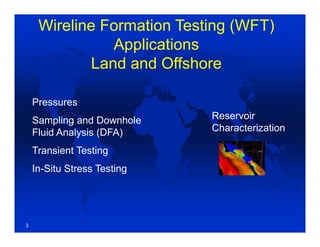
Wireline Formation Testing (WFT)
Applications
Land and Offshore
Pressures
Sampling and Downhole
Fluid Analysis (DFA)
Transient Testing
In-Situ Stress Testing
Reservoir
Characterization
3
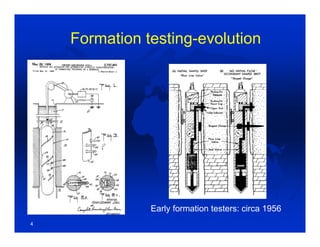
Formation testing-evolution
Early formation testers: circa 1956
4
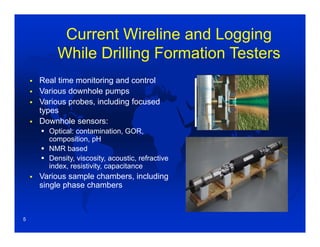
Current Wireline and Logging
While Drilling Formation Testers
 Real time monitoring and control
 Various downhole pumps
 Various probes, including focused
types
 Downhole sensors:
 Optical: contamination, GOR,
composition, pH
 NMR based
 Density, viscosity, acoustic, refractive
index, resistivity, capacitance
 Various sample chambers, including
single phase chambers
5
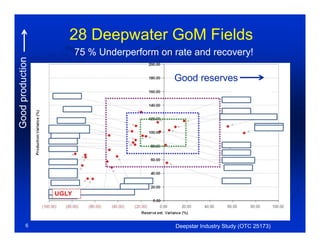
28 Deepwater GoM Fields
6 Deepstar Industry Study (OTC 25173)
75 % Underperform on rate and recovery!
Good reserves
Goodproduction
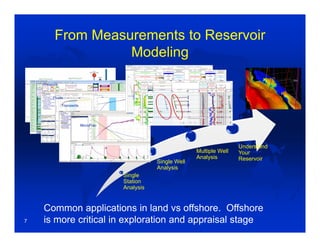
From Measurements to Reservoir
Modeling
Single
Station
Analysis
Single Well
Analysis
Multiple Well
Analysis
Understand
Your
Reservoir
Pressure
Fluids
Transients
Gradients & Contacts
Multi Well Gradients & Contacts
Multi Well DFA Prediction
Common applications in land vs offshore. Offshore
is more critical in exploration and appraisal stage7
MicroFrac
Pressures
Sampling and
Downhole Fluid
Analysis (DFA)
Transient Testing
In-Situ Stress Testing
Reservoir
Characterization
8
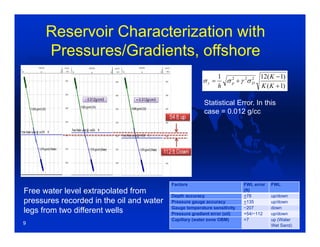
Reservoir Characterization with
Pressures/Gradients, offshore
Free water level extrapolated from
pressures recorded in the oil and water
legs from two different wells
)1(
)1(121 222



KK
K
h
Dp 
Statistical Error. In this
case = 0.012 g/cc
Factors FWL error
(ft)
FWL
Depth accuracy +78 up/down
Pressure gauge accuracy +135 up/down
Gauge temperature sensitivity −207 down
Pressure gradient error (oil) +54/−112 up/down
Capillary (water zone OBM) +7 up (Water
Wet Sand)9
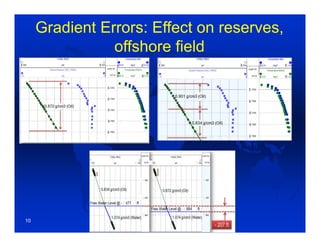
Gradient Errors: Effect on reserves,
offshore field
10
Pressures
Sampling and
Downhole Fluid
Analysis (DFA)
Transient Testing
In-Situ Stress Testing
Reservoir
Characterization
11
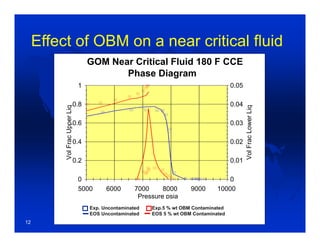
Effect of OBM on a near critical fluid
0
0.2
0.4
0.6
0.8
1
VolFracUpperLiq
0
0.01
0.02
0.03
0.04
0.05
VolFracLowerLiq
5000 6000 7000 8000 9000 10000
Pressure psia
Expt. Uncontaminated Expt.5 wt % Novaplus
EOS Uncontaminated EOS 5 wt% Novaplus
GOM Near Critical Fluid 180 F CCE
Phase Diagram
12
Exp. Uncontaminated Exp.5 % wt OBM Contaminated
EOS Uncontaminated EOS 5 % wt OBM Contaminated
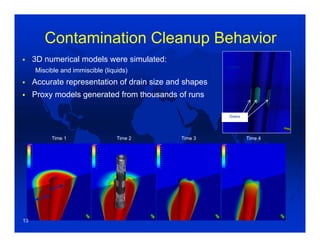
Contamination Cleanup Behavior
Drains
Saturn
 3D numerical models were simulated:
Miscible and immiscible (liquids)
 Accurate representation of drain size and shapes
 Proxy models generated from thousands of runs
Time 1 Time 2 Time 3 Time 4
13
10
-2
10
-1
10
0
10
1
10
2
10
-2
10
-1
10
0
Time [hrs]
Contamination
5% contamination
Saturn 3D Radial Probe
XLD Probe
Dual Packers
3D Radial Probe
Tool Cleanup
time
(5%)
[hrs]
3D Radial Probe 0.71
Extra Large
Dimension Probe
9.10
Dual Packers 1.00
3 Dimensional
Radial Probe
Probe Dual Packers
Contamination Cleanup Behaviour
Slope = -
5/12
Slope
= -2/3
1414
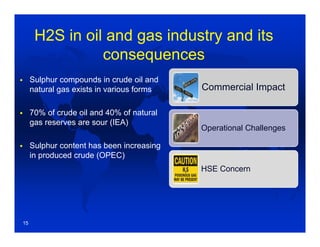
H2S in oil and gas industry and its
consequences
 Sulphur compounds in crude oil and
natural gas exists in various forms
 70% of crude oil and 40% of natural
gas reserves are sour (IEA)
 Sulphur content has been increasing
in produced crude (OPEC)
Commercial Impact
Operational Challenges
HSE Concern
15
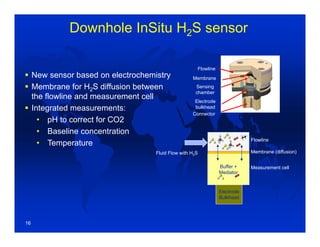
 New sensor based on electrochemistry
 Membrane for H2S diffusion between
the flowline and measurement cell
 Integrated measurements:
• pH to correct for CO2
• Baseline concentration
• Temperature
Downhole InSitu H2S sensor
Buffer +
Mediator
Electrode
Bulkhead
Membrane (diffusion)Fluid Flow with H2S
Flowline
Measurement cell
Flowline
Electrode
bulkhead
Membrane
Sensing
chamber
Connector
16
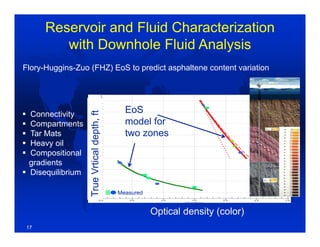
Flory-Huggins-Zuo (FHZ) EoS to predict asphaltene content variation
 Connectivity
 Compartments
 Tar Mats
 Heavy oil
 Compositional
gradients
 Disequilibrium
Reservoir and Fluid Characterization
with Downhole Fluid Analysis
17
Optical density (color)
TrueVrticaldepth,ft)
EoS
model for
two zones
Measured
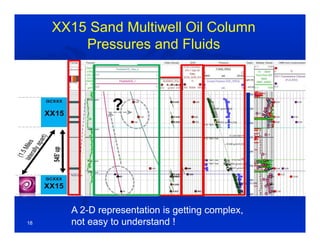
XX15 Sand Multiwell Oil Column
Pressures and Fluids
A 2-D representation is getting complex,
not easy to understand !18
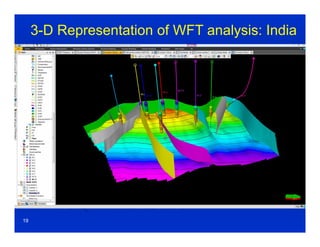
3-D Representation of WFT analysis: India
• Start in 3D
• Line of section
• WS Window
• 3D Showing OD distribution
19
Pressures
Sampling and
Downhole Fluid
Analysis (DFA)
Transient
Testing
In-Situ Stress Testing
Reservoir
Characterization
20
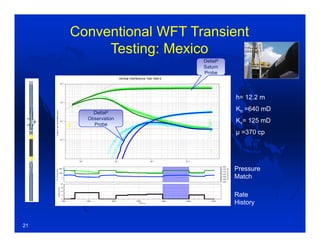
DeltaP
Saturn
Probe
h= 12.2 m
Kh =640 mD
Kv= 125 mD
μ =370 cp
DeltaP
Observation
Probe
Rate
History
Pressure
Match
Conventional WFT Transient
Testing: Mexico
21
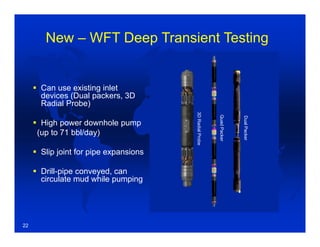
 Can use existing inlet
devices (Dual packers, 3D
Radial Probe)
 High power downhole pump
(up to 71 bbl/day)
 Slip joint for pipe expansions
 Drill-pipe conveyed, can
circulate mud while pumping
Hydrocarbon
Mixture
Drilling Mud
ReservoirQuad-Packer
High Capacity
Downhole Pump
Circulating
Equipment
Slip Joint
3DRadialProbe
QuadPacker
DualPacker
New – WFT Deep Transient Testing
22
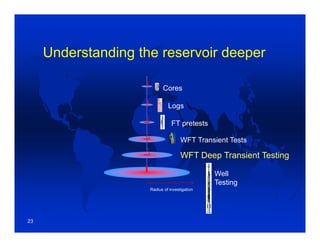
Cores
Logs
FT pretests
WFT Transient Tests
Well
Testing
Radius of investigation
WFT Deep Transient Testing
Understanding the reservoir deeper
23
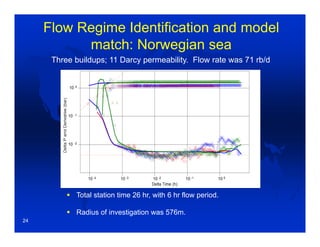
Flow Regime Identification and model
match: Norwegian sea
Three buildups; 11 Darcy permeability. Flow rate was 71 rb/d
 Total station time 26 hr, with 6 hr flow period.
 Radius of investigation was 576m.
24
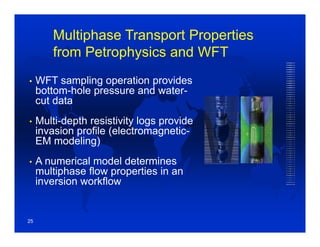
Multiphase Transport Properties
from Petrophysics and WFT
• WFT sampling operation provides
bottom-hole pressure and water-
cut data
• Multi-depth resistivity logs provide
invasion profile (electromagnetic-
EM modeling)
• A numerical model determines
multiphase flow properties in an
inversion workflow
25
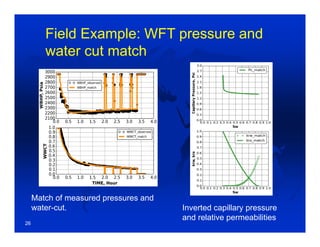
Field Example: WFT pressure and
water cut match
Match of measured pressures and
water-cut. Inverted capillary pressure
and relative permeabilities
26
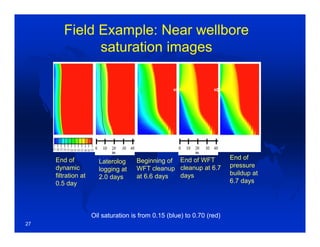
Field Example: Near wellbore
saturation images
Oil saturation is from 0.15 (blue) to 0.70 (red)
End of
dynamic
filtration at
0.5 day
Laterolog
logging at
2.0 days
Beginning of
WFT cleanup
at 6.6 days
End of WFT
cleanup at 6.7
days
End of
pressure
buildup at
6.7 days
27
Pressures
Sampling and
Downhole Fluid
Analysis
Transient Testing
(IPTT)
In-Situ Stress
Testing
Reservoir
Characterization
28
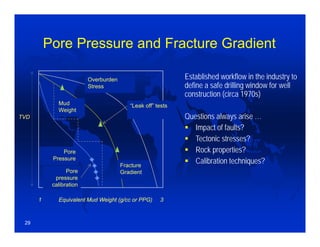
Pore Pressure and Fracture Gradient
Established workflow in the industry to
define a safe drilling window for well
construction (circa 1970s)
Questions always arise …
 Impact of faults?
 Tectonic stresses?
 Rock properties?
 Calibration techniques?
1 Equivalent Mud Weight (g/cc or PPG) 3
TVD
Overburden
Stress
Fracture
Gradient
“Leak off” tests
Pore
pressure
calibration
Mud
Weight
Pore
Pressure
29
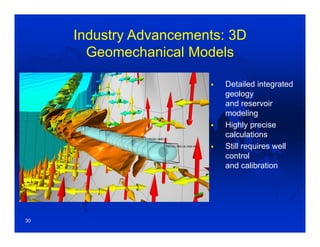
Industry Advancements: 3D
Geomechanical Models
 Detailed integrated
geology
and reservoir
modeling
 Highly precise
calculations
 Still requires well
control
and calibration
30
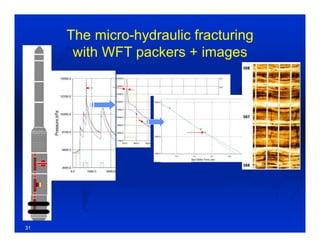
Fracture
initiation
Closure pressure
Breakdown pressure
The micro-hydraulic fracturing
with WFT packers + images
31
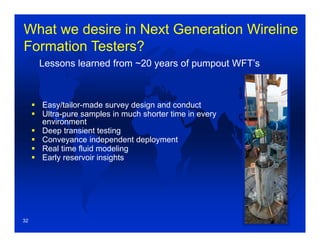
What we desire in Next Generation Wireline
Formation Testers?
 Easy/tailor-made survey design and conduct
 Ultra-pure samples in much shorter time in every
environment
 Deep transient testing
 Conveyance independent deployment
 Real time fluid modeling
 Early reservoir insights
Lessons learned from ~20 years of pumpout WFT’s
32
Concluding Remarks
Reservoir and Fluid Characterization with Formation Testers:
Reducing Asset Uncertainties
Pressure, fluid analysis, transient test results and stress
tests are seamlessly getting integrated into RE software
and workflows
Advanced downhole sensors will be included
New Generation tools are emerging with more
capabilities
Transient testing capabilities are improved, reducing
risks in reservoir evaluation
33
Society of Petroleum Engineers
Distinguished Lecturer Program
www.spe.org/dl 34
Your Feedback is Important
Enter your section in the DL Evaluation Contest by
completing the evaluation form for this presentation
Visit SPE.org/dl
34

Cosan Ayan

  • 1.
    Primary funding isprovided by The SPE Foundation through member donations and a contribution from Offshore Europe The Society is grateful to those companies that allow their professionals to serve as lecturers Additional support provided by AIME Society of Petroleum Engineers Distinguished Lecturer Program www.spe.org/dl
  • 2.
    Society of PetroleumEngineers Distinguished Lecturer Program www.spe.org/dl Dr. Cosan Ayan, Reservoir Eng. Advisor Reservoir and Fluid Characterization with Formation Testers: Reducing Asset Uncertainties
  • 3.
    Wireline Formation Testing(WFT) Applications Land and Offshore Pressures Sampling and Downhole Fluid Analysis (DFA) Transient Testing In-Situ Stress Testing Reservoir Characterization 3
  • 4.
  • 5.
    Current Wireline andLogging While Drilling Formation Testers  Real time monitoring and control  Various downhole pumps  Various probes, including focused types  Downhole sensors:  Optical: contamination, GOR, composition, pH  NMR based  Density, viscosity, acoustic, refractive index, resistivity, capacitance  Various sample chambers, including single phase chambers 5
  • 6.
    28 Deepwater GoMFields 6 Deepstar Industry Study (OTC 25173) 75 % Underperform on rate and recovery! Good reserves Goodproduction
  • 7.
    From Measurements toReservoir Modeling Single Station Analysis Single Well Analysis Multiple Well Analysis Understand Your Reservoir Pressure Fluids Transients Gradients & Contacts Multi Well Gradients & Contacts Multi Well DFA Prediction Common applications in land vs offshore. Offshore is more critical in exploration and appraisal stage7 MicroFrac
  • 8.
    Pressures Sampling and Downhole Fluid Analysis(DFA) Transient Testing In-Situ Stress Testing Reservoir Characterization 8
  • 9.
    Reservoir Characterization with Pressures/Gradients,offshore Free water level extrapolated from pressures recorded in the oil and water legs from two different wells )1( )1(121 222    KK K h Dp  Statistical Error. In this case = 0.012 g/cc Factors FWL error (ft) FWL Depth accuracy +78 up/down Pressure gauge accuracy +135 up/down Gauge temperature sensitivity −207 down Pressure gradient error (oil) +54/−112 up/down Capillary (water zone OBM) +7 up (Water Wet Sand)9
  • 10.
    Gradient Errors: Effecton reserves, offshore field 10
  • 11.
    Pressures Sampling and Downhole Fluid Analysis(DFA) Transient Testing In-Situ Stress Testing Reservoir Characterization 11
  • 12.
    Effect of OBMon a near critical fluid 0 0.2 0.4 0.6 0.8 1 VolFracUpperLiq 0 0.01 0.02 0.03 0.04 0.05 VolFracLowerLiq 5000 6000 7000 8000 9000 10000 Pressure psia Expt. Uncontaminated Expt.5 wt % Novaplus EOS Uncontaminated EOS 5 wt% Novaplus GOM Near Critical Fluid 180 F CCE Phase Diagram 12 Exp. Uncontaminated Exp.5 % wt OBM Contaminated EOS Uncontaminated EOS 5 % wt OBM Contaminated
  • 13.
    Contamination Cleanup Behavior Drains Saturn 3D numerical models were simulated: Miscible and immiscible (liquids)  Accurate representation of drain size and shapes  Proxy models generated from thousands of runs Time 1 Time 2 Time 3 Time 4 13
  • 14.
    10 -2 10 -1 10 0 10 1 10 2 10 -2 10 -1 10 0 Time [hrs] Contamination 5% contamination Saturn3D Radial Probe XLD Probe Dual Packers 3D Radial Probe Tool Cleanup time (5%) [hrs] 3D Radial Probe 0.71 Extra Large Dimension Probe 9.10 Dual Packers 1.00 3 Dimensional Radial Probe Probe Dual Packers Contamination Cleanup Behaviour Slope = - 5/12 Slope = -2/3 1414
  • 15.
    H2S in oiland gas industry and its consequences  Sulphur compounds in crude oil and natural gas exists in various forms  70% of crude oil and 40% of natural gas reserves are sour (IEA)  Sulphur content has been increasing in produced crude (OPEC) Commercial Impact Operational Challenges HSE Concern 15
  • 16.
     New sensorbased on electrochemistry  Membrane for H2S diffusion between the flowline and measurement cell  Integrated measurements: • pH to correct for CO2 • Baseline concentration • Temperature Downhole InSitu H2S sensor Buffer + Mediator Electrode Bulkhead Membrane (diffusion)Fluid Flow with H2S Flowline Measurement cell Flowline Electrode bulkhead Membrane Sensing chamber Connector 16
  • 17.
    Flory-Huggins-Zuo (FHZ) EoSto predict asphaltene content variation  Connectivity  Compartments  Tar Mats  Heavy oil  Compositional gradients  Disequilibrium Reservoir and Fluid Characterization with Downhole Fluid Analysis 17 Optical density (color) TrueVrticaldepth,ft) EoS model for two zones Measured
  • 18.
    XX15 Sand MultiwellOil Column Pressures and Fluids A 2-D representation is getting complex, not easy to understand !18
  • 19.
    3-D Representation ofWFT analysis: India • Start in 3D • Line of section • WS Window • 3D Showing OD distribution 19
  • 20.
    Pressures Sampling and Downhole Fluid Analysis(DFA) Transient Testing In-Situ Stress Testing Reservoir Characterization 20
  • 21.
    DeltaP Saturn Probe h= 12.2 m Kh=640 mD Kv= 125 mD μ =370 cp DeltaP Observation Probe Rate History Pressure Match Conventional WFT Transient Testing: Mexico 21
  • 22.
     Can useexisting inlet devices (Dual packers, 3D Radial Probe)  High power downhole pump (up to 71 bbl/day)  Slip joint for pipe expansions  Drill-pipe conveyed, can circulate mud while pumping Hydrocarbon Mixture Drilling Mud ReservoirQuad-Packer High Capacity Downhole Pump Circulating Equipment Slip Joint 3DRadialProbe QuadPacker DualPacker New – WFT Deep Transient Testing 22
  • 23.
    Cores Logs FT pretests WFT TransientTests Well Testing Radius of investigation WFT Deep Transient Testing Understanding the reservoir deeper 23
  • 24.
    Flow Regime Identificationand model match: Norwegian sea Three buildups; 11 Darcy permeability. Flow rate was 71 rb/d  Total station time 26 hr, with 6 hr flow period.  Radius of investigation was 576m. 24
  • 25.
    Multiphase Transport Properties fromPetrophysics and WFT • WFT sampling operation provides bottom-hole pressure and water- cut data • Multi-depth resistivity logs provide invasion profile (electromagnetic- EM modeling) • A numerical model determines multiphase flow properties in an inversion workflow 25
  • 26.
    Field Example: WFTpressure and water cut match Match of measured pressures and water-cut. Inverted capillary pressure and relative permeabilities 26
  • 27.
    Field Example: Nearwellbore saturation images Oil saturation is from 0.15 (blue) to 0.70 (red) End of dynamic filtration at 0.5 day Laterolog logging at 2.0 days Beginning of WFT cleanup at 6.6 days End of WFT cleanup at 6.7 days End of pressure buildup at 6.7 days 27
  • 28.
    Pressures Sampling and Downhole Fluid Analysis TransientTesting (IPTT) In-Situ Stress Testing Reservoir Characterization 28
  • 29.
    Pore Pressure andFracture Gradient Established workflow in the industry to define a safe drilling window for well construction (circa 1970s) Questions always arise …  Impact of faults?  Tectonic stresses?  Rock properties?  Calibration techniques? 1 Equivalent Mud Weight (g/cc or PPG) 3 TVD Overburden Stress Fracture Gradient “Leak off” tests Pore pressure calibration Mud Weight Pore Pressure 29
  • 30.
    Industry Advancements: 3D GeomechanicalModels  Detailed integrated geology and reservoir modeling  Highly precise calculations  Still requires well control and calibration 30
  • 31.
    Fracture initiation Closure pressure Breakdown pressure Themicro-hydraulic fracturing with WFT packers + images 31
  • 32.
    What we desirein Next Generation Wireline Formation Testers?  Easy/tailor-made survey design and conduct  Ultra-pure samples in much shorter time in every environment  Deep transient testing  Conveyance independent deployment  Real time fluid modeling  Early reservoir insights Lessons learned from ~20 years of pumpout WFT’s 32
  • 33.
    Concluding Remarks Reservoir andFluid Characterization with Formation Testers: Reducing Asset Uncertainties Pressure, fluid analysis, transient test results and stress tests are seamlessly getting integrated into RE software and workflows Advanced downhole sensors will be included New Generation tools are emerging with more capabilities Transient testing capabilities are improved, reducing risks in reservoir evaluation 33
  • 34.
    Society of PetroleumEngineers Distinguished Lecturer Program www.spe.org/dl 34 Your Feedback is Important Enter your section in the DL Evaluation Contest by completing the evaluation form for this presentation Visit SPE.org/dl 34