Romanticism ( 1800 – 1850 )
Done By
Maha Hassan Alzhrani
Ohoud Eid Alatawi
Bashayer Mohammad Fawal
Definition:
Romanticism (also known as the Romantic era) was an artistic,
literary, musical and intellectual movement that originated in
Europe towards the end of the 18th century, and in most areas
was at its peak in the approximate period from 1800 to 1850.
Romanticism was characterized by its emphasis on emotion and
individualism as well as glorification of all the past and nature,
preferring the medieval rather than the classical. It was partly a
reaction to the Industrial Revolution, the aristocratic social and
political norms of the Age of Enlightenment, and the scientific
rationalization of nature all components of modernity. It was
embodied most strongly in the visual arts, music, and literature,
but had a major impact on historiography, education, the social
sciences, and the natural sciences. It had a significant and complex
effect on politics, with romantic thinkers influencing liberalism,
radicalism, conservatism, and nationalism.
Characteristic:
Excess of emotion over the reason.
Power of the individual and ( his-her) imagination.
Interest in the supernatural.
Nationalism.
Spontaneity in thoughts and action.
Subjective experiences: feelings, desire, hopes
and dreams.
Freedom from rules.
Devotion to beauty. -
Looking to the past for the wisdom.
Period:
The period typically called Romantic varies greatly between
different countries and different artistic media or areas of
thought.
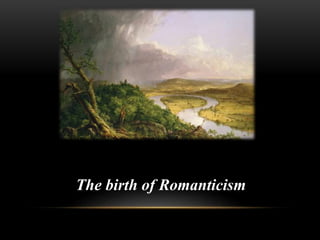
The birth of Romanticism
Romanticism represents a break with the universalistic outlook of
the Enlightenment. Reason is something universal and the
Enlightenment found its models in classical France and Rome :
all men are the same because there are all reasonable.
Romanticism if a fragmentation of consciousness, with no
universalistic ideas left.
The French Revolution was characterized by universalistic ideas
such as all men are created equal. It corresponds to the
philosophy of the Enlightenment. The nation is born out of a
social contract : it means that you are free to choose to belong to
one nation or another. It is different in Germany where you do not
choose your country, that is where you were born (organic
nation).
There is a difference between the first and second generation of
poets. British poets were rather progressive and close to
dissenters. The French Revolution was full of hope of equality but
it quickly changed when in 1793, it gave way to the Terror and the
beheading of the King.
:The first generation of British romantic poets
Only William Blake remained a radical, unlike Wordsworth
and Coleridge. There was an incredible pressure in England at
the time. The Prime Minister, Pitts, suspended the Habeas
Corpus and adopted the Sedition Act, which was meant to
prevent the freedom of press. It turned away the first
generation from their ideals.
Blake wrote a visionary, imaginary poetry, really difficult to
understand. Wordsworth and Coleridge were reactionary to the
French Revolution .Words worth turned away from the
excesses of the revolution and wrote a simple poetry in a
democratic style. Coleridge was inspired by the Middle Ages
and German thought, and was a reactionary Christian
nationalist.
The second generation of British romantic poets
The second generation remains more radical but the political
climate was so oppressive that the radicals left England or made
more indirect political comments. The Mask of Anarchy by Shelley
was inspired by the Peter loo Massacre of
1819. In Prometheus Unbound, a man fights against political and
religious oppression. Romanticism was connected with politics of
the time. Romantic poets could be either conservative or
progressive, depending on their vision
of the world.
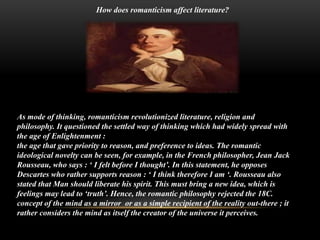
How does romanticism affect literature?
As mode of thinking, romanticism revolutionized literature, religion and
philosophy. It questioned the settled way of thinking which had widely spread with
the age of Enlightenment :
the age that gave priority to reason, and preference to ideas. The romantic
ideological novelty can be seen, for example, in the French philosopher, Jean Jack
Rousseau, who says : ‘ I felt before I thought’. In this statement, he opposes
Descartes who rather supports reason : ‘ I think therefore I am ‘. Rousseau also
stated that Man should liberate his spirit. This must bring a new idea, which is
feelings may lead to ‘truth’. Hence, the romantic philosophy rejected the 18C.
concept of the mind as a mirror or as a simple recipient of the reality out-there ; it
rather considers the mind as itself the creator of the universe it perceives.
Romanticism had a great impact on literature. Literary Romanticism
has changed the notion of literature. The latter, prior to the 18C.,
simply consisted of essays, history, and the study of ancient Greek &
Roman languages. It was restricted to the study of Classics, and it was
not something imaginative/inventive ; rather, it was very much limited
and dominated by rationality. Poetry was regarded primarily as an
imitation of nature. Then, Romanticism came as new beginning with
new conception for literature, by introducing new ideas and ways of
perceiving things. By this time, literature was becoming virtually
synonymous with the ‘imaginative’ & ‘inventive’ & ‘creative’. The
literary work itself came to be seen as an organic unity : it became, as
William Wordsworth defined it : ‘ the spontaneous overflow of
powerful feeling’. Poetry acquired then deep social, political and
philosophical implications. Literature has become a whole alternative
ideology governed by ‘imagination’.
References:
http://badre-thirdspace.blogspot.com/2009/06/impacts-of-romanticism-on-
literature.html
https://www.skyminds.net/the-19th-century-romanticism-in-art-and-literature/
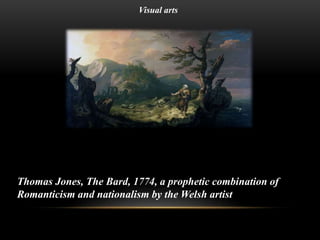
Visual arts
Thomas Jones, The Bard, 1774, a prophetic combination of
Romanticism and nationalism by the Welsh artist
In the visual arts, Romanticism first showed itself in landscape painting,
where from as early as the 1760s British artists began to turn to wilder
landscapes and storms, and Gothic architecture, even if they had to make
do with Wales as a setting. Caspar David Friedrich and J. M. W. Turner
were born less than a year apart in 1774 and 1775 respectively and were to
take German and English landscape painting to their extremes of
Romanticism, but both their artistic sensibilities were formed when forms of
Romanticism was already strongly present in art. John Constable, born in
1776, stayed closer to the English landscape tradition, but in his largest
"six-footers" insisted on the heroic status of a patch of the working
countryside where he had grown up—challenging the traditional hierarchy
of genres, which relegated landscape painting to a low status. Turner also
painted very large landscapes, and above all, seascapes. Some of these large
paintings had contemporary settings and staffage, but others had small
figures that turned the work into history painting in the manner of Claude
Lorrain, like Salvator Rosa, a late Baroque artist whose landscapes had
elements that Romantic painters repeatedly turned to. Friedrich often used
single figures, or features like crosses, set alone amidst a huge landscape,
"making them images of the transitoriness of human life and the
premonition of death".[96
Cavalier gaulois by Antoine-Augustin Préault, Pont d'Iéna, Paris
Sculpture remained largely impervious to Romanticism, probably partly
for technical reasons, as the most prestigious material of the day,
marble, does not lend itself to expansive gestures. The leading sculptors
in Europe, Antonio Canova and Bertel Thorvaldsen, were both based in
Rome and firm Neoclassicists, not at all tempted to allow influence
from medieval sculpture, which would have been one possible approach
to Romantic sculpture. When it did develop, true Romantic sculpture—
with the exception of a few artists such as Rudolf Maison—[104] rather
oddly was missing in Germany, and mainly found in France, with
François Rude, best known from his group of the 1830s from the Arc de
Triomphe in Paris, David d'Angers, and Auguste Préault. Préault's
plaster relief entitled Slaughter, which represented the horrors of wars
with exacerbated passion, caused so much scandal at the 1834 Salon
that Préault was banned from this official annual exhibition for nearly
twenty years.[105] In Italy, the most important Romantic sculptor was
Lorenzo Bartolini.[106]
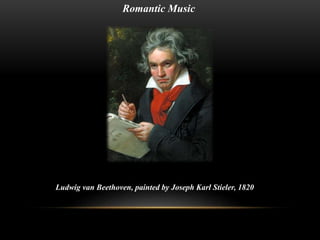
Romantic Music
Ludwig van Beethoven, painted by Joseph Karl Stieler, 1820
Musical Romanticism is predominantly a German phenomenon—
so much so that one respected French reference work defines it
entirely in terms of "The role of music in the aesthetics of German
romanticism".[108] Another French encyclopedia holds that the
German temperament generally "can be described as the deep and
diverse action of romanticism on German musicians", and that
there is only one true representative of Romanticism in French
music, Hector Berlioz, while in Italy, the sole great name of musical
Romanticism is Giuseppe Verdi, "a sort of [Victor] Hugo of opera,
gifted with a real genius for dramatic effect". Nevertheless, the
huge popularity of German Romantic music led, "whether by
imitation or by reaction", to an often nationalistically inspired
vogue amongst Polish, Hungarian, Russian, Czech, and
Scandinavian musicians, successful "perhaps more because of its
extra-musical traits than for the actual value of musical works by
its masters".[109]
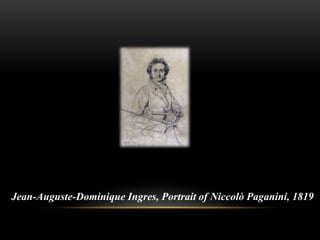
Jean-Auguste-Dominique Ingres, Portrait of Niccolò Paganini, 1819
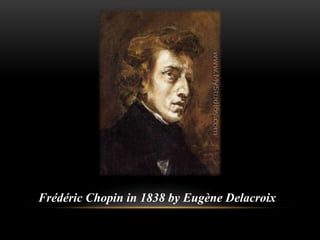
Frédéric Chopin in 1838 by Eugène Delacroix
Although the term "Romanticism" when applied to music has
come to imply the period roughly from 1800 until 1850, or else
until around 1900, the contemporary application of
"romantic" to music did not coincide with this modern
interpretation. Indeed, one of the earliest sustained
applications of the term to music occurs in 1789, in the
Mémoires of André Grétry.[110] This is of particular interest
because it is a French source on a subject mainly dominated
by Germans, but also because it explicitly acknowledges its
debt to Jean-Jacques Rousseau (himself a composer, amongst
other things) and, by so doing, establishes a link to one of the
major influences on the Romantic movement generally.[111]
In 1810 E. T. A. Hoffmann named Haydn, Mozart and
Beethoven as "the three masters of instrumental compositions"
who "breathe one and the same romantic spirit". He justified
his view on the basis of these composers' depth of evocative
expression and their marked individuality. In Haydn's music,
according to Hoffmann, "a child-like, serene disposition
prevails", while Mozart (in the late E-flat major Symphony, for
example) "leads us into the depths of the spiritual world", with
elements of fear, love, and sorrow, "a presentiment of the
infinite ... in the eternal dance of the spheres". Beethoven's
music, on the other hand, conveys a sense of "the monstrous
and immeasurable", with the pain of an endless longing that
"will burst our breasts in a fully coherent concord of all the
passions".[112]
It was only toward the end of the 19th century that the newly emergent discipline of Musikwissenschaft
(musicology)—itself a product of the historicizing proclivity of the age—attempted a more scientific
periodization of music history, and a distinction between Viennese Classical and Romantic periods was
proposed. The key figure in this trend was Guido Adler, who viewed Beethoven and Franz Schubert as
transitional but essentially Classical composers, with Romanticism achieving full maturity only in the
post-Beethoven generation of Frédéric Chopin, Felix Mendelssohn, Robert Schumann, Hector Berlioz and
Franz Liszt. From Adler's viewpoint, found in books like Der Stil in der Musik (1911), composers of the
New German School and various late-19th-century nationalist composers were not Romantics but
"moderns" or "realists" (by analogy with the fields of painting and literature), and this schema remained
prevalent through the first decades of the 20th century.[111]By the second quarter of the 20th century, an
awareness that radical changes in musical syntax had occurred during the early 1900s caused another
shift in historical viewpoint, and the change of century came to be seen as marking a decisive break with
the musical past. This in turn led historians such as Alfred Einstein[115] to extend the musical "Romantic
era" throughout the 19th century and into the first decade of the 20th. It has continued to be referred to as
such in some of the standard music references such as The Oxford Companion to Music[116] and Grout's
History of Western Music[117] but was not unchallenged. For example, the prominent German
musicologist Friedrich Blume, the chief editor of the first edition of Die Musik in Geschichte und
Gegenwart (1949–86), accepted the earlier position that Classicism and Romanticism together constitute a
single period beginning in the middle of the 18th century, but at the same time held that it continued into
the 20th century, including such pre-World War II developments as expressionism and neoclassicism.[118]
This is reflected in some notable recent reference works such as the New Grove Dictionary of Music and
Musicians[111] and the new edition of Musik in Geschichte und Gegenwart.[119]
Gerlad Abraham
M. H. Abrams
Donald Ault
Ian Bent
Tim Blanning
James Chandler
Maria Janion
Peter Kitson
Charles Rosen
Scholar of romanticism
Encyclopædia Britannica. "Romanticism. Retrieved 30 January 2008, from Encyclopædia
Britannica Online". Britannica.com. Archived from the original on 13 October 2005.
Retrieved 2010-08-24.^ Casey, Christopher (October 30, 2008). ""Grecian Grandeurs and the
Rude Wasting of Old Time": Britain, the Elgin Marbles, and Post-Revolutionary Hellenism".
Foundations. Volume III, Number 1. Archived from the original on May 13, 2009. Retrieved
2014-05-14.
Ashton Nichols, "Roaring Alligators and Burning Tygers: Poetry and Science from William
Bartram to Charles Darwin," Proceedings of the American Philosophical Society 2005 149(3):
304–15
Waterhouse (1926), throughout; Smith (1924); Millen, Jessica Romantic Creativity and the
Ideal of Originality: A Contextual Analysis, in Cross-sections, The Bruce Hall Academic
Journal – Volume VI, 2010 PDF; Forest Pyle, The Ideology of Imagination: Subject and
Society in the Discourse of Romanticism (Stanford University Press, 1995) p. 28.^ 1963–,
Breckman, Warren (2008). European Romanticism: A Brief History with Documents. Rogers
D. Spotswood Collection. (1st ed.). Boston: Bedford/St. Martins. ISBN 978-0-312-45023-6.
OCLC 148859077.^
References

Civilization

  • 1.
    Romanticism ( 1800– 1850 ) Done By Maha Hassan Alzhrani Ohoud Eid Alatawi Bashayer Mohammad Fawal
  • 2.
    Definition: Romanticism (also knownas the Romantic era) was an artistic, literary, musical and intellectual movement that originated in Europe towards the end of the 18th century, and in most areas was at its peak in the approximate period from 1800 to 1850. Romanticism was characterized by its emphasis on emotion and individualism as well as glorification of all the past and nature, preferring the medieval rather than the classical. It was partly a reaction to the Industrial Revolution, the aristocratic social and political norms of the Age of Enlightenment, and the scientific rationalization of nature all components of modernity. It was embodied most strongly in the visual arts, music, and literature, but had a major impact on historiography, education, the social sciences, and the natural sciences. It had a significant and complex effect on politics, with romantic thinkers influencing liberalism, radicalism, conservatism, and nationalism.
  • 3.
    Characteristic: Excess of emotionover the reason. Power of the individual and ( his-her) imagination. Interest in the supernatural. Nationalism. Spontaneity in thoughts and action. Subjective experiences: feelings, desire, hopes and dreams. Freedom from rules. Devotion to beauty. - Looking to the past for the wisdom.
  • 4.
    Period: The period typicallycalled Romantic varies greatly between different countries and different artistic media or areas of thought.
  • 5.
    The birth ofRomanticism
  • 6.
    Romanticism represents abreak with the universalistic outlook of the Enlightenment. Reason is something universal and the Enlightenment found its models in classical France and Rome : all men are the same because there are all reasonable. Romanticism if a fragmentation of consciousness, with no universalistic ideas left. The French Revolution was characterized by universalistic ideas such as all men are created equal. It corresponds to the philosophy of the Enlightenment. The nation is born out of a social contract : it means that you are free to choose to belong to one nation or another. It is different in Germany where you do not choose your country, that is where you were born (organic nation). There is a difference between the first and second generation of poets. British poets were rather progressive and close to dissenters. The French Revolution was full of hope of equality but it quickly changed when in 1793, it gave way to the Terror and the beheading of the King.
  • 7.
    :The first generationof British romantic poets Only William Blake remained a radical, unlike Wordsworth and Coleridge. There was an incredible pressure in England at the time. The Prime Minister, Pitts, suspended the Habeas Corpus and adopted the Sedition Act, which was meant to prevent the freedom of press. It turned away the first generation from their ideals. Blake wrote a visionary, imaginary poetry, really difficult to understand. Wordsworth and Coleridge were reactionary to the French Revolution .Words worth turned away from the excesses of the revolution and wrote a simple poetry in a democratic style. Coleridge was inspired by the Middle Ages and German thought, and was a reactionary Christian nationalist. The second generation of British romantic poets The second generation remains more radical but the political climate was so oppressive that the radicals left England or made more indirect political comments. The Mask of Anarchy by Shelley was inspired by the Peter loo Massacre of 1819. In Prometheus Unbound, a man fights against political and religious oppression. Romanticism was connected with politics of the time. Romantic poets could be either conservative or progressive, depending on their vision of the world.
  • 8.
    How does romanticismaffect literature? As mode of thinking, romanticism revolutionized literature, religion and philosophy. It questioned the settled way of thinking which had widely spread with the age of Enlightenment : the age that gave priority to reason, and preference to ideas. The romantic ideological novelty can be seen, for example, in the French philosopher, Jean Jack Rousseau, who says : ‘ I felt before I thought’. In this statement, he opposes Descartes who rather supports reason : ‘ I think therefore I am ‘. Rousseau also stated that Man should liberate his spirit. This must bring a new idea, which is feelings may lead to ‘truth’. Hence, the romantic philosophy rejected the 18C. concept of the mind as a mirror or as a simple recipient of the reality out-there ; it rather considers the mind as itself the creator of the universe it perceives.
  • 9.
    Romanticism had agreat impact on literature. Literary Romanticism has changed the notion of literature. The latter, prior to the 18C., simply consisted of essays, history, and the study of ancient Greek & Roman languages. It was restricted to the study of Classics, and it was not something imaginative/inventive ; rather, it was very much limited and dominated by rationality. Poetry was regarded primarily as an imitation of nature. Then, Romanticism came as new beginning with new conception for literature, by introducing new ideas and ways of perceiving things. By this time, literature was becoming virtually synonymous with the ‘imaginative’ & ‘inventive’ & ‘creative’. The literary work itself came to be seen as an organic unity : it became, as William Wordsworth defined it : ‘ the spontaneous overflow of powerful feeling’. Poetry acquired then deep social, political and philosophical implications. Literature has become a whole alternative ideology governed by ‘imagination’. References: http://badre-thirdspace.blogspot.com/2009/06/impacts-of-romanticism-on- literature.html https://www.skyminds.net/the-19th-century-romanticism-in-art-and-literature/
  • 10.
    Visual arts Thomas Jones,The Bard, 1774, a prophetic combination of Romanticism and nationalism by the Welsh artist
  • 11.
    In the visualarts, Romanticism first showed itself in landscape painting, where from as early as the 1760s British artists began to turn to wilder landscapes and storms, and Gothic architecture, even if they had to make do with Wales as a setting. Caspar David Friedrich and J. M. W. Turner were born less than a year apart in 1774 and 1775 respectively and were to take German and English landscape painting to their extremes of Romanticism, but both their artistic sensibilities were formed when forms of Romanticism was already strongly present in art. John Constable, born in 1776, stayed closer to the English landscape tradition, but in his largest "six-footers" insisted on the heroic status of a patch of the working countryside where he had grown up—challenging the traditional hierarchy of genres, which relegated landscape painting to a low status. Turner also painted very large landscapes, and above all, seascapes. Some of these large paintings had contemporary settings and staffage, but others had small figures that turned the work into history painting in the manner of Claude Lorrain, like Salvator Rosa, a late Baroque artist whose landscapes had elements that Romantic painters repeatedly turned to. Friedrich often used single figures, or features like crosses, set alone amidst a huge landscape, "making them images of the transitoriness of human life and the premonition of death".[96
  • 12.
    Cavalier gaulois byAntoine-Augustin Préault, Pont d'Iéna, Paris Sculpture remained largely impervious to Romanticism, probably partly for technical reasons, as the most prestigious material of the day, marble, does not lend itself to expansive gestures. The leading sculptors in Europe, Antonio Canova and Bertel Thorvaldsen, were both based in Rome and firm Neoclassicists, not at all tempted to allow influence from medieval sculpture, which would have been one possible approach to Romantic sculpture. When it did develop, true Romantic sculpture— with the exception of a few artists such as Rudolf Maison—[104] rather oddly was missing in Germany, and mainly found in France, with François Rude, best known from his group of the 1830s from the Arc de Triomphe in Paris, David d'Angers, and Auguste Préault. Préault's plaster relief entitled Slaughter, which represented the horrors of wars with exacerbated passion, caused so much scandal at the 1834 Salon that Préault was banned from this official annual exhibition for nearly twenty years.[105] In Italy, the most important Romantic sculptor was Lorenzo Bartolini.[106]
  • 13.
    Romantic Music Ludwig vanBeethoven, painted by Joseph Karl Stieler, 1820
  • 14.
    Musical Romanticism ispredominantly a German phenomenon— so much so that one respected French reference work defines it entirely in terms of "The role of music in the aesthetics of German romanticism".[108] Another French encyclopedia holds that the German temperament generally "can be described as the deep and diverse action of romanticism on German musicians", and that there is only one true representative of Romanticism in French music, Hector Berlioz, while in Italy, the sole great name of musical Romanticism is Giuseppe Verdi, "a sort of [Victor] Hugo of opera, gifted with a real genius for dramatic effect". Nevertheless, the huge popularity of German Romantic music led, "whether by imitation or by reaction", to an often nationalistically inspired vogue amongst Polish, Hungarian, Russian, Czech, and Scandinavian musicians, successful "perhaps more because of its extra-musical traits than for the actual value of musical works by its masters".[109]
  • 15.
    Jean-Auguste-Dominique Ingres, Portraitof Niccolò Paganini, 1819
  • 16.
    Frédéric Chopin in1838 by Eugène Delacroix
  • 17.
    Although the term"Romanticism" when applied to music has come to imply the period roughly from 1800 until 1850, or else until around 1900, the contemporary application of "romantic" to music did not coincide with this modern interpretation. Indeed, one of the earliest sustained applications of the term to music occurs in 1789, in the Mémoires of André Grétry.[110] This is of particular interest because it is a French source on a subject mainly dominated by Germans, but also because it explicitly acknowledges its debt to Jean-Jacques Rousseau (himself a composer, amongst other things) and, by so doing, establishes a link to one of the major influences on the Romantic movement generally.[111]
  • 18.
    In 1810 E.T. A. Hoffmann named Haydn, Mozart and Beethoven as "the three masters of instrumental compositions" who "breathe one and the same romantic spirit". He justified his view on the basis of these composers' depth of evocative expression and their marked individuality. In Haydn's music, according to Hoffmann, "a child-like, serene disposition prevails", while Mozart (in the late E-flat major Symphony, for example) "leads us into the depths of the spiritual world", with elements of fear, love, and sorrow, "a presentiment of the infinite ... in the eternal dance of the spheres". Beethoven's music, on the other hand, conveys a sense of "the monstrous and immeasurable", with the pain of an endless longing that "will burst our breasts in a fully coherent concord of all the passions".[112]
  • 19.
    It was onlytoward the end of the 19th century that the newly emergent discipline of Musikwissenschaft (musicology)—itself a product of the historicizing proclivity of the age—attempted a more scientific periodization of music history, and a distinction between Viennese Classical and Romantic periods was proposed. The key figure in this trend was Guido Adler, who viewed Beethoven and Franz Schubert as transitional but essentially Classical composers, with Romanticism achieving full maturity only in the post-Beethoven generation of Frédéric Chopin, Felix Mendelssohn, Robert Schumann, Hector Berlioz and Franz Liszt. From Adler's viewpoint, found in books like Der Stil in der Musik (1911), composers of the New German School and various late-19th-century nationalist composers were not Romantics but "moderns" or "realists" (by analogy with the fields of painting and literature), and this schema remained prevalent through the first decades of the 20th century.[111]By the second quarter of the 20th century, an awareness that radical changes in musical syntax had occurred during the early 1900s caused another shift in historical viewpoint, and the change of century came to be seen as marking a decisive break with the musical past. This in turn led historians such as Alfred Einstein[115] to extend the musical "Romantic era" throughout the 19th century and into the first decade of the 20th. It has continued to be referred to as such in some of the standard music references such as The Oxford Companion to Music[116] and Grout's History of Western Music[117] but was not unchallenged. For example, the prominent German musicologist Friedrich Blume, the chief editor of the first edition of Die Musik in Geschichte und Gegenwart (1949–86), accepted the earlier position that Classicism and Romanticism together constitute a single period beginning in the middle of the 18th century, but at the same time held that it continued into the 20th century, including such pre-World War II developments as expressionism and neoclassicism.[118] This is reflected in some notable recent reference works such as the New Grove Dictionary of Music and Musicians[111] and the new edition of Musik in Geschichte und Gegenwart.[119]
  • 20.
    Gerlad Abraham M. H.Abrams Donald Ault Ian Bent Tim Blanning James Chandler Maria Janion Peter Kitson Charles Rosen Scholar of romanticism
  • 21.
    Encyclopædia Britannica. "Romanticism.Retrieved 30 January 2008, from Encyclopædia Britannica Online". Britannica.com. Archived from the original on 13 October 2005. Retrieved 2010-08-24.^ Casey, Christopher (October 30, 2008). ""Grecian Grandeurs and the Rude Wasting of Old Time": Britain, the Elgin Marbles, and Post-Revolutionary Hellenism". Foundations. Volume III, Number 1. Archived from the original on May 13, 2009. Retrieved 2014-05-14. Ashton Nichols, "Roaring Alligators and Burning Tygers: Poetry and Science from William Bartram to Charles Darwin," Proceedings of the American Philosophical Society 2005 149(3): 304–15 Waterhouse (1926), throughout; Smith (1924); Millen, Jessica Romantic Creativity and the Ideal of Originality: A Contextual Analysis, in Cross-sections, The Bruce Hall Academic Journal – Volume VI, 2010 PDF; Forest Pyle, The Ideology of Imagination: Subject and Society in the Discourse of Romanticism (Stanford University Press, 1995) p. 28.^ 1963–, Breckman, Warren (2008). European Romanticism: A Brief History with Documents. Rogers D. Spotswood Collection. (1st ed.). Boston: Bedford/St. Martins. ISBN 978-0-312-45023-6. OCLC 148859077.^ References