THE RED AND PAINFUL
EYE
Olivier Lavigueur
ER PGY-1
July 21 2014
ANATOMY
PHYSICAL EXAM – VVEEPP + TOOLS
In the context of a red and painful eye:
 Visual Acuity
 (Visual Fields)
 External examination
 Extraocular movements
 Pupils
 Pressure (normal < 20 mmHg)
 Fundoscopy and Slit lamp
SLIT LAMP
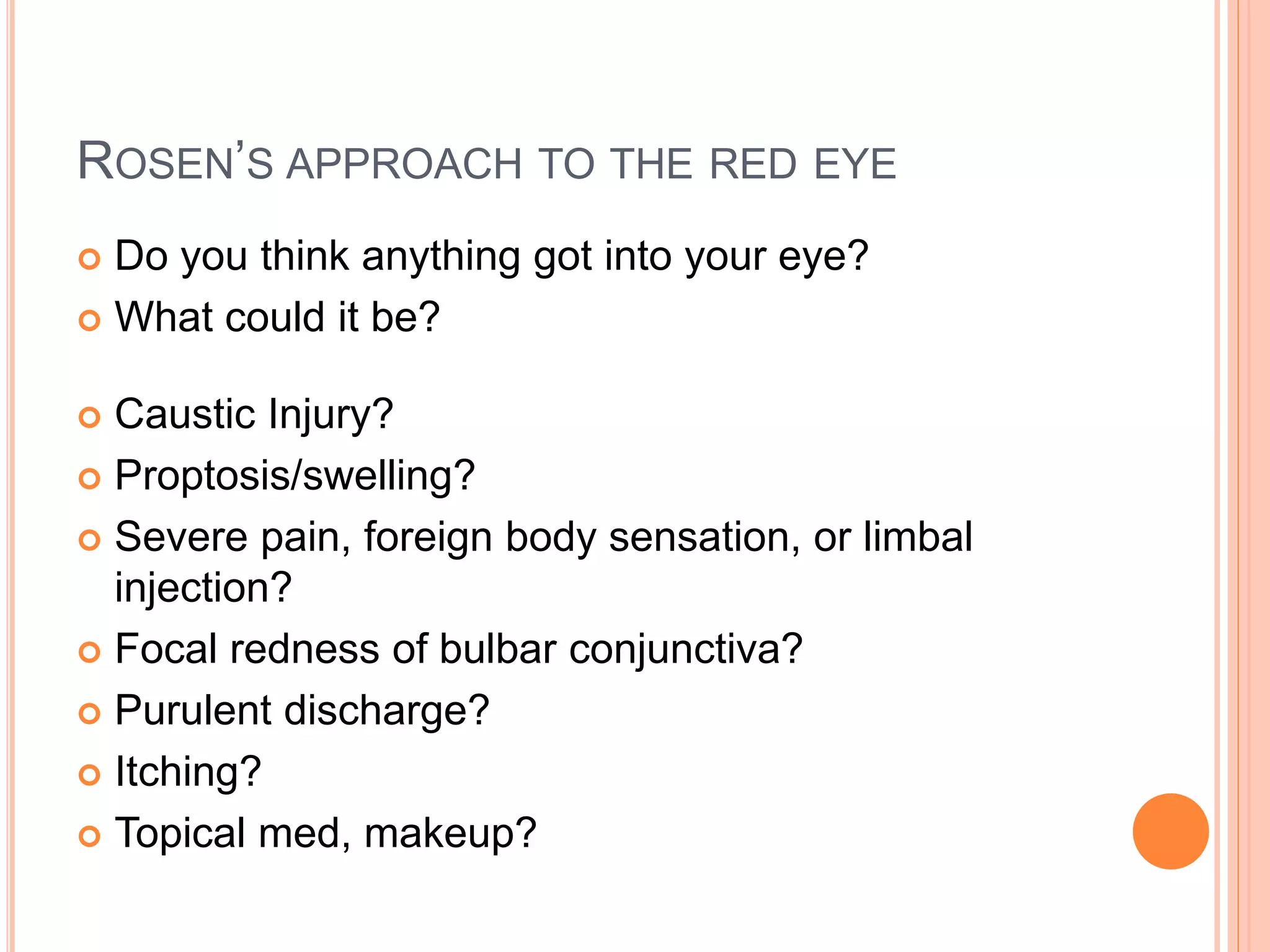
ROSEN’S APPROACH TO THE RED EYE
 Do you think anything got into your eye?
 What could it be?
 Caustic Injury?
 Proptosis/swelling?
 Severe pain, foreign body sensation, or limbal
injection?
 Focal redness of bulbar conjunctiva?
 Purulent discharge?
 Itching?
 Topical med, makeup?
CASE #1
APPROACH TO CASE #1
 Do you think anything got into your eye?
Yes
 What could it be?
DO SOMETHING!!!
 Caustic Injury?
Most likely
CAUSTIC INJURY
CAUSTIC INJURIES
 BAAAAD
 Irrigation, irrigation irrigation (> 30 min) until pH of
tear is neutral
If solid caustic agent present (look carefully), remove
with dry cotton swab before irrigating.
 Alkali worst than acids
 Opthalmology consultation, topical antibiotic,
cycloplegics, cross fingers
TRIVIA
CASE #2
CASE #2
APPROACH TO CASE #2
 Do you think anything got into your eye?
 Caustic Injury?
 Proptosis/swelling?
 Severe pain, foreign body sensation, or limbal
injection?
 Focal redness of bulbar conjunctiva?
Yes
SUBCONJUNCTIVAL HEMORRHAGE
 Well demarcated at
the limbus
 Flat, smooth, bright
red, limited to
bulbar conjunctiva
 Often occurs as a
result of trauma or
valsalva
 Not painful
 DC home, cold compress
TRIVIA
CASE #3
CASE #3
 Pain ++, sudden onset
 Was in the basement
 Now, sensitive to light
 Nausea and vomitting
 Can’t see well out of affected eye
APPROACH TO CASE #3
 Do you think anything got into your eye?
 Caustic Injury?
 Proptosis/swelling?
 Severe pain, foreign body sensation, or limbal
injection?
Yes
ACUTE ANGLE-CLOSURE GLAUCOMA
 Pupillary block of
aqueous humor
 Precipitated by
pupillary dilation
Darkness
Emotional upset
Anticholinergics
Sympathomimetics
 Rapid rise in IOP
 Leads to damage to
the optic nerve up to
blindness
ACUTE ANGLE CLOSE GLAUCOMA
Treatment
 Visual acuity reduced to hand movements
Topical
 Beta blocker (Timolol)
 Sympathomimetic (Pilocarpine)
 Alpha 2 agonist (Apraclonidine)
 Steroid (Prednisolone)
IV
 Carbonic anhydrase inhibitor (Acetazolamide)
 Osmotic agent (Mannitol)
 Visual acuity just blurry, IOP < 30 mmHg
Mannitol and pilocarpine not required.
 In both cases, consult Ophtalmology (surgery)
TRIVIA
CASE #4
CASE #4
 Pain
 Photophobia
 Slightly blurry vision
APPROACH TO CASE #4
 Do you think anything got into your eye?
 Caustic Injury?
 Proptosis/swelling?
 Severe pain, foreign body sensation, or limbal
injection?
Yes
HYPHEMA
 Spontaneously resolve
 Complications include:
Rebleed
Corneal blood staining
IOP
 Classic management
Antifibrinolytics
Raise head, bed rest
Cycloplegics
Steroids
…. No effect
GHARAIBEH A, ET AL.: MEDICAL INTERVENTIONS
FOR TRAUMATIC HYPHEMA.
 We found no evidence to show an effect on visual
acuity by any of the interventions evaluated in this
review.
 [Patients] who receive aminocaproic acid or
tranexamic acid are less likely to experience
secondary hemorrhaging. However, hyphema in
patients on aminocaproic acid take longer to clear.
MANAGEMENT
 Rule out globe rupture (US)
 If:
Small hyphema (less than 50%)
No vision loss
No IOP
No hemoglobinopathy (sickle cell)
Conservative management
 If not, patient would benefit from ophtalmological
follow up and IOP management
PATIENT COMES BACK!!
 Complaining of increasing pain
 Painful and reduced ocular movements
 Decreased visual acuity
 Notice he looks familiar
RETROBULBAR HEMATOMA
 Injury to orbital vessels
 Hemorrhage in a confined space
 Increased pressure
 Compromise of vessels and optic nerve
 Needs urgent decompression
RETROBULBAR HEMATOMA
 Medical
Topical beta blocker (timolol)
IV carbonic anhydrase inhibitor (acetazolamide)
IV osmotic agent (mannitol)
 Surgical
Lateral cathotomy
Needle aspiration
Surgical decompression of hematoma
TRIVIA
CASE 5
 36M, comes with eye pain
 Sudden onset
 Sawing through a piece of metal
 No eye protection
APPROACH TO CASE #5
 Do you think anything got into your eye?
Yes
 Do you know what it could be?
A piece of metal
SLIT LAMP EXAM
• Patient is immediately relieved with topical analgesia
SEIDEL TEST
 To rule in a corneal penetration
 Place a fluorescein strip over the abrasion
 Quick dilution of the concentrated fluorescein by
leaking aqueous humor
IMAGING
Ultrasound more sensitive, but CT delineates damage better
KERATITIS + PERFORATION
 Pain
 Foreign body sensation
 Tearing
 Injected conjunctiva
 Blepharospasm
 History often supportive
 Don’t forget to look under the eyelids!
 Can also occur with:
Insects
UV light (arc welding)
MANAGEMENT – FOREIGN BODY
 No penetration
Removal of FB
 Irrigation
 Cotton tip
 Do no use syringe, use small IV catheter
Rust rings from ferrous FB best removed the following
day
Topical antibiotics, no need for patch
Opthalmology if symptoms do not improve
 If penetration suspected
Consult opthalmology to determine damage extent
NO MRI!!
REFERENCES
 Chapters 22 and 71 – Rosen‘s 8th edition
 Gharaibeh, A, Savage HI, Scherer RW, Goldberg
MF, Lindsley K. Medical interventions for traumatic
hyphema. Cochrane Database Syst Rev. 2011 Jan
19;(1):CD005431.
 SGEM #18: Eye of the Tiger.
http://thesgem.com/2013/01/sgem18-eye-of-the-
tiger/

The red and painful eye

  • 1.
    THE RED ANDPAINFUL EYE Olivier Lavigueur ER PGY-1 July 21 2014
  • 3.
  • 4.
    PHYSICAL EXAM –VVEEPP + TOOLS In the context of a red and painful eye:  Visual Acuity  (Visual Fields)  External examination  Extraocular movements  Pupils  Pressure (normal < 20 mmHg)  Fundoscopy and Slit lamp
  • 5.
  • 6.
    ROSEN’S APPROACH TOTHE RED EYE  Do you think anything got into your eye?  What could it be?  Caustic Injury?  Proptosis/swelling?  Severe pain, foreign body sensation, or limbal injection?  Focal redness of bulbar conjunctiva?  Purulent discharge?  Itching?  Topical med, makeup?
  • 7.
  • 8.
    APPROACH TO CASE#1  Do you think anything got into your eye? Yes  What could it be? DO SOMETHING!!!  Caustic Injury? Most likely
  • 9.
  • 10.
    CAUSTIC INJURIES  BAAAAD Irrigation, irrigation irrigation (> 30 min) until pH of tear is neutral If solid caustic agent present (look carefully), remove with dry cotton swab before irrigating.  Alkali worst than acids  Opthalmology consultation, topical antibiotic, cycloplegics, cross fingers
  • 11.
  • 12.
  • 13.
  • 14.
    APPROACH TO CASE#2  Do you think anything got into your eye?  Caustic Injury?  Proptosis/swelling?  Severe pain, foreign body sensation, or limbal injection?  Focal redness of bulbar conjunctiva? Yes
  • 15.
    SUBCONJUNCTIVAL HEMORRHAGE  Welldemarcated at the limbus  Flat, smooth, bright red, limited to bulbar conjunctiva  Often occurs as a result of trauma or valsalva  Not painful  DC home, cold compress
  • 16.
  • 17.
  • 18.
    CASE #3  Pain++, sudden onset  Was in the basement  Now, sensitive to light  Nausea and vomitting  Can’t see well out of affected eye
  • 19.
    APPROACH TO CASE#3  Do you think anything got into your eye?  Caustic Injury?  Proptosis/swelling?  Severe pain, foreign body sensation, or limbal injection? Yes
  • 20.
    ACUTE ANGLE-CLOSURE GLAUCOMA Pupillary block of aqueous humor  Precipitated by pupillary dilation Darkness Emotional upset Anticholinergics Sympathomimetics  Rapid rise in IOP  Leads to damage to the optic nerve up to blindness
  • 21.
    ACUTE ANGLE CLOSEGLAUCOMA Treatment  Visual acuity reduced to hand movements Topical  Beta blocker (Timolol)  Sympathomimetic (Pilocarpine)  Alpha 2 agonist (Apraclonidine)  Steroid (Prednisolone) IV  Carbonic anhydrase inhibitor (Acetazolamide)  Osmotic agent (Mannitol)  Visual acuity just blurry, IOP < 30 mmHg Mannitol and pilocarpine not required.  In both cases, consult Ophtalmology (surgery)
  • 22.
  • 23.
  • 24.
    CASE #4  Pain Photophobia  Slightly blurry vision
  • 25.
    APPROACH TO CASE#4  Do you think anything got into your eye?  Caustic Injury?  Proptosis/swelling?  Severe pain, foreign body sensation, or limbal injection? Yes
  • 26.
    HYPHEMA  Spontaneously resolve Complications include: Rebleed Corneal blood staining IOP  Classic management Antifibrinolytics Raise head, bed rest Cycloplegics Steroids …. No effect
  • 27.
    GHARAIBEH A, ETAL.: MEDICAL INTERVENTIONS FOR TRAUMATIC HYPHEMA.  We found no evidence to show an effect on visual acuity by any of the interventions evaluated in this review.  [Patients] who receive aminocaproic acid or tranexamic acid are less likely to experience secondary hemorrhaging. However, hyphema in patients on aminocaproic acid take longer to clear.
  • 28.
    MANAGEMENT  Rule outglobe rupture (US)  If: Small hyphema (less than 50%) No vision loss No IOP No hemoglobinopathy (sickle cell) Conservative management  If not, patient would benefit from ophtalmological follow up and IOP management
  • 29.
    PATIENT COMES BACK!! Complaining of increasing pain  Painful and reduced ocular movements  Decreased visual acuity  Notice he looks familiar
  • 31.
    RETROBULBAR HEMATOMA  Injuryto orbital vessels  Hemorrhage in a confined space  Increased pressure  Compromise of vessels and optic nerve  Needs urgent decompression
  • 32.
    RETROBULBAR HEMATOMA  Medical Topicalbeta blocker (timolol) IV carbonic anhydrase inhibitor (acetazolamide) IV osmotic agent (mannitol)  Surgical Lateral cathotomy Needle aspiration Surgical decompression of hematoma
  • 34.
  • 35.
    CASE 5  36M,comes with eye pain  Sudden onset  Sawing through a piece of metal  No eye protection
  • 36.
    APPROACH TO CASE#5  Do you think anything got into your eye? Yes  Do you know what it could be? A piece of metal
  • 37.
    SLIT LAMP EXAM •Patient is immediately relieved with topical analgesia
  • 38.
    SEIDEL TEST  Torule in a corneal penetration  Place a fluorescein strip over the abrasion  Quick dilution of the concentrated fluorescein by leaking aqueous humor
  • 39.
    IMAGING Ultrasound more sensitive,but CT delineates damage better
  • 40.
    KERATITIS + PERFORATION Pain  Foreign body sensation  Tearing  Injected conjunctiva  Blepharospasm  History often supportive  Don’t forget to look under the eyelids!  Can also occur with: Insects UV light (arc welding)
  • 41.
    MANAGEMENT – FOREIGNBODY  No penetration Removal of FB  Irrigation  Cotton tip  Do no use syringe, use small IV catheter Rust rings from ferrous FB best removed the following day Topical antibiotics, no need for patch Opthalmology if symptoms do not improve  If penetration suspected Consult opthalmology to determine damage extent NO MRI!!
  • 43.
    REFERENCES  Chapters 22and 71 – Rosen‘s 8th edition  Gharaibeh, A, Savage HI, Scherer RW, Goldberg MF, Lindsley K. Medical interventions for traumatic hyphema. Cochrane Database Syst Rev. 2011 Jan 19;(1):CD005431.  SGEM #18: Eye of the Tiger. http://thesgem.com/2013/01/sgem18-eye-of-the- tiger/

Editor's Notes

  • #3 Havent done optho in a while… Is he going to be able to go home? Or is this something we have to deal with right away?
  • #4 Aqueous humor (nutrition to avascular structures, provide structure), from ciliary epithelium, goes to canal of schlemm Vitreous humor Pain is from pain fibers Sharp Cornea Conjunctiva Iris Dull Vasculature Pressure Outside http://scientopia.org/blogs/scicurious/files/2011/05/visual-system1.jpg
  • #5 Not useful for diagnosis, but provides baseline to compare from Hard to detect unless large deficits…. Which are mostly neurological rather than an ophtalmology problem Some scotomas from glaucoma 3) Eye itself, lids, globe position, surrounding tissues 4) Not for neurology, but to see if anything physically disturbing movements 5) Fixed? Afferent pupilary defect 6) Glaucoma, hemorrhae, retrobulbar pathology.
  • #6 Magnified view: Anterior chamber for floaters (cells in iritis, foreign bodies) Angle!!! Fluorescein absorbed by corneal defects and highlights with cobalt blue light (absence of movement of dye on blinking) http://img.alibaba.com/img/pb/416/077/239/1269584995981_hz_myalibaba_web15_1491.JPG
  • #7 Traumatic vs non traumatic
  • #11 Buffering solutions exist, but irrigation should not be delayed. Can use tap water. Analgesia helps tolerate treatment Can use morgan lens to keep eye open Alkali cause liquifaction necrosis, keeps burning Acids cause coagulation necrosis, slows itself down Solids in fornices?
  • #18 Whats wrong with this video? Open angle glaucoma is not supposed to cause pain
  • #19 What else do you see? Fixed pupil (photophobia) Limbal injection, circumferential Hazy cornea
  • #22 Timolol (beta blocker, blocks production of aqueous humor) Pilocarpine (miotic agent) Apraclonidine (increase trabecular outflow) Steroids Acetazolamide (reduces production of aqueous humor) Sedatives and anti-emetic as needed
  • #27 IOP because blood prevents evacuation of anterior chamber
  • #29 Requires surgery if clot remains, corneal staining, elevated IOP for days (more than 3-5)
  • #30 You had done a poor physical exam
  • #31 Dont delay treatment for imaging
  • #34 Primary incision Locating inferior cathal ligament and incision
  • #42 Polymyxin B Bacitracin
  • #43 Think of other things on differential H/A can cause eye pain Temporal arteritis Sinusitis